
Instrumentation Valves
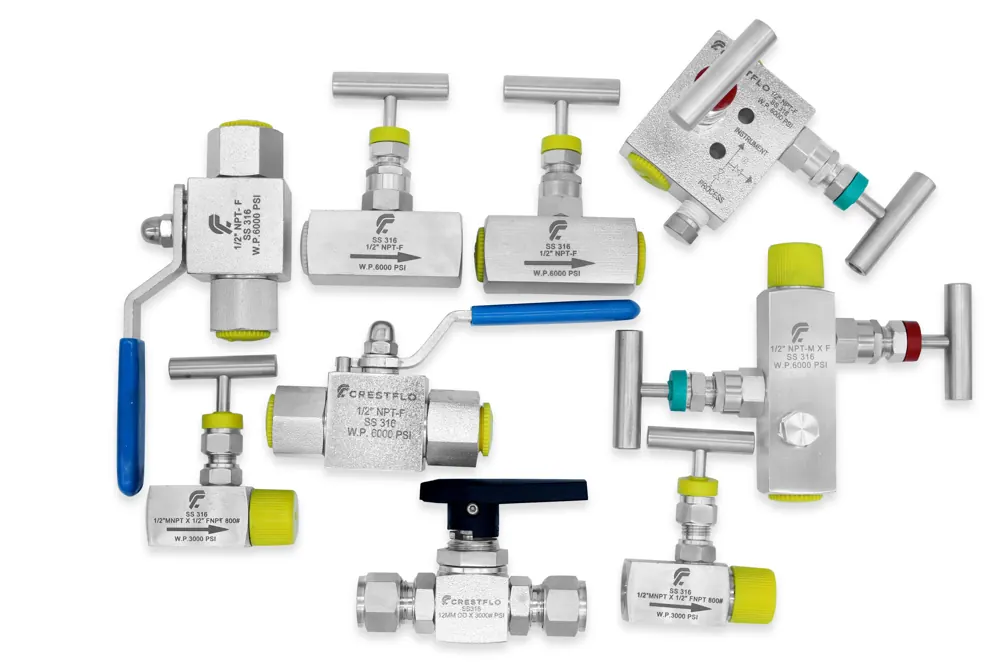
Instrumentation valves are small, precision-built valves. They isolate, regulate, shut off, vent, or direct the flow of liquid or gas in measurement, sampling, and control systems: gauges, transmitters, analyzers, impulse and sample lines. Sizes typically run from 1/16" to 1".
Crestflo manufactures instrumentation valves and fittings for the US market. The lineup covers the whole valve family: needle, ball, check, manifold, monoflange, and double block-and-bleed valves, in 316L stainless through Hastelloy. Every valve is built for dimensional interchange with the major brands. Lead time runs 6-8 weeks. Matching tube fittings round out the whole instrument hookup.
Request a quote or request a sample to get started.
Scope: these are instrumentation valves, the small-bore kind used for gauges, transmitters, and impulse or sample lines. They aren't plumbing, automotive, or HVAC valves. Wherever you see ball valve on this page, it refers to an instrumentation ball valve. Needle valve means a flow-metering instrument valve. Manifold means a valve manifold. Every valve type and every alloy build gets its own page, linked below.
Also Known As: Instrument Valves, Small-Bore Process & Impulse-Line Valves
Buyers and specifiers call this family by more than one name. You'll see it specified as instrument valves, instrumentation flow-control valves, small-bore process valves, impulse-line valves, or gauge and root isolation valves. No single alloy defines it. It spans too many working principles for that, so there's no one UNS or Werkstoff designation to point to. Material call-outs (316/316L, 904L, Hastelloy C-276, Inconel, Monel, Duplex, and more) live on the linked grade pages instead. This hub simply defines the family and sends each type, configuration, and alloy to its own page.
Types of Instrumentation Valves: Needle, Ball, Manifold, DBB & Packless
The instrumentation valve family spans every function class you'll find in a measurement or control hookup: quarter-turn shut-off types (ball, plug), multi-turn throttling types (needle, metering), spring-loaded non-return valves (check/NRV), block-and-bleed configurations (manifold valve or instrument manifold, monoflange, double block-and-bleed), and packless sealed designs (bellows, diaphragm). The table below lists the full family. Click through each link for dimensions, materials, and ordering detail on the owner page.
| Valve type | Working principle | Primary function | Typical hookup | Detail page |
|---|---|---|---|---|
| Needle valve | Multi-turn tapered stem | Fine throttling, isolation | Gauge, DP transmitter, calibration | Needle valve |
| Ball valve (2-way) | Quarter-turn ball | On/off isolation | Sample, instrument shut-off | Ball valve |
| 3-way / L-port / T-port ball | Quarter-turn multi-port | Diverting, selecting | Sample switching, gauge selection | 3-way, L-port, T-port |
| Trunnion / CWP ball | Trunnion-mounted ball | High-pressure isolation | Higher-load instrument lines | Trunnion, CWP |
| Check valve / NRV | Spring-loaded poppet | One-way / non-return flow | Pump, analyzer, back-flow guard | Check, NRV, pneumatic check |
| 2/3/5-valve manifold | Combined block + bleed/equalize | DP transmitter isolation | DPT / gauge manifolding | 2-valve, 3-valve, 5-valve |
| Monoflange valve | Integral block-and-bleed on a flange | Compact primary isolation | Direct-mount gauge/transmitter | Monoflange |
| Double block-and-bleed | Two blocks + bleed in one body | Positive double isolation | Custody, hazardous isolation | DBB valve |
| Bleed / vent valve | Small stem bleed | Vent, drain, depressurize | Manifold bleed, gauge vent | Bleed valve |
| Gauge / root valve | Multi-turn primary isolation | Root isolation | Gauge and instrument roots | Gauge root valve |
| Plug valve | Quarter-turn tapered plug | Isolation, diverting | Sample, drain | Plug valve |
| Metering valve | Fine vernier stem | Precise flow metering | Analyzer, calibration | Metering valve |
| Purge valve | Manual purge stem | Line purge / prep | Sample conditioning | Purge valve |
| Relief valve (PRV) | Spring-set poppet | Overpressure protection | Instrument overpressure guard | Relief valve |
| Toggle valve | On/off toggle | Fast shut-off | Panel, test | Toggle valve |
| Angle valve | Angle-pattern stem | Isolation with turn | Corner hookups | Angle valve |
| Flow-control valve | Metering throttle | Regulated flow | Instrument air, purge | Flow-control valve |
| Quick-exhaust valve | Fast exhaust | Rapid venting | Pneumatic actuation | Quick-exhaust valve |
| Bellows valve (packless) | Welded metal bellows seal | Zero-leak isolation | UHP, toxic, fugitive-emission service | Bellows valve |
| Diaphragm valve (packless) | Diaphragm seal | Packless isolation | High-purity, sanitary | Diaphragm valve |
Need excess-flow or another specialty pattern? We build those to order. Spell out the function on your RFQ, and our engineering team will confirm the build.
Instrumentation Valve Configurations & Handle Options: Panel-Mount, Trunnion, Fire-Safe & Vernier
Each type comes in a wide range of body and actuation configurations. Trunnion, panel-mount, low-profile, bi-directional, multi-directional, full-port, high-cycle, 3-piece bolted, fire-safe, forged-body, and bar-stock builds are all available, along with union-bonnet or integral-bonnet stem construction. Packing-below-stem-threads keeps media isolation cleaner, and non-rotating tips matter wherever fine throttling repeatability counts. For actuation, options include manual lever and handle, vernier and locking/lockout handles, phenolic or metal handles, panel mounting, and pneumatic actuation. Color-coded handles help with line identification. Details on configuration and availability for each pattern sit on the individual valve-type pages.
Instrumentation Valve Materials: 316/316L Stainless, 904L, Duplex, Hastelloy, Inconel & Monel
Crestflo makes instrumentation valves in stainless, super-austenitic, duplex, high-nickel, and titanium alloys, covering the corrosion-resistant range that hydrocarbon, chemical, and high-purity service demand. For general instrument work, 316/316L is the standard choice. Move up to a higher alloy once chlorides, acids, or temperature start to climb.
| Alloy family | Grades | When to choose | Grade page |
|---|---|---|---|
| Austenitic stainless | 304/304L, 316/316L | General instrument and sample service | 316/316L, 304/304L |
| Super-austenitic | 904L, 254 SMO (6Mo), AL-6XN, Alloy 20 | Chlorides, seawater, dilute acids | 904L, 254 SMO, AL-6XN, Alloy 20 |
| Duplex / super duplex | Duplex 2205, Super Duplex 2507 | Chloride stress-corrosion, offshore | Duplex 2205, Super Duplex 2507 |
| Nickel alloys | Hastelloy C-276, Inconel 625/825, Monel 400 | Strong acids, sour and high-temperature service | Hastelloy C-276, Inconel 625, Inconel 825, Monel 400 |
| Titanium | Titanium Gr2 | Chlorides, seawater, light weight | Titanium Gr2 |
Need a valve built entirely in one alloy? Check the valve-in-alloy pages for Hastelloy C-276, Inconel 625, Inconel 825, Super Duplex 2507, Monel 400, 904L, Duplex 2205, and 254 SMO. Alloy compositions and mechanical properties follow the applicable ASTM specifications, and they can be customized to your requirement.
Instrumentation Valve Sizes (1/16"–1") & End Connections: NPT, BSP, Tube & Weld
Instrumentation valves ship in imperial fractional sizes running from 1/16" to 1": the fixed steps are 1/16", 1/8", 1/4", 3/8", 1/2", 3/4", and 1". They also come in a common metric range, 3 mm to 25 mm, with steps such as 5 mm along the way, and either size range can have threaded or tube-fitting (compression) ends. Why start the metric range at 3 mm rather than a straight conversion of 1/16"? Because 1/16" works out to about 1.5 mm, and that's not a practical starting point. Specify imperial or metric on the RFQ. Thread and end standards follow published dimensions, though they can be adjusted to fit specific requirements.
| Attribute | Options | Standard |
|---|---|---|
| Size range | 1/16", 1/8", 1/4", 3/8", 1/2", 3/4", 1" (imperial); 3–25 mm metric menu | Imperial and metric |
| Tube-fitting ends | Compression, single or double ferrule | Dimensional interchange with major brands |
| Tapered pipe threads | NPT (male/female), BSPT | ASME B1.20.1 (NPT); BSP |
| Parallel pipe threads | BSPP / ISO parallel | ISO parallel |
| Flare / port | SAE / JIC 37° | Per applicable standard |
| Welded ends | Socket-weld, butt-weld | Per applicable standard |
| Flanged ends | On DBB and monoflange builds | ASME flange standards |
High-Pressure Instrumentation Valve Ratings & Temperature Limits
Pressure ratings aren't one-size-fits-all. Each valve design and its governing standard set the number. Manifolds top out at 10,000 psi, and double block-and-bleed valves are rated to 3,000 psi under ASME B16.34. Other valve types carry their own ratings on separate pages, and if your project needs something higher, that's covered on the high-pressure line. Temperature limits, on the other hand, come down to the seat and packing material. Standard PTFE service tops out around 450°F (232°C). Swap in PEEK, PCTFE, reinforced PTFE, graphite (Grafoil), or metal-to-metal seats, though, and you can push into hotter or cryogenic territory. All figures follow the applicable standard, and they can be adjusted to fit your requirements. Confirm the exact rating for your build when you submit the RFQ.
| Type | Max pressure | Rating basis |
|---|---|---|
| 2/3/5-valve manifold | Up to 10,000 psi | ASME B16.34 |
| Double block-and-bleed | Up to 3,000 psi | ASME B16.34 |
| Higher-pressure builds | See high-pressure line | High-pressure valves |
Testing, Certifications & Heat-Number Traceability
Every Crestflo valve comes out of an ISO 9001 / 14001 / 45001 & PED certified manufacturing system. Each part carries a heat or lot number, and EN 10204 3.1 material test certificates ship as standard, with 3.2 available on request. Testing runs deep: hydraulic proof, burst, and impulse; pneumatic; flexure and rotary-flex fatigue; vibration; thermal cycling; pull-out; and vacuum testing. Positive material identification (PMI) rounds out the list. Manifolds all get 100% seat and shell leak testing. In-house non-destructive testing pairs with destructive testing carried out at ISO/IEC 17025-accredited laboratories, and third-party inspection can be arranged on request. See material traceability and testing & inspection for more detail.
| Item | Standard | Applies to |
|---|---|---|
| Quality / environment / safety | ISO 9001 / 14001 / 45001 | All valves |
| Pressure equipment | PED | Applicable builds |
| Valve design | ASME B16.34 | DBB, applicable valves |
| Valve testing / inspection | API 598, API 6D, API 602 | Applicable valve types |
| Sour service | NACE MR0175 / ISO 15156 | Sour-service alloys |
| NPT threads | ASME B1.20.1 | Threaded ends |
| Traceability | EN 10204 MTC 3.1 / 3.2 | All valves |
Every valve ships to the standard approvals that apply to its type. Design follows ASME B16.34, and performance testing sits on API 598/6D/602 as the base standard. For sour hydrocarbon service, valves built in the appropriate alloys meet NACE MR0175 / ISO 15156 requirements. Datasheets and CAD models go out to customers on request.
Why Buy Instrumentation Valves From Crestflo
Crestflo is the instrumentation arm of an export house that's been in business for four decades and carries recognition from the Government of India. It has a long track record delivering into the Middle East, and that history shows in the manufacturing discipline and quality control behind its focused line of instrumentation valves. Crestflo serves US customers as a valves supplier and manufacturer, building products engineered to drop in as dimensional replacements for Swagelok, Parker, Hoke, Hy-Lok, and Fitok. Both imperial and metric sizing are covered, spanning the full range from stainless steel to nickel alloys.
The framing here is straightforward. Standard items ship from ready stock; specials are made to order. Delivery runs six to eight weeks, well under the twenty-plus weeks typical of the major brands. Every part ships with a heat number and a material test certificate. Small minimum order quantities are available, along with private-label programs. Origin is India, though US or European melt can be arranged on request, and full material traceability comes standard.
Buyer type determines the path. End users should request a quote or a sample. Distributors can become a distributor or request the valve catalog. OEMs looking to start a private-label program can begin there directly. Equipment manufacturers need only send a print for a made-to-order build. For specifics, check our lead time and US-origin compliance pages. We Engineer Confidence.
Swagelok, Parker & Hoke Instrumentation Valve Interchange
Crestflo builds its valves as dimensional interchange parts for the major instrumentation brands: Swagelok, Parker, Hoke, Hy-Lok, Fitok, Ham-Let, and DK-Lok. Performance is qualified against the applicable API valve standards and ASME B16.34. Swagelok® and the other brand names belong to their respective owners; Crestflo operates independently and has no affiliation with any of them. Competitor part numbers won't be listed here. Instead, our engineering team prepares a mapping for your specific list, so request your Swagelok®, Parker®, or Hoke® cross-reference directly. Begin at the master interchange, or jump to a brand page: Swagelok, Parker A-Lok, Hoke, Hy-Lok, Fitok, Ham-Let, DK-Lok. If you're weighing a US-serving alternative to Swagelok, Parker, or Hoke, the case is laid out on our Swagelok alternative, Parker A-Lok alternative, and Hoke alternative pages.
Instrumentation Valve Applications & Industries
Instrumentation valves handle impulse-line and DP-transmitter hookups, gauge isolation, and sampling and analyzer systems. They also cover steam-service instrument lines, sour-service (NACE) duty, oxygen and ultra-high-purity applications, cryogenic lines, and offshore or subsea installations.
Take a look at the industries we serve: oil & gas, offshore, analytical sampling systems, semiconductor, hydrogen, steam tracing, and instrument air.
On the product side, you'll find pressure regulators, tube fittings, high-pressure fittings and valves, and instrumentation accessories.
Frequently Asked Questions About Instrumentation Valves
What is an instrumentation valve?
An instrumentation valve is a small, precision-built valve used to isolate, regulate, shut off, or vent flow in measurement and control lines. Think gauges, transmitters, analyzers, and impulse or sample tubing. Sizes typically run from 1/16" to 1". What sets it apart from a process pipeline valve is the small bore, the tight-tolerance construction, and the instrument-style end connections.
What are the main types of instrumentation valves?
Valve types span needle, ball (2-way, 3-way, L-port, T-port, and trunnion), check/NRV, 2/3/5-valve manifolds, monoflange, double block-and-bleed, bleed, gauge/root, plug, metering, relief, toggle, angle, and flow-control designs, along with packless bellows- and diaphragm-sealed valves. You'll find each one covered on its own page, linked in the types table above.
What materials are Crestflo instrumentation valves made from?
Crestflo builds instrumentation valves in 316/316L and 304/304L stainless, plus 904L, Duplex 2205, Super Duplex 2507, 254 SMO, AL-6XN, Alloy 20, Inconel and Incoloy grades, Monel 400, Hastelloy C-276, Nickel 200/201, and Titanium Gr2. That's a wide range, and the choice isn't arbitrary. It follows the service conditions: 316L handles general duty, super-austenitic and duplex grades stand up to chlorides, and nickel alloys take on acids, sour service, and high temperatures.
Are Crestflo instrumentation valves NACE MR0175 / ISO 15156 compliant for sour service?
Yes. We can supply valves that meet NACE MR0175 and ISO 15156 for sour hydrocarbon service, built in the appropriate corrosion-resistant alloys. Just note your sour-service requirements on the RFQ, so we apply the correct alloy and hardness limits.
What certifications and traceability come with the valves?
Crestflo manufactures under a certified system covering ISO 9001, 14001, 45001 and PED. Each part carries a heat or lot number. EN 10204 3.1 material test certificates come standard, and 3.2 is available on request. PMI is performed, and manifolds get 100% seat and shell leak testing. Quality records hold all certificates. Ratings and compositions follow the applicable standards.
Can Crestflo valves replace Swagelok, Parker, Hoke, Hy-Lok, or Fitok valves?
They're built as dimensional interchange for those brands and performance-qualified to the applicable ASME B16.34 and API valve standards. Rather than publish part numbers, we put together a cross-reference for your specific list. Request your Swagelok®, Parker®, or Hoke® cross-reference from our engineering team. Trademarks belong to their owners; Crestflo isn't affiliated.
What is the pressure rating of an instrumentation valve?
Pressure rating depends on the type. Manifolds top out at 10,000 psi, while double block-and-bleed valves are rated to 3,000 psi under ASME B16.34. Other types carry their own ratings, listed on their respective pages. Anything beyond that doesn't stop at this page; it goes to our high-pressure line. As for temperature, the limit comes down to the seat and packing material.
What is a PRV or relief valve in instrumentation, and is it a regulator?
A pressure relief valve (PRV) is a safety device. It opens to protect a system from overpressure, then reseats once conditions return to normal. That's different from a pressure regulator, which continuously controls downstream pressure during normal operation. For the distinct entities, see our relief valve and pressure regulator pages.
What sizes and end connections are available?
Sizes run from 1/16" to 1", in imperial or metric. End connections cover tube-fitting (compression) and threaded types, including NPT, BSPT, BSPP/ISO-parallel, and SAE/JIC. DBB and monoflange builds also come with socket-weld, butt-weld, and flanged ends. Thread and end dimensions aren't one-size-fits-all: they follow the applicable standards and can be tailored to what's needed.
What is the lead time and minimum order?
Standard items ship from ready stock. Specials are made to order, with delivery running six to eight weeks. We keep minimum order quantities low, and private-label options are available too. Wondering about your specific configuration? Don't hesitate to reach out to our engineering team for its status.
Are these valves made in the USA?
Crestflo manufactures valves for the US market. Every valve is engineered for drop-in interchange with US standards, and lead time runs 6-8 weeks. Manufacturing origin is Indian, though US or European melt is available on request, and full material traceability comes standard. TAA and DFARS requirements get addressed in detail on our US-origin compliance page.
Can I get a specific valve in an exotic alloy or built to my print?
Yes. Made-to-order and made-to-print builds in exotic alloys are standard work here, including Hastelloy C-276, Inconel 625, Super Duplex 2507, and others. Send us your print, or just describe what you're after on the RFQ. Our engineering team will confirm the build from there.
Related Instrumentation Valve Resources
Compare types and specify with confidence: needle vs ball valve, 2- vs 3- vs 5-valve manifold, DBB vs monoflange, how to specify instrumentation fittings and valves, and instrumentation valve symbols. Or head back to all instrumentation products, or browse the full materials range.