
254 SMO (UNS S31254): 6-Moly Super-Austenitic Stainless for Instrumentation Fittings, Valves & Tubing
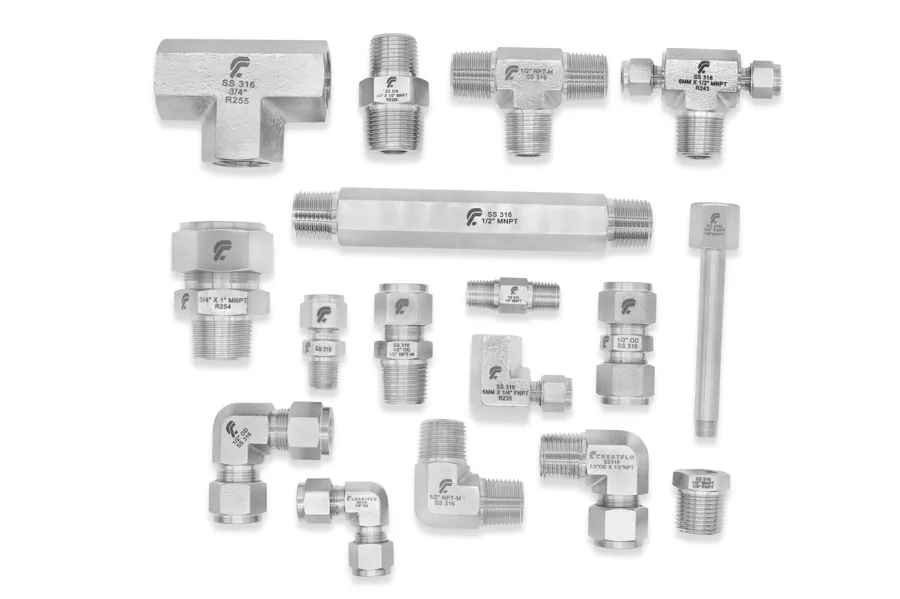
UNS S31254, better known as 254 SMO (EN 1.4547 too), is a 6% molybdenum, nitrogen-alloyed super-austenitic stainless steel. Its yield strength runs roughly double that of 316, and it holds up remarkably well against chloride pitting, crevice corrosion and stress-corrosion cracking. Crestflo supplies this grade as instrumentation tube and compression fittings, instrumentation valves, and instrumentation tubing. Every piece carries heat and lot-number traceability, each is engineered as a drop-in replacement for the major brands, and delivery within the US runs 6-8 weeks.
The composition, PREN, mechanical and corrosion values listed below come from standard published data for the alloy, drawn from the applicable ASTM specification. They can be customized to whatever your application requires.
Scope: here, 254 SMO refers to the super-austenitic stainless used in fluid-system instrumentation, meaning tube fittings, compression ferrules, valves and tubing. It's not structural plate, architectural stock, or general fabrication material. Crestflo sells this alloy only in instrumentation fitting, valve and tubing forms. Mill round bar, forgings, flanges, sheet, plate and pipe aren't part of that lineup.
Request a 254 SMO Quote · Request a Sample · sales@crestflousa.com · +1 346 594 9005 (Houston, TX)
254 SMO® and Ultra 254 SMO® are registered trademarks belonging to Outokumpu OYJ.
254 SMO Also Known As: UNS S31254, EN 1.4547, F44 & 6-Moly Stainless
On drawings, datasheets and purchase orders, the same grade shows up under a handful of different names. A print might call out "S31254," "1.4547," "Alloy 254," or just "6-moly stainless", but they're all the same super-austenitic, 6% molybdenum grade.
| Designation type | Value |
|---|---|
| Trade / common names | 254 SMO, 254SMO, SMO 254, Alloy 254, 6Mo, 6-moly, six-moly, 6Mo stainless steel, 6 moly stainless steel, 6% molybdenum stainless |
| UNS number | UNS S31254 (S31254) |
| EN / Werkstoff | EN 1.4547 (Werkstoff 1.4547 / W.-Nr. 1.4547 / DIN 1.4547) |
| ASTM forging/flange designation | F44 (e.g. A182 F44) |
| Producer trade names | 254 SMO® / Ultra 254 SMO® (Outokumpu, formerly Avesta 254 SMO); Alleima / Sandvik 254 SMO |
| Alloy class | Super-austenitic (high-moly) stainless steel |
UNS S31254 is the American designation, EN 1.4547 the European one, but they describe the same alloy. Specify a part under either name and you get 254 SMO. One caution, though: 254 SMO isn't 253 MA. That's a heat-resistant austenitic grade built for high-temperature service, a different alloy entirely, meant for a different job.
254 SMO Chemical Composition (S31254, 6% Molybdenum + Nitrogen)
254 SMO owes its performance to a high molybdenum content paired with a deliberate nitrogen addition; both push up pitting resistance. Copper goes in too, boosting resistance in reducing acids such as sulfuric. It's calculated as PREN = Cr + 3.3 × Mo + 16 × N.
| Element | wt % (per applicable ASTM specification) |
|---|---|
| Carbon (C) | 0.020 max |
| Chromium (Cr) | 19.5–20.5 |
| Nickel (Ni) | 17.5–18.5 |
| Molybdenum (Mo) | 6.0–6.5 |
| Nitrogen (N) | 0.18–0.22 |
| Copper (Cu) | 0.50–1.00 |
| Manganese (Mn) | 1.00 max |
| Silicon (Si) | 0.80 max |
| Phosphorus (P) | 0.030 max |
| Sulfur (S) | 0.010 max |
| Iron (Fe) | Balance |
Ranges follow the applicable ASTM product-form specification. Crestflo confirms the actual heat chemistry on the EN 10204 material test certificate that's included with every order.
254 SMO Mechanical & Physical Properties: Yield, Tensile, Hardness & Density
254 SMO, in the solution-annealed condition, delivers nearly double the 0.2% yield strength of 316/316L. That's a direct result of its nitrogen content. Ductility and toughness stay right where they need to be for fitting and valve forming, too. The values below are standard published minimums, along with nominal physical data for the alloy.
Mechanical properties (solution-annealed, room temperature)
| Property | SI | US |
|---|---|---|
| Yield strength (0.2% offset) | ≥ 300 MPa | ≥ 44 ksi |
| Tensile strength | ≥ 650 MPa | ≥ 94 ksi |
| Elongation | ≥ 35% | ≥ 35% |
| Hardness | — | ≤ ~96 HRB |
Physical properties
| Property | Value |
|---|---|
| Density | ~8.0 g/cm³ (0.29 lb/in³) |
| Structure | Austenitic |
| Magnetic response | Essentially non-magnetic (annealed) |
Mechanical minimums track the applicable ASTM spec for the annealed condition. Final certified properties for any given heat appear on the material test certificate.
254 SMO PREN & Critical Pitting Temperature (Pitting Resistance)
Based on nominal composition, 254 SMO comes out to a PREN of roughly 43, 45 (PREN = Cr + 3.3 × Mo + 16 × N): well clear of 316L, at around 24, and 904L, at about 34. That also gives it a high critical pitting temperature (CPT). In practice, the alloy resists localised chloride attack at temperatures where those lower-moly grades fail. PREN's just a calculated ranking, though; real-world corrosion behavior also depends on surface condition, temperature and the specific media involved. For a broader comparison across alloys, see the PREN comparison table.
254 SMO Corrosion Resistance by Media: Chlorides, Seawater & Acids
254 SMO was built for high-chloride and seawater service. Its blend of chromium, 6% molybdenum and nitrogen fights off pitting, crevice corrosion and chloride stress-corrosion cracking, the failure modes that put a ceiling on 316 stainless. Below, the table lays out typical service suitability, pulled from standard alloy corrosion literature. It also touches on PED considerations where relevant.
| Media / service | Suitability | Note |
|---|---|---|
| Chlorides / seawater / brackish water | Excellent | The defining application for the grade |
| Chloride stress-corrosion cracking (Cl-SCC) | Highly resistant | Key advantage over 316/316L austenitics |
| Crevice corrosion | Excellent | High CPT and critical crevice temperature |
| Sulfuric acid (H₂SO₄) | Good | Copper addition aids reducing-acid resistance |
| Phosphoric acid (H₃PO₄) | Good | Including contaminated process grades |
| Flue-gas / SO₂ scrubbers | Excellent | FGD absorber and scrubber environments |
| Sour service (H₂S) | Suitable | Within NACE MR0175 / ISO 15156 limits |
For selection tied to a specific process, check the corrosion-by-media × alloy matrix and the offshore & chloride selection guide.
254 SMO for Sour Service (NACE MR0175 / ISO 15156)
UNS S31254 works in sour, H₂S-containing service, but only within the limits of NACE MR0175 / ISO 15156. You'll want to confirm the hardness and material-condition limits in the standard for your specific application. Crestflo supplies NACE MR0175 / ISO 15156-compliant 254 SMO fitting and valve material options, each with an MTC. See the NACE MR0175 and ISO 15156 standard pages, plus the sour-service selection guide.
When to Choose 254 SMO vs 316L, 904L, Super Duplex 2507 & AL-6XN
254 SMO sits in the middle as the 6-moly option. Specify it when 316L starts pitting or cracking in chlorides. A nickel alloy such as Hastelloy C-276 or Alloy 20, or titanium, would go beyond what the application needs and cost more than necessary. In high-chloride and seawater duty, it frequently serves as a cost-effective alternative to nickel alloys. Below, a table ranks the alloys buyers most often compare against it, ordered by approximate PREN, with each one linking to its own material or comparison page.
| Alloy | ~PREN | Tier | More detail |
|---|---|---|---|
| 316 / 316L | ~24 | Standard austenitic baseline | how 6-moly beats 316 in chlorides |
| 904L | ~34 | Higher-moly austenitic | 904L (lower-moly) option |
| 254 SMO (S31254) | ~43–45 | 6-moly super-austenitic | This page |
| Super Duplex 2507 | ~43 | Super-duplex, higher strength | Super Duplex 2507 alternative |
| AL-6XN | ~45–47 | 6-moly super-austenitic | AL-6XN 6-moly alternative |
Need to weigh 254 SMO against the alternatives? Read 254 SMO vs Super Duplex vs AL-6XN, then select an alloy by service to match the grade to your application.
254 SMO Fabrication & Welding Notes
254 SMO welds well, provided you use a matching or slightly over-alloyed nickel-base filler, something like a Ni-Cr-Mo filler, to keep corrosion resistance intact in the weld metal. It ships in the solution-annealed condition. That anneal matters: after heavy hot working, it's what brings corrosion resistance back to its best level. None of this is unusual; these are standard practices in alloy fabrication. Crestflo handles the forming and finishing of the instrumentation product forms in-house.
254 SMO Applications & Industries: Offshore, Seawater & Chemical Processing
Chlorides eat through standard stainless steel. That's exactly where 254 SMO does its job: offshore and subsea instrument hook-ups, seawater and desalination systems, chemical and petrochemical process lines, flue-gas scrubbers, pulp-and-paper bleaching. Crestflo supplies the alloy as instrumentation fittings, valves and tubing for these services.
- Offshore & seawater service and subsea
- Petrochemical & chemical processing
- Oil & gas sour and chloride-bearing streams
- Marine & shipbuilding and water & wastewater
254 SMO Product-Form Standards (A213, A269, A479, A276 & A182 F44)
A family of ASTM specifications, organized by product form, covers this alloy. Each one defines the grade. Crestflo doesn't supply the raw mill forms; it supplies the instrumentation forms, fittings, valves and tubing, built from certified material that meets these specifications.
| Product form | Applicable ASTM specification |
|---|---|
| Seamless tube | A213 · A269 |
| Welded tube | A249 |
| Bar & rod | A276 · A479 |
| Forgings & fittings | A182 F44 |
| Plate, sheet & strip | A240 |
Pipe and pipe-fitting forms (covered by specs such as ASTM A312) sit outside this instrumentation's scope. Crestflo supplies the tube, fitting, valve and tubing forms listed above, not line pipe. Values and grades follow the applicable ASTM specification, and material certificates come with every order.
254 SMO Product Forms from Crestflo: Fittings, Valves & Tubing
Crestflo carries UNS S31254 across three instrumentation product lines, and each one gets its own detail page listing sizes, ratings and ordering information. The grade shows up in compression and ferrule fittings. It also covers needle, ball and manifold valves, plus instrumentation tubing drawn without a seam.
- 254 SMO tube & compression fittings: these come in single and double ferrule versions, hardened or non-hardened, in imperial and metric sizes, with end connections up to 2" (50 mm) OD. You'll also see them specified as S31254 compression fittings or 6-moly ferrule fittings. Compression tube fittings are performance-qualified per ASTM F1387.
- 254 SMO instrumentation valves: needle, ball, check, and 2/3/5-way manifold valves in 254 SMO, ranging from 1/16" to 1", with threaded or tube-fitting ends. Pressure regulators and regulator bodies in 254 SMO fall under this category too. Valve pressure-boundary design follows ASME B16.34, along with API seat-leak and test practice.
- Seamless 254 SMO instrumentation tubing: seamless and coiled tubing in 254 SMO / S31254, available in imperial and metric OD and wall thickness.
Every Crestflo 254 SMO part carries a heat/lot number and ships with an EN 10204 material test certificate. That's non-negotiable. Size, ferrule type, end connection (NPT, BSPT, BSPP, JIC-37°, SAE-ORB, or metric and imperial tube) and finish (material finish, electropolish, passivation, silver anti-galling) are all configured to requirement.
Why Crestflo for 254 SMO
We Engineer Confidence, and for a 6-moly grade like 254 SMO that means PMI-verified chemistry, honest sourcing and real interchange, in specs you can actually pull data from, not buried in some PDF.
- Drop-in interchange for Swagelok®, Parker®, Hoke® and Hy-Lok®: our parts match dimensionally, and every compression fitting end carries ASTM F1387 performance qualification. These are interchange/equivalent parts, not what people loosely call "compatible" or "intermix." Need a cross-reference? Request your Swagelok®/Parker® cross-reference from our engineering team on the cross-reference page.
- Lead times run 6-8 weeks, against the 20-plus weeks that's typical of the majors. Check the lead-time capability page for the full picture.
- Full traceability comes standard: every part carries a heat/lot number, and shipments include an EN 10204 MTC 3.1 certificate (3.2 on request). PMI confirms the material really is S31254, and our in-house testing & inspection backs all of it up.
- All fittings ship in NACE MR0175 / ISO 15156 material options, with single and double ferrules available hardened or non-hardened, in imperial and metric sizes alike.
- We're ISO 9001 / 14001 / 45001 & PED certified, with in-house CNC / VMC / EDM machining. Small MOQs and private-label options are also on offer.
- The heritage behind the brand: Crestflo is the instrumentation division of a four-decade-old export house recognized by the Government of India, with a proven record delivering across the Middle East. The manufacturing is new; the export pedigree runs deep. Read more about Crestflo.
Stock & delivery: we keep ready stock on standard items; specials are made to order, with 6-8 week delivery. Origin: Indian origin as standard, though US or European melt is available on request. Full material traceability comes with every order (origin & compliance).
Buyers ready to move forward can request a quote or a sample, that covers end users, EPC firms and panel fabricators. Equipment manufacturers and OEMs should talk to an engineer or send over a print. Interested in carrying our line? Become a distributor. We sell 254 SMO fittings, valves and tubing throughout the US by quotation, and we serve offshore and petrochemical & chemical processing operations nationwide.
254 SMO FAQs
What is 254 SMO material?
UNS S31254, also known by its designation 254 SMO (EN 1.4547), is a super-austenitic stainless steel carrying 6% molybdenum and an added dose of nitrogen. That combination gives it strong resistance to chloride pitting, crevice corrosion, and stress-corrosion cracking. Its yield strength runs roughly double that of 316. Crestflo supplies the material as instrumentation fittings, valves, and tubing.
What is 254 SMO equivalent to?
UNS S31254 is the standard designation, alongside EN / Werkstoff 1.4547 and ASTM forging grade F44 (A182 F44). Producers market it under trade names like 254 SMO® and Ultra 254 SMO®. Its corrosion resistance sits in the same class as other 6-moly super-austenitics, AL-6XN among them.
Is 254 SMO the same as 253 MA?
No. 253 MA is a heat-resistant austenitic grade built for high-temperature service. 254 SMO, on the other hand, is a corrosion-resistant super-austenitic grade meant for chloride and seawater environments. Different alloys, different jobs.
What is the PREN of 254 SMO?
Somewhere between 43 and 45, using the formula PREN = Cr + 3.3 × Mo + 16 × N. That puts it well ahead of 316L (~24) and 904L (~34) for pitting resistance, and it sits in the same 6-moly tier as AL-6XN.
Is 254 SMO NACE MR0175 compliant?
Yes, UNS S31254 does see use in sour service, but only within the limits set by NACE MR0175 / ISO 15156. Check the hardness and material-condition limits in the standard for your application. Crestflo supplies 254 SMO material that's NACE-compliant, backed by an MTC. Our NACE MR0175 page has more detail.
254 SMO vs 316, how much better?
254 SMO holds up far better than 316/316L in high-chloride and seawater environments, better pitting resistance, better crevice resistance, better resistance to chloride stress corrosion cracking. Its 0.2% yield strength is nearly double, too. When 316L is getting attacked but a full nickel alloy would be overkill, 254 SMO is the right call.
Is 254 SMO magnetic?
No. It's an austenitic stainless steel, and in the annealed condition it's essentially non-magnetic.
What product forms does Crestflo offer in 254 SMO?
Instrumentation tube and compression fittings, instrumentation valves, and seamless instrumentation tubing come in single or double ferrule versions, hardened or non-hardened, in both imperial and metric sizes. Electropolish, passivation, and silver anti-galling options are all available. Crestflo doesn't sell bar, sheet, plate or pipe mill forms.
Is 254 SMO weldable?
Yes. It welds readily with a matching or slightly over-alloyed nickel-base filler. After significant hot working, a solution anneal brings the corrosion resistance back to its optimum level.
What does 254 SMO cost?
Pricing runs by quotation only, there's no online cart for it. In high-chloride service, 254 SMO often works out cheaper than nickel alloys or titanium. Standard items ship from ready stock; specials are made to order, with delivery running six to eight weeks. Standard product comes from Indian mills, though US or European melt is available on request. Send an RFQ with your sizes and quantities, and we'll return a configured part number with pricing.
What certifications and traceability come with 254 SMO parts?
Crestflo is ISO 9001 / 14001 / 45001 and PED certified. Compression fittings are performance-qualified per ASTM F1387, and valves are designed to ASME B16.34, tested under API test practice. Every part ships with an EN 10204 MTC 3.1 (3.2 on request) and carries a heat/lot number, and that's how PMI confirms the alloy.
How fast can you deliver 254 SMO fittings and valves?
Lead times typically run 6-8 weeks, a fraction of the 20+ weeks many major brands demand. Small MOQs are available. Private-label options too. Standard items ship from ready stock, while specials are made to order.
Can Crestflo 254 SMO fittings replace Swagelok or Parker parts?
Yes. Crestflo 254 SMO fittings are dimensional interchange and equivalent parts for all the major brands, and their compression fitting ends carry ASTM F1387 performance qualification. Swagelok and Parker are trademarks of their respective owners. Crestflo parts are interchange or equivalent, not "compatible" or "intermix." Need a cross-reference for a particular brand? Just ask and we'll get it to you.
Related Alloys & Resources
- Super Duplex 2507, a super-duplex option that offers greater strength where chloride exposure is a concern.
- AL-6XN (al6xn), sister 6-moly super-austenitic grade.
- 904L, lower-moly austenitic option below the 6-moly tier.
- Choosing between 254 SMO vs Super Duplex vs AL-6XN or weighing 904L vs 316? These decision guides walk you through it.
- The material selection by service page and the corrosion-alloy matrix are worth a look too.
- For the full lineup, visit the instrumentation valves hub and the materials hub.
Request a 254 SMO Quote
Send the Crestflo Engineering Team your form (fittings, valves or tubing), size, end connections and line conditions. They'll get back to you with a configured part number, ratings and price.
Request a Quote · Request a Sample · Browse the materials hub sales@crestflousa.com · +1 346 594 9005 · Houston, TX
Datasheets and CAD files are available to customers on request. The Crestflo Engineering Team reviewed this material. 254 SMO® and Ultra 254 SMO® are registered trademarks of Outokumpu OYJ, and Swagelok® and Parker® belong to their respective owners.