
304 / 304L Stainless Steel for Instrumentation Fittings, Valves & Tubing
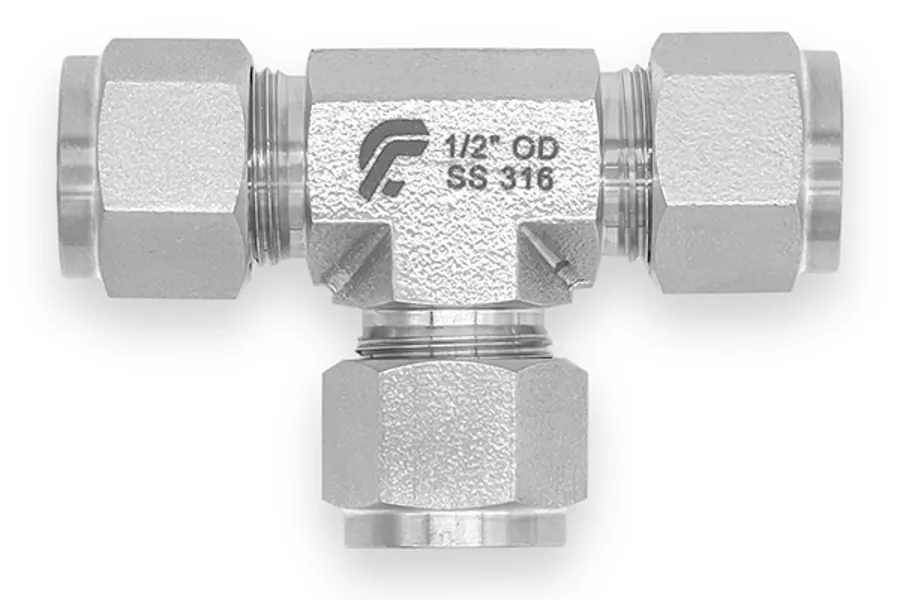
304 and 304L stainless steel make up the general-purpose 18/8 austenitic chromium-nickel grade (UNS S30400 / UNS S30403) that Crestflo machines into instrumentation tube fittings, valves, and tubing for fluid systems free of chlorides and sour service. Carbon steel rusts in ordinary air. So does mild steel. 304/304L doesn't, thanks to enough chromium to resist atmospheric corrosion, and that's what makes it the cost-effective baseline stainless for instrument air, clean water, oxidizing, and mild-atmospheric service. Fine where the media are benign. Honestly out of its depth once chlorides or H₂S enter the line. On this page, 304/304L refers to fluid-system stainless for instrumentation, not architectural sheet, cookware, or structural stainless.
Every 304/304L part carries a heat-number marking for full traceability. Each one ships with an EN 10204 3.1 material test certificate, and a 3.2 is available on request. Compression tube fittings go a step further: they're performance-qualified to ASTM F1387, so drop-in interchange is guaranteed. Standard items sit in ready stock. Specials are made to order, with delivery running 6-8 weeks.
Also Known As: Type 304, AISI 304, SS304, UNS S30400 & Werkstoff 1.4301
304/304L carries a long list of names, depending on whether you're reading a drawing standard, a mill certificate, or a buyer's requisition. You'll see it written as Type 304 and Type 304L, AISI 304 or AISI 304L, and SS 304 (sometimes 304 SS, 304SS, or 304-SS), with 304L marking the low-carbon variant. Under the UNS system, the designations are S30400 for 304 and S30403 for 304L. European drawings favor Werkstoff 1.4301 for 304 and 1.4307 (or the older 1.4306) for 304L, alongside the EN names X5CrNi18-10 and X2CrNi18-9. Engineers often shorten it to "18/8" or "18-8" stainless, a nod to the nominal chromium-nickel ratio, while fastener drawings tend to use the informal class "A2 stainless" for the same austenitic family. Some requisitions just call it "304 grade stainless steel." It's the same everyday 304 stainless steel material Crestflo machines into fittings, valves, and tubing.
| Designation system | 304 | 304L |
|---|---|---|
| Common / trade | 304 SS, SS304, 18/8 stainless | 304L SS, low-carbon 304 |
| Type / AISI | Type 304 / AISI 304 | Type 304L / AISI 304L |
| UNS | S30400 | S30403 |
| Werkstoff (EN) | 1.4301 | 1.4307 (older 1.4306) |
| EN name | X5CrNi18-10 | X2CrNi18-9 |
| Family | Austenitic Cr-Ni "18/8" | Austenitic, low-carbon |
Chemical Composition of 304 & 304L Stainless Steel (UNS S30400 / S30403)
304 and 304L share the same chromium-nickel base. The real difference comes down to carbon: 304L caps out at 0.030% maximum, which keeps it from sensitizing as readily. Figures below reflect the standard published composition limits under ASTM A240/A276/A479. They're not fixed, though; values can shift depending on the applicable standard, whether ASTM, PED, or another, and get tailored to requirement on the material test certificate.
| Element | 304 (S30400) | 304L (S30403) |
|---|---|---|
| Carbon (max) | 0.08% | 0.030% |
| Chromium | 18.0–20.0% | 18.0–20.0% |
| Nickel | 8.0–10.5% | 8.0–12.0% |
| Manganese (max) | 2.0% | 2.0% |
| Silicon (max) | 0.75% | 0.75% |
| Phosphorus (max) | 0.045% | 0.045% |
| Sulfur (max) | 0.030% | 0.030% |
| Nitrogen (max) | 0.10% | 0.10% |
| Iron | Balance | Balance |
Mechanical Properties: Tensile, Yield Strength & Hardness of 304/304L
304 runs a touch higher on minimum strength than 304L in the annealed condition, a result of its higher carbon content. Both grades still deliver the high ductility that makes austenitic stainless easy to form, bend, and orbital-weld. Here are the standard published minimums per ASTM A240 (annealed):
| Property | 304 | 304L |
|---|---|---|
| Tensile strength (min) | 515 MPa / 75 ksi | 485 MPa / 70 ksi |
| Yield strength, 0.2% offset (min) | 205 MPa / 30 ksi | 170 MPa / 25 ksi |
| Elongation in 50 mm (min) | 40% | 40% |
| Hardness (max, annealed) | 201 HB / 92 HRB | 201 HB / 92 HRB |
Physical Properties: Density, Magnetic Behavior & Melting Point
304 and 304L behave like textbook austenitic stainless steels. Magnetic permeability stays low, so in the annealed condition the material is essentially non-magnetic, and its density sits near 8.0 g/cm³. That's the baseline.
Things change a bit with cold work. Bending, ferrule swaging, machining: any of these can convert a small amount of austenite into martensite, and you'll notice slight magnetism as a result. Don't read too much into it. This is expected behavior, not evidence that you've received the wrong alloy.
Standard published physical values:
| Property | 304 / 304L |
|---|---|
| Density (specific gravity) | 8.0 g/cm³ (specific gravity 8.0; 0.289 lb/in³) |
| Magnetic response / permeability | Low magnetic permeability, essentially non-magnetic annealed; slightly magnetic after cold work |
| Melting range | ~1400–1450 °C (2550–2650 °F) |
| Elastic modulus | ~193 GPa (28 × 10⁶ psi) |
| Thermal conductivity (100 °C) | ~16 W/m·K |
| Coefficient of thermal expansion (0–100 °C) | ~17 × 10⁻⁶ /°C |
Temperature & Pressure Suitability of 304 Stainless Steel
304/304L keeps its toughness all the way down to cryogenic temperatures. It resists oxidation to roughly 870 °C in intermittent service, and to 925 °C when the service is continuous, giving the alloy a wide metallurgical temperature range. In practice, though, the useful instrumentation service temperature sits well below that ceiling. It's set by the fitting or valve rating, the seal material, and the media, not by the alloy's resistance to oxidation. Standard 304 is also prone to carbide sensitization when held in the 425–870 °C range. That's why 304L is the preferred choice for welded assemblies. Working pressure depends on product geometry, wall thickness, and end connection rather than on the grade alone. The fitting or valve pressure rating governs working pressure, not the alloy itself. For elevated-pressure duty, see high-pressure instrumentation fittings and valves.
Corrosion Resistance & Limitations of 304/304L (Chlorides, PREN & Sour Service)
Crestflo's 304/304L holds up well in mild atmospheric exposure, fresh water, oxidizing acids, and general food-contact work. Worth noting: it's suited to general food contact, not demanding sanitary duty. For sanitary and hygienic process lines, look instead at 316/316L.
Chlorides are where 304 falls short. Its pitting resistance equivalent number sits around PREN ~18–20 (PREN = %Cr + 3.3 × %Mo + 16 × %N, and 304 has no molybdenum at all), which leaves it open to pitting, crevice corrosion, and chloride stress-corrosion cracking once temperatures climb above roughly 60 °C. Sour service, meaning H₂S environments, is off the table too. Once your media push past what 304 can handle, move up a grade. Don't try to force it.
| Environment | 304 / 304L suitability | Recommended step-up |
|---|---|---|
| Atmospheric / indoor / mild | Suitable | — |
| Fresh water, clean steam | Suitable | — |
| Oxidizing (nitric) acids | Generally suitable | — |
| Chlorides / seawater / coastal | Not recommended (pitting, SCC) | 316/316L or 904L |
| Chloride SCC above ~60 °C | Susceptible | 904L / duplex |
| Sour service (H₂S) | Restricted | Qualify per NACE MR0175 |
For any line carrying chlorides, running in marine conditions, or handling sour service, step up to 316/316L or a higher CRA. NACE MR0175 / ISO 15156 governs material selection for sour service.
304 vs 304L Stainless Steel: The Low-Carbon Difference
The real difference between 304 and 304L comes down to carbon. 304L caps carbon at 0.030% maximum, and that low ceiling suppresses chromium-carbide precipitation at grain boundaries during welding, a process called sensitization. Because of that, 304L resists intergranular "weld decay" and has become the default pick for welded and orbital-weld assemblies where post-weld solution annealing just isn't practical. Standard 304 runs up to 0.08% carbon, gives you slightly higher strength, and works fine for machined, non-welded parts, or for assemblies that get annealed after welding anyway. Dual-certified 304/304L material, meeting both chemistries at once, is common, and it's what most instrumentation stock ships as.
304 vs 316 Stainless Steel: When to Step Up
316/316L works from the same austenitic base as 304 but adds roughly 2–3% molybdenum, which pushes up the PREN and gives it noticeably better resistance to chlorides and pitting. Go with 316 for coastal, marine, brackish, or chloride-bearing environments, and for most process-plant applications. Stick with 304 where conditions are milder, chloride isn't a factor, and cost matters more.
A full comparison of chemistry, corrosion behavior, and cost is available at 304 vs 316 stainless steel and on the 316/316L material page.
ASTM / ASME Specifications Governing 304/304L Product Forms
Different ASTM specifications govern 304/304L depending on the product form. Each one sets out the chemistry, mechanicals, and testing required for that form; among the forms Crestflo supplies are the instrumentation types.
| Product form | Governing specification |
|---|---|
| Seamless / welded tubing | ASTM A269, ASTM A213 |
| Pipe | ASTM A312 |
| Bar & forgings for fittings | ASTM A276, ASTM A479 |
| Forged fittings | ASTM A182 |
| Plate & sheet | ASTM A240 |
304 / 304L Instrumentation Fittings, Valves & Tubing from Crestflo
Crestflo machines 304/304L into the instrumentation forms that build fluid systems, not mill products. It offers both imperial and metric sizes, with hardened or non-hardened ferrules. Finishes include material finish, electropolish, passivation, and silver anti-galling plating.
| Form | What Crestflo makes | Qualified to |
|---|---|---|
| Tube fittings | Single-ferrule & double-ferrule compression fittings, up to 2″ (50 mm) OD | ASTM F1387 |
| Ferrules | Front & back ferrules, hardened or non-hardened | To drawing |
| Instrumentation valves | Needle, ball & check valve bodies, 1/16″–1″ | ASME B16.34 / API |
| Instrumentation tubing | Seamless & welded instrumentation tubing | ASTM A269 / A213 |
Looking for a competitor part matched to 304 or 304L? Request your Swagelok® or Parker® cross-reference from our engineering team.
Why Crestflo for 304 / 304L Stainless Steel
Crestflo is the instrumentation arm of a four-decade-old export house recognized by the Government of India, with a long record of delivery into demanding international markets. That kind of heritage counts for something with 304 and 304L. Here's what it brings:
- ASTM F1387 interchange on compression tube fittings: dimensional and performance match to the major brands. It's the interchange proof most competitors won't publish.
- 6-8 week delivery, with ready stock on standard items and made-to-order runs for specials. See lead time.
- Full traceability. Every part carries a heat-number mark, with EN 10204 3.1 MTC as standard and 3.2 on request.
- Indian origin, with US and European melt available on request, and full material traceability wherever domestic-melt sourcing is required.
- ISO 9001, 14001, and 45001 certified, plus PED, manufacturing that covers in-house machining and NDT, with third-party inspection on request.
- Small MOQ across imperial and metric sizes, plus a private-label program built for OEMs.
Crestflo engineers confidence. Get in touch with our US sales desk at sales@crestflousa.com or call +1 346 594 9005. We're based in Houston, TX.
Cost & Availability of 304 / 304L Stainless Steel
304 stands as the most economical of the instrumentation stainless grades. It carries the lowest cost per kilogram, and in practical terms, the cheapest stainless option across the instrumentation range. That's precisely why it serves as the default choice whenever chlorides and sour service aren't a factor. Crestflo operates on an RFQ basis, with no live pricing posted. Cost depends on form, size, quantity, and finish, though small MOQs remain available. Standard items ship from ready stock. Specials, on the other hand, are made to order, with delivery running 6-8 weeks. Request a quote with your sizes and quantities to get a firm figure.
Frequently Asked Questions About 304 / 304L Stainless Steel
What is 304 / 304L stainless steel?
304/304L is the general-purpose 18/8 austenitic stainless steel (UNS S30400 / S30403), with roughly 18–20% chromium and 8–10.5% nickel. 304L is the low-carbon version (≤0.030% carbon), and it resists weld sensitization. For non-chloride, non-sour instrumentation fittings, valves, and tubing, it's the standard, cost-effective choice.
What are the disadvantages of 304 stainless steel?
304's real weakness comes down to chlorides. It has no molybdenum, and with a PREN of only about 18–20, it's prone to pitting and crevice corrosion wherever chlorides are present, and to chloride stress-corrosion cracking above roughly 60 °C. Weld standard 304 without switching to the low-carbon 304L grade, and it can sensitize too. For chloride or sour service, step up to 316/316L or a higher alloy.
What is better, 304 or 316 stainless steel?
Neither grade wins outright. It comes down to the media. 316 carries roughly 2-3% molybdenum, which gives it a real edge in chloride and pitting resistance, and that's why it's the choice for marine, coastal, and other chloride-heavy service. For milder, non-chloride systems, 304 is the more economical pick. Check our 304 vs 316 comparison for the full breakdown.
What is the difference between 304 and 304L?
304L keeps carbon capped at 0.030% maximum, which resists sensitization and intergranular weld decay. That's why it's the preferred grade for welded and orbital-weld assemblies. Standard 304 allows up to 0.08% carbon and offers marginally higher strength. Dual-certified 304/304L material meets both requirements at once.
Is 304 stainless steel magnetic?
In the annealed condition, 304/304L is essentially non-magnetic, since its structure is austenitic. Cold working, whether bending, ferrule swaging, or machining, can convert a bit of that austenite to martensite, and a slight magnetism follows. That's normal. It doesn't mean you've got the wrong grade.
Is 304 stainless steel suitable for sour (NACE) service?
304 and 304L aren't approved for sour (H₂S) service under NACE MR0175 / ISO 15156. Sour-service instrumentation needs a NACE-qualified alloy. See our NACE MR0175 page for details, and be sure to flag the sour-service requirement on your RFQ so we can select the correct grade and heat.
Do you make stainless steel fittings and valves in 304?
Crestflo machines 304/304L into compression tube fittings, both single and double ferrule, qualified to ASTM F1387. We also produce instrumentation needle, ball, and check valve bodies, plus instrumentation tubing, in imperial and metric sizes alike. What we don't supply are mill forms: no bar, no sheet, no plate, no pipe.
What ASTM specifications cover 304/304L?
It depends on the form the material takes. Tubing falls under ASTM A269 and A213. Pipe is governed by A312, bar and forgings by A276 and A479, forged fittings by A182, and plate and sheet by A240. Among these, Crestflo supplies the instrumentation forms.
What is the price of 304 stainless steel tubing or fittings?
Crestflo works on an RFQ basis, so there's no live pricing, cost depends on form, size, quantity, and finish. Request a quote for your specification. Small MOQs are available. Standard items ship from ready stock, while specials are made to order with a 6-8 week delivery.
Do parts come with material test certificates?
Yes. Every part carries a heat number for full traceability, and each one comes with an EN 10204 3.1 material test certificate as standard. Need 3.2 certification instead? Just ask, and we'll arrange it.
Are Crestflo 304 fittings drop-in replacements for Swagelok or Parker?
Crestflo compression tube fittings match dimensionally, and they're performance-qualified to ASTM F1387. Need the exact 304/304L equivalent? Ask our engineering team for a Swagelok® or Parker® cross-reference. Swagelok® and Parker® remain trademarks of their respective owners.
What is the lead time for 304/304L parts?
Ready stock covers the standard items. Specials are made to order, with delivery running 6-8 weeks, well under the 20-plus weeks you'd typically wait with the major brands.