
Alloy 20 (UNS N08020): Instrumentation Fittings, Valves & Tubing
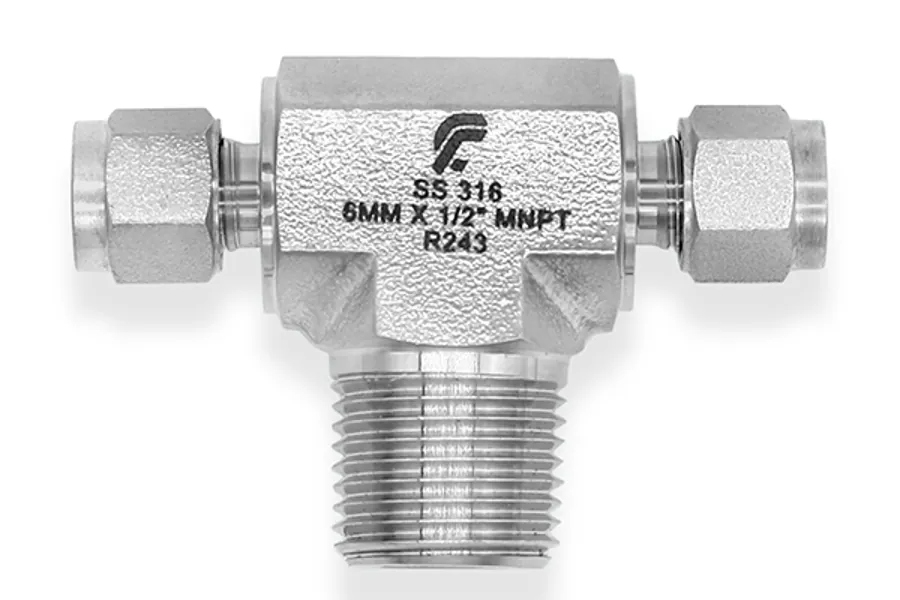
Crestflo sells Alloy 20 material, UNS N08020, Werkstoff 2.4660, as a niobium-stabilized super-austenitic nickel-iron-chromium stainless alloy. It's built above all for sulfuric-acid and mixed-acid service, the kind of environment where 304 and 316 stainless simply corrode. The grade comes as instrumentation tube and compression fittings, instrumentation valves, and instrumentation tubing. Every piece carries heat/lot-number traceability, is engineered as a drop-in replacement for the major brands, and ships within 6-8 weeks to customers across the US.
The composition, mechanical, PREN and corrosion values below reflect standard published data for the alloy, drawn from the applicable ASTM specification. They can be customized to whatever the application requires.
Scope: Alloy 20 here refers specifically to the corrosion-resistant instrumentation alloy UNS N08020 (part of the Carpenter 20 / 20Cb-3 family), used for fluid-system tube fittings, compression ferrules and instrumentation valves. It isn't a generic "20 alloy," not an aluminum designation, and not a weld-filler product. "Compression fitting" in this context means an SS/alloy instrumentation fitting, not a plumbing fitting. Crestflo supplies this alloy only in instrumentation fitting, valve and tubing forms. Mill bar, sheet, plate and pipe aren't part of the offering.
Need a quote on Alloy 20? Request one here, or request a sample first if you'd rather test it out. Crestflo keeps things simple: reach the team directly at sales@crestflousa.com or +1 346 594 9005, based in Houston, TX.
20Cb-3® is a registered trademark of Carpenter Technology Corporation.
Alloy 20 Also Known As: UNS N08020, Carpenter 20, 20Cb-3 & Werkstoff 2.4660
On drawings, datasheets and purchase orders, this alloy shows up under a handful of different names. A print might call it "Carpenter 20." Another might list "N08020 alloy." Still others use "Alloy 20Cb." All three point to the same niobium-stabilized Ni-Fe-Cr super-austenitic grade.
| Designation type | Value |
|---|---|
| Trade / common names | Alloy 20, Carpenter 20, 20Cb-3®, Alloy 20Cb, Incoloy 20 |
| UNS number | UNS N08020 (N08020) |
| Werkstoff (W.Nr.) / EN | 2.4660 (NiCr20CuMo) |
| Alloy family | Niobium-stabilized super-austenitic Ni-Fe-Cr stainless alloy |
| Spaced / reversed forms | 20 alloy, N08020 alloy, Alloy 20 stainless, Carpenter alloy 20 |
UNS N08020, the US designation, and Werkstoff 2.4660, the European one, describe the same alloy. Carpenter Technology sells it under the trade name 20Cb-3® for N08020. Crestflo supplies material to the UNS N08020 specification.
Alloy 20 Chemical Composition (Ni-Fe-Cr-Cu-Mo, per ASTM B729)
Alloy 20's resistance to acid isn't accidental. Copper and molybdenum handle the sulfuric acid; roughly 33% nickel guards against stress-corrosion cracking; niobium (columbium) stabilizes the material so it won't suffer intergranular attack after welding. Since it's an alloy rather than a chemical compound, its composition is expressed as ranges of elements, not a fixed formula.
| Element | wt % (per ASTM B729 / UNS N08020) |
|---|---|
| Nickel (Ni) | 32.0–38.0 |
| Chromium (Cr) | 19.0–21.0 |
| Iron (Fe) | Balance |
| Copper (Cu) | 3.0–4.0 |
| Molybdenum (Mo) | 2.0–3.0 |
| Niobium (Nb/Cb) | 8 × C min to 1.0 max |
| Manganese (Mn) | 2.0 max |
| Silicon (Si) | 1.0 max |
| Carbon (C) | 0.07 max |
| Phosphorus (P) | 0.045 max |
| Sulfur (S) | 0.035 max |
Ranges follow whatever ASTM product-form specification applies. Crestflo confirms the actual heat chemistry on the EN 10204 material test certificate that's supplied with every order.
Alloy 20 Mechanical & Physical Properties (Density, Tensile, Hardness)
Annealed, Alloy 20 pairs moderate strength with the high ductility that fitting and valve forming demand. Weldability's solid too, since the low carbon limit and niobium stabilization keep sensitization from creeping in. Below are the standard published minimums and nominal physical data for the alloy.
Mechanical properties (annealed, room temperature)
| Property | Value |
|---|---|
| Tensile strength | ≥ 80 ksi (551 MPa) |
| Yield strength (0.2% offset) | ≥ 35 ksi (241 MPa) |
| Elongation | ≥ 30% |
| Hardness | ≤ ~95 HRB |
Physical properties
| Property | Value |
|---|---|
| Density | 8.05 g/cm³ (0.291 lb/in³) |
| Melting range | 1425–1465 °C (2600–2670 °F) |
| Structure | Austenitic (face-centered cubic) |
Alloy 20 gets picked for its resistance to wet corrosion, not for strength at high temperatures. Mechanical minimums come from ASTM B729, annealed condition. The final certified properties for any given heat show up on the material test certificate.
Alloy 20 PREN (Pitting Resistance Equivalent Number)
Work from the nominal composition and Alloy 20's pitting resistance equivalent number comes out to roughly 28, using PREN = Cr + 3.3 × Mo (Cr near 20, Mo near 2.5, nitrogen too small to factor in). That's above 316 and 316L, though still below the 6-molybdenum super-austenitics such as 254 SMO and AL-6XN. PREN, though, only ranks chloride pitting resistance. What actually sets Alloy 20 apart is its resistance to acids, sulfuric acid especially, and that comes from its copper and molybdenum content rather than from its PREN score. For a look at how it stacks up against other alloys, see the PREN comparison table.
Alloy 20 Corrosion Resistance by Media (Sulfuric, Phosphoric & Nitric Acid)
Alloy 20 was developed to close the gap between stainless steel and the pricier high-nickel alloys, primarily for sulfuric-acid service. It also performs well in phosphoric acid, nitric acid, and many mixed acids. High nickel content gives it strong resistance to chloride stress-corrosion cracking. The table below draws on standard alloy corrosion literature to summarize typical service suitability, but confirm the exact concentration and temperature against a corrosion chart for your duty.
| Media / service | Suitability | Note |
|---|---|---|
| Sulfuric acid (H₂SO₄) | Excellent | The defining application, across a broad concentration and temperature range |
| Phosphoric acid (H₃PO₄) | Good–Excellent | Fertilizer and process acid streams |
| Nitric acid (HNO₃) | Good | Oxidising-acid service |
| Mixed / contaminated acids | Good | Copper + Mo give an edge over 304/316 |
| Chlorides (pitting/crevice) | Moderate | PREN ≈ 28; step up to a 6-moly grade for aggressive chlorides |
| Chloride stress-corrosion cracking | Highly resistant | High nickel resists SCC that limits 300-series stainless |
| Intergranular attack after welding | Resistant | Niobium stabilization plus low carbon |
For selection against a specific process, check the corrosion-by-media × alloy matrix and the material-selection-by-service guide.
Alloy 20 for Sour Service (NACE MR0175 / ISO 15156)
Where sour (H₂S-containing) service demands it, Crestflo supplies Alloy 20 / UNS N08020 instrumentation components to NACE MR0175 / ISO 15156. Confirm the hardness and material-condition limits in the standard for your specific application, and state the requirement on your RFQ. See the NACE MR0175 and ISO 15156 standard pages, along with the sour-service selection guide.
Alloy 20 Temperature & Pressure Suitability
Alloy 20 earns its keep in wet-corrosion service, not high-temperature work. Its stabilized, low-carbon structure holds up against sensitization even in the annealed condition. There's no single published temperature limit for instrumentation use, since the grade gets chosen for acid resistance rather than a high ceiling on heat. Check the temperature limit for your specific media and concentration against a corrosion chart before you commit. As for pressure: the rating on a finished part comes from the product form and wall thickness, not from the grade itself. Working-pressure ratings live on the individual product forms, set by the applicable standard, and can be adjusted to whatever the job requires.
Alloy 20 Product-Form Standards (ASTM B729, B468, B473, B462 & B366)
The alloy falls under a family of ASTM specifications organized by product form. These define the grade. Crestflo supplies the instrumentation forms, fittings, valves, tubing, built from certified material that meets these specifications, but the mill forms themselves aren't part of what Crestflo provides.
| Product form | ASTM specification |
|---|---|
| Seamless pipe & tube | B729 |
| Welded tube | B468 |
| Welded pipe | B464 |
| Bar, rod & wire | B473 |
| Forgings & flanges | B462 |
| Plate, sheet & strip | B463 |
| Wrought fittings | B366 |
Values and grades follow the applicable ASTM specification. Every order comes with EN 10204 material certificates attached, no exceptions. For the full details, see EN 10204 MTC.
When to Choose Alloy 20 vs 316L, 904L & Hastelloy C-276
When sulfuric or mixed acids are the trouble, Alloy 20 offers a cost-effective step up from stainless. Chloride pitting is another matter, though, and so are the harshest acids: those call for a higher alloy. Below, we compare it against the grades buyers most often weigh against it. Each one links out to its own material or comparison page.
| Grade | UNS | Ni % | Cr % | Mo % | Cu % | PREN (approx) | Best-fit service | More detail |
|---|---|---|---|---|---|---|---|---|
| Alloy 20 | N08020 | 32–38 | 19–21 | 2–3 | 3–4 | ~28 | Sulfuric & mixed acids, SCC resistance | This page |
| 316 / 316L | S31600 / S31603 | 10–14 | 16–18 | 2–3 | — | ~24 | Standard, mildly corrosive instrument service | 316 / 316L · Alloy 20 vs 316 |
| 904L | N08904 | 23–28 | 19–23 | 4–5 | 1–2 | ~34 | Higher-alloy austenitic for sulfuric + chlorides | 904L |
| 254 SMO | S31254 | 17.5–18.5 | 19.5–20.5 | 6–6.5 | 0.5–1 | ~43 | Aggressive chloride pitting / crevice | 254 SMO · AL-6XN |
| Hastelloy C-276 | N10276 | Balance | 14.5–16.5 | 15–17 | — | ~68 | Hot HCl, wet chlorine, the most severe acids | Hastelloy C-276 |
For the head-to-head matchup against standard stainless, check out the Alloy 20 vs 316 guide.
Alloy 20 Product Forms from Crestflo: Fittings, Valves & Tubing
Crestflo supplies UNS N08020 across three instrumentation product forms. The head keyword "Alloy 20 pipe fittings" ranks well, but the US range is instrumentation only, not a full pipe-fittings line. So that search intent gets served here with instrumentation tube and compression fittings, rather than mill pipe fittings.
- Alloy 20 tube & compression fittings: these fittings come in single and double ferrule (twin-ferrule) styles, hardened or non-hardened, in imperial and metric sizes, with end connections running up to 2" (50 mm) OD. They're also specified as Alloy 20 compression fittings, N08020 ferrule fittings, or Carpenter 20 fittings. For matching hardware, see the nut & ferrule sets. Compression tube fittings are performance-qualified per ASTM F1387.
- Alloy 20 instrumentation valves: the range covers Alloy 20 needle valves, ball valves, check valves, and 2/3/5-way manifold valves, sized from 1/16" to 1", with threaded or tube-fitting ends. Valve bodies are machined from certified N08020 round bar. Pressure-boundary design follows ASME B16.34, with API seat-leak and test practice applied throughout.
- Alloy 20 instrumentation tubing: this tubing is Alloy 20 / N08020, available with no weld seam or as welded tube, and comes in imperial and metric OD and wall sizes.
Every Crestflo Alloy 20 part carries its own heat/lot number. It ships with an EN 10204 material test certificate as well. Size, ferrule type, thread standard, end connection: NPT, NPTF, BSPT, BSPP, ISO parallel, JIC 37°, SAE-ORB, socket/butt weld, or tube OD. All of it gets configured to the requirement at hand.
Why Crestflo for Alloy 20
We're an Alloy 20 supplier and manufacturer serving the USA, and our approach comes down to one idea: Engineer Confidence. For an acid-service alloy like N08020, that means PMI-verified chemistry, honest sourcing, and real interchange, laid out in specs you can actually pull numbers from. Not something buried in a PDF.
Drop-in interchange for Swagelok®, Parker®, Hoke® and Hy-Lok®. The fit is dimensional, and compression fitting ends are qualified against ASTM F1387 performance testing. These are interchange, or equivalent, parts, not simply "compatible" or "intermix." Ask our engineering team for a Swagelok®/Parker® cross-reference through the Swagelok cross-reference page.
- Lead time 6-8 weeks, against 20+ weeks typical for the majors. Details sit on the lead-time capability page.
- Full traceability. Every part carries a heat and lot number. EN 10204 MTC 3.1 comes standard, with 3.2 available on request. PMI confirms the material really is N08020, backed further by in-house testing.
- NACE MR0175 / ISO 15156 material options are available on all fittings, in single and double ferrules, hardened or non-hardened, imperial and metric.
- ISO 9001 / 14001 / 45001 & PED certified. We handle CNC, VMC and EDM machining in-house, and offer small MOQs along with private-label options.
- The heritage behind the brand: Crestflo is the instrumentation division of a four-decade-old export house recognized by the Government of India, with a proven track record delivering into the Middle East. New manufacturing, built on deep export pedigree. Read more about Crestflo.
Stock & delivery: Standard items ship from ready stock. Specials are made to order, with delivery running 6-8 weeks. Origin: Material comes from Indian origin as standard, though US and European melt can be arranged on request. Full material traceability is provided in every case (origin & compliance).
Buyers: Request a Quote or a Sample if you're an end user, EPC firm, or panel fabricator. Equipment manufacturers and OEMs should talk to an engineer or send us a print. Want to carry our line? Become a distributor. We serve petrochemical & chemical processing operations across the US.
Alloy 20 FAQs
What material is Alloy 20?
Alloy 20 (UNS N08020) is a niobium-stabilized super-austenitic stainless alloy. Nickel sits around 33%, chromium at 20%, with iron making up the balance, plus 3–4% copper and 2–3% molybdenum. It was developed mainly to stand up to sulfuric acid and mixed-acid environments. Crestflo sells it in the form of instrumentation fittings, valves and tubing.
Is Alloy 20 the same as Carpenter 20?
Correct. Same alloy, different names: Carpenter 20, 20Cb-3® (a registered trademark of Carpenter Technology Corporation), Alloy 20Cb, and Incoloy 20 all designate UNS N08020. Crestflo supplies material to that N08020 specification.
Is Alloy 20 stainless steel or a nickel alloy?
It hovers right at the edge, a super-austenitic stainless alloy loaded with nickel. People often lump it in with nickel alloys, and for good reason: nickel makes up roughly 33% of the mix, and that's what gives it stress-corrosion-cracking resistance well beyond what standard 300-series stainless can manage.
Is Alloy 20 better than stainless steel?
For sulfuric acid and most mixed acids, the answer is yes: copper and molybdenum give far better acid resistance than 304 or 316. Plain seawater and chloride pitting are a different story. There, a 6-molybdenum grade like 254 SMO or AL-6XN, or a Hastelloy grade, may serve better.
What is Alloy 20 equivalent to?
UNS N08020 lines up with Werkstoff 2.4660, sold under the names Carpenter 20 and 20Cb-3. No exact 300-series match exists for it. The closest options among higher-alloy austenitics are 904L and 254 SMO.
Does Alloy 20 resist sulfuric acid?
Yes, sulfuric acid service is its signature application, and it covers a wide range of concentrations and temperatures. Check the exact concentration and temperature against a corrosion chart for your specific duty before committing.
What is the chemical composition of Alloy 20?
Nickel runs 32 to 38%, chromium 19 to 21%, with iron making up the balance. Copper sits at 3 to 4%, molybdenum at 2 to 3%. Niobium is set at eight times the carbon content, capped at 1.0% max, and carbon itself is held to 0.07% max. The full ASTM B729 ranges appear in the composition table above.
What is the PREN and density of Alloy 20?
Work the formula through and PREN comes out around 28 (Cr + 3.3 × Mo). That puts it above 316, though still short of the 6-molybdenum super-austenitics. Density sits near 8.05 g/cm³, or 0.291 lb/in³ if you prefer imperial. Keep in mind PREN only measures resistance to chloride pitting. Acid resistance is where Alloy 20 actually earns its keep.
Is Alloy 20 NACE MR0175 compliant?
Crestflo supplies Alloy 20 instrumentation components to NACE MR0175 / ISO 15156 whenever sour service demands it. Check the hardness and material-condition limits in the standard before you order. Don't leave that requirement off your RFQ.
Which ASTM specs cover Alloy 20 product forms?
ASTM B729 covers seamless pipe and tube. B468 applies to welded tube, while B464 covers welded pipe. Bar and wire fall under B473; forgings and flanges under B462; plate, sheet, and strip under B463. Wrought fittings follow B366. Crestflo supplies the instrumentation forms built to these specifications.
What Alloy 20 products does Crestflo make?
Crestflo supplies instrumentation compression and double-ferrule tube fittings up to 2" (50 mm) OD. The range also covers needle, ball and check valves, plus 2/3/5-way manifolds from 1/16" to 1", along with instrumentation tubing. Everything comes in imperial and metric, and it can be customized to suit what's needed. One thing Crestflo won't sell: mill bar, sheet, plate or pipe.
What is the price and lead time for Alloy 20 fittings?
Pricing works by quotation; there's no online cart. Standard items ship from ready stock, while specials are made to order, running six to eight weeks for delivery. The standard product line is of Indian origin. US and European melt is available on request, with full traceability provided. To get a configured part number and price, submit an RFQ specifying size, form, material and rating.
Related Alloys & Resources
- 904L, higher-alloy austenitic for sulfuric acid combined with chlorides.
254 SMO · AL-6XN: 6-molybdenum super-austenitic grades, chosen when chloride pitting gets aggressive.
- Hastelloy C-276, the step up for hot HCl, wet chlorine and the most severe acids.
- 316 / 316L stainless, the standard-service baseline before an alloy upgrade.
- For a straight comparison, see the Alloy 20 vs 316 guide, then work through the corrosion-alloy matrix if you need help deciding.
- Want to see everything on offer? Start at the instrumentation valves hub, or check the materials hub.
Request an Alloy 20 Quote
Send us your form, fittings, valves, or tubing, along with size, end connections and line conditions. The Crestflo Engineering Team will send back a configured part number, ratings and price.
Request a Quote · Request a Sample · Browse the materials hub sales@crestflousa.com · +1 346 594 9005 · Houston, TX
Datasheets and CAD files are available to customers on request. The Crestflo Engineering Team reviewed this document before release. 20Cb-3® is a registered trademark of Carpenter Technology Corporation, and Swagelok® and Parker® remain the property of their respective owners as trademarks.