
Face-Seal Fittings: Metal-Gasket (VCR-type) & O-Ring (VCO-type) for High-Purity & Vacuum Service
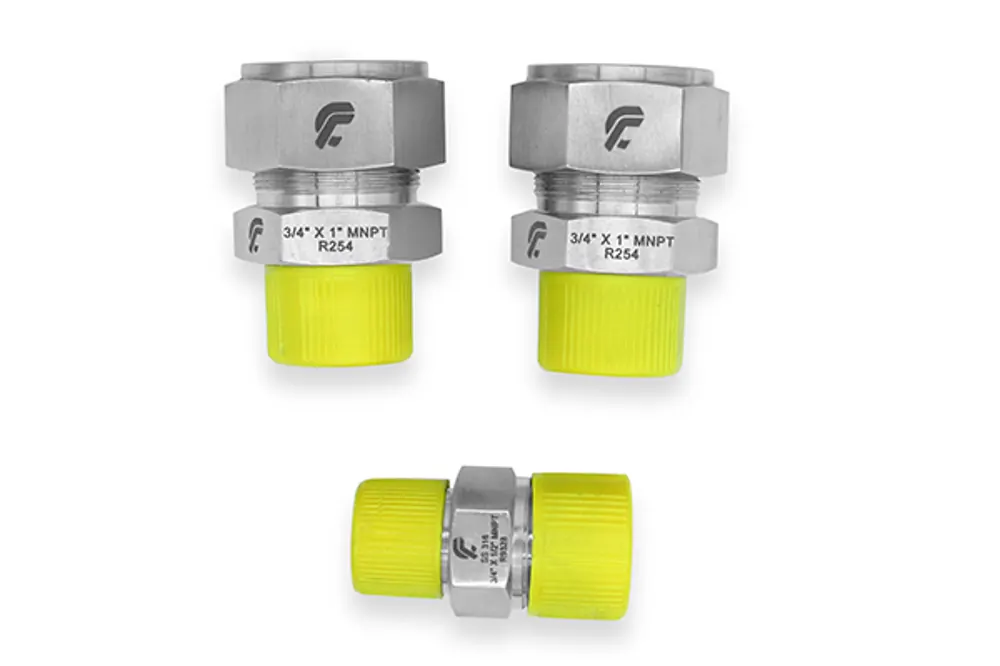
A face-seal fitting is an instrumentation connection that seals on a flat face against a gasket, not on a ferrule or thread. That gives you a leak-tight, low-particle joint, exactly what high-purity gas and vacuum systems need. Crestflo builds two families here: metal-gasket VCR-type fittings for ultra-high-purity and vacuum service, and O-ring VCO-type fittings for medium-purity connections that get serviced often. Both come in 316L and high-nickel alloys, in imperial and metric sizes, and can be electropolished or oxygen-cleaned on request. On this page, "face-seal fitting" refers specifically to an instrumentation metal-gasket (VCR-type) or O-ring (VCO-type) fitting used in semiconductor, hydrogen, analytical and vacuum systems. It doesn't mean the hydraulic O-Ring Face Seal (ORFS / SAE J1453 / flat-face) adapter. That's a separate high-pressure hose connection, and Crestflo doesn't list it.
Also Specified As: VCR Fittings, VCO Fittings & Metal-Gasket Face Seals
Gas-panel drawings, purchase specs and instrumentation catalogs rarely agree on what to call this fitting. Engineers and buyers use several names for it: face seal fitting or metal face seal fitting, gasketed face seal, metal-gasket face-seal fitting, high-purity or UHP face-seal fitting, and vacuum face-seal fitting. Subtype names show up just as often, among them VCR fitting, VCR face seal fitting, VCR coupling, VCR connection, VCR union, VCO fitting, and VCO O-ring face seal. Component call-outs add still more terms: VCR gland or VCR body, male VCR nut and female VCR nut, VCR gasket (316L, nickel or silver-plated), long-arm gland, and weld-end, tube-stub or bulkhead ends. They're all pointing at the same thing, though: the flat-face gasketed instrumentation connection covered here. Its metal-gasket and O-ring subtypes are detailed on the VCR face-seal fittings and VCO O-ring face-seal fittings pages.
How a Face-Seal Fitting Seals: Metal Gasket vs O-Ring Face Seal
A face seal forms when a gland bead squeezes a gasket against a flat mating surface. In a metal-gasket VCR-type fitting, two glands bite into a captured metal gasket; tightening the male and female nuts deforms that gasket plastically, giving a metal-to-metal seal that won't leak. An O-ring VCO-type fitting works differently: an elastomer O-ring sits in a groove and gets compressed against a flat face. In both cases the threads do one job only, clamping the two halves together. They carry no lubricant and play no part in the seal itself.
Because sealing happens on a replaceable gasket at a flat face, face-seal fittings beat out ferrule and thread-sealed connections for high-purity and vacuum work. There's no thread sealant to outgas. No trapped internal volume where particles can hide. And since the gasket gets renewed every time the joint is made up, the connection stays clean and can be reused indefinitely. The metal-gasket subtype goes a step further, with a fully metallic wetted seal that outgases very little, exactly what's needed for ultra-high vacuum and high-temperature gas service.
VCR-Type vs VCO-Type Face-Seal Fittings: Which to Choose
Picking between the two subtypes really comes down to three things: purity, vacuum level, and how often you'll be breaking the joint open. The metal-gasket VCR-type sets the bar for ultra-high purity and vacuum performance. The O-ring VCO-type costs less and suits medium-purity lines that get serviced often.
| Attribute | Metal-gasket (VCR-type) | O-ring (VCO-type) |
|---|---|---|
| Seal element | Deformable metal gasket (316L, nickel, silver-plated) | Elastomer O-ring (FKM, FFKM, EPDM) |
| Purity level | Ultra-high-purity (UHP) | Medium-purity |
| Vacuum capability | High and ultra-high vacuum, low outgassing | Limited by elastomer permeation |
| Temperature limit | High-temperature capable (metal seal) | Limited by O-ring compound |
| Gasket reuse | New gasket recommended each make-up | O-ring reusable within compound life |
| Best use | Semiconductor gas delivery, hydrogen, vacuum, analytical | Frequently-serviced medium-purity gas and sampling lines |
Route selection depends on the service. UHP, vacuum, and high-temperature gas lines call for Crestflo's metal-gasket VCR-type. For medium-purity connections that get opened often and need to stay economical, the O-ring VCO-type is the better fit. Neither one matches a compression (ferrule) fitting. That design seals on ferrules gripping the tube OD, not on a flat-face gasket, and the distinction is worth understanding: see face-seal versus ferrule fittings.
Face Seal vs Hydraulic ORFS vs O-Ring Boss (ORB): Disambiguation
The term "face seal" also shows up in fluid power. Worth keeping separate, then: the instrumentation VCR/VCO connection versus the hydraulic O-Ring Face Seal (ORFS / O-Lok, SAE J1453) and the O-ring boss (ORB) port. Different surfaces. Different standards. Different domains entirely.
| Connection | Seal | Standard | Domain | In Crestflo face-seal scope? |
|---|---|---|---|---|
| VCR-type | Metal gasket on flat gland face | Industry VCR-type geometry | Instrumentation UHP / vacuum / gas | Yes |
| VCO-type | Elastomer O-ring on flat face | Industry VCO-type geometry | Instrumentation medium-purity | Yes |
| ORFS (O-ring face seal) | O-ring in a flat face, UNF nut | SAE J1453 | Hydraulic / high-pressure hose | No, hydraulic, not listed |
| O-ring boss (ORB) | O-ring in a threaded boss cavity | SAE J1926 straight thread | Hydraulic port connection | No, hydraulic, not listed |
Crestflo's face-seal line covers the instrumentation VCR/VCO family. The hydraulic ORFS and ORB connections, including metric O-ring face seal (ORFS) variants, belong to a separate group of high-pressure ports and don't fall within this page. In hydraulic usage, an "O-ring face seal plug" closes an SAE J1453 port, which also sits outside this scope. If you need a closed VCR/VCO end, ask for a cap or a plug gland instead.
Face-Seal Fitting Components: Gland, Male Nut, Female Nut & Gasket
A face-seal fitting comes together from a gland or body, a male nut, a female nut, and the seal element itself, either a metal gasket or an elastomer O-ring. Glands come in short-arm and long-arm patterns, with a range of end connections. That means a gas panel or sampling line can be built entirely from one matched alloy family, with common heat traceability throughout.
| Component | Function | Options |
|---|---|---|
| Gland / body | Beads against the gasket to form the flat-face seal | Short and long-arm patterns |
| Male nut | Clamps the joint from the male side | 316/316L and alloy |
| Female nut | Clamps the joint from the female side | 316/316L and alloy |
| Gasket (VCR-type) | Metal seal element, renewed at make-up | 316L, nickel, silver-plated, high-nickel alloys |
| O-ring (VCO-type) | Elastomer seal element | FKM, FFKM, EPDM |
| End connections | Join the gland to the process line | Tube butt-weld, socket-weld, tube-stub, male/female NPT, tube-fitting end, bulkhead |
Full gasket, O-ring and gland detail sits on the child pages for the two fitting types. That includes silver-plated and high-nickel gasket options. You'll find the VCR-type specs on its own page, and the VCO-type specs on its own as well.
Face-Seal Fitting Sizes (1/8″–1″) & Metric Equivalents
Crestflo supplies face-seal fittings across the common instrumentation range, with metric tube equivalents to match. The typical gas-panel size is a 1/4-inch VCR-type fitting, and both imperial and metric sizes are available.
| Nominal size (in) | Tube OD (in) | Metric equivalent (mm) | Typical ends |
|---|---|---|---|
| 1/8 | 0.125 | 3.18 | Weld, tube-stub, NPT |
| 1/4 | 0.250 | 6.35 | Weld, tube-stub, NPT, bulkhead |
| 3/8 | 0.375 | 9.53 | Weld, tube-stub, NPT |
| 1/2 | 0.500 | 12.70 | Weld, tube-stub, NPT, bulkhead |
| 3/4 | 0.750 | 19.05 | Weld, tube-stub, NPT |
| 1 | 1.000 | 25.40 | Weld, tube-stub, NPT, bulkhead |
Tube-OD values follow standard tube tables, though they can be customized to your requirement. Gland series identifiers and the full ordering code stay proprietary to each build. For the ordering-code guide and size chart, reach out to Crestflo's engineering team through the RFQ form.
Face-Seal Fitting Materials: 316L Stainless, Inconel, Hastelloy & Monel
Stainless steel VCR fittings in 316 and 316L are the standard for ultra-high-purity gas and vacuum service. For aggressive or corrosive process gases, something tougher is needed: high-nickel and other corrosion-resistant alloys. The face-seal line carries every one of these alloys, and each links to its own material page, where you'll find the composition and property data.
| Family | Representative grades | When to choose |
|---|---|---|
| Stainless | 316/316L, 304/304L, 904L | UHP gas, vacuum and general high-purity service |
| Duplex / super-austenitic | Duplex 2205, Super Duplex 2507, 254 SMO, AL-6XN | Chloride and aggressive-media exposure |
| Nickel alloys | Inconel 625, Inconel 825, Monel 400, Hastelloy C-276 | Corrosive gas, acidic and high-temperature media |
| Titanium | Titanium Gr2 | Light-weight, high corrosion resistance |
Crestflo supplies face-seal fittings in stainless steel and corrosion-resistant alloys only. No carbon steel, no brass, no aluminum. For grade selection, see 316 vs 316L and the high-purity semiconductor selection guide. Origin is India, though US and European melt can be arranged on request, with full material traceability provided.
Finishes & Cleanliness: Electropolish, Passivation & Oxygen/UHP Clean
Face-seal fittings dominate gas-panel and semiconductor work where purity isn't optional. The metal-gasket VCR type stands out among them, specified as UHP fittings or ultra-high-purity fittings for the cleanest gas lines.
For high-purity service, Crestflo supplies these fittings with the finishing that gas-panel and semiconductor buyers specify: electropolish for a smooth, low-particle wetted surface, passivation for corrosion resistance, silver anti-galling plating on the threads, and oxygen or ultra-high-purity cleaning. Oxygen cleaning follows ASTM G93 and CGA G4.1. High-purity finishing references ASME BPE. Standard UHP electropolish targets a low surface roughness per SEMI and ASME BPE practice, so specify your Ra target on the RFQ. Cleanroom double-bag packaging for high-purity handling is available on request; check oxygen and UHP cleaning and electropolished tubing for the matched tubing.
| Finish | Purpose | Typical service |
|---|---|---|
| Electropolish (EP) | Smooth, low-particle wetted surface | UHP gas delivery, semiconductor |
| Passivation | Restores the chromium-oxide layer | General high-purity and corrosion resistance |
| Silver anti-galling plating | Prevents thread galling on make-up | Repeated make-up on stainless glands |
| Oxygen / UHP clean | Removes hydrocarbons for O2 and UHP service | Oxygen, analytical and high-purity gas |
Finishes per applicable standard; customizable to requirement.
Ratings, Testing & Traceability: Vacuum-to-Pressure, Seal Temperature & MTC
Metal-gasket VCR-type fittings use a fully metallic seal, and it holds all the way from ultra-high vacuum to positive-pressure gas. The rating you actually get depends on size, gasket, and grade. O-ring VCO-type fittings work differently: their ratings are capped by whatever the elastomer compound can take. Every rating follows the applicable standard, though they're adjustable to fit specific requirements. Elastomer service temperature tracks the standard published limits for seal compounds, summarized below; full detail is in the seal-material temperature guide.
| Seal material | Typical temperature range | Notes |
|---|---|---|
| Metal gasket (316L / nickel) | Broad; high-temperature capable | UHP and vacuum, low outgassing |
| FKM (fluoroelastomer) | approx. −15 °C to 205 °C | General medium-purity O-ring |
| FFKM (perfluoroelastomer) | approx. −15 °C to 260 °C+ | Aggressive gas, higher temperature |
| EPDM | approx. −50 °C to 150 °C | Steam and polar-media service |
Temperature limits follow whatever seal-material standard applies, though these can be tailored to the requirement. Testing covers hydraulic proof, burst and impulse, pneumatic, flexure fatigue, vibration, thermal cycling and vacuum, along with helium and vacuum leak testing and positive material identification (PMI). NDT is handled in-house as standard practice. Destructive testing goes to labs accredited under ISO/IEC 17025, and third-party inspection can be arranged on request. Every part carries a heat or lot number, which gives full material traceability. EN 10204 MTC 3.1 comes as standard, with 3.2 available on request. Datasheets and CAD files are also supplied to customers on request.
Face-Seal Fitting Applications: Semiconductor, Hydrogen & Analytical Systems
Wherever purity and seal integrity govern the design, the leak-tight, low-particle face-seal joint is the connection of choice. That includes semiconductor gas delivery and gas panels, where a face-seal fitting is often specified as a gas face-seal fitting or semiconductor gas fitting; hydrogen systems; analytical and sampling systems; pharmaceutical and biotech high-purity lines; and vacuum and calibration rigs. Metal-gasket VCR-type fittings dominate the UHP and vacuum ends of these systems. O-ring VCO-type fittings handle the medium-purity lines instead, the ones serviced often. For matched components, pair face-seal fittings with high-purity regulators, grab-sampling systems, and sampling cylinders.
VCR-Type Interchange & Swagelok Alternative
Crestflo's metal-gasket VCR-type fittings are dimensional equivalents, built to interchange with existing VCR-type face-seal fittings on the standard gland-and-gasket geometry. That claim is backed by ASTM F1387 performance qualification. VCR® and VCO® are trademarks of Swagelok Company, and Crestflo has no affiliation with, endorsement from, or sponsorship by Swagelok. Crestflo parts are described as interchange or equivalent, never as genuine or compatible product. Need to confirm interchange for your incumbent part numbers? Request a Swagelok VCR® cross-reference from our engineering team at the cross-reference desk.
Why Crestflo for Face-Seal Fittings
Crestflo serves the US market as a manufacturer and supplier of face-seal fittings. It's the instrumentation arm of an export house that's operated for four decades, carrying Government of India recognition and a delivery record across the Middle East. Now it brings drop-in instrumentation fittings to American customers. Face-seal fittings come as engineered drop-in replacements backed by ASTM F1387, in both imperial and metric sizes. The alloy range runs deeper than what most commodity sellers offer. Every part gets electropolish and oxygen/UHP-clean finishing, plus a heat-number MTC. Standard items ship from ready stock; specials are made to order. Delivery runs six to eight weeks. Small MOQ and private-label programs make it practical to standardize a gas panel or sampling system, no need to carry a major's lead time. We Engineer Confidence.
Request a Quote for Face-Seal Fittings
Send sizes, subtype (VCR-type or VCO-type), alloy, gasket or O-ring material and finish for a fast quote, order a sample, or set up a distributor, OEM or private-label program. Request a quote · request a sample · private-label program. US sales: sales@crestflousa.com · +1 346 594 9005 · Houston, TX. To confirm brand interchange, request your Swagelok VCR® cross-reference from the cross-reference desk.
Frequently Asked Questions: Face-Seal Fittings
What are face-seal fittings?
Face-seal fittings seal against a gasket on a flat face rather than relying on a ferrule or thread. That difference matters: it produces a leak-tight, low-particle joint suited to high-purity, gas, and vacuum service. Crestflo carries two subtypes here. The metal-gasket VCR-type handles ultra-high-purity and vacuum work, while the O-ring VCO-type covers connections where medium purity is enough.
What is a face seal and how does it seal?
A gland bead does the work of forming a face seal: it presses a gasket, if metal, or an O-ring, if elastomer, against a flat mating face. The threads exist only to clamp the two halves together. They carry no sealant and play no part in the seal itself. That's exactly why the joint stays clean and can be taken apart and reused.
What is the difference between VCR-type and VCO-type face-seal fittings?
VCR-type fittings use a deformable metal gasket to create a metal-to-metal seal. That makes them the right choice for ultra-high-purity work, vacuum lines, and high-temperature service. VCO-type fittings rely on an elastomer O-ring instead. They suit medium-purity, budget-conscious connections that get opened and closed frequently, though the O-ring compound caps both the pressure rating and the temperature range.
What is the difference between a face seal and an O-ring boss (ORB) seal?
A face seal works against a flat gasket or O-ring pressed between two flat mating faces. The O-ring boss, or ORB, takes a different route. Built to the SAE J1926 straight-thread standard, it seals by compressing an O-ring inside a threaded boss cavity. Crestflo's face-seal products are instrumentation fittings, VCR and VCO style, not the hydraulic ORB port.
Are face-seal fittings the same as hydraulic ORFS (SAE J1453) fittings?
No. The O-Ring Face Seal (ORFS) fitting built to SAE J1453 is a flat-face, O-ring-sealed high-pressure hose and hydraulic connection. Crestflo's face-seal line is different: it covers the instrumentation-grade VCR metal-gasket family and the VCO O-ring family, both built for high-purity gas and vacuum service. ORFS hydraulic adapters fall into a separate family, and Crestflo doesn't list them.
What is an O-ring face seal plug?
A plug seals off a face-seal port, plain and simple. In hydraulic work, "ORFS plug" points to the SAE J1453 connection, and that's outside Crestflo's instrumentation scope. Looking for a closed VCR-type or VCO-type end instead? Ask for a cap or plug gland.
How is a face-seal fitting different from a compression (ferrule) fitting?
A face-seal fitting seals on a replaceable gasket at a flat face. That makes it reusable, low-particle and vacuum-tight. A compression fitting, by contrast, seals with ferrules that grip the tube's outside diameter. For ultra-high-purity gas panels and vacuum systems, face seals are the preferred choice.
What materials and finishes are available for face-seal fittings?
316/316L stainless is the standard choice, but 904L, duplex and super-duplex grades, and high-nickel alloys like Inconel, Hastelloy and Monel are all available, as is Titanium Gr2. Finishes run from electropolish and passivation to silver anti-galling plating and oxygen/UHP cleaning. Carbon steel, brass and aluminum aren't offered.
What sizes do face-seal fittings come in?
Common lengths run from 1/8″ up to 1″, with metric tube equivalents to match, roughly 3 mm through 25 mm. Crestflo carries both imperial and metric lines. Ask the engineering team for the full size chart and the ordering-code guide.
Do Crestflo face-seal fittings interchange with Swagelok VCR® fittings?
Crestflo makes metal-gasket VCR-type fittings as dimensional equivalents, built to interchange on the standard gland-and-gasket geometry. That claim rests on ASTM F1387 qualification. VCR® is a trademark of Swagelok Company, and Crestflo isn't affiliated with or endorsed by it. Need a cross-reference? Request one from the cross-reference desk.
Are face-seal fittings suitable for high vacuum?
VCR fittings use a metal gasket, so the seal is fully metallic and outgassing stays low. That makes them well suited to high and ultra-high vacuum work. VCO fittings rely on an O-ring instead. Elastomer permeation limits them, so they're a better fit for medium-purity pressure service.
What certifications and documentation come with face-seal fittings?
Crestflo holds ISO 9001 / 14001 / 45001 certification along with PED approval. Sour-service grades are available too, built to NACE MR0175 / ISO 15156-compliant standards, and the company carries the standard approvals for instrumentation fittings, including ASTM F1387 interchange qualification. Each part gets a heat or lot number, with EN 10204 MTC 3.1 as standard and 3.2 available on request.
What is the lead time and minimum order for face-seal fittings?
We keep standard items in stock and ready to ship. Specials get made to order, and delivery runs 6-8 weeks either way. Small MOQs are available, and we offer private-label options too. Just send your sizes, subtype, materials and finish to the RFQ desk, and we'll get you a quote.
Related Products & Resources
- VCR metal-gasket face-seal fittings
- VCO O-ring face-seal fittings
- Compression tube fittings
- Orbital-weld fittings
- Electropolished tubing
- High-purity regulators
- High-purity semiconductor selection
- Swagelok cross-reference