
Gauge Root Valve
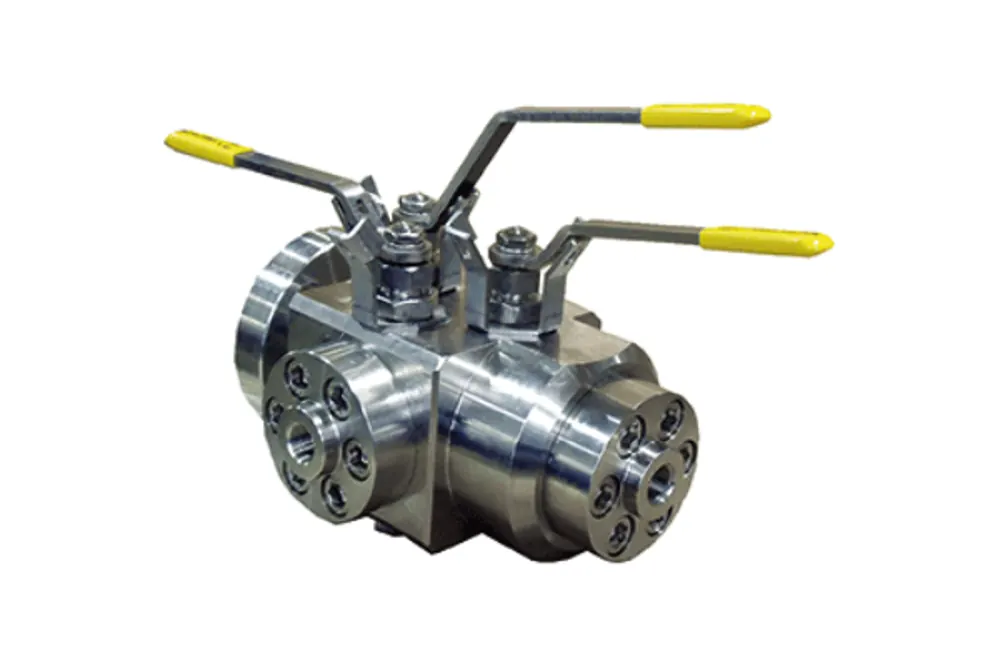
A gauge root valve is a small-bore primary isolation valve fitted right at the process root, the tapping point on the line, and its job is to shut off flow to a pressure gauge, transmitter, switch or other instrument. That way the instrument can be zero-checked, calibrated, serviced or pulled without depressurizing the process. Crestflo builds these valves from 1/16" up to 1" in 316/316L stainless, plus a full range of exotic alloys. Ends come in NPT, socket-weld, butt-weld, flanged or tube-fitting configurations, isolation is available in needle or hard-seat form, and every part carries a heat/lot number. EN 10204 MTC 3.1 certification comes standard.
Standard items ship from ready stock. Specials are made to order, with delivery running 6-8 weeks.
To keep the scope clear: on this page, gauge root valve means an instrumentation isolation valve at the process root that blocks a gauge or instrument, not a pressure-measuring gauge itself, and not a plumbing or gauge-glass cock.
Engineers also call this component a root valve, a gauge valve, a gauge isolation valve, a pressure gauge root valve, an instrument root valve, a gauge shut-off valve, or a primary isolation valve. Its older name is gauge cock. Ordering depends on a few things. The internal element determines whether it's specified as a gauge root needle valve or a gauge root ball valve. Flow path sets the pattern: straight (in-line) or angle (90°). Mounting matters too. It can be panel-mounted as a root valve, or, when an integral vent is needed, supplied as a two-valve gauge root manifold that gives block-and-bleed at the tap.
What Is a Gauge Root Valve & How Does It Work?
A gauge root valve does its job by driving a hand-operated stem, either a taper-ground needle or a hard metal seat element, into a matching seat. That blocks the small annular flow path between the process and the instrument. Open the valve and process pressure reaches the gauge, giving a live reading. Close it and the instrument gets isolated at metal-to-metal shut-off, so the gauge can be vented, re-zeroed, or swapped out while the line keeps running. The valve sits first in the hook-up, closest to the process, which makes it the primary isolation point, the root, ahead of any snubber, syphon, or the gauge itself.
The same body that isolates also protects. Throttling the root valve slightly on start-up damps the pressure surge that would otherwise slam a sensitive gauge. It's this combination of positive isolation and gentle commissioning control that makes the gauge root valve, not a quarter-turn cock, the standard first component in an instrument hook-up.
Gauge Root Valve vs Needle Valve: Application vs Valve Type
People often use "gauge root valve" and "needle valve" interchangeably, but they don't name the same thing. A gauge root valve describes an application: it's the primary isolation point mounted at the root of an instrument. Needle valve, by contrast, describes a type of valve, one that throttles flow finely through a tapered stem. Most gauge root valves happen to be built as needle valves, just specified by their isolation role rather than their mechanism. Others use a hard-seat or ball element instead. Pick the valve based on what it needs to do, not what it's called.
| Aspect | Gauge root valve | Needle valve |
|---|---|---|
| Primary role | Isolation (block) at the instrument root | Fine throttling / metering |
| Typical element | Needle, hard-seat or ball | Tapered needle stem |
| Mounting | At the process tap, close-coupled to the gauge | Anywhere in the line |
| What it names | The application | The valve type |
| Overlap | Often built as a needle valve | Often used as a root valve |
See the needle valve for throttling work, where stem and seat detail carries the weight. For on/off duty away from the root, turn to the instrumentation ball valve.
Gauge Root Valve Types: Needle, Ball, Hard-Seat, Straight, Angle & Panel-Mount
Gauge root valves get set up based on three things: internal element, flow path, and mounting. Which pattern you use comes down to how the valve sits at the tap, and whether it needs venting on the same body.
| Configuration | Description | Typical use | Availability |
|---|---|---|---|
| Gauge root needle valve | Tapered needle stem into a conical seat | Isolation plus start-up throttling to a gauge | Standard |
| Gauge root ball valve | Quarter-turn ball element | Fast full-bore isolation where throttling is not needed | Made-to-order |
| Hard-seat (metal-to-metal) | Integral hard seat for durable shut-off | High-cycle and higher-temperature isolation | Standard |
| Straight / in-line | Inlet and outlet on one axis | In-line taps on a straight run | Standard |
| Angle / right-angle (90°) | Flow turns 90° through the body | Corner take-offs and compact gauge roots | Standard |
| Panel-mount | Body with a mounting collar | Front-of-panel gauge isolation | Made-to-order |
| Two-valve gauge root manifold | Root block plus integral bleed/vent | Block-and-bleed at the gauge tap | Made-to-order |
Both bar-stock and forged bodies are available. When a hook-up needs isolation and venting combined on a single assembly, step up to Crestflo's two-valve gauge manifold (block-and-bleed). Need a dedicated downstream vent instead? Add a bleed valve. Every configuration can be built to spec.
Gauge Root Valve End Connections: NPT, Socket-Weld, Butt-Weld, Flanged & Tube
A gauge root valve usually has a male process end and a female instrument end, though female-to-female and male-to-male versions exist for whatever the tap and gauge call for. End connections come threaded, welded, flanged, or as tube fittings. Thread and flange dimensions follow the applicable standard, and they can be customized as needed.
| End connection | Standard | Notes |
|---|---|---|
| NPT (male × female) | ASME B1.20.1 | Most common gauge-root pattern; MxF, FxF or MxM |
| BSPP / BSPT | ISO 7 / ISO 228 | Parallel or tapered pipe threads |
| Socket-weld | ASME B16.11 | Welded process end for permanent, leak-tight roots |
| Butt-weld | ASME B16.25 | High-integrity welded connection |
| Flanged | ASME B16.5 | Flanged root on larger or code-piping taps |
| Tube-fitting / compression | Crestflo compression ends | Direct tube take-off with hardened or non-hardened ferrules |
If you need a drop-in replacement for an existing installation, request your Swagelok®, Parker® or Hy-Lok® cross-reference. Just specify the size, the ends and the material.
Gauge Root Valve Sizes (1/16″–1″), Pressure & Temperature Ratings
Gauge root valves come in sizes from 1/16" to 1", available in imperial fractional or metric ends. 1/4", 1/2" and 3/4" are the common gauge-root sizes. As isolation devices they operate at low flow coefficient. The design intent is positive shut-off, not flow capacity. Standard 1/2" 316 stainless designs are commonly rated to 6,000 psi (414 bar) cold working pressure. Hard-seat high-pressure builds go up to 10,000 psi (689 bar). These figures represent the usual industry design ranges. Pressure-temperature ratings follow the applicable valve design standard and can be adjusted to requirement.
| Nominal size | Common ends | Cold working pressure (316 SS, typical) | Seat |
|---|---|---|---|
| 1/4" · 6 mm | NPT MxF, socket-weld | to 6,000 psi (414 bar) | Needle / hard-seat |
| 1/2" · 12 mm | NPT MxF, flanged, socket-weld | to 6,000 psi (414 bar); to 10,000 psi hard-seat | Needle / hard-seat |
| 3/4" · 18 mm | NPT, flanged | to 6,000 psi (414 bar) | Needle / hard-seat |
The seat and packing seal set the maximum service temperature, not the body alloy. Below are the commonly published continuous-service limits for each seal material. Crestflo supplies the packing that best matches the service, and it can be tailored to your requirements.
| Packing / seal | Typical continuous-service temperature (published seal limits) |
|---|---|
| PTFE | –65°F to +450°F (–54°C to +232°C) |
| Reinforced PTFE (RPTFE) | up to approx. +500°F (+260°C) |
| PEEK | up to approx. +550°F (+288°C) |
| Flexible graphite (Grafoil-type) | up to approx. +1,000°F (+538°C) |
Metal-to-metal hard seats push the upper temperature range well past what a soft seat can handle. Check the RFQ for the certified CWP and temperature specific to your size, material and seat type.
Gauge Root Valve Materials: 316 Stainless, Duplex, Monel & Hastelloy C-276
Bodies and stems come from bar stock machined to ASTM A479/A276, covering stainless, duplex, super-austenitic and nickel alloys, brass isn't used. Each grade links to its own material page. The valve ships in instrumentation form only; it isn't available as bar, sheet or mill product.
| Family | Grade (UNS) | When to choose |
|---|---|---|
| Stainless | 316/316L (S31600/S31603), 904L (N08904) | General gauge and instrument isolation; 904L for higher chloride resistance |
| Duplex / super-austenitic | Duplex 2205 (S32205), Super Duplex 2507 (S32750), 254 SMO (S31254), Alloy 20 (N08020) | High-chloride, offshore and acid service needing strength plus pitting resistance |
| Nickel | Monel 400 (N04400), Inconel 625 (N06625), Inconel 825 (N08825), Hastelloy C-276 (N10276) | Sour, halide and aggressive-chemical service; hydrofluoric, seawater and reducing acids |
| Titanium | Titanium Gr2 (R50400) | Seawater and oxidising-chloride service where weight and corrosion both matter |
Finishes run the gamut: material finish, electropolish, passivation, silver anti-galling plating and oxygen-clean preparation. All of it can be tailored to spec. For the full lineup, browse alloy options for gauge root valves from Crestflo.
Standards, NACE Compliance & Traceability
Crestflo holds ISO 9001, ISO 14001, ISO 45001 and PED certification. Gauge root valves meet the standard approvals that apply to instrumentation valves: ASME B16.34 sets the design and pressure-temperature basis, ASME B1.20.1 governs NPT threads, and ASTM A479 / A276 cover bar stock. For sour service, material options are supplied to NACE MR0175 / ISO 15156.
Every valve carries a heat/lot number marked on the part and ships as standard with an EN 10204 MTC 3.1 certificate. MTC 3.2 with third-party endorsement is available on request. We hold certificates in our quality system; on content pages, we state conformance and don't list certificate numbers.
Testing & Quality Assurance
Every valve goes through hydraulic proof, burst and impulse testing, pneumatic testing, and seat and shell leak checks, backed by positive material identification (PMI) to confirm the alloy. Non-destructive testing happens in-house. Destructive testing gets sent out to laboratories accredited to ISO/IEC 17025, and pressure testing follows the applicable API standards (API 598 / API 602) along with BS EN 12266-1. Third-party inspection can be arranged on request. That testing regime is what backs the drop-in interchange claim: the valve earns its qualification to ASME B16.34 and the applicable API standards through test results, not a line in a catalog.
Gauge Root Valve Applications, Hook-Ups & Industries
The gauge root valve is the first component in a pressure-instrument hook-up: root valve, then an optional pressure snubber or syphon / pigtail, then the gauge, with a gauge saver or other gauge accessories where over-range or pulsation protection is required. Its job is to isolate the instrument for zero-checking, calibration and replacement, and, in a two-valve version, to vent trapped pressure before the gauge is removed.
Out in the field, these Crestflo valves show up everywhere: oil and gas upstream, midstream and refining plants, petrochemical and chemical operations, power generation and nuclear hook-ups, and oil and gas production. Any spot where a gauge or transmitter taps off a live line needs isolation with full material traceability, PED compliance included. It's the same approach for gauge root valve replacement and retrofit: match the size, the ends, the material, and drop it in.
Why Buy Crestflo Gauge Root Valves
Crestflo is the instrumentation arm of a Government-of-India-recognized export house with four decades behind it and a proven track record delivering across the Middle East. That heritage now sits behind a focused new manufacturing brand. For US buyers, the offer is simple:
- Drop-in fit, no redesign. Gauge and root valves from Swagelok, Parker, Hoke and Hy-Lok interchange dimensionally with Crestflo's line. Request a part-number cross-reference rather than re-engineering the hook-up yourself.
- Faster than the majors. Standard items ship from ready stock, and specials get made to order, with delivery running 6-8 weeks. That's a sharp contrast to the 20-week-plus lead times typical of the big suppliers.
- Alloys, covered. The range runs from 316 through Monel, Hastelloy, Duplex and Titanium, all machined in-house on CNC, VMC and EDM equipment.
- Small MOQ and private-label programs for OEMs and distributors, with kitting to print.
- ISO 9001 / 14001 / 45001 and PED certified, MTC 3.1 and heat-number traceability on every valve.
Indian-origin material comes standard, though US or European melt is available on request, complete with full material traceability, for TAA/DFARS-driven projects. See country of origin & compliance for details from Crestflo.
Confidence is what we build. Request a quote, request a sample, or become a Crestflo distributor whenever you're ready. Our US sales team is reachable at sales@crestflousa.com, by phone at +1 346 594 9005, or in person in Houston, TX.
Gauge Root Valve FAQs
What is a gauge root valve?
A gauge root valve sits at the process root, the tapping point on the line, and acts as the primary isolation valve there. Its job is simple: shut off flow to a pressure gauge or instrument so the device can be calibrated, serviced, or pulled without depressurizing the process. In an instrument hook-up, it's the first isolation point, the one closest to the process itself.
What is the purpose of a gauge valve?
One job: isolate and protect the instrument. Process pressure gets blocked right at the gauge, so you can safely zero-check it, replace it, or vent it. In a two-valve version, it goes further still, bleeding off trapped pressure before the gauge comes out. On start-up, a slight throttle takes the edge off the pressure surge, sparing a sensitive gauge from the shock it'd otherwise take.
What is the difference between a gauge root valve and a needle valve?
"Gauge root valve" describes the application: root-mounted instrument isolation. "Needle valve" describes a valve type, one built for fine throttling through a tapered stem. Many gauge root valves happen to be needle valves specified for isolation duty. Others use a hard-seat or ball element instead. For stem and seat detail, see our needle valve page.
What type of valve is a gauge valve?
Typically a small-bore, bar-stock hand valve of needle- or hard-seat design, rated for instrument isolation. "Gauge cock" is the legacy name for the same device. Ball-element and panel-mount versions are also supplied.
What sizes and end connections are available?
Sizes run from 1/16" to 1", with 1/4", 1/2" and 3/4" the most common, in either imperial or metric. End options include NPT (per ASME B1.20.1), BSPP/BSPT, socket-weld, butt-weld, flanged, or tube-fitting/compression styles. Most units pair a male process end with a female instrument end; FxF and MxM configurations exist too.
What pressure can a gauge root valve handle?
A standard 1/2" 316 stainless design is typically rated for 6,000 psi (414 bar) cold working pressure. Hard-seat, high-pressure builds go further, up to 10,000 psi (689 bar). Ratings follow the applicable valve design standard, ASME B16.34, and they're customizable. Confirm the certified CWP for your size and material on the RFQ.
What materials are available?
316/316L and 904L stainless make up the base offering, alongside Duplex 2205, Super Duplex 2507, 254 SMO and Alloy 20. For higher-performance needs, there's Monel 400, Inconel 625/825 and Hastelloy C-276, plus Titanium Gr2. No brass. Bodies and stems are machined from ASTM A479/A276 bar stock.
Are gauge root valves NACE-compliant for sour service?
Yes. NACE MR0175 / ISO 15156-compliant material options are available for sour and H2S service, and each one ships with the matching material traceability.
Do you provide material certificates?
Every valve leaves the factory with an EN 10204 MTC 3.1 certificate as standard; a 3.2 is available on request. Each part carries a heat/lot number stamped on it. Crestflo manufactures under ISO 9001, ISO 14001, ISO 45001 and PED certification.
Can Crestflo supply drop-in replacements for other brands?
Yes. We engineer the valves for dimensional interchange with Swagelok®, Parker®, Hoke® and Hy-Lok® gauge and root valves, and each one is tested and qualified to ASME B16.34 and the applicable API standards. Those names remain trademarks of their respective owners; our parts are interchange/equivalent, not "compatible/intermix." Ask our engineering team for your part-number cross-reference.
Where are they made and are they TAA-eligible?
Our standard product comes from India. If you need domestic-melt or TAA compliance, we can supply US or European melt on request, and full material traceability comes with it either way. Details on origin and how we handle TAA/DFARS requirements are laid out on our country of origin and compliance page.
What is the lead time and how do I order?
Ready stock covers standard items; specials are made to order, with a 6-8 week delivery window. Pricing runs by quotation only, and there's no online cart. Send an RFQ or sample request with size, ends, material and pressure rating, and our engineering team will get back to you with a quote and lead time.
Related Pages
- All instrumentation valves
- For straightforward on/off control, Crestflo offers a needle valve and an instrumentation ball valve.
- Isolating a pressure gauge is where a two-valve gauge manifold (block-and-bleed) earns its keep, usually paired with a bleed valve.
- Round things out with gauge savers, snubbers, and syphons.
- Material questions come up constantly. Start with alloy options for gauge root valves, then check the ASME B16.34 valve design basis and, for sour environments, NACE MR0175 sour service requirements.
- When corrosion resistance is non-negotiable, gauge root valves in Monel 400 are a common choice; for tougher sour or acidic conditions, Hastelloy C-276 is the go-to. Hastelloy handles what Monel 400 can't.
- Instrumentation valves supplier, Texas