
3-Way Instrumentation Ball Valves (L-Port & T-Port)
A 3-way instrumentation ball valve is a quarter-turn, multiport valve whose drilled ball, bored in an L-pattern or a T-pattern, switches, diverts, mixes or selects flow between three ports in a small-bore fluid, sampling or hydraulic system. Crestflo manufactures these valves from 1/16" to 1" in 316/316L stainless through high-nickel and titanium alloys, with threaded or tube-fitting ends, a heat/lot number marked on every part, and EN 10204 MTC 3.1 certification as standard. Every valve is offered on a ready-stock-for-standard-items or made-to-order basis and delivered in 6–8 weeks, engineered as a drop-in replacement for the majors.
To keep the scope clear: on this page, 3-way ball valve means an instrumentation multiport ball valve for small-bore process, analytical and hydraulic systems, not a plumbing, PVC, irrigation or HVAC diverter valve.
Also Known As: 3-Way Selector, Switching, Diverter & Multiport Ball Valve
This valve is also specified as a three-way ball valve, a 3-way instrument ball valve, a multiport ball valve, and, by its function, a 3-way selector valve, a 3-way switching valve, a 3-way diverter valve or a 3-way sampling valve. Specifiers call out the ball bore (L-port or T-port, sometimes written L-flow or T-flow), the port size (full-port or standard-port), and the size, end connection and alloy when placing an order. L-port and T-port variants each have their own dedicated pages, the L-port ball valve and the T-port ball valve, which this page summarizes and links.
How a 3-Way Ball Valve Works: 2-Way vs 3-Way
The working principle of a 3-way ball valve is straightforward: it works by rotating a ball that is drilled through with two intersecting bores rather than a single straight one. As the handle turns, those bores line up with different combinations of the three body ports, so a single quarter-turn (L-port) or up-to-180° movement (T-port) re-routes flow without adding a second valve. The difference from a 2-way ball valve is structural: a 2-way valve has one straight bore and simply opens or closes a single path between two ports, whereas a 3-way valve carries a shaped bore across three ports to switch, divert or combine streams.
That single-body multiport design is what makes the 3-way valve the compact choice for sampling take-offs, instrument-selector duty and flow diversion where panel space and connection count matter.
L-Port vs T-Port Flow Patterns: Switching, Diverting & Mixing
The bore geometry sets what the valve can do. An L-port ball connects the common port to one of the two side ports at a time and can shut off between positions, making it a two-way switching or selector valve. A T-port ball connects the common port to one or both side ports, letting it divert, distribute or mix between the two outlets. The table below maps handle position to the ports that are open for each pattern.
| Ball bore | Handle position | Ports connected | Typical function |
|---|---|---|---|
| L-port | 0° | Common ↔ Port A | Switch flow to A |
| L-port | 90° | Common ↔ Port B | Switch flow to B |
| L-port | between positions | none (isolated) | Shut off / select |
| T-port | 0° | Common ↔ Port A | Divert to A |
| T-port | 90° | Common ↔ Port B | Divert to B |
| T-port | 180° / mid | Common ↔ A + B | Mix / distribute to both |
The flow-pattern diagram below shows how each bore routes the common port (C) as the handle turns:
``` L-PORT (switching / selecting) T-PORT (diverting / mixing)
A B A B │ │ │ │ └──┐ ┌──┘ └──┐ ┌──┘ └─┘ ball bore = ⌐ (90° elbow) └┬┘ ball bore = ┬ (tee) │ │ C (C→A or C→B, off between) C (C→A, C→B, or C→A+B) ```
Because the L-port switches and the T-port diverts or mixes, the two are not interchangeable in a circuit, choose by flow function first, then size and material. Both patterns are covered in depth on the L-port switching ball valve and T-port diverter ball valve pages.
3-Way Ball Valve Sizes (1/16″–1″) & End Connections: NPT & Tube
3-way instrumentation ball valves are supplied from 1/16" to 1" in both imperial fractional and metric sizes, in full-port or standard-port bore. End connections are either threaded, NPT to ASME B1.20.1, or BSPP/BSPT parallel and tapered, or tube-fitting / compression ends. Thread and OD dimensions follow the applicable standard and are customizable to requirement. Where an application calls for them, SAE straight-thread (O-ring boss) port ends or flanged connections can be supplied to requirement, confirm the full end-connection menu for your size on the RFQ.
| Size (imperial / metric) | NPT (B1.20.1) | BSPP / BSPT | Tube / compression end | Port option |
|---|---|---|---|---|
| 1/16", 1/8", 1/4" · 3–6 mm | ✓ | ✓ | ✓ | Full / standard |
| 3/8", 1/2" · 8–12 mm | ✓ | ✓ | ✓ | Full / standard |
| 3/4", 1" · 18–25 mm | ✓ | ✓ | ✓ | Full / standard |
Tube-end valves accept hardened or non-hardened ferrules to requirement. For a drop-in replacement on an existing installation, request your Swagelok®, Parker® or Hoke® cross-reference and specify the size, ends, bore pattern and material.
3-Way Ball Valve Materials: 316 Stainless, Duplex, Monel & Hastelloy C-276
Bodies, balls and stems are machined from bar stock to ASTM A479/A276 in stainless, duplex, super-austenitic and nickel alloys, no brass. Each grade below links to its material page; the valve is offered in instrumentation form only, not as bar, sheet or mill product.
| Family | Grade (UNS) | Typical driver |
|---|---|---|
| Stainless | 316/316L (S31600/S31603), 904L (N08904) | General instrument and sampling service; 904L for higher chloride resistance |
| Duplex / super-austenitic | Duplex 2205 (S32205), Super Duplex 2507 (S32750), 254 SMO (S31254), Alloy 20 (N08020) | High-chloride, offshore and acid service needing strength plus pitting resistance |
| Nickel | Monel 400 (N04400), Inconel 625 (N06625), Inconel 825 (N08825), Hastelloy C-276 (N10276) | Sour, halide and aggressive-chemical service; reducing acids and seawater |
| Titanium | Titanium Gr2 (R50400) | Seawater and oxidising-chloride service where weight and corrosion both matter |
Sour-service material options are supplied to NACE MR0175 / ISO 15156. Finishes include material finish, electropolish, passivation, silver anti-galling plating and oxygen-clean preparation, customizable to requirement. Browse all instrumentation valve materials.
High-Pressure 3-Way Ball Valve Ratings & Temperature Limits
Standard bar-stock instrumentation ball valves are commonly rated up to 6,000 psi (414 bar) cold working pressure, with the certified rating set by size, bore and seat; these are the usual industry design ranges, with pressure–temperature ratings per the applicable valve design standard and customizable to requirement. Maximum service temperature is governed by the seat and seal material, not the body alloy. The values below are the commonly published continuous-service limits for each seat material; Crestflo supplies the seat best matched to your service.
| Seat / seal material | Typical continuous-service temperature (published seat limits) |
|---|---|
| PTFE | –65°F to +450°F (–54°C to +232°C) |
| Reinforced PTFE (RPTFE) | up to approx. +500°F (+260°C) |
| PEEK | up to approx. +550°F (+288°C) |
Pressure–temperature basis follows ASME B16.34. Buyers who need higher cold working pressure should see the CWP ball valve; to confirm the certified CWP for a specific size, bore and seat, submit an RFQ with your service conditions.
3-Way Ball Valve Configurations & Options: Panel-Mount, Locking & Actuated
Beyond the L-port / T-port bore choice, 3-way ball valves are configured to suit the panel and duty. Available options include panel-mount and bulkhead bodies for front-of-panel access, a locking / lockable handle for position security, 3-piece bolted and forged-body or bar-stock construction, a fire-safe build to requirement, full-port or standard-port bore, and pneumatic-actuated operation where remote or automated switching is required. Seat materials (PTFE, reinforced PTFE, PEEK) and vent/relief-ported balls are selected to service, and all configurations are customizable to requirement.
Standards, Certifications & Traceability
Crestflo is ISO 9001, ISO 14001, ISO 45001 and PED certified. 3-way ball valves conform to the standard approvals applicable to instrumentation valves: ASME B16.34 for design and pressure–temperature basis, the applicable API valve testing standards (API 598 / API 6D) for shell and seat testing, ASME B1.20.1 for NPT threads, and ASTM A479 / A276 for bar stock. Sour-service material options are supplied to NACE MR0175 / ISO 15156, and fugitive-emission testing to ISO 15848 is available where specified.
Every valve carries a heat/lot number marked on the part and ships with an EN 10204 MTC 3.1 certificate as standard; MTC 3.2 with third-party endorsement is available on request. Certificates are held in our quality system; content pages state conformance rather than certificate numbers.
Testing & Quality Assurance
Valves are subject to hydraulic proof, burst and impulse testing, pneumatic testing, and seat and shell leak testing, with positive material identification (PMI) to confirm alloy. Non-destructive testing is performed in-house; destructive testing is outsourced to ISO/IEC 17025-accredited laboratories, and valve pressure testing follows the applicable API/EN test standard. Third-party inspection is available on request. This regime backs the drop-in interchange claim: the valve is qualified by test, not by catalog assertion.
3-Way Ball Valve Applications & Industries
3-way instrumentation ball valves serve analytical sampling take-off and stream selection, flow switching and diverting, instrument-air routing, hydraulic control, and oxygen-clean service. In the field they appear across oil and gas, petrochemical and chemical plants, analytical sampling systems, instrument-air and hydraulic systems, wherever a small-bore line must switch, divert or sample with full material traceability.
3-Way Ball Valve vs 3-Valve Manifold
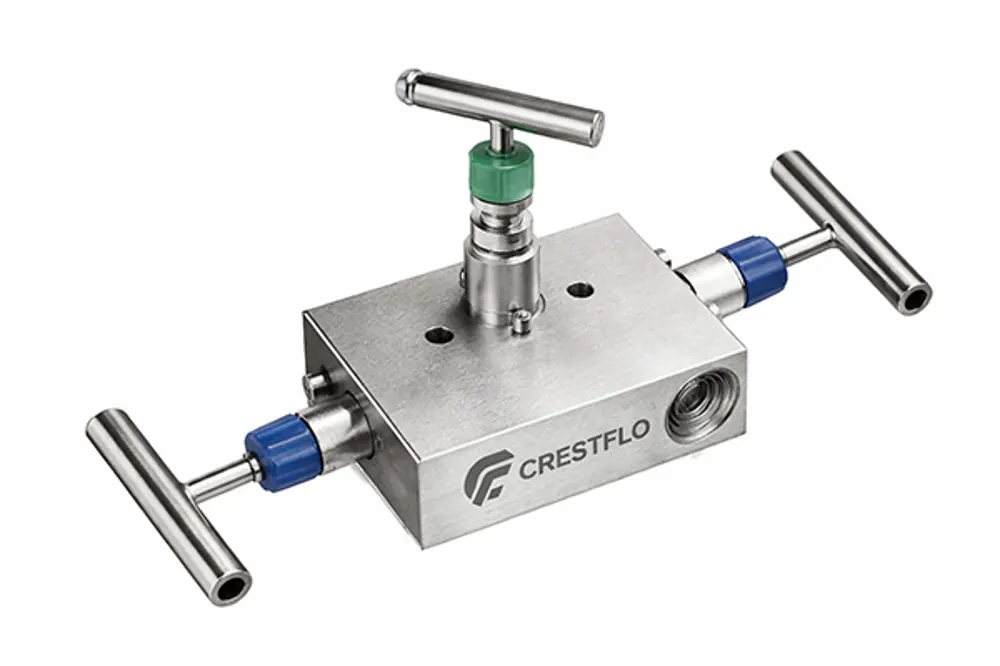
A 3-way ball valve is a single multiport valve with a drilled ball; it is not the same as a 3-valve manifold, which combines two block valves and an equalizing valve in one body for differential-pressure transmitter hook-ups. If the requirement is to isolate and equalize a DP instrument, the manifold is the correct product; if it is to switch, divert or sample a single stream across three ports, the 3-way ball valve is.
Why Buy Crestflo 3-Way Ball Valves
Crestflo is the instrumentation division of a four-decade-old, Government-of-India-recognized export house with a proven Middle-East delivery record, established heritage behind a focused new manufacturing brand. For US buyers that translates into a clear offer:
- Drop-in dimensional interchange for Swagelok®, Parker®, Hoke® and Hy-Lok® 3-way ball valves, request your part-number cross-reference rather than re-engineering the panel.
- Ready stock for standard items · made-to-order for specials · 6–8 week delivery, measured against the 20-week-plus lead times typical of the majors.
- Full alloy breadth, 316 through Monel, Hastelloy, Duplex and Titanium, machined in-house on CNC, VMC and EDM equipment, in imperial and metric.
- Small MOQ and private-label programs for OEMs and distributors, with kitting to print.
- ISO 9001 / 14001 / 45001 and PED certified, MTC 3.1 and heat-number traceability on every valve.
- Indian origin; US or European melt available on request, with full material traceability for TAA/DFARS-driven projects.
We Engineer Confidence, request a quote, request a sample, or become a distributor. US sales: sales@crestflousa.com · +1 346 594 9005 · Houston, TX.
3-Way Ball Valve FAQs
How does a 3-way ball valve work?
A quarter-turn (L-port) or up-to-180° (T-port) rotation turns a drilled ball so its bore aligns with different combinations of the three ports, switching, diverting or mixing flow. The ball carries two intersecting bores rather than the single straight bore of a 2-way valve, which is what lets one valve body serve three ports.
What is the difference between an L-port and a T-port 3-way ball valve?
An L-port connects the common port to one of two side ports at a time and can shut flow off between positions, so it switches or selects. A T-port connects the common port to one or both side ports, so it diverts, distributes or mixes. Choose L-port for switching and T-port for diverting or combining streams.
What is another name for a three-way ball valve?
It is also called a 3-way selector valve, a 3-way switching valve, a 3-way diverter valve, a 3-way sampling valve or, generically, a multiport ball valve. The bore is described as L-port (L-flow) or T-port (T-flow).
How is a 3-way ball valve different from a 2-way ball valve?
A 2-way ball valve has one straight bore and simply opens or closes a single flow path between two ports. A 3-way valve has three ports and a shaped ball bore that routes flow among them, so it can switch, divert or mix rather than only start and stop flow.
What sizes and end connections are available?
Sizes run from 1/16" to 1" in imperial or metric, with NPT (per ASME B1.20.1), BSPP or BSPT threaded ends, or tube-fitting / compression ends, in full-port or standard-port bore. Tube ends accept hardened or non-hardened ferrules to requirement.
Which materials can I get a 3-way ball valve in?
316/316L as standard, plus 904L; Duplex 2205, Super Duplex 2507, 254 SMO and Alloy 20; Monel 400, Inconel 625/825 and Hastelloy C-276; and Titanium Gr2. Brass is not offered. Bodies, balls and stems are machined from ASTM A479/A276 bar stock.
Is a 3-way ball valve available for sour (NACE) service?
Yes, NACE MR0175 / ISO 15156-compliant material options are available for sour and H2S service, supplied with the corresponding material traceability.
What is the pressure rating of a 3-way ball valve?
Standard bar-stock instrumentation ball valves are commonly rated to 6,000 psi (414 bar) cold working pressure, with the exact rating set by size, bore and seat. Ratings follow ASME B16.34 and are customizable, confirm the certified CWP for your size and material on the RFQ, and see the CWP ball valve page for higher-pressure needs.
Can this replace a Swagelok or Parker 3-way ball valve?
Yes, the valves are engineered for dimensional interchange with those brands and qualified by test to ASME B16.34 and the applicable API standards. Swagelok®, Parker® and Hoke® are trademarks of their respective owners; parts are interchange/equivalent, not "compatible/intermix." Request your part-number cross-reference from our engineering team.
What traceability comes with each valve?
Each valve ships with an EN 10204 MTC 3.1 certificate as standard (3.2 on request) and carries a heat/lot number marked on the part. Crestflo manufactures under ISO 9001, ISO 14001, ISO 45001 and PED certification.
What is the lead time and minimum order?
Ready stock for standard items, made-to-order for specials, with 6–8 week delivery. Small MOQ and private-label options are available. Standard product is of Indian origin, with US or European melt available on request where domestic-melt or TAA compliance is required.
Is this an instrumentation or a plumbing 3-way valve?
Instrumentation only, a multiport ball valve for small-bore process, analytical and hydraulic systems. These are not plumbing, PVC, irrigation or HVAC diverter valves.