
Inconel 825 / Incoloy 825 (Alloy 825 / UNS N08825): Instrumentation Fittings, Valves & Tubing
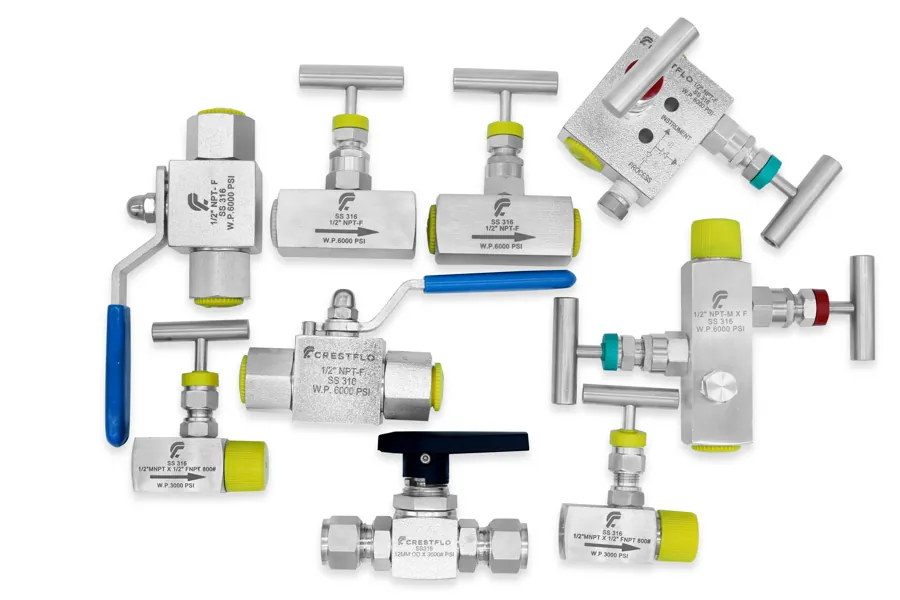
Inconel 825 is a titanium-stabilized nickel-iron-chromium alloy, UNS N08825, built to stand up to sulfuric and phosphoric acids, chloride stress-corrosion cracking, and sour (H₂S) service. Here, "Inconel 825" refers to Alloy 825 as a material of construction for instrumentation fittings, valves, and tubing. Not pipe, plate, or bar mill products. It's a distinct grade from Inconel 625, 718, and Incoloy 800, each its own separate specification.
Crestflo builds instrumentation components from high-nickel, corrosion-resistant alloys, Alloy 825 among them. On this page you'll find the metallurgy laid out for the taking: composition, mechanical and physical properties, how the material holds up against different corrosive media, and whether it's fit for sour service. From there, you're pointed to the actual instrumentation forms Crestflo supplies, with an RFQ ready for whatever your specific requirement calls for.
Inconel 825 at a Glance: What Alloy 825 Is, and Whether It Is Really "Inconel"
Alloy 825 is a wrought nickel-iron-chromium alloy. It gets its strength from solid-solution strengthening, not age hardening; it simply doesn't harden that way. Roughly 40% of the composition is nickel, backed by 3% molybdenum and 2% copper, and that combination gives the alloy solid resistance to reducing acids, sulfuric and phosphoric especially. Chromium takes care of the rest, at about 21%: it fights oxidizing media, pitting, and crevice attack. A deliberate titanium addition rounds things out, stabilizing the alloy against intergranular corrosion after welding.
Naming causes more confusion here than anything else: Inconel 825 is, strictly speaking, a misnomer. The correct trade name is Incoloy® 825. That's because 825 is a nickel-iron-chromium alloy, not one of the nickel-chromium grades that actually carry the Inconel name. INCOLOY® and INCONEL® are registered trademarks of Special Metals Corporation, and Crestflo has no affiliation with that company and isn't endorsed by it. On this page, "Alloy 825" refers to the generic UNS N08825 material, no matter which trade name a given specification happens to use.
Inconel 825 Designations & Equivalents: UNS N08825, Werkstoff 2.4858, NiCr21Mo
Alloy 825 goes by a number of names across different national and standards-body systems. Buyers and specifiers might know it as Incoloy 825, Inconel 825, Alloy 825, Nickel Alloy 825, or simply 825 nickel alloy. Metallurgists, on the other hand, tend to reference it by UNS number, by Werkstoff (W.Nr.), by its German DIN designation, or by the British standard. Different names, same material: a nickel-iron-chromium alloy prized for corrosion resistance.
| System | Designation |
|---|---|
| Common / trade | Incoloy 825, Incoloy® 825, Inconel 825 (misnomer), Alloy 825, Nickel Alloy 825 |
| UNS | N08825 |
| Werkstoff (W.Nr.) | 2.4858 |
| DIN | NiCr21Mo |
| Descriptive | NiFe30Cr21Mo3 |
| British Standard | BS NA16 |
| ASTM/ASME product-form specs | B163 / B423 (seamless tube), B424 (plate/sheet/strip), B425 (bar/rod), B564 (forgings), B366 (wrought fittings), B705 (welded pipe) |
All of these designations refer to one and the same material, UNS N08825. The values follow whichever standard applies, and they're adjustable to fit specific requirements.
Inconel 825 Chemical Composition (UNS N08825, wt%)
Alloy 825 starts from a nickel-iron base, alloyed with chromium, molybdenum, copper, and titanium. That combination of copper and molybdenum is what sets 825 apart from a plain Ni-Cr grade, and it's what gives the alloy its performance in sulfuric and phosphoric acid service. The table below lists the standard published limits for UNS N08825.
| Element | Min % | Max % |
|---|---|---|
| Nickel (Ni) | 38.0 | 46.0 |
| Iron (Fe) | 22.0 | balance |
| Chromium (Cr) | 19.5 | 23.5 |
| Molybdenum (Mo) | 2.5 | 3.5 |
| Copper (Cu) | 1.5 | 3.0 |
| Titanium (Ti) | 0.6 | 1.2 |
| Carbon (C) | — | 0.05 |
| Manganese (Mn) | — | 1.0 |
| Silicon (Si) | — | 0.5 |
| Sulfur (S) | — | 0.03 |
| Aluminum (Al) | — | 0.2 |
Composition follows UNS N08825 chemistry. Each lot's heat-specific values appear on the material test certificate, verified through positive material identification (PMI).
Inconel 825 Mechanical & Physical Properties (Solution-Annealed)
The values below are standard published properties for solution-annealed Alloy 825. Because 825 is not through-hardenable, its hardness stays in the annealed band; actual delivered properties depend on product form and condition and are confirmed on the certificate.
| Property | Value (metric) | Value (imperial) |
|---|---|---|
| Density | 8.14 g/cm³ | 0.294 lb/in³ |
| Melting range | 1370–1400 °C | 2500–2550 °F |
| Tensile strength (min, typical) | 586 MPa | 85 ksi |
| Yield strength (0.2% offset, min typical) | 241 MPa | 35 ksi |
| Elongation | 30% min | 30% min |
| Hardness | 75–90 HRB (annealed, non-hardenable) | 75–90 HRB |
| Modulus of elasticity | 193 GPa | 28 × 10⁶ psi |
| Coefficient of thermal expansion (20–100 °C) | 14.0 µm/m·°C | 7.8 µin/in·°F |
| Thermal conductivity (RT) | 11 W/m·K | 76 BTU·in/hr·ft²·°F |
| Electrical resistivity | 1.13 µΩ·m | 680 Ω·circ-mil/ft |
| Maximum continuous service (mechanical) | ~540 °C | ~1000 °F |
Values per applicable standard; adjustable to whatever the requirement calls for. Alloy 825 comes solution-annealed and won't age-harden, so heat treatment doesn't do anything to strengthen it.
Inconel 825 Corrosion Resistance by Media: Sulfuric Acid, Chlorides, Sour Service & PREN
Does Inconel 825 rust? No. Alloy 825 is built for corrosion resistance, not carbon steel's kind of vulnerability. Chromium, molybdenum, and copper in the alloy form a passive film on the surface, and that film holds up against oxidation, a wide range of acids, and chloride attack. Rust simply isn't part of the picture the way it is with steel. The table below breaks down its behavior across different environments.
| Media / Environment | Alloy 825 behavior | Note |
|---|---|---|
| Sulfuric acid (H₂SO₄) | Excellent | Resists across a wide concentration/temperature range; the Cu+Mo signature strength |
| Phosphoric acid (H₃PO₄) | Excellent | Including hot commercial and wet-process acid |
| Chlorides / seawater | Very good | Resists pitting, crevice attack, and chloride stress-corrosion cracking |
| Sour service (H₂S) | Suitable | Acceptable under NACE MR0175 / ISO 15156 in the annealed condition |
| Reducing & mildly oxidizing acids | Good | Molybdenum and copper broaden the reducing-acid range |
| Nitric and other oxidizing acids | Good | Chromium supports moderate oxidizing service |
| Caustic / alkaline media | Good | Suitable for many alkaline streams |
| Intergranular attack after welding | Resistant | Titanium-stabilized against sensitization |
| Pitting resistance equivalent number (PREN) | ≈ 30–33 (calculated) | PREN = Cr + 3.3 × Mo; indicative value from mid-range chemistry, not a measured rating |
High nickel content is what drives chloride SCC resistance; for reducing acids, it's the molybdenum-copper pairing that does the job. When a service runs more aggressively oxidizing or carries halogens, look instead to Hastelloy C-276 for aggressive acids or Inconel 625 for oxidizing and sour service.
Inconel 825 Sour Service & NACE MR0175 / ISO 15156 Acceptability
Alloy 825 counts among the well-established corrosion-resistant alloys covered by NACE MR0175 / ISO 15156 for sour, H₂S-bearing oil-and-gas service, and it's accepted in the solution-annealed condition. Before specifying it, though, check the standard's material tables for your exact service conditions. That means confirming the certified hardness limits and any environmental restrictions on partial pressure, temperature, and chloride content, since this holds true for any CRA used in sour service.
Start with our NACE MR0175 sour-service requirements and ISO 15156 materials for sour service pages to review the standard itself. From there, the sour-service material selection guide is what you'll want for the decision logic that weighs 825 against 625, Duplex, and Hastelloy grades.
Inconel 825 Standards & Product-Form Specifications (ASTM/ASME B-Series)
Wrought Alloy 825 gets procured to the ASTM/ASME B-series specifications, sorted by product form. Across the industry, these serve as the reference specifications for the alloy. Crestflo's instrumentation components are made from material that meets the applicable form specification. Crestflo itself doesn't supply the mill forms.
| Product form | ASTM specification | ASME equivalent |
|---|---|---|
| Seamless tube | B163 / B423 | SB-163 / SB-423 |
| Welded pipe | B705 | SB-705 |
| Plate, sheet & strip | B424 | SB-424 |
| Bar & rod | B425 | SB-425 |
| Forgings | B564 | SB-564 |
| Wrought fittings | B366 | SB-366 |
Every Crestflo part carries a heat/lot number, backed by an EN 10204 3.1 material test certificate (MTC) as standard, with 3.2 available on request. Values follow the applicable standard, and we'll tailor them to your requirement.
Inconel 825 Weldability, Machining & Heat Treatment
Alloy 825 welds well with the common arc processes. The matching filler metal is ERNiFeCr-1 (AWS A5.14), and the alloy's titanium stabilization keeps sensitization in the weld heat-affected zone in check. Machining it feels much like machining other solid-solution nickel alloys. It work-hardens, so you need rigid setups, positive feeds, and sharp tooling to do it right. The alloy ships solution-annealed. It isn't age-hardenable, which means its mechanical properties come from the anneal and any cold work applied, not from a precipitation heat treatment.
When to Choose Inconel 825: and When to Specify Another Alloy
Alloy 825 is the right choice for sulfuric and phosphoric acid service. It also stands up to sour (H₂S) oil-and-gas duty. Chloride and seawater environments, where stress-corrosion cracking is the real threat, call for it too. Pickling and acid-handling lines are another good fit, and so are pollution-control streams such as FGD scrubbers.
Specify an alternative when:
- You need broader oxidizing-acid and high-temperature capability with higher strength → Inconel 625.
- You face aggressive reducing acids (hot hydrochloric, strong sulfuric) → Hastelloy C-276.
- You need high-temperature strength and oxidation rather than aqueous corrosion resistance → Incoloy 800/800H.
- The service is general stainless duty at lower cost → 316/316L or 904L.
| If you need… | Choose | Reference |
|---|---|---|
| Sulfuric/phosphoric acid & sour service | Inconel 825 | This page |
| Oxidizing acids, higher strength, high temperature | Inconel 625 | Inconel 625 · Inconel 625 vs 825 |
| Aggressive reducing acids | Hastelloy C-276 | Hastelloy C-276 · Hastelloy vs Inconel |
| High-temperature strength/oxidation | Incoloy 800 | Incoloy 800 |
| Reducing-acid service at lower nickel | Alloy 20 | Alloy 20 |
| General chloride/stainless service | 904L / 316L | 904L · 316/316L |
| Nickel-vs-nickel selection logic | Guided comparison | Inconel vs Monel · Monel 400 |
Available Inconel 825 Product Forms from Crestflo: Fittings, Valves & Tubing
Crestflo carries Alloy 825 in instrumentation forms only: compression/tube fittings, instrumentation valves, and instrumentation tubing. Pipe fittings, flanges, bar, sheet, plate, and other mill products in this alloy fall outside the US instrumentation scope, so they're not offered. Searching for 825 pipe fittings? The closest in-scope options are the tube and compression fittings below.
| Form | Size range | Ends / options | Product link |
|---|---|---|---|
| Compression / tube fittings | Up to 2″ (50 mm) OD | Single & double ferrule; hardened or non-hardened; NPT/BSPT/BSPP/ISO; imperial + metric | Alloy 825 tube fittings |
| Instrumentation valves | 1/16″ to 1″ | Needle, ball, check, manifold, DBB; threaded or tube-fitting ends | Alloy 825 instrumentation valves |
| Instrumentation tubing | Standard OD/wall per size chart | Seamless & welded | Alloy 825 instrumentation tubing |
We test compression tube fittings against ASTM F1387 fitting qualification, confirming dimensional and performance interchange with the major brands. Instrumentation valves are a different matter: they qualify to the valve standards that actually apply, ASME B16.34 and API, not F1387. That's a compression-tube-fitting standard, not a valve standard. Need a brand interchange? Request your Swagelok® or Parker® cross-reference from our engineering team. Standard items ship from ready stock; specials are made to order, with delivery running 6-8 weeks. Request an Alloy 825 quote for exact OD, wall, ends, and configuration. Datasheets and CAD go out to customers on request.
Inconel 825 Applications & Industries
Alloy 825 shows up in sour oil-and-gas wells, downhole and wellhead hardware, chemical-processing acid and pickling lines, phosphoric and sulfuric acid plants, pollution-control and flue-gas-desulfurization (FGD) scrubbers, marine and offshore seawater systems, and nuclear fuel reprocessing. Wherever reducing-acid and chloride corrosion are a concern, and sour-service acceptability matters, this is the material people reach for. In instrumentation terms, that means fittings, valves, and tubing on sour, acid, and seawater analyzer, sampling, and process lines.
Why Crestflo for Inconel 825 Instrumentation Components
Crestflo operates as the instrumentation division of an export house that's been in business for four decades and carries Government of India recognition. Its parent company has a proven track record delivering into the Middle East. That heritage sits behind a brand built specifically for instrumentation work. Here's what it means for you on Alloy 825:
- ASTM F1387-backed interchange on compression tube fittings. Dimensionally and functionally, it's a drop-in for the major brands.
- 6-8 week delivery. Ready stock for standard items, made-to-order for specials, and still faster than the 20+ weeks common at the majors. See our 6, 8-week lead time methodology and the alloy lead-time & post-tariff cost benchmark.
- Small MOQ + private label, see the private-label & OEM program.
- Heat-number traceability covers every part, backed by an EN 10204 3.1 MTC as standard, with the tighter 3.2 version available on request. PMI confirms it: the material is genuine N08825.
- NACE MR0175 / ISO 15156 material condition available for sour service, and both imperial and metric sizing.
- ISO 9001 / 14001 / 45001 & PED certified.
Origin, stated honestly: Indian origin. US and European melt is available on request, with full material traceability. Crestflo serves the US market and is engineered as a drop-in replacement for US applications. Houston, TX is our US sales-contact city (sales@crestflousa.com · +1 346 594 9005). We never claim "made in USA." Where domestic-melt or TAA compliance is required, US/European-melt options are available on request; see US origin & TAA compliance. We Engineer Confidence.
Inconel 825 FAQ
Is Inconel 825 the same as Incoloy 825?
Yes, both names point to the same alloy: UNS N08825. Incoloy® 825 is the technically correct trade name, a registered trademark held by Special Metals Corporation. Calling it Inconel 825 is a common mistake, though, since this is really a nickel-iron-chromium alloy, not a nickel-chromium grade in the true "Inconel" family. Whichever name a specification uses, the composition and properties don't change.
What is the chemical composition of Alloy 825?
Nickel runs 38–46% nominally, with iron making up 22% and the balance. Chromium sits at 19.5, 23.5%, molybdenum at 2.5, 3.5%, copper between 1.5 and 3.0%, and titanium from 0.6 to 1.2%. Carbon, manganese, silicon, sulfur, and aluminum all stay within the UNS N08825 limits. Exact figures vary by heat, and you'll find those on each material test certificate.
Does Inconel 825 rust?
Alloy 825 isn't carbon steel. It's a corrosion-resistant alloy. Chromium, molybdenum, and copper in its makeup form a passive film that stands up to oxidation, a wide range of acids, and chloride attack, so it won't rust the way steel does.
What is the difference between Inconel 625 and 825?
Inconel 625 is a higher-nickel nickel-chromium-molybdenum alloy, and it brings greater strength along with broader capability at high temperatures and in oxidizing corrosion. Alloy 825, by contrast, is a nickel-iron-chromium alloy built around copper and molybdenum, tuned for sulfuric and phosphoric acid exposure and sour service, at a lower cost. For the decision logic behind choosing between them, see the full Inconel 625 vs 825 comparison.
Is Inconel 825 better than Inconel 800?
These two alloys serve different purposes. Engineers pick Incoloy 800/800H for its strength at high temperatures and its resistance to oxidation. Alloy 825, by contrast, brings molybdenum and copper into the mix, giving it an edge in aqueous acid environments and sour-service corrosion. The real question comes down to this: is the governing risk heat, or is it wet corrosion? That's the deciding factor.
Is Alloy 825 suitable for sour (H₂S) service?
Yes. Alloy 825 falls under NACE MR0175 and ISO 15156, and it's acceptable for sour service in the solution-annealed condition. Before you rely on it, though, check the certified hardness and any environmental limits against the standard's material tables for your specific service.
What is the equivalent material of Incoloy 825?
Four different designations all point to the same alloy: UNS N08825, Werkstoff (W.Nr.) 2.4858, DIN NiCr21Mo, and BS NA16. Written out descriptively, it's NiFe30Cr21Mo3.
What ASTM standards cover Alloy 825 products?
Seamless tube falls under B163/B423. Plate, sheet, and strip follow B424; bar and rod, B425. Forgings are covered by B564, wrought fittings by B366, and welded pipe by B705. Crestflo builds its instrumentation components from material that meets whichever of these form specifications applies.
What instrumentation products does Crestflo make in Alloy 825?
The lineup covers compression tube fittings, single and double ferrule, sized up to 2″/50 mm OD and tested to ASTM F1387. Instrumentation valves too, ranging from 1/16″ up to 1″. Along with instrumentation tubing. Crestflo doesn't supply bar, plate, or pipe mill forms.
What is the lead time and MOQ for 825 instrumentation parts?
Standard items ship from stock we already have on hand. Specials get made to order, and those take 6-8 weeks, even on small MOQs. Private label is available too. Send us your sizes and quantities and we'll put together a quote.
What certifications and traceability come with Crestflo 825 parts?
Crestflo holds ISO 9001, 14001, and 45001 certification along with PED. Compression fittings meet ASTM F1387, and valves are qualified to ASME B16.34 / API. Every part gets heat-number marking, with an EN 10204 3.1 material test certificate included as standard; 3.2 is available on request, alongside PMI. For sour service, material condition can be supplied to NACE MR0175 / ISO 15156.
Where is Crestflo's Alloy 825 made, and can you ship to the US?
Crestflo serves the US market. Its material origin is Indian, though US and European melt is available on request, with full material traceability included. Standard items ship from stock on hand. Specials are made to order and take 6-8 weeks for delivery. Houston, Texas serves as our US sales-contact city. We don't claim our products are made in the USA.
Related Materials, Standards & Resources
- All instrumentation fitting materials
- Alloy 825 tube fittings · Alloy 825 instrumentation valves · Alloy 825 instrumentation tubing
- Inconel 625 · Incoloy 800 · Hastelloy C-276 · Monel 400 · Alloy 20 · 904L · 316/316L
- Inconel 625 vs 825 · Inconel vs Monel · Hastelloy vs Inconel · sour-service material selection
- NACE MR0175 sour-service requirements · ISO 15156 · ASTM F1387 fitting qualification · ASME B16.34 valve standard · EN 10204 3.1/3.2 certificates
- Brand cross-reference / interchange · Request an Alloy 825 quote