
CWP Ball Valves: Cold Working Pressure Rated Instrumentation Ball Valves
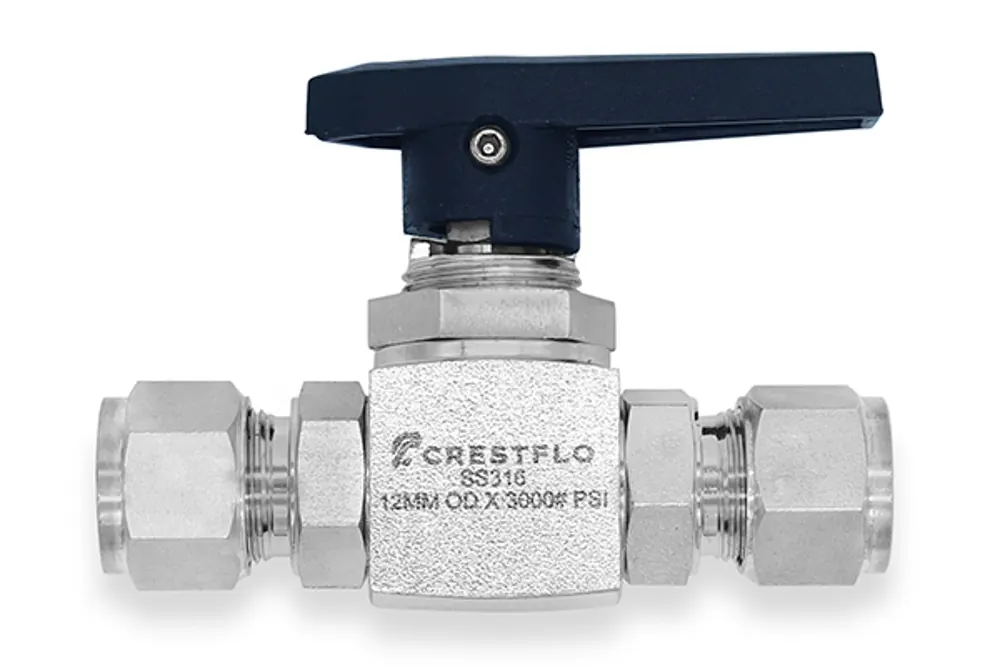
A CWP ball valve gets its name from its cold working pressure (CWP) rating: the maximum non-shock pressure it can hold at ambient temperature. Industry generally sets that range at roughly −20°F to 100°F (−29°C to 38°C).
On this page, ball valve means an instrumentation or industrial shut-off valve made of stainless steel or high-nickel alloy. It doesn't mean a brass plumbing, potable-water or residential-gas ball valve. Crestflo doesn't supply brass or lead-free plumbing valves.
Crestflo is the instrumentation division of an export house with four decades behind it, recognized by the Government of India and backed by a proven delivery record across the Middle East. We manufacture cold-working-pressure-rated instrument ball valves in 316 stainless and corrosion-resistant alloys, built for drop-in service in the US market. Standard items ship from ready stock. Specials are made to order, with delivery running 6-8 weeks. Request a quote.
Also Known As: Cold Working Pressure Ball Valve, WOG Ball Valve & CWP-Rated Valve
The marking stamped on the body, together with whatever drawing convention is in use, determines what this valve gets called: a cold working pressure ball valve, a CWP-rated ball valve, a ball valve CWP, or simply a CWP valve. WOG (water-oil-gas) is the older, equivalent marking. So a buyer hunting for a 600 WOG, 1000 WOG, or 2000 WOG ball valve is really describing the same ambient-pressure rating under a different name. Pressure classes also turn up written as Class 2000, Class 3000, or Class 6000, and the rating figures most commonly quoted are 600, 800, 1000, 2000, 3000, or 6000 CWP. Steam pressure has its own figure, WSP (working steam pressure), and it isn't interchangeable with CWP; that distinction is explained below.
What Is CWP (Cold Working Pressure) on a Ball Valve?
CWP stands for cold working pressure: the maximum non-shock (steady, non-surging) pressure a valve is rated to hold with cold liquids and gases at ambient temperature. The ambient basis is conventionally taken as approximately −20°F to 100°F (−29°C to 38°C). The figure is stamped on the valve body or handle alongside the size, material grade and applicable standard, so a valve marked "600 CWP" is rated for up to 600 psi of non-shock pressure at ambient temperature. CWP is the current marking that has largely replaced the older WOG designation, and it describes only cold service, it does not apply to steam. These are published industry conventions; the pressure a specific valve may hold still depends on its size, body material and seat.
CWP vs WOG vs WSP: What Each Valve Marking Means
WOG (water-oil-gas) is the older marking. It carries the same ambient cold-service meaning as CWP, which is why engineers treat the two as equivalent for cold liquid and gas service. WSP (working steam pressure) is different: a separate, lower rating that applies to saturated steam at steam temperature. CWP doesn't cover steam duty. The table below lays out how the three markings relate to one another. The values shown reflect standard industry conventions, though they can be adjusted to fit specific requirements.
| Marking | Full name | Applies to | Temperature basis | Relationship to CWP |
|---|---|---|---|---|
| CWP | Cold working pressure | Non-shock cold liquids and gases | Ambient (≈ −20°F to 100°F) | Current standard marking |
| WOG | Water, oil, gas | Same cold service as CWP | Ambient | Legacy term; equal to CWP in meaning |
| WSP | Working steam pressure | Saturated steam service | Steam temperature (lower figure) | Separate and lower; CWP does not cover steam |
How to Read a CWP Marking on a Ball Valve Body
The CWP figure sits on the valve body or the handle, usually alongside the nominal size, the material grade and the governing standard. On an older valve you might find a WOG figure in that same spot, and a valve built for steam service will carry a lower WSP number as well. Read these markings together and you get three things: the maximum cold non-shock pressure (CWP or WOG), the steam limit where one applies (WSP), and the alloy the body is cast from. Confirming a valve suits the service ahead of installation comes down to knowing exactly these three facts.
The CWP marking diagram below walks through a typical body stamp line by line, labeling each figure so it's easy to spot and read at a glance. The numbers shown are only examples of the marking layout. They don't reflect a specific Crestflo rating.
| Line on the body stamp | What it labels | Illustrative marking |
|---|---|---|
| Size | Nominal valve size | 1/2" |
| Rating | Cold working pressure (legacy: WOG) | 600 CWP |
| Steam limit | Working steam pressure, where steam-rated | 150 WSP |
| Material | Body alloy grade | 316 |
| Standard | Governing pressure-class standard | ASME B16.34 |
CWP Ball Valve Pressure Ratings & PSI Classes: 600, 1000, 2000, 3000 & 6000 CWP
Ball valves are grouped into standard pressure classes marked in CWP or WOG. The figures below are common industry rating classes, not a single Crestflo value; the pressure class basis follows ASME B16.34, and figures are per the applicable standard and customizable to requirement.
| CWP / WOG class | Ambient rating | Typical description |
|---|---|---|
| 600 CWP | Up to 600 psi | Light-duty isolation class |
| 800 CWP | Up to 800 psi | General shut-off class |
| 1000 CWP | Up to 1,000 psi | General instrument isolation |
| 2000 CWP (Class 2000) | Up to 2,000 psi | Medium-pressure instrument service |
| 3000 CWP (Class 3000) | Up to 3,000 psi | Higher-pressure instrument service |
| 6000 CWP | Up to 6,000 psi | High-pressure instrument isolation |
Crestflo instrumentation ball valves cover a broad range. Small-bore instrument ball valves are commonly rated up to 6,000 psi (413 bar) CWP for isolation service, and 3,000 psi designs handle general duty. CWP falls as bore size increases, because hoop stress rises with diameter. The smallest bores, then, carry the highest classes, while larger threaded bodies, a 3/4-inch or 1-inch (1 inch) valve, for instance, typically sit in lower industry classes such as 600 CWP. Which class applies to a given size and alloy comes down to the certified per-model pressure-temperature curve supplied with the quotation. Values follow the applicable standard and can be customized to requirement. Beyond the standard ball-valve pressure classes, high-pressure ball service moves to the trunnion ball valve. Instrument manifolds, meanwhile, are rated up to 10,000 psi. That's the right route for a 10,000 psi ball-valve-class requirement, not over-rating a standard ball valve.
CWP and Temperature: Pressure-Temperature Derating Above Ambient
CWP is set at ambient temperature, so the allowable working pressure falls once service temperature climbs above roughly 100°F. That drop follows the valve body's pressure-temperature rating under ASME B16.34. The seat material, in turn, sets the assembly's upper temperature limit. A valve marked with a given CWP needs derating for hot service, then. Crestflo's pressure-temperature derating guide explains how to read the curves. Steam service isn't rated by the ambient CWP figure at all; it's rated separately by WSP.
Crestflo Instrumentation Ball Valves: 2-Way, Full-Port & Panel-Mount
Crestflo builds two-way instrument ball valves as quarter-turn isolation valves, available in one-, two- and three-piece bolted bodies, either forged or machined from bar stock. A floating-ball closure delivers positive on/off shut-off rather than throttling. Nominal sizes span 1/16" to 1", offered in both imperial and metric, with full-port or reduced-port bore and tube-fitting (compression) or threaded ends. Switching and high-pressure variants get their own coverage: the ball valve family page, the three-way, L-port and T-port valves, and the trunnion ball valve for high-pressure trunnion service.
| Attribute | Specification |
|---|---|
| Valve type | Quarter-turn ball valve, 2-way isolation |
| Rating basis | Cold working pressure (CWP), ambient; pressure-temperature per ASME B16.34 |
| Size range | 1/16" to 1" (imperial and metric) |
| Port pattern | Full-port and reduced-port |
| Body construction | One-, two- and three-piece bolted; forged or bar-stock; floating ball |
| End connections | Tube-fitting (single/double ferrule), NPT per ASME B1.20.1, socket-weld, butt-weld |
| Actuation | Manual lever or oval handle; pneumatic-actuated option |
CWP Ball Valve Materials: 316 Stainless, Duplex, 6-Moly, Monel, Inconel & Hastelloy
Crestflo stainless steel CWP ball valves come machined from bar stock and forgings, in stainless steel and corrosion-resistant alloys. No brass shows up anywhere on this US instrumentation range. That's the real difference between these valves and the brass plumbing valves that dominate the CWP/WOG market. Standard bodies use 316/316L stainless and 304/304L. Higher alloys handle chloride, sour and high-temperature service. The same valve is also available in a matrix build, such as a Hastelloy C-276 instrumentation valve or an Inconel 625 instrumentation valve.
| Grade | Family | Typical service |
|---|---|---|
| 316 / 316L | Austenitic stainless | Standard instrument service |
| 304 / 304L | Austenitic stainless | General instrument service |
| 904L | Super-austenitic | Sulfuric and acid media |
| Alloy 20 | Nickel-iron-chromium | Sulfuric and mixed-acid service |
| Duplex 2205 | Duplex | Chloride, higher strength |
| Super Duplex 2507 | Super duplex | Offshore, high chloride |
| 254 SMO | 6-Moly | Seawater, bleaching |
| Monel 400 / K500 | Nickel-copper | Hydrofluoric, marine |
| Inconel 625 / 825 | Nickel-chromium | High temperature, corrosion |
| Hastelloy C-276 | Nickel-molybdenum | Aggressive chemical service |
| Titanium Gr 2 | Titanium | Chloride, oxidising media |
For sour service, Crestflo supplies alloys that meet NACE MR0175 / ISO 15156. The full range of alloy options sits on the materials hub. Seat and seal materials, PTFE, RPTFE, PEEK and PCTFE, are picked to match line temperature and media; metal-seated options are also on offer for fire-safe and high-temperature isolation.
CWP Ball Valve Standards, Certifications & Testing
Crestflo ball valves meet the standard approvals expected of instrument valves. Pressure-temperature ratings follow ASME B16.34; seat and shell testing follows API 598; fire-safe testing follows API 607 where it's specified. Sour-service applications comply with NACE MR0175 / ISO 15156. NPT ends are cut per ASME B1.20.1, and Crestflo itself carries ISO 9001 / 14001 / 45001 and PED certification. Every part carries its heat or lot number. Material ships with an EN 10204 MTC 3.1 certificate, and a 3.2 is available on request. Testing covers hydraulic proof, burst and impulse, pneumatic, seat and shell leak checks, and positive material identification (PMI). In-house NDT and destructive testing take place alongside work at ISO/IEC 17025-accredited labs, and third-party inspection can be arranged on request. Certificates sit in our quality and traceability records, and datasheets and CAD files go out to customers whenever they're needed.
Replacing a Brass CWP / WOG Valve with a Stainless Instrument Ball Valve
Most of the CWP and WOG market runs on brass plumbing and gas valves. But when the service is genuinely instrumentation or industrial, you need a stainless or alloy instrument ball valve instead, that's the correct upgrade. Crestflo valves are built as dimensional drop-in interchanges, so they fit right into existing tube-fitting envelopes and panel layouts without rework. We don't publish a fixed part-number table. Our engineering team builds the interchange to your specification instead.
Want a match? Request your Swagelok or Parker A-Lok cross-reference, or browse the full cross-reference program. Swagelok® and Parker® are trademarks of their respective owners. Crestflo isn't affiliated with or endorsed by them.
CWP Ball Valve Applications: Oil & Gas, Instrument Air, Hydrogen & Sampling
CWP-rated instrument ball valves handle isolation duty on impulse, tubing and sensing lines throughout oil and gas work, including sour service, plus petrochemical, instrument air and hydrogen systems, and analytical and sampling setups. When a valve on this range is marked "for gas," that means instrument gas or instrument air service. It doesn't mean residential plumbing gas. Alloy and seat choices are matched to each service's media, temperature and pressure.
Why Crestflo for CWP Ball Valves
Crestflo serves the US market as an instrumentation ball valve manufacturer, delivering CWP-rated instrument ball valves in stainless steel and exotic alloys. Lead times run 6 to 8 weeks, against the 20-plus weeks typical of the major players. That pace rests on four decades of heritage as a Government-of-India-recognized export house.
Standard items from stock. Specials made to order. Standard product comes from Indian origin. Need US or European melt instead? It's available on request, with full material traceability. Details are on our US origin and compliance page.
Small MOQs and private-label programs are available. MTC 3.1 with heat-number traceability comes standard, as does ISO and NACE conformance. Pricing depends on configuration, so request a quote with your CWP rating, size, alloy and end connection. We Engineer Confidence.
For US inquiries, contact sales@crestflousa.com or +1 346 594 9005 (Houston, TX). Request a quote, request a sample, download the catalog, or talk to an engineer. Distributors can review the distributor program and OEMs the OEM program.
Frequently Asked Questions
What does CWP stand for on a ball valve?
CWP means cold working pressure. It's the highest non-shock pressure a valve can withstand at ambient temperature, and by convention that range runs roughly from -20°F to 100°F. When a valve carries the marking "600 CWP," it's rated to handle up to 600 psi of non-shock pressure at that same ambient temperature.
Is CWP the same as WOG?
Yes, in meaning, for cold service. WOG stands for water-oil-gas, the older of the two markings. CWP has taken its place in most cases, but the definition hasn't changed: it's still an ambient-pressure rating. So a 600 WOG valve and a 600 CWP valve carry the same cold-service rating.
Does CWP apply to steam?
No. CWP applies to cold, ambient liquid and gas service only. Steam runs on a separate rating: WSP, or working steam pressure, which comes in lower than CWP. Don't pick a valve for steam duty using a CWP figure.
What does 600 CWP mean?
The valve carries a rating of up to 600 psi non-shock pressure at ambient temperature. 600 CWP is a standard class across the industry. Crestflo instrument ball valves come in the full range of standard classes, up to 6,000 psi, and certified per-model curves are issued at the time of quotation.
What does a "1000 CWP" rating on a valve mean?
The cold working pressure tops out at 1,000 psi at ambient temperature. Like every CWP rating, though, that number doesn't hold once things heat up: allowable pressure drops once service temperature climbs past roughly 100°F.
Does the CWP rating change with temperature?
Yes. CWP is an ambient rating. Once temperature climbs past roughly 100°F, the allowable pressure drops, tracking the valve's pressure-temperature curve under ASME B16.34. What actually caps the assembly's top-end temperature is the seat material.
What CWP or pressure rating do Crestflo ball valves reach?
Cold working pressure varies with size, seat material and alloy. Small-bore instrument ball valves often carry a CWP rating up to 6,000 psi, though 3,000 psi is standard for general duty. Values follow the applicable standard and can be tailored to what's required. Each model's certified pressure-temperature curve ships with the quotation.
What materials are Crestflo CWP ball valves made from?
The lineup covers 316/316L and 304/304L stainless steel, along with 904L, Duplex 2205, and Super Duplex 2507 for tougher corrosion demands. Round it out with 254 SMO, Alloy 20, Monel 400/K500, Inconel 625/825, and Hastelloy C-276/C-22, plus Titanium Grade 2. Brass isn't offered on this US instrumentation range.
Can Crestflo replace a brass Apollo-type CWP or WOG valve with a stainless one?
Yes. For instrumentation or industrial service, we can supply a stainless or alloy instrument ball valve as a dimensional interchange for a brass CWP/WOG valve. We don't work from a fixed part-number table. Instead, our engineering team builds the cross-reference to match your specification.
What sizes and end connections are available?
Sizes run from 1/16" to 1", available in imperial and metric, with tube-fitting ends (single or double ferrule) or threaded connections. NPT threads are cut per ASME B1.20.1. Dimensions follow the applicable standard, and we'll customize to whatever the job requires.
Is material traceability provided?
Yes. Every part carries its heat or lot number, and material ships with an EN 10204 MTC 3.1 certificate; 3.2 is available on request. Crestflo holds ISO 9001 / 14001 / 45001 certification, along with PED.
What is the lead time and origin?
Standard items ship from stock, while specials are made to order, with delivery running six to eight weeks. Small MOQs are available, along with private-label programs. Standard product is of Indian origin. US or European melt can be sourced on request, and it's backed by full material traceability.
Related Products & Resources
- Instrumentation ball valve, the full ball-valve family page
- Three-way, L-port, T-port and trunnion ball valves
- ASME B16.34, the pressure-class basis, paired with the pressure-temperature derating guide
- NACE MR0175, the sour-service standard, alongside the materials hub
- The instrumentation valves range and the cross-reference program