
Titanium Grade 2 (CP Ti, UNS R50400) for Instrumentation Fittings & Tubing
Titanium Grade 2 is the commercially pure (unalloyed) alpha titanium grade, designated UNS R50400, chosen across fluid-system instrumentation for its balance of moderate strength, excellent formability and weldability, and best-in-class resistance to seawater, chlorides and oxidizing media. It is the "workhorse" of the CP titanium family, the grade specifiers reach for when corrosion resistance, not raw strength, drives the material selection.
Crestflo supplies Titanium Grade 2 as instrumentation product forms, compression and double-ferrule tube fittings up to 2" (50 mm) OD and instrumentation tubing, engineered as drop-in replacements for the major brands and delivered on a made-to-order basis. Below you will find the grade in full: composition, mechanical and physical properties, corrosion behavior by media, designation crosswalk, and how Grade 2 compares to other titanium grades and stainless/nickel CRAs. Grade 2 here means the CP unalloyed titanium alloy UNS R50400 used in fluid-system fittings and tubing, not aerospace Grade 5 (Ti-6Al-4V), not medical implant stock, and not consumer titanium.
Ready stock for standard items · made-to-order for specials · 6–8 week delivery. Request a quote for your sizes and configuration.
What Is Titanium Grade 2? CP Titanium, "Workhorse" Unalloyed Grade
Titanium Grade 2 is commercially pure (CP), unalloyed alpha titanium, roughly 99% titanium with tightly controlled maxima of oxygen, iron, carbon, nitrogen and hydrogen that set its strength and ductility. It is single-phase (alpha), non-heat-treatable, and is specified when a component must survive aggressive chloride or oxidizing environments while remaining easy to form, machine and weld. Grade 2 carries higher iron and oxygen than Grade 1, giving it more strength while keeping the outstanding fabricability that makes it the default general-purpose CP grade. Is Grade 2 titanium good? For corrosion-driven service it is one of the most reliable engineering metals available, which is exactly why it dominates seawater, offshore, desalination and chemical-dosing instrumentation.
Titanium Grade 2 Designations & Equivalents: UNS R50400, Werkstoff 3.7035, ASTM Grade 2
Grade 2 is specified worldwide under a family of equivalent designations. The same commercially pure titanium is called out on drawings and material certificates as any of the following, so a request for one is a request for all:
| System | Designation |
|---|---|
| UNS (USA) | R50400 |
| ASTM | Grade 2 (ASTM Grade 2 titanium) |
| Werkstoff (W.-Nr., Germany) | 3.7035 (titanium 3.7035) |
| DIN | Ti2 / Ti 40 |
| JIS (Japan) | Class 2 |
| Common trade name | "50A" / Ti-50A |
| Descriptor forms | CP Titanium Grade 2, Ti Grade 2, Ti Gr2, Titanium Gr2, Titanium Gr 2, Grade 2 Titanium, unalloyed titanium Grade 2 |
Values and designations are per the applicable ASTM/DIN/JIS standards. If you need the Grade 2 equivalent for a legacy or overseas specification, our engineering team will confirm the crosswalk against your drawing.
Titanium Grade 2 Chemical Composition (Max wt%)
The composition below reflects the standard interstitial maxima for UNS R50400 per ASTM B348/B265/B338; the balance is titanium. Values per applicable standard; customizable to requirement, with heat-specific figures governing on the material test certificate.
| Element | Max % |
|---|---|
| Nitrogen (N) | 0.03 |
| Carbon (C) | 0.08 |
| Hydrogen (H) | 0.015 |
| Iron (Fe) | 0.30 |
| Oxygen (O) | 0.25 |
| Titanium (Ti) | Balance (~99%) |
Titanium Grade 2 Mechanical & Physical Properties: Yield, Tensile, Hardness, Density
The mechanical minima and physical properties below are the standard published values for annealed CP Titanium Grade 2 per ASTM B348/B265. Grade 2 is non-magnetic, has low thermal conductivity, and, as an alpha grade, is not strengthened by heat treatment. Values per applicable standard; customizable to requirement.
| Property | Value (SI) | Value (US) |
|---|---|---|
| Tensile strength (min) | 345 MPa | 50 ksi |
| Yield strength, 0.2% offset (min) | 275 MPa | 40 ksi |
| Elongation (min) | 20% | 20% |
| Hardness | ~160 HB | ~80 HRB |
| Density | 4.51 g/cm³ | 0.163 lb/in³ |
| Melting point | ~1665 °C | ~3030 °F |
| Modulus of elasticity | ~103–105 GPa | ~15 Msi |
| Magnetic response | Non-magnetic | Non-magnetic |
Grade 2 hardness is usually reported on the Rockwell B or Brinell scale (~80 HRB / ~160 HB) rather than HRC, because CP titanium is too soft for the HRC range to read meaningfully.
Titanium Grade 2 Corrosion Resistance by Media: Seawater, Chlorides, Acids
Titanium Grade 2 resists corrosion through a tenacious, self-healing passive titanium-dioxide (TiO₂) film. That mechanism, not chromium/molybdenum/nitrogen alloying, is why Grade 2 is immune to chloride pitting, crevice corrosion (at moderate temperatures) and chloride stress-corrosion cracking that limit stainless steels. Because it relies on a passive oxide film rather than a stainless alloying balance, a PREN (Pitting Resistance Equivalent Number) does not apply to titanium; PREN is a stainless/duplex index and should not be quoted for Grade 2. The film thrives in oxidizing conditions and is weakened by strongly reducing acids.
| Media | Suitability | Note |
|---|---|---|
| Seawater / brine | Excellent | Immune to chloride pitting, crevice (moderate temp) and chloride SCC |
| Chlorides (general) | Excellent | The defining strength of Grade 2 |
| Wet chlorine (Cl₂) | Excellent | Requires moisture; dry chlorine can ignite titanium |
| Hypochlorite / chlorine dioxide (ClO₂) | Excellent | Suited to chlorine/hypochlorite dosing service |
| Nitric acid (oxidizing) | Excellent | Passive film favored by oxidizers |
| Hydrochloric acid (HCl) | Limited | Attacked unless dilute, inhibited or oxidizer-bearing |
| Sulfuric acid (H₂SO₄) | Limited | Same caution as other reducing acids |
| Hydrofluoric acid (HF) | Not recommended | HF aggressively attacks titanium, avoid entirely |
| Caustic (NaOH) | Good | Well-behaved across common concentrations/temperatures |
Titanium Grade 2 Temperature & Service Limits
As an unalloyed alpha grade, Grade 2 retains useful strength to roughly 315 °C (600 °F) for continuous mechanical service, with tensile and yield strength derating as temperature rises; the values above are room-temperature figures. It performs well down to cryogenic temperatures. Actual pressure/temperature ratings for a finished fitting depend on size, wall and configuration, values per applicable standard, customizable to requirement.
Titanium Grade 2 vs Grade 5, Grade 1 & Grade 4: Which Titanium Grade to Choose
Grade selection turns on the strength-versus-corrosion/fabricability trade-off. Grade 2 sits in the middle of the CP grades and is the fluid-system default; Grade 5 (Ti-6Al-4V) is a different, alloyed animal aimed at structural strength.
| Grade | UNS | Type | Min yield | Key trait |
|---|---|---|---|---|
| Grade 1 | R50250 | CP (unalloyed) | 170 MPa (25 ksi) | Purest, softest, most formable |
| Grade 2 | R50400 | CP (unalloyed) | 275 MPa (40 ksi) | Workhorse: balanced strength + corrosion |
| Grade 4 | R50700 | CP (unalloyed) | 480 MPa (70 ksi) | Higher O/Fe → stronger, less ductile |
| Grade 5 | R56400 | Ti-6Al-4V (alloy) | 830 MPa (120 ksi) | High strength, lower weldability/corrosion |
What is better, Grade 5 or Grade 2? Neither universally, Grade 5 wins on structural strength, Grade 2 wins on corrosion resistance, formability and weldability, which is what fluid-system instrumentation needs. Grade 1 is softer and more ductile than Grade 2; Grade 4 trades ductility for higher strength via more oxygen and iron. For chloride and seawater instrumentation, Grade 2 is the correct choice among the titanium grades.
When to Choose Titanium Grade 2 vs 316 Stainless & Nickel CRAs
Titanium Grade 2 outperforms 316/316L stainless, super-austenitic and duplex alloys in seawater, hypochlorite and other high-chloride oxidizing media, where those alloys risk pitting, crevice attack or chloride SCC. Choose a stainless or nickel CRA instead when the service is a strongly reducing acid, when higher mechanical strength is required, or on a cost basis where chlorides are not the governing threat. Compare Grade 2 against sibling seawater alloys, 254 SMO, Super Duplex 2507, AL-6XN, Monel 400 and Hastelloy C-276, or read the titanium vs stainless steel comparison. See all instrumentation fitting materials for the full CRA range.
Titanium Grade 2 Standards, Certifications & Traceability
Crestflo is ISO 9001 / 14001 / 45001 & PED certified. Compression tube fittings are tested to ASTM F1387, the performance-qualification standard for compression tube fittings that underpins dimensional drop-in interchange. For sour and chloride service, titanium alloys are addressed as corrosion-resistant alloys within ISO 15156 / NACE MR0175; confirm the specific environmental limits per application. Every part carries a heat/lot number for full traceability, backed by EN 10204 3.1 or 3.2 material certificates, positive material identification (PMI), important for verifying a titanium alloy, in-house NDT, and destructive testing at ISO/IEC 17025-accredited labs, with third-party inspection on request. Read the ASTM F1387 interchange qualification basis and our material traceability approach.
The standard product-form specifications that govern Grade 2 mill product are listed below for reference. Crestflo does not sell bar, sheet, plate or pipe, these feedstock forms are the input from which our instrumentation fittings and machined bodies are produced.
| Form | ASTM spec | ASME equivalent | Crestflo instrumentation offering |
|---|---|---|---|
| Bar / billet | B348 | SB-348 | Machined bodies, on request |
| Sheet / plate / strip | B265 | SB-265 | Feedstock only (not sold as mill product) |
| Seamless / welded tube | B338 / B337 | SB-338 | Instrumentation tubing |
| Welded fittings | B363 | SB-363 | Instrumentation fittings |
| Forgings | B381 | SB-381 | Forged bodies, on request |
Titanium Grade 2 Instrumentation Fittings & Tubing from Crestflo
Crestflo offers Titanium Grade 2 in instrumentation product forms only:
- Titanium Grade 2 compression tube fittings, single and double-ferrule instrumentation tube fittings up to 2" (50 mm) OD, tested per ASTM F1387, NACE-compliant, in both imperial and metric sizes. Because titanium is galling-prone, a silver anti-galling plating option is available alongside standard finishes (material finish, electropolish, passivation).
- Titanium ferrules, hardened and non-hardened ferrules to requirement.
- Titanium Grade 2 instrumentation tubing, alloy instrumentation tubing; OD and wall are specified to your line requirements.
- End connections & threads, NPT (ASME B1.20.1), tube-fitting ends and 37° flare (ISO 8434-2), per product.
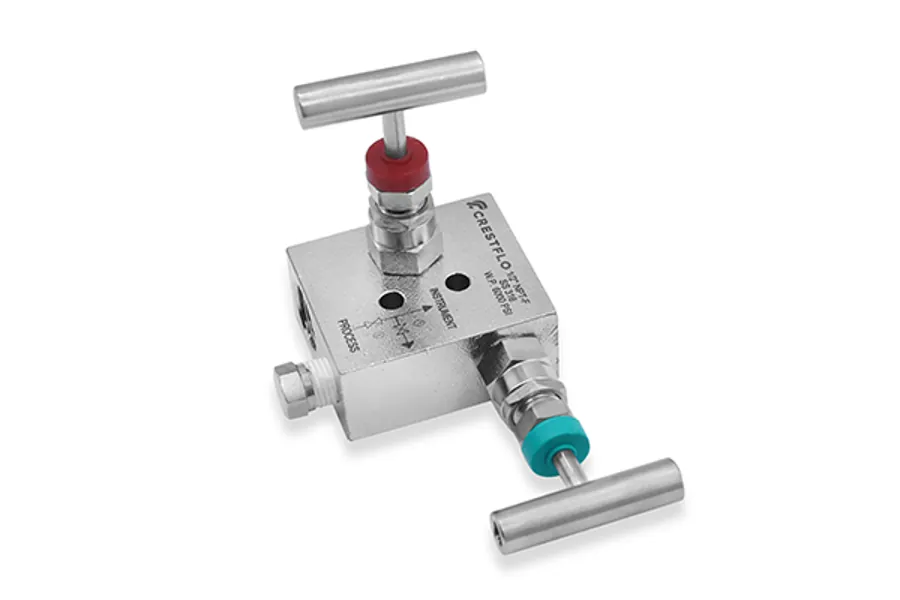
- Machined and forged bodies in titanium Grade 2, including needle-valve, ball-valve and manifold bodies, are quoted made-to-order on request from B348 bar or B381 forgings.
We do not publish per-product datasheet or CAD downloads publicly; datasheets and CAD are available to customers on request. For competitor interchange, request your Swagelok®/Parker® cross-reference rather than working from a published table (Swagelok® and Parker® are trademarks of their respective owners). Standard product is Indian origin; US / European melt is available on request, with full material traceability.
Titanium Grade 2 Applications & Industries
Titanium Grade 2 instrumentation is specified wherever chlorides and oxidizing media govern: offshore and subsea production, marine and shipbuilding, desalination and water/wastewater treatment, chlor-alkali and hypochlorite/chlorine dosing, and oxidizing-acid or analytical service across petrochemical and chemical plants. In each, Grade 2 fittings and tubing give a corrosion margin that stainless steel cannot match in seawater.
Why Crestflo for Titanium Grade 2
Crestflo is the instrumentation division of a four-decade-old, Government-of-India-recognized export house with a proven Middle-East delivery track record, heritage that backs a new manufacturing brand built for the US market. For Titanium Grade 2 that means:
- Drop-in replacement for Swagelok, Parker, Hoke, Hy-Lok and Fitok, backed by ASTM F1387 performance qualification, the interchange proof most competitors do not publish.
- 6–8 week lead time versus the 20+ weeks typical of the majors.
- Small MOQ and private-label options, both imperial and metric on every fitting.
- Full traceability, heat-number marking on every part plus EN 10204 3.1 / 3.2 certificates.
- Cost-competitive after US duties, with US / European melt available on request.
We Engineer Confidence. Talk to our engineering team at sales@crestflousa.com or +1 346 594 9005 (Houston, TX). Request a quote or request a sample.
Titanium Grade 2 FAQ
Is Grade 2 titanium good?
Yes, Grade 2 is the "workhorse" commercially pure titanium, pairing moderate strength (275 MPa / 40 ksi minimum yield) with excellent formability and weldability and outstanding corrosion resistance in seawater and chlorides. For corrosion-driven fluid-system service it is one of the most dependable engineering metals available.
What is better, Grade 5 or Grade 2 titanium?
Neither is universally better. Grade 5 (Ti-6Al-4V) is far stronger and suits structural and aerospace loads; Grade 2 (CP) is more corrosion-resistant, more formable and more weldable, which makes it the right choice for chloride and seawater instrumentation.
What is the difference between Grade 2 and Grade 4 titanium?
Both are commercially pure, but Grade 4 allows higher oxygen and iron, giving it higher strength and lower ductility. Grade 2 is the balanced, general-purpose CP grade, easier to form and weld.
What is the difference between Grade 1 and Grade 2 titanium?
Grade 1 is the purest, softest and most ductile CP grade, with the lowest strength. Grade 2 carries slightly higher iron and oxygen for more strength while remaining highly formable.
What is the UNS number for titanium Grade 2?
Titanium Grade 2 is UNS R50400, equivalent to Werkstoff 3.7035, ASTM Grade 2, DIN Ti2/Ti 40 and JIS Class 2, and is also known by the trade name "50A".
What is titanium Grade 2's chemical composition?
Grade 2 is balance titanium with maxima of oxygen 0.25%, iron 0.30%, carbon 0.08%, nitrogen 0.03% and hydrogen 0.015%, roughly 99% titanium.
Is titanium Grade 2 good for seawater?
Yes, Grade 2 resists chloride pitting, crevice corrosion and chloride stress-corrosion cracking, making it a top choice for seawater, offshore and desalination service.
Is titanium Grade 2 NACE-compliant for sour service?
Titanium alloys are addressed as corrosion-resistant alloys within ISO 15156-3, and Grade 2 is used in sour and chloride service; confirm the specific environmental limits per application. Crestflo supplies NACE MR0175 / ISO 15156-compliant parts.
Which acids should titanium Grade 2 not be used in?
Avoid hydrofluoric acid entirely, and use caution with concentrated reducing acids such as hydrochloric and sulfuric unless they are dilute, inhibited or contain an oxidizer. Grade 2 excels in oxidizing acids like nitric.
Does Crestflo make titanium Grade 2 tube fittings?
Yes, compression and double-ferrule instrumentation tube fittings up to 2" (50 mm) OD in titanium Grade 2, tested per ASTM F1387, NACE-compliant, with EN 10204 3.1/3.2 certificates and heat-number traceability.
What are the lead time and MOQ for titanium Grade 2 fittings?
Ready stock for standard items, made-to-order for specials, with typical 6–8 week delivery and small MOQ plus private-label options. Request a quote for your sizes and configuration.
What is the price of titanium Grade 2?
Pricing is quote-based (RFQ model) and depends on form, size and quantity. Request a quote for current pricing rather than a list price.