
Instrumentation Relief Valves: Stainless Steel & High-Nickel Alloy, Adjustable Set Pressure
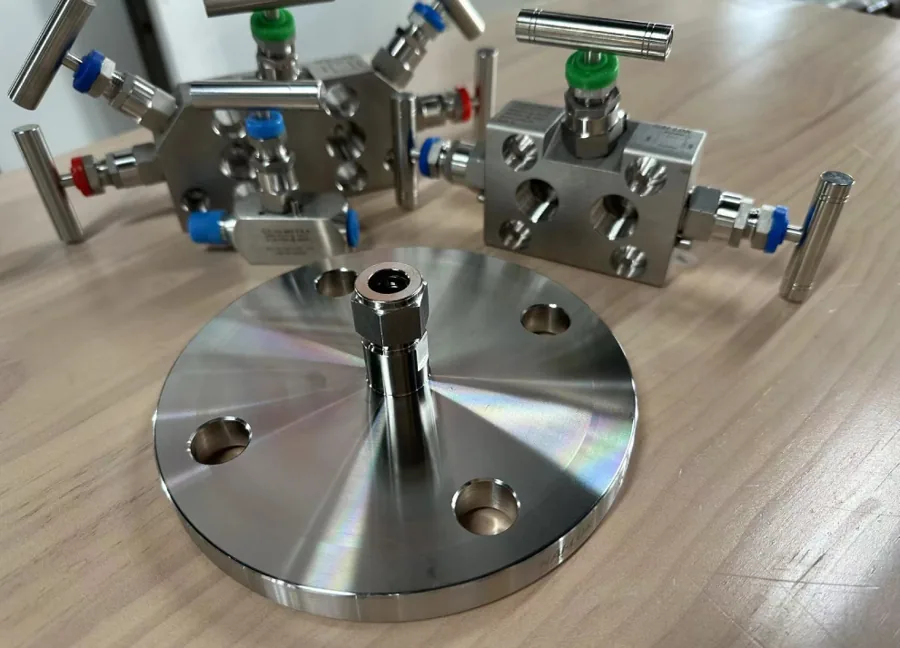
An instrumentation relief valve is a small-bore, spring-loaded proportional valve. It guards gauges, transmitters, regulators and sampling lines against overpressure, opening gradually once pressure climbs past a set cracking point, then reseating as line pressure falls back to normal. Crestflo builds these overpressure relief valves from 1/16" up to 1", in 316 stainless and across the full high-nickel-alloy range, with threaded or tube-fitting ends. It's a US-serving operation: standard items ship from stock, specials are made to order, and delivery runs 6-8 weeks.
Crestflo relief valves are instrumentation proportional relief valves built to protect instruments, regulator outlets and analyzer lines. They aren't plumbing or water-heater T&P valves, HVAC or hydronic relief valves, hydraulic (power-unit) relief valves, or ASME Section VIII code-stamped vessel safety valves. They're also different from excess-flow valves, which cap flow rate rather than pressure. For that function, see the instrumentation valve range. Need backflow prevention instead of overpressure protection? Check the check valve and non-return valve pages instead.
Also Known As: Proportional, Spring-Loaded, Adjustable & In-Line Relief Valves
People specify this valve under a lot of names: instrument relief valve, instrument pressure relief valve, proportional relief valve, spring-loaded relief valve, adjustable relief valve, poppet relief valve, bellows relief valve, in-line relief valve, overpressure relief valve, set-pressure valve. Line lists often flip the order too, listing it as "valve, relief," alongside a cracking-pressure figure and a body-alloy note. If a drawing points to a competitor's series, just send over your cross-reference. We'll match it to the equivalent Crestflo build.
How an Instrumentation Relief Valve Works: Cracking Pressure, Proportional Relief & Reseat
A spring-loaded poppet keeps the seat shut until upstream pressure hits the cracking pressure, the moment the poppet first lifts off its seat. Past that point, a proportional relief valve opens by degrees: flow climbs as pressure climbs, bleeding the excess off to a vent or downstream line, and the poppet settles back onto its seat once pressure drops below the set point. That gradual response is what sets an instrument-scope relief valve apart from a pop-action ASME code safety valve, which snaps fully open in one go.
Set pressure comes from the spring, and you can get it two ways: adjustable, where it's field-settable within a spring range, or factory-fixed to a specified cracking pressure. Sensing relies on a poppet for general instrument service. Where a defined effective area and a clean reseat matter, bellows are the better choice. Reseat happens below the set pressure, which fits proportional-relief behavior. The exact reseat-to-set ratios get configured to the application, and they can be customized as needed.
Adjustable vs Fixed Relief Valve Set Pressure
Adjustable set-pressure valves give the field or panel shop room to tune the cracking pressure within the installed spring range. Fixed-set valves, by contrast, are sealed to a single cracking pressure for tamper resistance. We supply and set every valve to your specified cracking pressure across the common instrument-service bands. The exact set-pressure and spring-range scheme isn't a public standard value; it's part of Crestflo's ordering code. Request the ordering-code guide from our engineering team, and we'll confirm the spring range, whether you need adjustable or fixed, and any lockable configuration for your service.
High-Pressure Relief Valve Ratings & Temperature Limits
Maximum working pressure depends on size, body alloy and seat/seal selection. High-pressure configurations are available across the 1/16"–1" instrumentation range, and ratings can be customized to requirement. Temperature capability comes down to the seal and seat material: standard PTFE service reaches roughly 200 °C, while PEEK and metal seats push higher, and elastomer grades (FKM, EPDM, FFKM) get chosen to suit the operating window. All values follow the applicable material standard and can be customized to requirement, so confirm the target set pressure, working pressure and temperature on your RFQ.
Relief Valve Sizes (1/16"–1") & End Connections: NPT, Tube-Fitting & Compression
Relief valves span a size range from 1/16" to 1". Within that range sit the common discrete sizes: 1/8", 1/4", 3/8" and 1/2". They're available in imperial or metric, and each one comes with an inlet port and a relief, or vent, port.
| Attribute | Options |
|---|---|
| Size range | 1/16" to 1", including 1/8", 1/4", 3/8" and 1/2" (imperial or metric) |
| Threaded ends | NPT per ASME B1.20.1; BSP on request |
| Tube-fitting ends | Compression / tube-fitting connections, single or double ferrule |
| Ports | Inlet + relief (vent) outlet |
| Flow coefficient (Cv) | Configured per size and set pressure, value supplied by our engineering team on request |
| Configurations | In-line, panel-mount, poppet-sensed, bellows-sensed |
Thread and OD dimensions follow the applicable standard, and we can adjust them to your requirement. The flow coefficient (Cv) depends on the size and cracking pressure you specify. It shifts across the build matrix, so don't assume a single figure applies, ask our engineering team for the value that matches your configuration.
Instrumentation Relief Valve Materials: 316 Stainless, Duplex, Monel, Hastelloy & Titanium
Body and trim are machined from corrosion-resistant instrumentation alloys, with the grade matched to the service chemistry. Crestflo builds its stainless steel relief valve in 316/316L, and the lineup runs the full high-nickel-alloy range, each family linked below to its own material page. Alloy composition and mechanicals track published standards. They're customizable to requirement, too.
| Alloy family | Grades | Sour-service (NACE) suitable | Typical driver |
|---|---|---|---|
| Stainless steel | 304/304L, 316/316L, 904L | Selected grades | General instrument service, chloride resistance |
| Duplex / super-duplex | Duplex 2205, Super Duplex 2507, 254 SMO, AL-6XN, Alloy 20 | Yes | Chloride stress-corrosion, strength |
| Nickel alloys | Inconel 600/601/625/718/825, Incoloy 800/800H/825, Monel 400/K500, Hastelloy C-276/C-22/B-2/B-3/X, Nickel 200/201 | Yes | Sour, acidic, high-temperature service |
| Titanium | Titanium Gr2 | — | Seawater, oxidising chlorides |
Builds can conform to NACE MR0175 / ISO 15156 for sour service, provided the alloys are right for it. For grade selection guidance, browse Crestflo's full corrosion-resistant valve alloy range.
Cleaning & Finishes: Oxygen-Clean & UHP Relief Valve Options
Surface options range from a standard material finish to electropolish, passivation and silver anti-galling plating. For oxygen service, the oxygen relief valve can be supplied oxygen-clean / UHP, cleaned to the applicable cleaning standard. Just request the oxygen-clean / UHP cleaning option and specify it on your order.
Standards, Certification & Traceability
Instrumentation valves are designed with reference to ASME B16.34 for valve design, with NPT threads to ASME B1.20.1; seat and shell leak testing follows API 598 practice. These are the standard approvals applicable to this product type, this is an instrumentation proportional relief valve, not an ASME Section VIII code-stamped safety valve. Crestflo is ISO 9001 / 14001 / 45001 and PED certified. Every part carries a heat/lot number for full traceability, with an EN 10204 material test certificate (MTC 3.1) standard and 3.2 on request. PMI, in-house NDT and third-party inspection are available; values are per the applicable standard and customizable to requirement.
Applications: Gauge, Regulator, Gas & Sampling-Line Protection
Instrumentation relief valves protect pressure gauges and transmitters, and they guard regulator outlets against overpressure. On gas panels, instrument-air lines and analyzer/sampling systems, they act as a gas relief valve that vents excess pressure. Crestflo serves oil and gas, semiconductor, hydrogen, instrument-air and analytical sampling system applications. In each case, a small overpressure relief valve made from the correct alloy protects instruments that are simply too costly to risk.
Products & Ordering
Configuring a relief valve means specifying size, body alloy, end connections, cracking (set) pressure, seal grade and any cleaning option. The series designation and ordering code are specific to Crestflo, so you'll need to request the ordering-code guide and a quote from our engineering team; they'll return a build code and lead time. For related protection and isolation equipment, look at the back-pressure regulator and the bellows-sealed valve. The full instrumentation valve range covers the rest of the family.
Primary CTA: Request a Quote · Request a Sample · Become a Distributor · Private-Label Program. US contact: sales@crestflousa.com · +1 346 594 9005 · Houston, TX.
Why Crestflo for Relief Valves
Crestflo is the instrumentation division of a Government-of-India-recognized export house with four decades behind it and a track record of deliveries across the Middle East. We serve the US market as a relief valve manufacturer. Valves ship in 6–8 weeks, against the 20-plus weeks you'll typically wait on from the majors, our lead-time methodology explains how. MOQs stay small, and we handle private-label and made-to-print builds. Every part leaves with a heat number and MTC 3.1.
Product is Indian origin. US and European melt is available on request, and full material traceability comes standard. TAA and origin questions get answered on our US-origin compliance page.
Need a dimensional drop-in against another brand? Request your Swagelok® cross-reference, and our engineers will map the equivalent build for you. We Engineer Confidence.
Frequently Asked Questions
What is the purpose of an instrumentation relief valve?
It protects gauges, transmitters, regulators and sampling lines from overpressure. Once pressure climbs past a set cracking point, the valve opens and vents the excess before it can damage the instruments downstream. Then, as conditions return to normal, it reseats on its own.
What are the two main types of relief valve?
Proportional relief valves open gradually, and you'll find them mostly in instrument and liquid service. Pop-action safety valves work differently: they snap fully open, which is exactly what makes them suited for ASME code pressure safety valves (PSVs) on vessels and boilers. Crestflo supplies the proportional instrument type.
What is the difference between a check valve and a relief valve?
A check valve stops backflow based on the direction of flow. A relief valve caps overpressure once it hits a set pressure point. Different jobs entirely, for backflow prevention, see our check valve and NRV pages.
What happens if a relief valve fails?
Fail closed, and downstream instruments risk overpressure damage. Open failure means continuous leaking or venting. Get the set-pressure setting right, match the alloy and seal to the job, and keep QA traceable. Do that, and failure risk drops.
Is this an ASME code (PSV) safety valve?
No, it isn't. This is an instrumentation proportional relief valve built to protect instruments, not an ASME Section VIII code-stamped vessel safety valve. Its design follows ASME B16.34 for valve design.
What set-pressure range is available?
Valves come pre-set to your specified cracking pressure, and they're available across the common instrument-service bands in either adjustable or factory-fixed form. Need to confirm the spring range for your service? Request the ordering-code guide from our engineering team.
What sizes and end connections are offered?
Sizes span 1/16" to 1", in imperial or metric. Ends are threaded NPT per ASME B1.20.1, or they're tube-fitting and compression instead. Dimensions follow whichever standard applies, and can be customized to what the job requires.
What materials can the relief valve be made in?
316/316L and 304 stainless lead the list, followed by 904L, duplex and super-duplex, 254 SMO, AL-6XN, Alloy 20, Inconel, Incoloy, Monel, Hastelloy, and Nickel 200/201. Titanium Gr2 rounds it out. Each grade gets matched to the service chemistry it'll face.
Are relief valves available for sour (NACE) service?
Yes. Builds can meet NACE MR0175 / ISO 15156 when the right alloys are used, and we back that up with heat-number traceability and material test certificates.
Can I get an oxygen-clean relief valve?
Yes. We offer electropolish, passivation, and oxygen/UHP cleaning, each carried out to the applicable cleaning standard specified on your order.
What is the lead time, and can you drop-in replace another brand?
6–8 weeks, more often than not. Standard items ship from ready stock; specials get made to order. Dimensional drop-in against other brands works too, just request your cross-reference and we'll match it to the equivalent Crestflo build.
Related Pages
Take a look at the instrumentation valve range, which covers the check valve and the bellows-sealed valve. There's also a back-pressure regulator in the lineup. Everything is available in 316 and 316L material, built to ASME B16.34 and NACE MR0175 standards. A Swagelok cross-reference is on hand for comparison, and you can always talk to the Crestflo engineering team with questions.