
Non-Return Valves (NRV): Instrumentation Check Valves in Stainless & High-Nickel Alloys
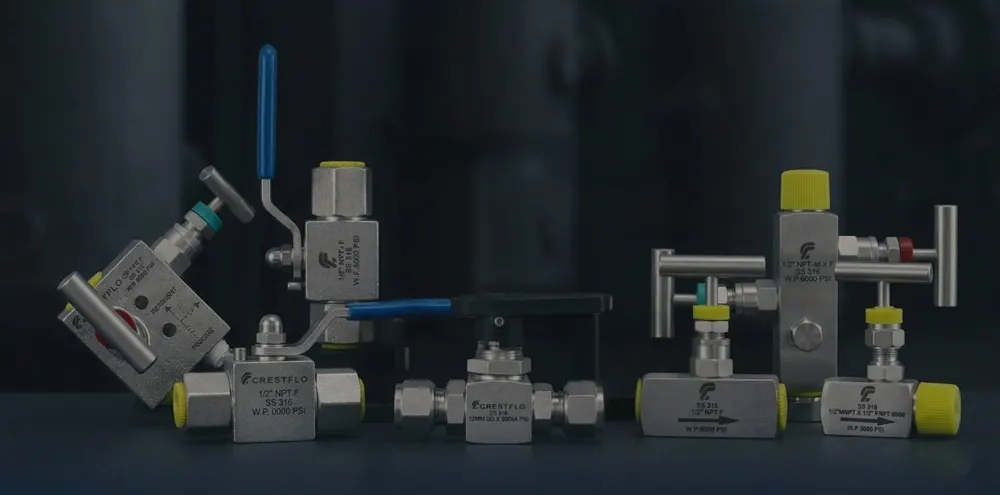
A non-return valve, or NRV, is an instrumentation check valve. It lets flow move in one direction and shuts off reverse flow the instant the pressure differential flips. Crestflo builds inline non-return valves for fluid and gas systems in stainless steel and high-nickel alloys, ranging from 1/16″ to 1″, with tube-fitting or NPT ends. They're engineered for US drop-in replacement and ship in 6-8 weeks.
On this page, "non-return valve" refers specifically to an instrumentation or fluid-system check valve made of stainless steel or high-nickel alloy. It doesn't mean a plumbing, water-tank, PVC, boiler-feed, or automotive non-return valve.
Request a quote · Request a sample
What Is a Non-Return Valve (NRV)? Purpose & Full Form
NRV stands for Non-Return Valve. Its job is straightforward: let media flow forward and shut off automatically the moment flow tries to reverse, guarding pumps, compressors, analyzers, and sensitive instruments against backpressure, siphoning, and contamination. No operator touches it, and no signal drives it. A spring-assisted poppet opens when flow moves forward and reseals the instant pressure reverses. Because its function comes from flow direction rather than a hand-set position, engineers group the NRV with other automatic, self-acting one-way devices in an instrumentation fluid system. On a datasheet, an NRV valve is specified by size, end connection, alloy, seat, and cracking pressure.
In the field, technicians know this same part by more names than you'd expect. Call it a check valve, and you're right. Call it a one-way valve, or a one-directional valve, or a one-way check valve, and you're still right. Reflux valve, retention valve, back-flow valve, back-pressure prevention valve, all the same thing. Old-timers in plumbing might even call it a clack valve; that term describes the identical one-way principle, though it's mentioned here purely so you'll recognize it, not because it names a Crestflo product line. Whatever label shows up on your P&ID or bill of materials, you're looking at the same automatic one-way valve.
NRV terminology & equivalence
| Term | Region / usage context | Same device as an NRV? |
|---|---|---|
| Non-return valve / non return valve / NRV | UK / EU / commonwealth engineering | Yes |
| Check valve | US / ASME terminology | Yes |
| One-way valve / one-directional valve | Generic / function description | Yes |
| Reflux valve | Process / older references | Yes |
| Retention valve | Process / older references | Yes |
| Back-flow / back-pressure prevention valve | Function description | Yes |
| Clack valve | Legacy plumbing / boiler slang | Same principle (not a product name) |
NRV vs Check Valve: Are They the Same Valve?
Yes. A non-return valve and a check valve are the same piece of equipment. In the United States, and in ASME documentation, "check valve" is the term you'll see most; in the UK and across European practice, "non-return valve" wins out. Functionally, there's no difference between them. Crestflo's dedicated instrumentation check valve page serves as the hub for the head term, covering swing, lift, and ball configuration theory. This NRV page, by contrast, owns the non-return terminology and feeds into that same product family. For variants operated by an air pilot, see the pneumatic check valve.
How a Non-Return Valve Works: Poppet & Spring Mechanism
Forward flow pushes inlet pressure above the cracking pressure, the small differential needed to lift the poppet off its seat and open a path for flow. As forward flow eases and pressure starts building on the reverse side, the spring drives the poppet straight back onto its seat, sealing the line before backflow can take hold. At the 1/16″ to 1″ instrumentation size range, this inline spring-loaded poppet reseals fast and holds up in any mounting orientation. Crestflo covers swing, lift, and ball mechanism theory in more depth on its check valve page.
Non-Return Valve Symbol (P&ID) & Flow-Direction Arrow
On a P&ID, a non-return valve is drawn with the standard check-valve schematic, a flow path with a seat and a poppet or ball that closes against reverse flow, and the direction of permitted flow is fixed by the drawing and by the flow-direction arrow cast or marked on the valve body. Always install the valve so the body arrow points in the direction of forward flow. A fuller reference to instrumentation valve symbols is in the instrumentation valve symbols guide.
Non-Return Valve Types: Inline Check Valve, Poppet & Spring Configurations
At instrumentation sizes, Crestflo's focus is the inline poppet / spring-loaded non-return valve, an inline check valve, also known as a poppet check valve or spring check valve. It's compact, doesn't care which way you orient it, and pairs easily with tube-fitting ends. Ball, lift, and swing check configurations, along with the trade-offs between them, are covered on the check valve page. Pneumatic (air-operated) versions have their own page, pneumatic check valve. Looking for setpoint back-pressure relief instead, venting above a set pressure rather than blocking reverse flow? That's covered on the relief valve page.
Non-Return Valve Sizes (1/16″–1″) & End Connections: Tube-Fitting & NPT
Crestflo non-return valves come in sizes from 1/16″ to 1″, in imperial or metric equivalents, with either tube-fitting (compression) ends or threaded ends. The same valve can be specified as a tube-fitting check valve, a compression-fitting check valve that mates directly with Crestflo compression fittings, or as an NPT check valve, a threaded non-return valve cut to NPT per ASME B1.20.1. Further national and international threads are available on request. Sizes and end preparations follow the applicable dimensional standards, and they can be customized to requirement. Among the common instrumentation builds are the 1/4″ check valve, the 1/2″ NRV, and the 1″ non-return valve. All three share the same inline poppet design.
| Nominal size (imperial) | Metric equivalent | Tube-fitting (compression) end | Threaded (NPT) end |
|---|---|---|---|
| 1/16″ | ~1.6 mm | Yes | On request |
| 1/8″ | ~3 mm / 6 mm | Yes | Yes |
| 1/4″ | 6 mm | Yes | Yes |
| 3/8″ | 8 / 10 mm | Yes | Yes |
| 1/2″ | 12 mm | Yes | Yes |
| 3/4″ | ~18 / 20 mm | Yes | Yes |
| 1″ | ~25 mm | Yes | Yes |
Non-Return Valve Materials: 316L Stainless, Duplex, Inconel, Monel & Hastelloy
By default, the stainless steel check valve comes in 316/316L. The same non-return valve is also supplied in stainless grades up to 904L, plus the full high-nickel alloy range, so it will match tubing and fittings already specified for the service. Grade compositions follow the standard published UNS designations. Choose the family based on media, chloride load, and temperature.
| Alloy family | Grades | Representative UNS | Typical selection driver |
|---|---|---|---|
| Austenitic stainless | 304/304L, 316/316L, 904L | S30400, S31603, N08904 | General instrumentation, broad corrosion resistance |
| Duplex / super-austenitic | Duplex 2205, Super Duplex 2507, 254 SMO, Alloy 20 | S32205, S32750, S31254, N08020 | Chlorides, seawater, higher strength |
| Nickel alloys | Inconel 625/825, Monel 400, Hastelloy C-276 | N06625, N04400, N10276 | Sour, acidic, and high-temperature media |
| Titanium | Titanium Gr 2 | R50400 | Seawater, oxidising chlorides |
Sour-service builds conform to NACE MR0175 / ISO 15156. Need oxygen-clean preparation or extra finishes? That's available on request. Crestflo keeps the complete alloy menu on its materials hub.
NRV Ratings: Cracking Pressure, Back-Pressure, High-Pressure & Temperature Limits
| Attribute | Value | Note |
|---|---|---|
| Cracking (opening) pressure | Specified to the application | Set point selected and stated on the RFQ; customizable to requirement |
| Reverse-flow (back) pressure | Per body material and rating class | Aligned to the ASME B16.34 pressure-temperature framework |
| Pressure-temperature basis | ASME B16.34 P-T framework | Rating by body material and class; customizable to requirement |
| Seat / seal options | Soft-seat elastomer or metal seat | Standard PTFE / FKM / PEEK seals selected to service temperature |
| Temperature range | Governed by the selected seal | Values per the applicable seal material limits; customizable to requirement |
| Body / trim material | Full SS and high-nickel alloy range | Per selected UNS grade |
Cracking pressure on a check valve is the minimum forward differential needed to open it. It's set for the specific service and confirmed on the quote, not pulled from a single catalog figure. For high-pressure check valve or high-pressure NRV duty, the reverse-flow rating follows the ASME B16.34 pressure-temperature framework, based on body material and class. Again, this isn't fixed to one catalog number; it's built around what the application needs. Valve ratings and seal temperature limits follow the applicable standards too, and they can likewise be adjusted to requirement. For a specific build, request Crestflo's ordering-code guide.
Installing a Non-Return Valve: Orientation & Flow Direction
Install the valve with the body's flow-direction arrow pointing the way flow will actually travel. You'll typically find non-return valves downstream of a pump or compressor, where they stop reverse rotation and backflow on shutdown. They also belong upstream of sensitive instruments that need protection from back-pressure or contamination. Inline poppet designs will seal regardless of orientation. Get the sizing right: forward flow needs to reliably exceed the cracking pressure. Go too big and the valve can chatter. Go too small and you're stuck with pressure drop you didn't need. Weigh the downsides before committing: the pressure drop it adds, the risk of chatter or water hammer if sizing is off, and the fact that you still have to pick a cracking pressure suited to the service.
Standards, Testing & Traceability: ASME B16.34, API 598, NACE & EN 10204 MTC
Crestflo non-return valves are instrumentation valves, so they qualify against the standard approvals that apply to that product type: the ASME B16.34 pressure-temperature framework and API valve inspection and test criteria. They don't qualify against the compression-fitting standard used for tube fittings.
| Item | Standard | When applied |
|---|---|---|
| Pressure-temperature design basis | ASME B16.34 | All valve builds |
| Seat & shell leak inspection | API 598 acceptance criteria | Standard test regime |
| Sour-service compliance | NACE MR0175 / ISO 15156 | Sour / H₂S service |
| Material test certificate | EN 10204 3.1 MTC (3.2 on request) | Every order, with heat/lot number on every part |
| Quality management | ISO 9001 / 14001 / 45001 & PED certified | Company-wide |
Positive material identification (PMI), in-house NDT, and third-party inspection on request all back the alloy and pressure integrity of every part. Crestflo documents this fully on the traceability page.
Non-Return Valve Applications: Instrument Air, Gas, Hydrogen & Cryogenic
Instrumentation non-return valves protect and isolate lines across instrument air and pneumatic systems, gas sampling and analytical sampling systems, hydraulics, and oil and gas process lines. Swap the alloy and seal, and the same valve handles hydrogen and LNG / cryogenic service too. For gas and instrument-air duty, Crestflo's compact inline poppet instrument check valve reseals fast and holds leakage low through repeated cycling.
Why Crestflo for Instrumentation Non-Return Valves
Crestflo is the instrumentation arm of a Government-of-India-recognized export house with four decades behind it and a proven delivery record across the Middle East. The parent brings that engineering depth to bear on a focused catalog of US instrumentation.
Ready stock for standard items, made-to-order for specials. Delivery runs 6-8 weeks, against the 20-plus-week lead times typical of the majors.
Dimensional interchange with common instrumentation check valves means a straight drop-in replacement. Request your Swagelok or Parker cross-reference and we'll map the equivalent.
The full alloy range spans 316L through duplex, Inconel, Monel, Hastelloy, and titanium. One supplier covers the whole material spread.
Origin is Indian, with US or European melt available on request. Every part carries full material traceability, an EN 10204 3.1 MTC (3.2 on request), and its own heat/lot number.
- Small MOQ and private-label / made-to-print builds for OEMs and distributors.
Request a Non-Return Valve Quote
Give us the size, end connections, alloy, and cracking pressure. From there, Crestflo's engineering team will put together a quote and an ordering-code guide. Send the details to sales@crestflousa.com, or call +1 346 594 9005; the line rings through to our Houston, TX office.
Request a quote, get pricing details from Crestflo. Need to see the product first? Request a sample instead. If you're trying to match a part you already use, request your cross-reference and let Crestflo sort out the equivalent. Distributors and OEMs looking to partner up should send a distributor & OEM inquiry.
Non-Return Valve FAQ
What is a non-return valve (NRV)?
A non-return valve doesn't let flow travel both ways: it opens for flow moving in one direction and blocks anything trying to reverse. Most engineers call it a check valve, or sometimes a one-way valve. At instrumentation sizes, the mechanism is a spring-loaded poppet. It opens under forward flow and reseals the instant pressure reverses.
Is an NRV the same as a check valve?
Yes, they're the same device. "Check valve" is what you'll hear in the US and in ASME documentation; "non-return valve," or NRV, is the term used across the UK and Europe. Functionally, there's no difference between them.
What does NRV stand for?
NRV stands for Non-Return Valve.
What is another name for a non-return valve?
A non-return valve goes by several other names: check valve, one-way valve, reflux valve, retention valve. Plumbers of an older generation called it a clack valve. Different terms, same one-way principle.
What sizes and end connections does Crestflo offer?
Non-return valves come in sizes from 1/16″ to 1″, in either imperial or metric equivalents, with tube-fitting (compression) or threaded NPT ends. Sizes and threads follow the applicable standards, and both can be customized to whatever the application calls for.
What materials are available for the non-return valve?
Bodies and trim come in 304/304L and 316/316L stainless, plus 904L, duplex, super-duplex, Alloy 20, Inconel, Monel, Hastelloy, and Titanium Gr 2. For sour service, builds meet NACE MR0175 / ISO 15156.
Where should a non-return valve be installed?
Install the unit so the body's flow-direction arrow points the way flow actually moves. That's usually downstream of a pump or compressor, where it stops backflow, or upstream of instruments that need protection from reverse pressure. Inline poppet designs, though, will seal no matter how you orient them.
What are the downsides of a non-return valve?
The main headache is the extra pressure drop the valve adds. Get the sizing wrong and you risk chatter or even water-hammer. And picking the right cracking pressure for the service matters more than people think.
What is cracking pressure?
Cracking pressure is the minimum forward pressure differential needed to lift the poppet off its seat and open the valve. It's specified for the application and confirmed on the quote. Contact the engineering team for the set-point options available for your service.
Is the non-return valve suitable for sour (NACE) or oxygen service?
Sour-service builds meet NACE MR0175 / ISO 15156. Need oxygen-clean prep? It's available on request, just specify the cleanliness target when you send your inquiry.
Can it drop-in replace a Swagelok, Parker, or Hoke check valve?
Crestflo makes dimensional interchanges for common instrumentation check valves. Send in your cross-reference, and the engineering team will match it to the equivalent Crestflo part. Check the cross-reference hub for details.
What certifications and traceability come with the valve?
Crestflo holds ISO 9001, 14001 and 45001 certification, along with PED. Every order goes out with an EN 10204 3.1 material test certificate, 3.2 available on request, and each part carries its own heat/lot number.
Related Instrumentation Valves & Resources
- Instrumentation check valve: the central resource for Crestflo's line, laying out swing, lift, and ball configuration theory in one place.
- Pneumatic check valve: the air-operated variant.
- Relief valve, setpoint back-pressure relief
- Instrumentation valves, full valve family
- Instrumentation valve symbols, P&ID reference
- Cross-reference / interchange hub, request your competitor equivalent