
Instrumentation Ball Valves
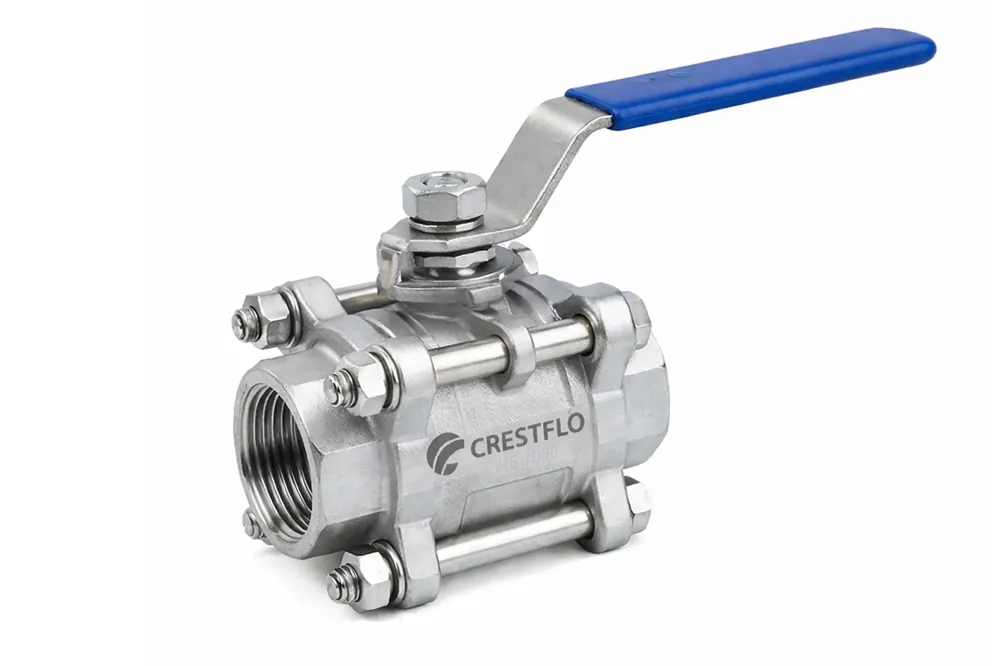
An instrumentation ball valve is a quarter-turn (90°) rotary shut-off valve. It uses a bored ball as the closure element, which gives it positive on/off isolation in small-bore instrument, tubing, gauge, analyzer and sensing lines. The two-way version comes in sizes from 1/16" to 1", made from stainless steel and corrosion-resistant alloys, with tube-fitting or threaded ends. These are instrument-isolation valves built for tubing and sensing lines. They're not plumbing valves, and they're not full-bore pipeline ball valves.
Crestflo is the instrumentation arm of a Government-of-India-recognized export house with four decades behind it and a proven record delivering into the Middle East. We manufacture quarter-turn ball valves built for US drop-in service, and we support end users, distributors, OEMs and equipment builders alike. Standard items ship from ready stock; specials are made to order, with delivery running 6–8 weeks. Request a quote.
Also Known As: Instrument Ball Valve, Quarter-Turn Isolation & Shut-Off Valve
Buyers and specifiers don't always use the same name for this valve; it depends on the drawing convention and the service. Common designations include instrument ball valve, ball shut-off valve, quarter-turn ball valve, two-way ball valve, isolation ball valve, and instrument isolation valve (ball type). End connection gives you a tube-fitting ball valve or compression-end ball valve. Construction gives you a floating ball valve or three-piece ball valve. Switching variants (three-way, L-port and T-port), along with the trunnion ball valve, get their own pages.
What Is an Instrumentation Ball Valve and How Does It Work?
A ball valve opens and closes by turning a bored ball a quarter turn between the seats. When the bore lines up with the flow path, the valve sits fully open. Turn the handle 90° and the ball's solid face rotates across the bore, cutting off flow. In a floating-ball design, line pressure pushes the ball against the downstream seat, and that's what forms the seal. The ball only ever travels between fully open and fully closed, so an instrumentation ball valve is a shut-off, or isolation, device. It isn't meant for throttling or metering flow. If you need fine flow control, specify a needle valve instead. Crestflo's needle-versus-ball comparison lays out when to use each.
Ball Valve Types: Full-Port vs Reduced-Port, Two-Piece, Three-Piece & Floating
Instrument ball valves get classified two ways: by port pattern and by body construction. A full-port valve, sometimes called full-bore, has a bore that matches the connecting tube or line size, so flow restriction stays minimal. A reduced-port valve (also called reduced-bore or standard-port) uses a smaller bore instead, which keeps the body more compact. Construction varies too. Bodies come as one-piece, two-piece, or three-piece bolted assemblies, machined from forgings or bar stock, and all use a floating-ball closure. The three-piece bolted design stands out for one reason: you can service the seats and seals in place, without touching the end connections at all.
| Type | Description | Typical use |
|---|---|---|
| Full-port ball valve | Bore matches line size; minimal restriction | High-flow, low-pressure-drop isolation |
| Reduced-port ball valve | Smaller bore, compact body | General instrument isolation |
| Two-piece ball valve | Two-part body, robust and economical | Standard shut-off duty |
| Three-piece ball valve | Bolted body for in-line rebuild | Serviceable, high-cycle lines |
| Floating ball valve | Ball floats to seal downstream seat | Small-bore instrument service |
Multi-port switching valves get their own coverage: three-way, L-port and T-port, along with the trunnion ball valve.
Ball Valve Sizes (1/16"–1") & End Connections: NPT, Tube-Fitting & Weld
Crestflo instrumentation ball valves come in nominal sizes from 1/16" to 1", spanning both imperial and metric, with a full range of instrument end connections. Tube-fitting (compression) ends are available in single- and double-ferrule form, with hardened or non-hardened ferrules built to requirement. Threaded ends are cut to NPT per ASME B1.20.1. Socket-weld and tube butt-weld ends round out the lineup. BSP (BSPT/BSPP), ISO 8434-2 flare (SAE), and DIN 2353 bite-type ends ship to requirement too. Dimensions follow whichever end-connection standard applies, and they're customizable to requirement.
| Nominal size | Tube-fitting | NPT | Socket-weld | Butt-weld |
|---|---|---|---|---|
| 1/16" | Yes | Yes | Yes | Yes |
| 1/8" | Yes | Yes | Yes | Yes |
| 3/16" | Yes | Yes | Yes | Yes |
| 1/4" | Yes | Yes | Yes | Yes |
| 3/8" | Yes | Yes | Yes | Yes |
| 1/2" | Yes | Yes | Yes | Yes |
| 3/4" | Yes | Yes | Yes | Yes |
| 1" | Yes | Yes | Yes | Yes |
High-Pressure Ball Valve Ratings & Cold Working Pressure (CWP)
The pressure rating of a ball valve is expressed as cold working pressure (CWP), and it depends on body size, seat material and the alloy used. Small-bore instrument ball valves are commonly rated up to 6,000 psi (413 bar) CWP for isolation service; 3,000 psi designs are typical for general duty. Values follow the applicable standard and can be adjusted to requirement. Pressure-temperature ratings for the valve body follow ASME B16.34. Our CWP ball valve page explains the rating basis in detail, and certified per-model curves ship with the quotation. Datasheets and CAD files are available to customers on request.
Ball Valve Seat Materials, Seals & Temperature Limits: PTFE, RPTFE & PEEK
The seat material is what sets the valve's temperature and media limits. Below, you'll find the standard published service limits for common instrument seat and seal materials. Pick the seat to match your temperature and media; values follow the applicable standard, and they can be tailored to your requirement.
| Seat / seal material | Typical temperature limit | Notes |
|---|---|---|
| PTFE | −65°F to 450°F (−54°C to 232°C) | General chemical service, low friction |
| RPTFE (reinforced PTFE) | Up to 500°F (260°C) | Higher pressure and wear resistance |
| PEEK | Up to 600°F (315°C) | High-temperature, high-cycle service |
| PCTFE | Up to 300°F (150°C) | Cryogenic and high-purity service |
When fire safety or high-temperature isolation matters, a metal-seated (metal-to-metal) seat is available in place of the standard polymer versions. It's built, where specified, to the API 607 fire-test basis. Stem sealing relies on PTFE packing, with elastomer O-ring options such as FKM/Viton available to suit the media. Flow coefficient, or Cv, shifts with size and with bore or orifice dimensions. The exact figure for a given model isn't fixed here; it comes with the quotation.
Ball Valve Materials: 316 Stainless, Duplex, 6-Moly, Monel, Inconel & Hastelloy
Crestflo machines its stainless steel ball valves from bar stock and forgings, using stainless steel and corrosion-resistant alloys. Brass isn't offered anywhere on this US instrumentation range. Standard bodies come in 316/316L stainless and 304/304L, while higher-alloy options handle chloride, sour and high-temperature service. Each grade links through to its own material page. The same valve design is also available as a matrix build, such as a Hastelloy C-276 instrumentation valve or an Inconel 625 instrumentation valve.
| Grade | Family | Typical service |
|---|---|---|
| 316 / 316L | Austenitic stainless | Standard instrument service |
| 904L | Super-austenitic | Sulfuric and acid media |
| Duplex 2205 | Duplex | Chloride, higher strength |
| Super Duplex 2507 | Super duplex | Offshore, high chloride |
| 254 SMO | 6-Moly | Seawater, bleaching |
| Alloy 20 | Nickel-alloy | Sulfuric acid |
| Monel 400 / K500 | Nickel-copper | Hydrofluoric, marine |
| Inconel 625 / 825 | Nickel-chromium | High temperature, corrosion |
| Hastelloy C-276 / C-22 | Nickel-molybdenum | Aggressive chemical service |
| Titanium Gr 2 | Titanium | Chloride, oxidising media |
For sour service applications, we supply alloys that meet NACE MR0175 / ISO 15156 requirements. You'll find the full range of alloy options on Crestflo's materials hub.
Ball Valve Actuation & Configuration Options: Panel-Mount, Fire-Safe & Pneumatic
Standard actuation comes as a manual lever or oval handle. A locking handle and a panel-mount handle are also available for panel and enclosure builds. Configuration options run the gamut: panel-mount, low-profile, bi-directional, high-cycle, zero-leak, forged-body, bar-stock and vented designs. For automated isolation, Crestflo offers pneumatic-actuated ball valves, driven by either a rack-and-pinion or scotch-yoke actuator on the valve stem. Where specified, fire-safe designs are built to the API 607 test basis. Finishes include electropolish, passivation and silver anti-galling plating, and these can be customized to whatever the application requires.
Ball Valve Standards, Certifications & Testing
Crestflo ball valves meet the standard approvals instrument valves are held to. Pressure-temperature ratings follow ASME B16.34. Seat and shell testing is done to API 598, and fire-safe testing follows API 607 where it's specified. Fugitive-emission control complies with ISO 15848, while sour-service work meets NACE MR0175 / ISO 15156. NPT ends are cut per ASME B1.20.1. Crestflo holds ISO 9001 / 14001 / 45001 certification and is PED certified as well. Each part carries its heat or lot number, and material ships with an EN 10204 MTC 3.1 certificate; a 3.2 is available on request. Testing covers hydraulic proof, burst and impulse, pneumatic, seat and shell leak checks, and positive material identification (PMI). NDT is done in-house, and destructive testing runs through ISO/IEC 17025-accredited labs, with third-party inspection arranged on request. Certificates sit in our quality records.
Ball Valve vs Needle Valve: Choosing the Right Instrument Valve
| Factor | Ball valve | Needle valve |
|---|---|---|
| Function | On/off isolation | Fine throttling / metering |
| Motion | Quarter-turn (90°) | Multi-turn stem |
| Flow | Full or reduced bore | Restricted, adjustable |
| Best for | Fast positive shut-off | Precise flow control |
Specify a ball valve when you need to isolate a line, and pair it with a needle valve for throttling. Other isolation products worth considering include the gauge root valve, the double block and bleed valve, and Crestflo's valve manifolds.
Ball Valve Applications: Oil & Gas, Cryogenic, Hydrogen & Sampling
Instrument ball valves isolate impulse, tubing and sensing lines across a wide span of services. That list runs from oil and gas (including sour service), petrochemical, offshore and subsea, LNG and cryogenic, and hydrogen, through steam-tracing and steam-isolation duty, analytical and sampling systems, and instrument air. Crestflo matches alloy and seat selection to the media, temperature and pressure of each service.
Drop-In Interchange for Swagelok, Parker & Hoke Ball Valves
Crestflo instrumentation ball valves are built as dimensional drop-in interchanges, a straightforward swap for the major instrument brands. They fit right into existing tube-fitting envelopes and panel layouts. Our engineering team skips the fixed part-number table; instead, they build the interchange to your exact specification. Ask for your Swagelok or Parker A-Lok cross-reference, or browse the full cross-reference program, which also covers Hoke. Swagelok®, Parker® and Hoke® are trademarks of their respective owners. Crestflo isn't affiliated with or endorsed by them.
Why Crestflo for Instrumentation Ball Valves
Crestflo manufactures instrument ball valves in stainless steel and exotic alloys for customers across the US. Lead times run 6–8 weeks, far short of the 20-plus weeks typical among the major suppliers. That speed comes from four decades of standing as a Government-of-India-recognized export house. Ready stock covers standard items; specials are made to order. Indian origin is standard, but US or European melt is available on request, with full material traceability included. Details are on our US origin and compliance page. Small minimum order quantities and private-label programs are part of the offering, alongside MTC 3.1 documentation with heat-number traceability and ISO / NACE conformance, all standard. Instrumentation ball valve pricing is quoted per configuration. Send us your size, alloy, and end connection, and we'll get you a quote. We Engineer Confidence.
For inquiries originating in the US, reach the Crestflo team at sales@crestflousa.com or call +1 346 594 9005, based in Houston, TX. Need a quote, a sample, or the catalog? Here's where to go: Request a quote, request a sample, download the catalog, or talk to an engineer. Distributors should review the distributor program. OEMs have a program of their own: the OEM program.
Frequently Asked Questions
What is an instrumentation ball valve?
A quarter-turn valve, this one uses a bored ball to open or shut off flow in small-bore instrument, tubing and sensing lines. It gives positive on/off isolation rather than throttling. Don't confuse it with a plumbing or full-bore pipeline ball valve; the two are built for different jobs entirely.
What are the main types of ball valves?
Valves split into full-port or reduced-port by pattern. By switching type, they're two-way, three-way, L-port or T-port. By build, they come one-piece, two-piece, three-piece, floating, or trunnion. Crestflo covers the two-way isolation valve on this page, with the switching and trunnion variants covered separately.
What sizes and end connections are available?
Sizes span 1/16" to 1", in imperial and metric alike. End options: tube-fitting (single or double ferrule), NPT, socket-weld, or butt-weld. Dimensions track the applicable standard, though they're adjustable to whatever the job requires.
What pressure rating (CWP) can an instrument ball valve reach?
Size, seat and alloy all shape cold working pressure. Small-bore instrument ball valves typically carry a CWP rating up to 6,000 psi, though 3,000 psi is more common for general duty work. Ratings for pressure and temperature follow ASME B16.34, and certified per-model curves come with every quotation.
What materials are available for Crestflo ball valves?
This lineup includes 316/316L and 304/304L stainless steel, 904L, Duplex 2205 and Super Duplex 2507. It also covers 254 SMO, AL-6XN, Alloy 20, Monel 400/K500, Inconel 625/825, Hastelloy C-276/C-22 and Titanium Gr 2. Brass, however, isn't offered on this US instrumentation range.
Are Crestflo ball valves suitable for sour (NACE) service?
Yes, our alloys ship compliant with NACE MR0175 / ISO 15156. Each one carries heat-number traceability and comes with an EN 10204 MTC 3.1 certificate. A 3.2 is available on request.
Can a Crestflo ball valve replace a Swagelok or Parker ball valve?
Yes. Our valves are engineered as dimensional drop-in interchanges. We don't rely on a fixed part-number table; instead, our engineering team builds the cross-reference to your specification. Request your Swagelok® or Parker® cross-reference today. Swagelok® and Parker® are trademarks of their respective owners, and Crestflo isn't affiliated with or endorsed by either company.
What is the difference between a ball valve and a needle valve?
A ball valve delivers quick quarter-turn on/off isolation. A needle valve, by contrast, offers fine multi-turn throttling and metering. Use the ball valve when you need to shut off a line; reach for the needle valve when you need to control flow.
What are common ball-valve problems and how do you avoid them?
Throttling with a ball valve is the usual culprit behind seat wear and packing leaks. Ball valves should be specified for isolation duty only. When throttling is needed, use a needle or metering valve instead, and choose the seat material based on the line's temperature and the media it carries.
What is the lead time, minimum order and origin?
Standard items ship from stock. Specials are made to order, with delivery running 6-8 weeks. Small MOQs and private-label programs are available too. Standard product comes from India, but if you need US or European melt, we'll supply it on request, complete with full material traceability.
Do you provide datasheets, CAD models or fire-safe and oxygen-clean options?
Customers can request datasheets and CAD on demand. Fire-safe valves are built to the API 607 test basis where specified. Cleaning finishes are available too: passivation, electropolish and silver anti-galling plating. You'll just need to specify your requirement on the RFQ.
Related Products & Resources
- Instrumentation valves, the full valve range
- Needle valve, plus a comparison piece on needle vs ball valve
- Three-way, L-port, T-port, and trunnion ball valves from Crestflo
- CWP ball valve rating explainer
- Crestflo's guides to ASME B16.34 and NACE MR0175 lay out both standards in plain terms.
- Need materials data or valve specs? The Materials hub and the instrumentation valve cross-reference have you covered.