
Monoflange Valves: Single-Block, Block-and-Bleed & Double Block-and-Bleed Instrument Valves
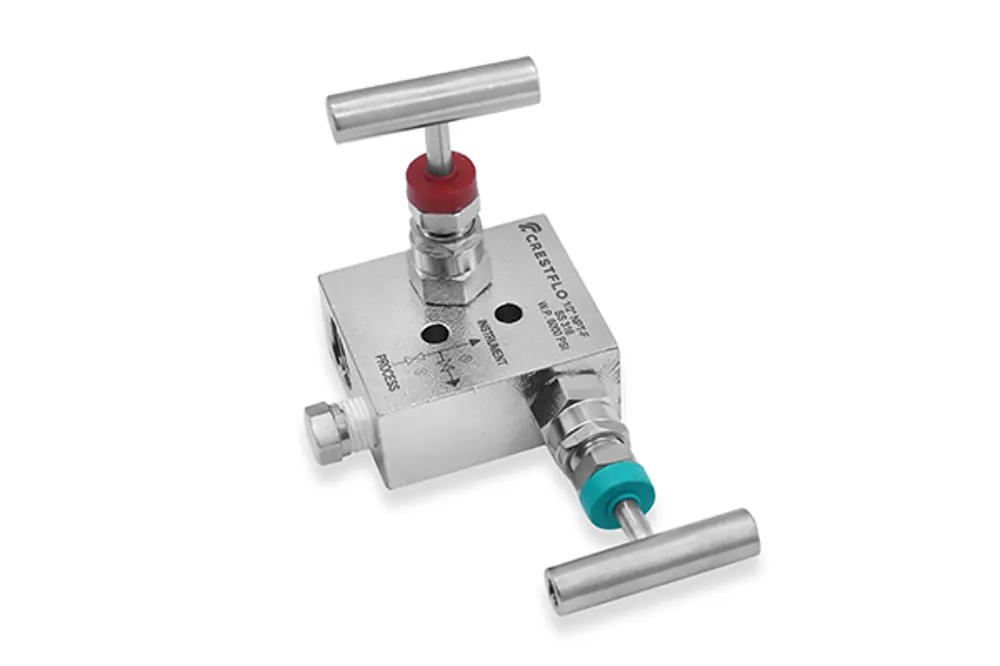
A monoflange valve is a compact instrumentation isolation valve. It builds the primary isolation into a single machined flanged body, and in block-and-bleed and double-block-and-bleed versions, it adds a second isolation plus a bleed or vent point. The result: a pressure gauge or transmitter mounts straight onto a process flange, no multi-valve hook-up needed. Here, "monoflange valve" refers specifically to an instrumentation integral-flange isolation valve used for gauge and transmitter take-offs. It's not a general pipeline flanged gate or ball valve.
Crestflo builds monoflange valves for customers across the US, working in 316/316L and also in high-nickel and corrosion-resistant alloys. Each valve is designed per ASME B16.34, with an ASME B16.5 flange connection and full material traceability built in. Standard items ship from ready stock. Specials don't sit on a shelf; they're made to order, and delivery runs 6-8 weeks. Reviewed by the Crestflo Engineering Team.
What Is a Monoflange Valve? Function & Working Principle
A monoflange valve takes the place of a whole bank of separate isolation and bleed valves, folding them into one flanged block that holds between one and three internal isolation valves. The primary isolation element seals the instrument off from process pressure. A bleed or vent port then lets out the pressure trapped between the isolation and the instrument, so the gauge or transmitter can be calibrated, tested, or pulled without shutting down the main line. Put those functions in a single body and you cut weight, reduce potential leak paths, and shave installation time compared with a bolted-together assembly of gauge-root, isolation, and bleed valves.
The component also goes by mono flange valve, mono-flange valve, monoblock valve, or simply monoflange, and, when it carries the bleed function, monoflange block-and-bleed valve or monoflange double block-and-bleed (DBB) valve. All these names point to the same integral-flange instrument isolation valve covered here.
Monoflange, Monoblock, DBB & Instrument Monoflange: Also Known As
Across drawings, data sheets, and RFQs the same valve appears under several names. Engineers call it a monoflange valve, mono flange valve, monoblock valve, or monoflange instrument valve; by function it is written as a monoflange isolation valve, monoflange single block-and-bleed valve, monoflange block-and-bleed valve, or monoflange DBB / double block-and-bleed valve. By valve count the configurations are described as 2-valve, 3-valve, and 5-valve monoflanges, and by mounting as a process monoflange or an instrument monoflange (direct-mount or remote-mount). With its integral flanged process connection it is written as a flanged monoflange valve, and for a gauge take-off as a monoflange gauge valve. By isolating element you will see the monoflange needle valve and the monoflange ball valve. All name the one-to-three-isolation integral-flange instrument valve on this page.
Monoflange Valve Types & Configurations: Single Block, Block-and-Bleed & Double Block-and-Bleed (DBB)
Monoflange valves get specified according to how many isolations and bleeds they carry. A single-block monoflange offers one primary isolation. Add a bleed or vent for safe depressurization, and you've got a block-and-bleed monoflange. Go further still: a double-block-and-bleed (DBB) monoflange carries two isolations in series with a bleed between them, giving redundant, provable isolation of hazardous or high-pressure media. The DBB build folds that same double-isolation-and-bleed logic, the kind you'd find in a discrete double block-and-bleed valve, into a single flanged body.
| Configuration | Isolation valves | Bleed / vent | Also called | Primary use |
|---|---|---|---|---|
| Single-block monoflange | 1 primary isolation | — | 1-valve monoflange | Basic gauge/transmitter isolation |
| Block-and-bleed monoflange | 1 primary isolation | 1 bleed | 2-valve monoflange | Isolate and safely vent before service |
| Double block-and-bleed (DBB) monoflange | 2 isolations in series | 1 bleed | 3-valve / DBB monoflange | Redundant, provable isolation for hazardous media |
| Instrument-mount DBB monoflange | 2 isolations + secondary | 1–2 bleeds | 5-valve monoflange | Full DBB with additional test/calibration port |
The vent, bleed, and test ports can be configured to match your hook-up. Specify the configuration and port arrangement you need on the RFQ.
Process vs Instrument Monoflange: Direct-Mount & Remote-Mount
A process monoflange bolts straight onto the main process flange and serves as the primary shut-off for the take-off point. That's the direct-mount arrangement. An instrument monoflange, by contrast, mounts onto a primary or root valve that's already in place, and it carries the secondary isolation and bleed for the instrument. This is the remote-mount arrangement. Which one you choose comes down to a simple question: is the monoflange delivering the primary process isolation, or is it refining an isolation that already exists closer to the gauge or transmitter?
Monoflange Isolation Elements: Needle & Ball
The internal isolation can take the form of a needle element or a ball element. A needle valve element delivers fine, metering-grade shut-off and suits high-pressure, small-bore service; a ball valve element gives quarter-turn, full-bore isolation instead. Seats come soft, in PTFE or PEEK, for tight bubble-tight shut-off, or hard and metal for the widest temperature span. The bleed function itself is typically handled by a bleed valve needle element. Both needle- and ball-element monoflanges are built to order. Specify your preferred isolating element on the RFQ.
Monoflange Valve Pressure Class (150–2500), Sizes & Connections
Crestflo monoflange valves follow ASME B16.34 for isolation duty. The process connection is flanged to ASME B16.5, available in Classes 150 through 2500, and instrument ports come in NPT, tube-fitting, or flanged form. Pressure-temperature capability tracks the applicable ASME B16.5 flange class and material group. The seal sets the temperature range. A metal or hard seat runs up to the body-material limit. A PTFE soft seat, by contrast, stays within the standard PTFE range of about −54 °C to +232 °C (−65 °F to +450 °F), and a PEEK seat pushes higher still. Three mounting options are available: the direct process-flange build, the remote instrument build, and a panel-mount monoflange suited to gauge panels and enclosures. Specify the mount on the RFQ.
| Parameter | Basis / value |
|---|---|
| Isolation design standard | ASME B16.34 pressure-temperature rating |
| Flange connection | ASME B16.5, raised-face or ring-type joint (RTJ) |
| Flange class range | Class 150, 300, 600, 900, 1500, 2500 |
| Instrument connection | NPT (ASME B1.20.1), tube-fitting, or flanged instrument port |
| Isolation size range | 1/16″–1″ instrumentation range, imperial and metric |
| Mounting options | Process (direct-mount), instrument (remote-mount), and panel-mount configurations |
| Soft-seat temperature | PTFE approx. −54 °C to +232 °C (standard PTFE limit); PEEK higher |
| Hard/metal-seat temperature | To the body-material limit per ASME B16.34 |
Values follow the applicable standard and can be adjusted to your requirements. Contact the engineering team for certified flange-class ratings and per-size data specific to your configuration.
Monoflange Valve Materials: 316 Stainless, 904L, Duplex, Inconel, Monel & Hastelloy
The standard stainless steel monoflange valve comes in 316/316L, backed by a full corrosion-resistant-alloy ladder that covers chloride, sour, and other aggressive-media service. When chloride pitting, sour partial pressures, or elevated temperature push past what 316 can handle, an exotic alloy takes over. Sour-service builds ship in NACE MR0175 / ISO 15156 compliant materials on request. Brass isn't offered on the US range.
| Grade | UNS | Family | Instrumentation form |
|---|---|---|---|
| 316 / 316L | S31600 / S31603 | Austenitic stainless | 316/316L valves |
| 304 / 304L | S30400 / S30403 | Austenitic stainless | 304/304L |
| 904L | N08904 | Super-austenitic | 904L valves |
| Duplex 2205 | S31803 / S32205 | Duplex | Duplex 2205 |
| Super Duplex 2507 | S32750 | Super duplex | Super Duplex 2507 for chlorides |
| 254 SMO | S31254 | 6Mo super-austenitic | 254 SMO |
| AL-6XN | N08367 | 6Mo super-austenitic | AL-6XN |
| Alloy 20 | N08020 | Nickel-alloy | Alloy 20 |
| Inconel 625 | N06625 | Nickel-chromium | Inconel 625 |
| Inconel 825 | N08825 | Nickel-iron-chromium | Inconel 825 |
| Monel 400 | N04400 | Nickel-copper | Monel 400 valves |
| Hastelloy C-276 | N10276 | Nickel-molybdenum | Hastelloy C-276 |
| Titanium Gr2 | R50400 | Titanium | Titanium Gr2 |
UNS designations are the standard published references for each grade. Finishes include material finish, electropolish, passivation, and silver anti-galling plating; oxygen and ultra-high-purity cleaning is available for clean-service builds. Explore the full instrumentation valve material range or specify your grade on the RFQ.
Monoflange Standards & Compliance: ASME B16.34, B16.5, B1.20.1 & NACE MR0175
Crestflo monoflange valves meet the ASME B16.34 pressure-temperature standard. The process flange is built to ASME B16.5, while NPT threads follow ASME B1.20.1. For sour service, materials compliant with NACE MR0175 and ISO 15156 are available. Instrument valves, though, qualify under the standards that actually govern them: ASME B16.34, plus API pressure test and qualification methods. That's not the same as ASTM F1387, which covers compression fittings. Crestflo holds ISO 9001, ISO 14001, ISO 45001 and PED certification, along with the standard approvals expected for instrumentation valves of this type.
| Standard | Scope | Applies to monoflange |
|---|---|---|
| ASME B16.34 | Valve pressure-temperature ratings & design | Isolation design, working pressure |
| ASME B1.20.1 | NPT pipe threads | NPT instrument connections |
| NACE MR0175 / ISO 15156 | Sour-service materials | Alloy selection for H₂S service |
| ISO 9001 / 14001 / 45001, PED | Quality, environmental, safety, pressure equipment | Manufacturing system |
| EN 10204 | Material test certificates | 3.1 standard / 3.2 on request |
Monoflange Valve Testing, Traceability & Quality
Every monoflange valve carries heat- and lot-number marking, and it ships with an EN 10204 3.1 material test certificate as standard; 3.2 certification is available on request. Seat and shell leak testing verifies each isolation. Hydraulic proof testing, burst testing, and pneumatic testing back that up, and on block-and-bleed and DBB builds, the bleed port proves each isolation stage. Positive material identification (PMI) confirms the alloy grade. In-house NDT supports the build. Destructive testing happens at ISO/IEC 17025-accredited laboratories, and third-party inspection can be arranged on request.
Monoflange Valve Applications & Industries
Monoflange valves isolate pressure gauges, DP transmitters, and process take-offs in situations where space, weight, and leak paths need to stay to a minimum. They serve as a compact alternative to a bolted gauge-root, isolation, and bleed assembly, or to a remote 2-valve, 3-valve, or 5-valve manifold. Engineers specify them across oil and gas, offshore, petrochemical, LNG and cryogenic, and analytical sampling service. For sour and high-chloride duty, the body is built from a NACE-compliant duplex or nickel alloy, so isolation and corrosion allowance get specified as one package.
Why Use a Monoflange: Space, Weight & Leak-Path Savings
A monoflange takes what would be a multi-valve gauge hook-up and folds it into a single flanged block. That cuts installed weight, eliminates bolted joints, and removes the leak paths that come with them, while making installation and inspection far simpler. Its integral bleed lets an instrument be depressurized and calibrated safely, and there's no need to isolate the wider system. The DBB build goes further still, adding redundant, provable isolation for hazardous or high-pressure media. That's the combination that explains why engineers reach for monoflanges over discrete valve stacks on modern instrument installations.
Monoflange Ordering, Cross-Reference & Request a Quote
Crestflo builds dimensional drop-in monoflange valves designed to swap directly in place of the units you already specify. No need to mix brands. Give the engineering team your existing part number, and they'll return an equivalent Crestflo build. Just request a cross-reference for your Swagelok®, Parker®, or WIKA® monoflange. Full specifications sit right on the product page. The catalog itself is downloadable, and customers can request per-product datasheets and CAD models on demand. Standard items ship from stock already on hand; specials are built to order, with delivery running six to eight weeks.
Contact Crestflo US at sales@crestflousa.com, call +1 346 594 9005, or visit us in Houston, TX. Request a quote or request a sample. Distributors should look at the distributor program, while OEMs will want the private-label program.
Why Crestflo for Monoflange Valves
Crestflo is the instrumentation arm of a four-decade-old export house recognized by the Government of India, with a proven delivery record across the Middle East and now serving the US market with drop-in instrumentation valves. Monoflange valves come in stainless and high-nickel alloys, from single-block through DBB, with heat-number traceability and EN 10204 material certificates on every part. Standard product is of Indian origin. US or European melt is available on request, with full material traceability. Small minimum order quantities, private-label and made-to-print options, and a 6-8 week lead time make Crestflo a low-risk second-source supplier and manufacturer for distributors, OEMs, equipment manufacturers, and end users. Pricing for monoflange valves runs on an RFQ model, with no published list price; cost depends on configuration, alloy, flange class, and certification scope. We Engineer Confidence.
Monoflange Valve FAQ
What is a monoflange valve?
A monoflange valve packs one to three internal isolation and bleed valves into a single flanged body. That's the whole point of it: a compact instrument isolation valve that lets a pressure gauge or transmitter bolt straight onto a process flange, with no separate multi-valve hook-up needed. Some engineers call it a monoblock valve. Others say mono-flange.
How does a monoflange valve work?
The primary isolation element cuts the instrument off from process pressure. A bleed or vent port then releases, safely, the pressure trapped between the isolation and the instrument, allowing the gauge or transmitter to be calibrated or removed without shutting down the main line. Block-and-bleed designs add that bleed; DBB goes further, adding a second isolation point, so isolation can actually be proven.
What are the types and configurations of a monoflange valve?
Monoflange valves fall into three basic types. Single-block is the simplest: one isolation, nothing more. Block-and-bleed adds a bleed to that isolation, turning it into a 2-valve monoflange. Double-block-and-bleed, or DBB, brings two isolations plus a bleed together in a 3-valve monoflange. A 5-valve monoflange goes further still, tacking on a test or calibration port. Don't forget to specify the configuration and ports on the RFQ.
What is the difference between a process and an instrument monoflange?
A process monoflange bolts straight onto the main process flange, and it serves as the primary shut-off. That's the direct-mount version. An instrument monoflange, by contrast, mounts onto an already-installed primary or root valve. It carries the secondary isolation and bleed for the instrument, this is the remote-mount type.
Which valve is best for instrument isolation?
For gauge and transmitter take-offs, a monoflange (or a valve manifold) is the preferred choice. It brings isolation and bleed together into one leak-tight body. A double-block-and-bleed monoflange goes a step further, adding redundant, testable isolation for hazardous or high-pressure media.
What materials and pressure classes are available for a monoflange valve?
Standard construction uses 316/316L stainless, though 904L, Duplex 2205, Super Duplex 2507, 254 SMO, Inconel, Monel, Hastelloy, and Titanium Gr2 are all available. Isolation components follow ASME B16.34, and the process flange meets ASME B16.5, spanning Classes 150 through 2500. Class and size aren't fixed; both can be tailored to the requirement.
Are Crestflo monoflange valves NACE compliant for sour service?
Yes. Sour-service monoflange valves ship in NACE MR0175 / ISO 15156 compliant materials, fully traceable. For H₂S service, pick a duplex or nickel alloy body so the isolation function and the corrosion allowance get specified together.
What valve is best for steam service?
For steam and steam-tracing hook-ups, go with a metal or graphite seat and packing rated for the service temperature, not a soft PTFE seat. Crestflo matches seal materials to the service. Give us your temperature on the RFQ, and the seat gets picked to the applicable standard limit.
What certifications and test reports come with a monoflange valve?
The company holds ISO 9001, 14001, 45001 and PED certification. Each valve carries a heat and lot number, and ships with an EN 10204 3.1 material test certificate; a 3.2 version is available on request. Seat and shell leak testing come standard. So does PMI. In-house NDT is available too, and third-party inspection can be arranged on request.
Where are Crestflo monoflange valves made, and how fast can they ship?
Standard product comes from India and is engineered as a drop-in replacement for US material, with US or European melt available on request and full material traceability. Standard items ship from stock already on hand. Specials, though, are made to order, with a 6-8 week delivery window, small minimum order quantities, and private-label options.
Related Instrumentation Valves & Resources
Take a look at the full instrumentation valves range, along with the related double block-and-bleed valve, gauge root valve, bleed valve, needle valve, and ball valve. There's also the 2-valve, 3-valve, and 5-valve manifolds worth a look. For standards, check the ASME B16.34 design standard and the NACE MR0175 sour-service standard. Need a brand cross-reference? Request one through the cross-reference resources.