
904L Stainless Steel (UNS N08904): Instrumentation Fittings, Valves & Tubing
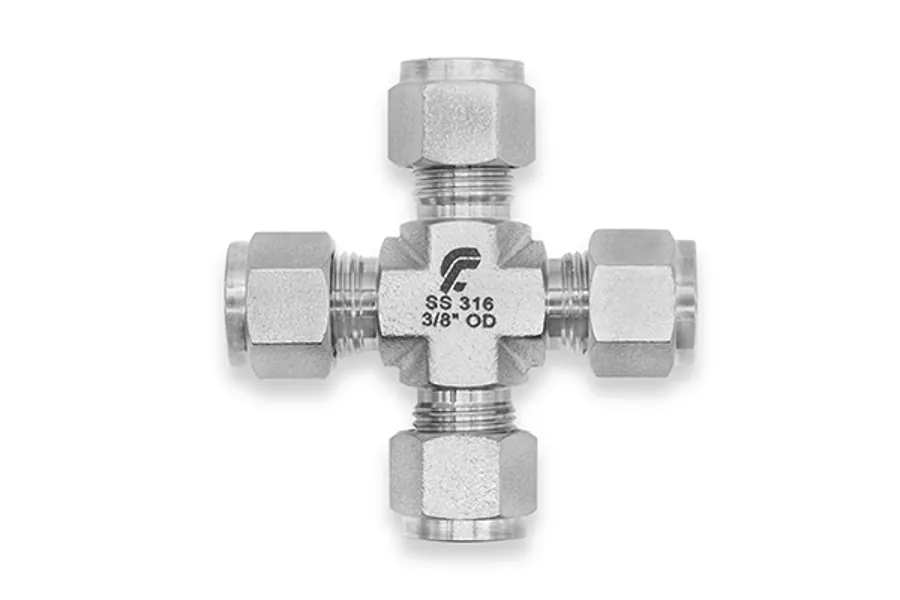
904L is a super-austenitic stainless steel, loaded with nickel and molybdenum and given a deliberate copper addition. It's designated UNS N08904, also known as Werkstoff 1.4539, and built to resist reducing acids, chlorides and seawater in spots where 300-series stainless just corrodes away. Crestflo, a US-serving 904L supplier and stockist, offers this grade as instrumentation tube and compression fittings, instrumentation valves, and instrumentation tubing. Traceable by heat and lot number. Built as a drop-in replacement for the major brands, and delivered in 6-8 weeks. The composition, mechanical, PREN and corrosion values below are standard published figures for the alloy, drawn from the applicable ASTM specification, and they can be adjusted to your requirements.
Scope: on Crestflo, 904L refers to the super-austenitic stainless steel (UNS N08904) used in industrial fluid-system components: instrumentation fittings, compression ferrules, valves and tubing. It doesn't mean luxury-watch case steel. The trade name "Oystersteel" points to a watch-industry variant of 904L, a different thing entirely. Crestflo stocks this alloy only as instrumentation fittings, valves and tubing. No mill bar, sheet, plate or pipe.
Request a 904L Quote · Request a Sample · sales@crestflousa.com · +1 346 594 9005 (Houston, TX)
904L Also Known As: UNS N08904, Alloy 904L & Werkstoff 1.4539
Drawings, datasheets and purchase orders rarely settle on one name for the same alloy. A print might read "Alloy 904L," "Type 904L," "SAE 904L," or "X1NiCrMoCu25-20-5." Four labels, one grade: this super-austenitic stainless steel.
| Designation type | Value |
|---|---|
| Trade / common names | 904L, Alloy 904L, Type 904L, SAE 904L, 904 L, stainless steel 904L |
| UNS number | UNS N08904 (N08904) |
| Werkstoff (W.Nr.) | 1.4539 (Werkstoff 1.4539 / DIN 1.4539) |
| EN name | X1NiCrMoCu25-20-5 (EN 1.4539) |
| Alloy family | Super-austenitic (high-alloy austenitic) stainless steel |
| Spaced / reversed forms | 904 L, stainless steel 904L, N08904 alloy |
UNS N08904 is the US designation. Werkstoff 1.4539 is the European one. Both describe the same alloy, so no matter which name shows up on a spec sheet, you're looking at the same 904L super-austenitic stainless.
904L Chemical Composition (Super-Austenitic Stainless, per ASTM)
904L owes its resistance to corrosion to a mix of high nickel and molybdenum, a copper addition, and one of the lowest carbon limits found in any austenitic stainless. Copper is the piece that separates it from other stainless grades when it comes to reducing acids. The low carbon content, meanwhile, keeps resistance intact in welds and the areas right next to them.
| Element | wt % (per ASTM B625 / B677) |
|---|---|
| Chromium (Cr) | 19.0–23.0 |
| Nickel (Ni) | 23.0–28.0 |
| Molybdenum (Mo) | 4.0–5.0 |
| Copper (Cu) | 1.0–2.0 |
| Manganese (Mn) | 2.0 max |
| Silicon (Si) | 1.0 max |
| Carbon (C) | 0.020 max |
| Phosphorus (P) | 0.045 max |
| Sulfur (S) | 0.035 max |
| Iron (Fe) | Balance |
Ranges follow whatever ASTM product-form specification applies. Crestflo confirms the actual heat chemistry on the EN 10204 material test certificate that comes with every order.
904L Mechanical & Physical Properties (Density, Non-Magnetic, Strength)
Annealed 904L pairs moderate strength with high ductility and toughness, which suits it well for fitting and valve forming. It's fully austenitic, so it holds onto its toughness even at cryogenic temperatures, with no ductile-to-brittle transition to worry about. The figures below are standard published minimums along with nominal physical data for the alloy.
Mechanical properties (annealed, room temperature)
| Property | Value |
|---|---|
| Tensile strength | ≥ 71 ksi (490 MPa) |
| Yield strength (0.2% offset) | ≥ 32 ksi (220 MPa) |
| Elongation | ≥ 35% |
| Hardness | ≤ ~90 HRB |
Physical properties
| Property | Value |
|---|---|
| Density | 7.95 g/cm³ (0.287 lb/in³) |
| Melting range | 1300–1390 °C (2370–2535 °F) |
| Structure / magnetism | Austenitic; essentially non-magnetic in the annealed condition |
Mechanical minimums follow the applicable ASTM specification for the annealed condition. Final certified properties for a given heat, though, are stated on the material test certificate.
904L PREN & Corrosion Resistance (Does 904L Rust?)
904L's pitting resistance equivalent number, calculated from nominal composition using PREN = Cr + 3.3 × Mo + 16 × N, comes out to roughly 34, 36. That's well above the ~24 you get from 316L, and it reflects something simple: 904L carries about double the molybdenum. The alloy resists pitting and crevice corrosion well. Where it really pulls ahead of 300-series stainless, though, is chloride stress-corrosion cracking. High nickel and copper content also give it a genuine edge in reducing acids like sulfuric and phosphoric.
No alloy is immune to everything. Selection still comes down to the media involved, the temperature, and the chloride level in play. PREN itself is just a calculated ranking index, nothing more. For a look across alloys side by side, see the PREN comparison table.
904L Corrosion Resistance by Media: Sulfuric Acid, Chlorides & Seawater
904L was built specifically for dilute-to-moderate sulfuric acid and other reducing environments that chew through standard stainless. It still holds onto strong resistance to chloride attack and stress-corrosion cracking. The table below sets out typical service suitability, drawn from standard alloy corrosion literature and relevant to PED-rated applications.
| Media / service | Suitability | Note |
|---|---|---|
| Sulfuric acid (H₂SO₄), dilute–moderate | Good–Excellent | Copper addition is the defining advantage over 316L |
| Phosphoric acid (H₃PO₄) | Good | Including contaminated process acid |
| Acetic & formic acids | Excellent | Organic-acid process streams |
| Chlorides / pitting & crevice | Good | ~2× the molybdenum of 316L; PREN ~34 |
| Chloride stress-corrosion cracking | Highly resistant | Key advantage over 304/316 austenitics |
| Seawater / brackish water | Good | Marine and desalination service |
| Flue-gas / scrubber condensate | Good | Reducing, chloride-bearing condensate |
For checking a specific process against alloys, look at the corrosion-by-media × alloy matrix and the material-selection-by-service guide.
904L vs 316L: Composition, PREN & When to Step Up
904L versus 316L is the question we hear most from buyers. 904L carries roughly double the molybdenum of 316L, along with higher nickel and a copper addition. That combination pushes PREN to about 34, compared with roughly 24 for 316L, and it brings genuine resistance in reducing acids and against chloride stress-corrosion cracking. The trade-off is a premium on raw material cost and machining that's noticeably tougher. For general instrument service, 316L usually does the job, and it costs less.
The gap widens further when you compare 904L with plain 304. Molybdenum, extra nickel, and a copper addition all set 904L apart, and 304 has none of these. So in conditions where 304 pits or cracks under chloride stress and reducing acids, 904L simply holds up.
| Property | 316L (S31603) | 904L (N08904) | 254 SMO (S31254) |
|---|---|---|---|
| Chromium (Cr) | 16–18% | 19–23% | 19.5–20.5% |
| Nickel (Ni) | 10–14% | 23–28% | 17.5–18.5% |
| Molybdenum (Mo) | 2–3% | 4–5% | 6–6.5% |
| Copper (Cu) | — | 1–2% | 0.5–1% |
| PREN (approx.) | ~24 | ~34 | ~43 |
| Relative cost | Baseline | Premium | Higher |
| Choose when | Standard service, no acid/chloride upgrade | Reducing acids, chlorides, SCC risk | High-chloride/seawater beyond 904L |
For a full breakdown, check the 904L vs 316 comparison page. The 316 / 316L material page and the 304 / 304L material page cover each grade in more depth.
When to Choose 904L: and When to Step Up to 6Mo, Alloy 20 or Duplex
904L falls somewhere between the everyday austenitic grades and the tougher 6-molybdenum and nickel alloys on the corrosion scale. Where exactly? The decision points below answer that by stacking it up against the grades buyers most often compare it to, and each one links out to its own material or comparison page.
| Alloy | Key strength | Choose when | More detail |
|---|---|---|---|
| 316 / 316L (S31603) | Cost-effective general service | Mildly corrosive instrument service | 316 / 316L |
| 904L (N08904) | Reducing acids, chlorides, Cl-SCC resistance | Sulfuric/phosphoric acid and chloride duty beyond 316L | This page |
| 254 SMO (S31254) / AL-6XN | 6-Mo pitting resistance (PREN ~43) | High-chloride, seawater and stronger pitting risk than 904L handles | 254 SMO · AL-6XN |
| Alloy 20 (N08020) | Sulfuric-acid specialist | Concentrated/hot sulfuric acid service | Alloy 20 |
| Duplex 2205 / Super Duplex 2507 | High strength with chloride resistance | Strength-plus-corrosion, chloride-rich duty | Duplex 2205 · Super Duplex 2507 |
Two guides cover this comparison in depth. For the three-way matchup, see the 254 SMO vs super duplex vs AL-6XN guide. For the head-to-head between Alloy 20 and 316, read the Alloy 20 vs 316 guide.
904L for Sour Service (NACE MR0175 / ISO 15156)
904L can be supplied to NACE MR0175 / ISO 15156 where the sour (H₂S-containing) application qualifies. Check the hardness and material-condition limits in the standard against your specific service before you commit to it. Crestflo supplies NACE MR0175 / ISO 15156-compliant 904L fitting and valve material options. See the NACE MR0175 and ISO 15156 standard pages, and take a look at the sour-service selection guide as well.
904L Temperature & Pressure Suitability
904L is fully austenitic, so it keeps its toughness from cryogenic temperatures on up, with no ductile-to-brittle transition. It's typically used for corrosion service up to around 350–400 °C (660–750 °F), depending on the environment. Pressure rating for a finished part comes down to product form and wall thickness, though, not the grade itself. That's why working-pressure ratings are given on the individual tube-fitting, valve and tubing pages, according to the applicable standard and open to customization as needed. See also pressure–temperature derating.
904L Product-Form Standards (ASTM B677, B674, B673, B649, B625 & ASME SB-)
A family of ASTM specifications covers the alloy, organized by product form, and each one carries a matching ASME SB designation. Those specifications define the grade. Crestflo doesn't supply the mill forms. It supplies the instrumentation forms (fittings, valves, tubing) built from certified material to these specifications.
| Product form | ASTM | ASME equivalent |
|---|---|---|
| Seamless pipe & tube | B677 | SB-677 |
| Welded pipe | B674 | SB-674 |
| Welded tube | B673 | SB-673 |
| Rod & bar | B649 | SB-649 |
| Plate, sheet & strip | B625 | SB-625 |
Values and grades follow the applicable ASTM or ASME specification, and material certificates come with every order. For traceability documentation, see EN 10204 MTC.
904L Weldability & Machinability
904L carries very low carbon, so it welds without sensitisation and keeps its corrosion resistance intact in and around the weld. Filler metals matched to the base alloy preserve that balance. It work-hardens fast, though, and cuts tougher than 316L. That's one practical reason to buy finished, correctly formed instrumentation parts rather than fabricate from bar. Crestflo machines 904L in-house on CNC / VMC / EDM equipment, with tooling and speeds set for the grade.
904L Applications & Industries: Chemical, Oil & Gas and Marine
904L gets specified whenever reducing acids or chlorides would defeat standard stainless. Think chemical and petrochemical acid handling, oil and gas and offshore systems, seawater and desalination, flue-gas scrubbers, and pulp-and-paper bleaching. For instrumentation, that means impulse lines, sample systems, analyzer panels, and gauge hook-ups on those same services.
- Petrochemical & chemical processing, sulfuric/phosphoric acid and mixed-media streams.
- Oil & gas, sour and chloride-bearing production and process service.
- Marine & shipbuilding, seawater, brackish water and desalination duty.
For chloride-driven selection, see the offshore-chloride selection guide.
904L Product Forms from Crestflo: Fittings, Valves & Tubing
Crestflo offers UNS N08904 across three instrumentation product lines, each with its own detail page covering sizes, ratings and ordering information. The grade works with compression and ferrule fittings, needle, ball and manifold valves, and seamless instrumentation tubing.
- 904L tube & compression fittings: offered in single and double ferrule (twin-ferrule) styles, hardened or non-hardened, in imperial and metric sizes, with end connections running up to 2" (50 mm) OD. Some catalogs list these as 904L compression fittings, 904L double-ferrule fittings, or UNS N08904 fittings. Every compression tube fitting is performance-qualified per ASTM F1387. For more, browse the tube-fittings hub.
- 904L instrumentation valves: needle, ball, check, and 2/3/5-way manifold valves, all in 904L, ranging from 1/16" to 1". The pressure-boundary design follows ASME B16.34, paired with API seat-leak and test practice. Check out the instrumentation-valves hub for the full range.
- Seamless 904L instrumentation tubing: seamless 904L / N08904 instrumentation tubing available in imperial and metric OD/wall combinations. Finish options run from material finish to electropolish and passivation.
Every Crestflo 904L part comes stamped with a heat/lot number and ships alongside an EN 10204 material test certificate. Size, ferrule type, finish, thread standard: all set to match what's specified.
Why Crestflo for 904L
We Engineer Confidence. For a premium super-austenitic like 904L, that means chemistry checked and verified through PMI. Sourcing you can trust. Interchange that's genuinely real. And all of it lives in specs you can actually pull data from, not some PDF buried in a folder nobody opens.
- Drop-in interchange for Swagelok®, Parker®, Hoke® and Hy-Lok®, dimensions match, and the compression fitting ends carry ASTM F1387 performance qualification behind them (these are interchange/equivalent parts, not "compatible/intermix"). Want a cross-reference? Ask our engineering team for your Swagelok®/Parker® cross-reference via the Swagelok cross-reference page.
- Lead time runs 6-8 weeks, against 20+ weeks typical for the majors. See the lead-time capability page for details.
- Full traceability comes standard: heat/lot number stamped on every part, EN 10204 MTC 3.1 included as a baseline (3.2 available on request), and PMI to confirm the material really is N08904. In-house testing backs all of it.
- NACE MR0175 / ISO 15156 material options are available across the board, in single and double ferrules, hardened or non-hardened, imperial and metric, on every fitting.
- We're ISO 9001 / 14001 / 45001 & PED certified, and machining happens in-house, CNC / VMC / EDM, with small MOQ and private-label options on the table.
- The heritage behind the brand: Crestflo is the instrumentation division of a four-decade-old export house recognized by the Government of India, with a delivery track record built across the Middle East. New in manufacturing, but the export pedigree runs deep. Read more about Crestflo.
Standard stock ships from inventory; specials are made to order, running 6-8 weeks for delivery. Origin is Indian, though US or European melt is available on request, and full material traceability comes with it (origin & compliance).
Buyers: Request a Quote or a Sample if you're an end user, EPC, or panel fabricator. Equipment manufacturers and OEMs should talk to an engineer or send a print. Want to sell our products? Become a distributor. We serve the oil & gas, petrochemical & chemical, and marine sectors across the US.
904L Stainless Steel FAQs
Is 904L better than 316L?
904L stands up better against reducing acids like sulfuric and phosphoric, against chlorides, and against stress-corrosion cracking. It carries roughly double the molybdenum of 316L, along with higher nickel and a copper addition, which pushes its PREN to about 34 versus about 24 for 316L. For general instrument service, though, 316L usually does the job just fine, and it costs less. Match the alloy to the media. Don't over-specify.
What is 904L stainless steel used for?
Chemical and petrochemical acid handling, oil and gas and offshore systems, seawater and desalination, flue-gas scrubbers, and pulp-and-paper bleaching: it holds up wherever reducing acids or chlorides chew through standard stainless. In instrumentation, that's impulse lines, sample systems, and gauge hook-ups on those same services.
What is 904L equivalent to?
904L carries a handful of designations: UNS N08904, Werkstoff 1.4539 (DIN 1.4539), SAE 904L, and EN X1NiCrMoCu25-20-5. They're not different alloys, though; UNS N08904 and Werkstoff 1.4539 describe one and the same super-austenitic stainless alloy.
Does Rolex use 904L?
Rolex sells a 904L variant under the name "Oystersteel" for watch cases. Crestflo's 904L (UNS N08904) isn't for watches at all; it's used in industrial instrumentation, fittings, valves and tubing. Same alloy family, different application.
Does 904L rust?
904L stands up well against corrosion. It resists pitting, crevice corrosion and chloride stress-corrosion cracking far better than 300-series stainless does. Still, no alloy holds up against everything. Whether it's right for your application comes down to the media involved, the temperature and how much chloride your service actually sees.
Is 904L magnetic?
No. 904L comes out fully austenitic, and in the annealed condition it's essentially non-magnetic. Push it hard with cold work, though, and you'll see a trace of magnetism creep in. That's true of other austenitic stainless steels too.
What is the chemical composition of 904L?
Chromium runs 19–23%, nickel 23–28%, molybdenum 4–5%, copper 1–2%, and carbon is capped at 0.020% max, with iron making up the balance. It's the copper and the high molybdenum content that give 904L its resistance to reducing acids and chlorides. Full ASTM ranges are in the composition table above.
Which ASTM/ASME specs cover 904L product forms?
Pipe and tube made without a weld fall under ASTM B677. Welded pipe carries the B674 designation, and welded tube falls under B673. Rod and bar are covered by B649; plate, sheet, and strip by B625. Each of these pairs with a matching ASME SB standard.
Is 904L NACE-compliant for sour service?
Crestflo can supply 904L to NACE MR0175 / ISO 15156 where the application qualifies. Check the standard for the hardness and material-condition limits that apply to your service before you commit. Crestflo offers NACE-compliant 904L options across its fitting and valve material range.
What sizes of 904L tube fittings can Crestflo supply?
Compression and tube fittings up to 2" (50 mm) OD, available in single or double ferrule, hardened or non-hardened, instrumentation valves from 1/16" to 1", and seamless instrumentation tubing. Both imperial and metric are covered, and everything can be customized to requirement.
Why is 904L more expensive than 316L?
Higher nickel, molybdenum and copper content push up raw-material cost. The alloy work-hardens, too, and it's tougher to machine than 316L. Buying finished, correctly formed parts sidesteps the fabrication risk. Crestflo prices by quotation, and even after US duties, it stays cost-competitive.
Can I get 904L parts with material certificates and heat traceability?
Yes. EN 10204 3.1 certificates are standard, and we'll provide 3.2 on request. Every part carries a heat/lot number, so full traceability isn't an issue. PMI confirms the alloy, and testing follows Crestflo's in-house QA regime.
What is the price and lead time for 904L fittings?
Pricing runs by quotation, not through an online cart. Standard items ship from ready stock; specials are made to order, with delivery running 6 to 8 weeks. Standard product comes from India. US or European melt is available on request, and full traceability comes with it. To get a configured part number and price, submit an RFQ with size, form, material and rating.
Related Alloys & Resources
- 316 / 316L stainless, the standard-service baseline before a 904L upgrade.
- 254 SMO · AL-6XN, 6-molybdenum super-austenitics for higher-chloride service.
- Alloy 20, the sulfuric-acid specialist alloy.
- Duplex 2205 · Super Duplex 2507, high-strength chloride-resistant duplex grades.
- 904L vs 316 and the corrosion-alloy matrix decision guides.
- Browse the full range from the instrumentation valves hub and the materials hub.
Request a 904L Quote
Send the Crestflo Engineering Team your form type (fittings, valves or tubing) along with size, end connections and line conditions. They'll get back to you with a configured part number, ratings and price.
Request a Quote · Request a Sample · Browse the materials hub Reach Crestflo at sales@crestflousa.com or +1 346 594 9005. We're based in Houston, TX.
Datasheets and CAD drawings are available to customers on request. The Crestflo Engineering Team reviewed this information. Swagelok®, Parker®, Hoke® and Hy-Lok® are trademarks of their respective owners. Crestflo parts are interchange or equivalent parts.