
Stainless Steel & Alloy Instrumentation Tube Fittings
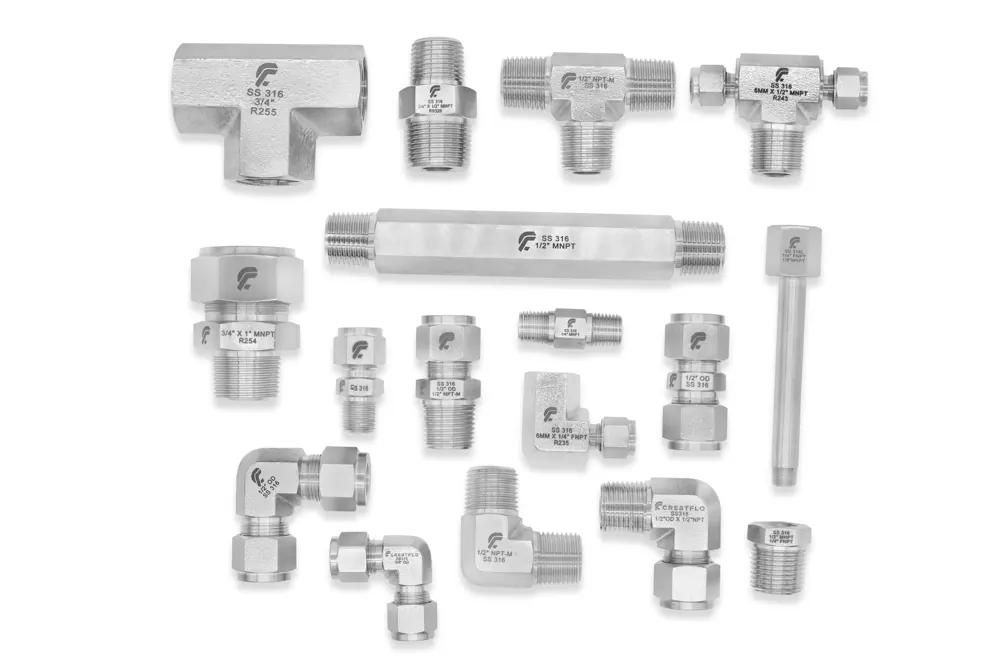
A stainless steel tube fitting is a mechanical-grip (compression) fitting that joins and seals instrument tubing by advancing a nut that drives one or two ferrules onto the tube outside diameter, forming a leak-tight metal seal and a strong tube grip without brazing, flaring, or threading the tube itself. Crestflo manufactures instrumentation tube fittings in 316/316L, high-nickel alloy, and titanium, with end connections up to 2" (50 mm) OD, single or double ferrule, imperial and metric, engineered as ASTM F1387-qualified drop-in replacements and delivered on a 6-8 week lead time.
These are instrumentation fittings for process, analytical, and hydraulic instrument lines, instrumentation-grade stainless and alloy compression tube fittings, not copper or plumbing compression fittings, and not pipe fittings. Ready stock for standard items, made-to-order for specials, 6-8 week delivery. Request a quote or request a sample.
Across catalogs and datasheets these components are specified under many names. The same part is called a tube fitting, a compression fitting, a compression tube fitting, a double-ferrule, two-ferrule, or twin-ferrule fitting, a single-ferrule or ferrule fitting, an instrument tube fitting, a tube coupling or tube union coupling, a tube connector, or simply a stainless tube fitting, an SS tube fitting, or a stainless-steel tube fitting; distributors and specifiers list the same SS tube fittings and stainless tube fittings interchangeably. Buyers searching for a "tube to pipe fitting" are looking for a tube-end by pipe-thread adapter, which is a threaded connector within the same family. Standards designations that travel with the product include ASTM F1387 (mechanically-attached fitting performance), ASTM A269/A213 (the instrument tubing they connect), ISO 8434-1 (24° cone), and DIN 2353 (bite-type). Crestflo supplies the full range under all of these designations.
What Is an Instrumentation Tube Fitting? Working Principle & Tube vs Pipe
An instrumentation tube fitting seals by mechanical grip. As the nut is tightened, it drives the ferrule (or a back-and-front ferrule pair) radially inward onto the tube OD; the ferrule bites into and springs back against the tube to grip it, while its leading edge coins a circumferential metal-to-metal seal against the fitting body. No heat, flame, flux, flare, or tube threading is involved, so the tube wall and its corrosion resistance stay intact. This is what distinguishes a compression, double-ferrule, twin-ferrule, or mechanical-grip fitting from welded, brazed, or flared connections.
Tube and pipe are specified differently, which matters when selecting fittings. Tube is called out by its actual outside diameter and wall thickness (for example per ASTM A269 or A213) and is used for instrument sensing, sampling, and hydraulic lines; pipe is called out by nominal size and schedule. These are fittings for tube. Where a run must transition to pipe, a threaded connector (NPT or BSPP) makes the tube-to-pipe adapter.
Compression Tube Fittings: Where They Are Used
Compression tube fittings (also written tube compression fittings) are the default make-and-break connection for instrument tubing because they are reliable, re-makeable, and require only a wrench and a gap-gauge check to install. They dominate analyzer and sampling systems, transmitter and gauge hook-ups, instrument-air and pneumatic lines, hydraulic control circuits, and process tie-ins where a welded joint is impractical. Crestflo offers both single-ferrule and double-ferrule compression designs, in hardened or non-hardened ferrules to suit the tubing hardness and service.
Double-Ferrule (Twin-Ferrule) Design & Vibration Resistance
The double-ferrule, or twin-ferrule, design separates the two jobs the connection must do. The back ferrule hinges and collets onto the tube to provide the grip and act as a spring-loaded vibration damper, while the front ferrule advances to form the primary seal against the body and the tube. Splitting grip from seal improves performance under vibration, pressure cycling, and thermal cycling, which is why twin-ferrule fittings are specified on rotating equipment, compressors, and thermally active lines. Crestflo double-ferrule fittings are qualified per ASTM F1387 and are offered with hardened or non-hardened ferrules. For single-ferrule, ferrule-less, and DIN 2353 bite-type variants, and for standalone ferrule sets, see the single-ferrule, ferrule-less, DIN 2353, and ferrules pages.
Tube Fitting Types & Shapes: Union, Tee, Elbow, Connector, Reducer
Crestflo builds every shape in the instrumentation tube-fitting family. Select the configuration your run needs and open its page for specifics.
| Shape | Typical function | Configuration page |
|---|---|---|
| Union | Joins two equal tube ends in line | Tube union |
| Male / female connector | Transitions tube OD to a threaded port | Connector · Male connector · Female connector |
| Elbow | Turns the run 90° | Elbow |
| Tee / cross | Branches or splits a line | Tee · Cross |
| Reducer | Changes tube size in the run | Reducer |
| Adapter | Mates dissimilar ends or standards | Adapter |
| Bulkhead union | Fixes a line through a panel | Bulkhead union |
| Port connector | Ties into a gauge or instrument port | Port connector |
| Cap / plug | Closes a tube end or a fitting body | Cap · Plug |
| Nut & ferrule | Spare grip/seal components | Nut and ferrule |
| Weld / orbital-weld connector | Welded tube-stub transition | Weld connector · Orbital-weld fitting |
| Calibration fitting | Test and calibration hook-ups | Calibration fitting |
End Connections & Threads: NPT, BSPP, JIC 37°, Socket-Weld & Tube-to-Pipe
Threaded and welded ends carry standard published thread forms; values are per the applicable standard and customizable to requirement. A tube-to-pipe fitting is simply a tube-OD end paired with a pipe thread.
| End / thread | Standard designation | Typical use | Page |
|---|---|---|---|
| Tube OD | ASTM A269 / A213 tube | Tube-to-tube grip | Tube-OD |
| Male / female NPT | ASME B1.20.1 | General tapered pipe thread | NPT |
| NPTF (dryseal) | ASME B1.20.3 | Sealing without compound | NPTF |
| BSPT / BSPP | ISO 7 / ISO 228 | European tapered / parallel | BSPT · BSPP |
| ISO parallel (G) | ISO 228 | Bonded-seal parallel port | ISO parallel |
| JIC 37° flare | SAE J514 | Hydraulic 37° seat | JIC-37 |
| SAE-ORB | SAE J1926 | O-ring boss port | SAE-ORB |
| Socket-weld / butt-weld | ASME B16.11 / B16.9 practice | Permanent welded ends | Socket-weld · Butt-weld |
Tube Fitting Sizes: Imperial (1/8"-1") & Metric (6-12 mm) to 2" OD
Every fitting is available in both imperial and metric tube sizes, with end connections up to 2" (50 mm) OD. Working-pressure capability is OD-, wall-, and alloy-dependent; use the published tube working-pressure tables for the selected tube per the applicable standard, customizable to requirement, see the size chart.
| System | Range | Availability | Size page |
|---|---|---|---|
| Imperial / fractional | 1/8", 1/4", 3/8", 1/2", 5/8", 3/4", 1" | Standard | 1/4" · 3/8" · 1/2" · imperial |
| Metric | 6 mm, 8 mm, 10 mm, 12 mm | Standard | 6 mm · 10 mm · 12 mm · metric |
| Maximum end connection | Up to 2" (50 mm) OD | Made-to-order | Size chart |
Tube Fitting Materials: 316 Stainless Steel Tube Fittings, Duplex, 6Mo & Nickel Alloys
Crestflo leads with 316/316L stainless steel and extends through duplex, super-austenitic, high-nickel, and titanium corrosion-resistant alloys (CRA), the exotic-alloy depth most catalog suppliers omit. Grades are offered NACE MR0175 / ISO 15156 compliant where the alloy qualifies. These pages educate the grade and link the instrumentation forms in which Crestflo supplies it.
| Family | Grades | NACE MR0175 | Material page |
|---|---|---|---|
| Austenitic stainless | 304/304L, 316/316L, 904L | Yes, where qualified | 316/316L · 304/304L · 904L |
| Duplex / super-austenitic | Duplex 2205, Super Duplex 2507, 254 SMO, AL-6XN, Alloy 20 | Yes | Duplex 2205 · Super Duplex 2507 · 254 SMO |
| High-nickel | Inconel 625/825, Incoloy 800/825, Monel 400/K500, Hastelloy C-276/C-22 | Yes | Inconel 625 · Monel 400 · Hastelloy C-276 |
| Titanium | Titanium Gr2 | — | Titanium Gr2 |
Compositions and mechanicals are per the applicable ASTM/UNS standard, customizable to requirement. The US material scope is stainless and alloy, no brass. Material finish, electropolish, passivation, silver anti-galling plating, and oxygen cleaning per ASTM G93 are available.
Drop-In Interchange with Swagelok, Parker & Other Brands
Crestflo tube fittings are engineered as dimensional interchange, drop-in equivalents for the major instrumentation brands, Swagelok®, Parker®, Hoke®, Hy-Lok®, Fitok®, and others, with interchange backed by ASTM F1387 performance qualification, which few alternatives can show. We use interchange and equivalent language only; Crestflo parts are not represented as compatible with or genuine to any brand, and all trademarks belong to their respective owners. Crestflo is an independent manufacturer and is not affiliated with these companies. Rather than publishing a part-number table, our engineers will build the exact interchange for your bill of material. Request your Swagelok® or Parker® cross-reference from the engineering team, or see the Swagelok cross-reference and Parker A-Lok cross-reference pages.
Certifications, Testing & Traceability: ASTM F1387, NACE & EN 10204 MTC
Crestflo is ISO 9001 / 14001 / 45001 and PED certified, and holds the standard approvals applicable to compression tube fittings. Fittings are qualified to ASTM F1387 and offered NACE MR0175 / ISO 15156 compliant in the appropriate alloys.
| Item | Scope | Status |
|---|---|---|
| Quality & environmental | ISO 9001 / 14001 / 45001, PED | Certified |
| Fitting performance | ASTM F1387 mechanically-attached fitting qualification | Qualified |
| Sour-service | NACE MR0175 / ISO 15156 | Where alloy qualifies |
| Traceability | EN 10204 3.1 MTC standard, 3.2 on request; heat/lot number on every part | Standard |
| Testing regime | Hydraulic proof, burst & impulse, pneumatic, flexure & rotary-flex fatigue, vibration, thermal cycling, pull-out, vacuum, PMI | In-house |
In-house NDT is standard; destructive testing is performed at ISO/IEC 17025-accredited laboratories, and third-party inspection is available on request. Certificate copies are held in the quality section; material traceability accompanies every part. Datasheets and CAD are available to customers on request.
Why Crestflo for Tube Fittings: Manufacturer, Fast Lead Time, US-Served
For US buyers weighing a second source, here is how Crestflo compares with a typical major-brand tube-fitting supplier:
| Buyer criterion | Crestflo | Typical major-brand supplier |
|---|---|---|
| Lead time (specials) | 6-8 weeks | Often 12-20+ weeks |
| Alloy range | 316/316L plus full high-nickel and CRA, Hastelloy, Inconel, Monel, Duplex / Super-Duplex, 254 SMO, AL-6XN, Alloy 20, Titanium | Mostly 316 SS; limited exotics |
| Interchange | ASTM F1387-qualified drop-in for Swagelok, Parker and Hy-Lok | Proprietary |
| MOQ and private label | Small MOQ; private label available | Standard MOQ |
| Certification | ISO 9001 / 14001 / 45001, PED; EN 10204 3.1 standard / 3.2 on request; heat-number traceability | Varies |
| Sizes | Imperial 1/16"-2" plus metric 3-50 mm | Varies |
| Origin transparency | Country of origin stated; TAA-eligibility confirmed on request | Varies |
Crestflo is the instrumentation division of a four-decade-old, Government-of-India-recognized export house with an established Middle-East delivery track record, now serving the US market. As a US-served tube fittings manufacturer with in-house CNC, VMC, EDM, and milling, not a trader, Crestflo controls quality from bar stock to finished fitting. The buyer advantages: a 6-8 week lead time versus the 20-plus weeks typical of the majors; ASTM F1387 drop-in interchange; imperial and metric on every fitting; small MOQ and private-label and OEM / made-to-print programs; and heat-number marking with EN 10204 MTC on every part. Indian origin; US / European melt available on request, with full material traceability. We Engineer Confidence.
Applications & Industries: Oil & Gas, Semiconductor, Hydrogen, Hydraulics
Crestflo instrumentation tube fittings serve process and analytical lines across oil and gas, refining and petrochemical, offshore and subsea, hydrogen, LNG and cryogenic, semiconductor, power generation, analytical and sampling systems, instrument air, hydraulics, and steam tracing. Hydraulic tube fittings and gas tube fittings for these lines are covered by the DIN 2353 bite-type and JIC 37° ranges above.
How to Order Tube Fittings: Request a Quote
There is no cart and no list pricing; Crestflo runs an RFQ model. Send the shape, end connection, tube size, material grade, quantity, and any specification, and the engineering team returns a quote. Ready stock for standard items, made-to-order for specials, 6-8 week delivery. Request a quote, request a sample, or contact us about OEM, private-label, and distributor programs. US contact: sales@crestflousa.com · +1 346 594 9005 · Houston, TX.
Tube Fittings FAQ
What is a stainless steel tube fitting?
It is a mechanical-grip compression fitting that seals and grips instrument tubing with one or two ferrules driven by a nut, no brazing, flaring, or tube threading. Crestflo makes them in 316/316L, high-nickel alloy, and titanium, up to 2" (50 mm) OD.
What is the difference between single-ferrule and double-ferrule fittings?
A double- (twin-) ferrule design splits the work: a back ferrule grips the tube and damps vibration while a front ferrule forms the seal, improving performance under vibration and thermal cycling. Both are offered, hardened or non-hardened, qualified per ASTM F1387.
What are the different types of stainless steel tube fittings?
They are classified by shape, union, tee, elbow, cross, reducer, adapter, connector, bulkhead union, cap, and plug, and by end connection, tube OD, NPT/BSPP/JIC threads, and socket- or butt-weld. Each shape and end has its own configuration page.
Are Crestflo tube fittings interchangeable with Swagelok or Parker?
They are engineered as dimensional drop-in, interchange equivalents, backed by ASTM F1387 qualification. Crestflo uses interchange and equivalent language, not compatible or genuine; trademarks belong to their owners, and Crestflo is not affiliated. Request your cross-reference from the engineering team.
What materials and alloys are available?
304/304L, 316/316L, and 904L stainless; Duplex 2205, Super Duplex 2507, 254 SMO, AL-6XN, and Alloy 20; Inconel, Incoloy, Monel, and Hastelloy nickel grades; Nickel 200/201; and Titanium Gr2. Compositions are per the applicable ASTM/UNS standard.
What sizes do you offer, metric and imperial?
Both systems on every fitting: fractional 1/8" to 1" and metric 6 to 12 mm, with end connections up to 2" (50 mm) OD. See the size chart for dimensions and working-pressure references.
Are the fittings NACE MR0175 compliant?
Yes, compression tube fittings are offered NACE MR0175 / ISO 15156 compliant in the appropriate duplex, super-austenitic, and nickel alloys for sour service.
Can I use push-to-connect fittings on stainless tubing instead?
Push-to-connect suits lower-pressure pneumatic and instrument-air lines. For higher-pressure or critical process service, ferrule compression fittings are the standard choice; see push-to-connect fittings for the alternative.
Do you make stainless steel pipe fittings?
The US scope is instrumentation tube fittings. Tube-to-pipe transitions are made with threaded connectors (NPT or BSPP), not pipe fittings.
What is the difference between tube and pipe?
Tube is specified by actual OD and wall (for example per ASTM A269) for instrument lines; pipe is specified by nominal size and schedule. These fittings are for tube, see instrumentation tubing.
What certifications and traceability come with the fittings?
ISO 9001 / 14001 / 45001 and PED certification, ASTM F1387 qualification, EN 10204 3.1 MTC as standard (3.2 on request) with a heat/lot number on every part, plus PMI and third-party inspection on request.
What is the lead time and minimum order?
Ready stock for standard items and made-to-order for specials, with 6-8 week delivery, small MOQ, and private-label options. Start an RFQ with the shape, end, size, material, and quantity.
Related Pages
Explore the tree: tube union, male connector, NPT tube fittings, and metric tube fittings; the size chart; 316/316L and other materials; matching instrumentation tubing and instrumentation valves; the cross-reference library; and standards ASTM F1387, NACE MR0175, and EN 10204 MTC.
Double-ferrule connection anatomy: how a Crestflo tube fitting seals
A Crestflo instrumentation compression tube fitting seals in four parts. As the nut is tightened, the front and back ferrules are driven forward onto the tube: the front ferrule seals on the tube OD, the back ferrule grips the tube. The result is a gaugeable, leak-tight, vibration-resistant connection, the same double-ferrule geometry that makes it a dimensional drop-in for Swagelok® and Parker® fittings.
Body
Machined from solid bar; its tapered bore is the seat the front ferrule drives into.
Front ferrule
Swages against the body taper to form the primary, leak-tight seal on the tube OD.
Back ferrule
Bites onto the tube behind the front ferrule for a strong grip and vibration/impulse resistance.
Nut
Drives both ferrules forward as it is tightened 1¼ turns past finger-tight, gaugeable make-up.
Schematic cross-section for illustration; not to scale. Make-up per the applicable installation gauge.
Tested to prove it: QA & test regime
Interchange and integrity are claims until they are tested. Every Crestflo tube-fitting design is qualified against the regime below; the ASTM F1387 performance report is available on request with your RFQ.
| Test | What it verifies | Basis |
|---|---|---|
| Hydrostatic proof & burst | Seal integrity and pressure margin to rated working pressure | ASTM F1387 / in-house |
| Hydraulic impulse & fatigue | Endurance under pressure cycling on impulse/sample lines | ASTM F1387 |
| Vibration / flexure / rotary flex | Leak-tight retention under vibration and mechanical load | ASTM F1387 |
| Pneumatic & helium-leak test | Gas-tight sealing for instrument, gas and UHP service | BS EN 12266-1 / He-leak |
| PMI (positive material identification) | Confirms the alloy of every lot before shipment | In-house |
| In-house NDT | Surface/sub-surface defect screening | In-house; destructive at ISO/IEC 17025 labs |
| Heat & lot traceability | Heat number marked on every part; EN 10204 3.1 std / 3.2 on request | EN 10204 |
| ASTM F1387 performance qualification | Third-party basis for the drop-in interchange claim | ASTM F1387 |
Crestflo tube-fitting part-number reference
How to read a Crestflo instrumentation tube-fitting part number: the leading code identifies the fitting family, followed by size and material designators. 75 families are listed below (thread suffixes: -N NPT, -R other threads, -G gasket-seal, -U/-UP SAE/ISO). Full ordering codes, sizes and dimensions come with the catalog or your RFQ.
| Prefix | Fitting family |
|---|---|
| CU | Union |
| CL | Union Elbow |
| CT | Union Tee |
| CX | Union Cross |
| CUB | Bulkhead Union |
| CBR | Bulkhead Retainer |
| CBL | Union |
| CUR | Reducing Union |
| CLR | Elbow |
| CXR | Cross |
| CTR | Tee |
| CTRF-N | Female Run Tee |
| CTBF-N | Female Branch Tee |
| CMC-N | Male Connector |
| CMC-R | Male Connector |
| CMCT | Connector |
| CMC-G | Bonded Gasket Seal |
| CMCB-N | Connector |
| CLM-N | Male Elbow |
| CLM-R | Male Elbow |
| CTRM-N | Male Run Tee |
| CTRM-R | Male Run Tee |
| CTBM-N | Male Branch Tee |
| CTBM-R | Male Branch Tee |
| CCF-N | Female Connector |
| CCF-R | Female Connector |
| CCF-GG | Gauge Connector |
| CCBF-N | Female Connector |
| CLF-N | Female Elbow |
| CR | Reducer |
| CAB | Bulkhead Adapter |
| CAM-N | Male Adapter |
| CAM-R | Male Adapter |
| CAM-G | Male Adapter |
| CAM-U | Male Adapter |
| CAM-UO | Male Adapter |
| CAF-N | Female Adapter |
| CAF-R | Female Adapter |
| CAF-GR | Female Adapter |
| CAF-GG | Adapter |
| CLA | Elbow Adapter |
| CTRA | Run Tee Adapter |
| CTBA | Branch Tee Adapter |
| CFA | Fuse Plug |
| CMD | Vent Protector |
| CCRP | CCP/CCPZ |
| CSFC | Sanitary Fitting |
| CTRS-UP | SAE Male Run Tee |
| CTBS-UP | SAE Male Branch Tee |
| CLM-GP | ISO Parallel thread |
| CF | Crestflo Flanges |
| CLJ | Flange Connector |
| CN | Nut |
| CFF | Front Ferrule |
| CFB | Back Ferrule |
| CP | Plug |
| CC | Cap |
| CI | Tube Insert |
| CUA | AN Union |
| CUBA | AN Bulkhead Union |
| CMAA | Male AN Adapter |
| CAA | AN Adapter |
| CMC-UO | Thread Connector |
| CMC-NO | Thread Connector |
| CMCS-U | SAE Male Connector |
| CLS-UP | Male Elbow |
| CLBS-UP | Positionable |
| CCW | Weld Connector |
| CLW | Weld Elbow |
| CCSW | Weld Connector |
| CLSW | Weld Elbow |
| CBUW | Union |
| CPS | Preswaging Tool |
| CIG | Gap Gauge |
| CTM | Marking Tool |