
Instrumentation Metering Valves: Precision Fine-Flow Control
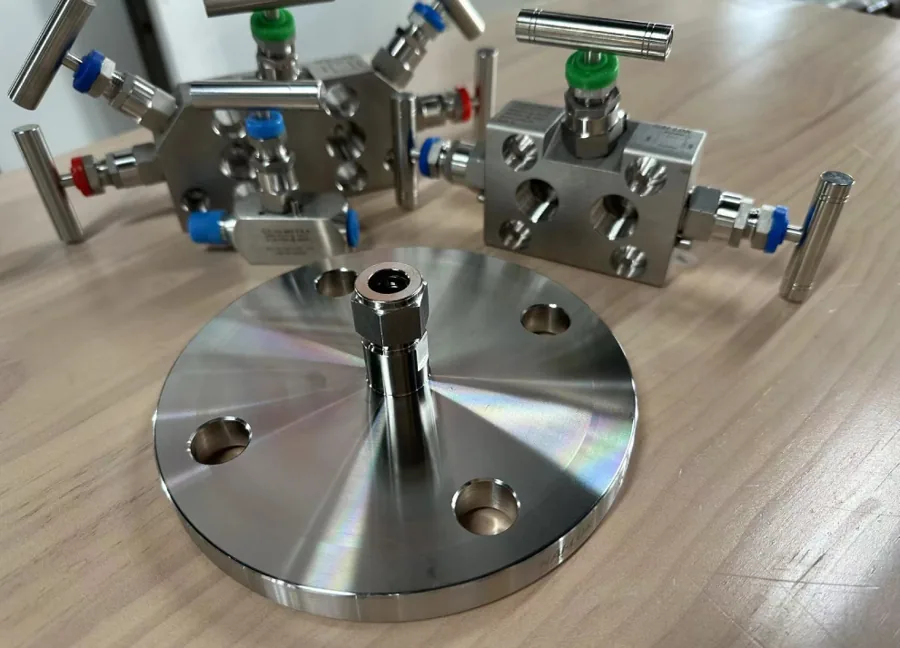
Crestflo makes instrumentation metering valves, small-bore devices for fine, repeatable control of low gas or liquid flow rates. A fine-pitch, multi-turn stem drives a tapered needle or vernier stem into a matched orifice, giving smooth adjustment rather than tight on/off shut-off, this is set-and-hold throttling. Sizes run from 1/16" to 1", built in 316/316L stainless and a full range of high-nickel and corrosion-resistant alloys. Ends come as tube-fitting or threaded, handles as vernier or knurled. Every part carries a heat/lot number, and EN 10204 MTC 3.1 certification is standard, not an add-on. Standard items ship from ready stock; anything else is made to order, with delivery in 6-8 weeks either way.
One clarification before anything else: on this page, metering valve refers to an instrumentation fine-flow-control valve used in process, sampling and analytical systems. It's not the automotive brake metering, or proportioning, valve. Nor is it a softwash or spray-mix proportioning valve.
This valve goes by several names in the field. You'll hear it called a fine metering valve, a precision metering valve, a micro metering valve or micro-flow valve, a low-flow or fine-flow control valve, a flow-metering valve, a metering needle valve, a needle metering valve or fine metering needle valve, and an instrument metering valve or instrumentation metering valve. Its handle or body shape gives rise to still more names: vernier metering valve, knurled-handle or T-bar metering valve, integral-bonnet metering valve, straight- or angle-pattern metering valve.
When placing an order, specifiers usually call out four things. The pattern first (straight/in-line or angle), then the handle (vernier micrometer, knurled or T-bar). Mounting matters too, whether panel-mount or bulkhead. And finally the service: gas or liquid, standard or high-pressure.
What Is a Metering Valve & How Does a Metering Valve Work?
A metering valve works by driving a slender, taper-ground stem, or in some designs a fine vernier stem, into a close-fitting orifice through a fine-pitch, multi-turn thread. The thread is finer than on a general throttling valve, and the stem taper is shallower too. That combination means each turn of the handle shifts the annular gap between stem and orifice by only a tiny amount. The change in flow comes out gradual and nearly linear, with fine adjustment resolution spread across many turns. That's what lets an operator dial in a precise, low flow rate and return to it again and again.
That's the geometry a metering valve is built for: a very low flow coefficient (Cv), fine resolution and steady control at the bottom of the flow range, right where a needle or quarter-turn valve would behave like an on/off switch. A vernier or micrometer handle adds a calibrated scale, so you can read a setting and reproduce it later. Above all, a metering valve is a control device. When positive metal-to-metal isolation matters most, an instrumentation needle valve fits the job better.
Metering Valve vs Needle Valve vs Proportioning Valve
Metering, needle and proportioning valves get mixed up all the time because they share that same tapered-stem look. But they're built for different jobs. The table below spells out the difference, including the other, more common meaning of "proportioning" that Crestflo doesn't make.
| Trait | Metering valve | Needle valve | Proportioning valve |
|---|---|---|---|
| Stem thread | Fine-pitch, multi-turn (often vernier) | Fine-pitch, multi-turn | Not a metering device |
| Flow coefficient (Cv) | Very low, lower than a general needle valve | Low | n/a |
| Primary duty | Set and hold a precise low flow | Throttle and isolate | Automotive brake-pressure balance |
| Shut-off | Not a tight-shutoff device | Metal-to-metal shut-off at full close | n/a |
| Scope on this site | In scope (instrumentation) | In scope (instrumentation) | Out of scope, automotive, not built |
In instrumentation terms, then, a metering valve sits at the fine, repeatable end of the throttling family. A needle valve is the broader adjustable throttle, and it isolates as well. Don't mix either one up with a "proportioning" or "brake metering" valve, though. That's an automotive brake-balance part, a completely different product. For the full instrumentation comparison, see the needle valve vs ball valve guide. The sibling needle valve and flow control valve pages cover their own duties.
Metering Valve Types: Fine, Micro, Low-Flow, Angle & Panel-Mount
Instrumentation metering valves come configured by flow resolution, pattern and mounting. Which variant you pick depends on two things: how fine the adjustment needs to be, and how the valve fits into the tubing run or sits on the panel.
| Type / configuration | Description | Typical use | Availability |
|---|---|---|---|
| Fine / precision metering | Standard fine-pitch multi-turn stem | General repeatable low-flow control | Standard |
| Micro-metering / micro-flow | Very small orifice and stem taper | Trace-flow gas dosing, analyzer feed | Made-to-order |
| Low-flow / fine-flow | Optimized for the lowest Cv band | Calibration and sampling take-off | Standard |
| Straight / in-line | Inlet and outlet on one axis | Straight tube runs | Standard |
| Angle / right-angle (90°) | Flow turns 90° through the body | Corner take-offs and compact panels | Standard |
| Integral-bonnet | Bonnet machined as one piece with the body | Higher pressure integrity, stem alignment | Standard |
| Panel-mount / bulkhead | Body with mounting collar | Instrument panels with front-of-panel access | Standard |
| High-pressure | Heavier-wall bar-stock or forged body | Elevated-pressure metering service | Made-to-order |
Straight and angle bodies in fine and low-flow configurations cover most gas and liquid metering duties. When trace resolution, board layout, or elevated pressure drive the design, micro-metering, panel-mount, or high-pressure variants get specified instead. Every configuration's customizable to requirement.
Metering Valve Handles: Vernier, Knurled & T-Bar Actuation
The handle you choose determines how the operator reads and repeats a setting. A vernier, or micrometer, handle carries a calibrated scale, so a flow setting can be logged and dialed back in with precision. That's why metering valves rely on this style for calibrated, repeatable work. A knurled round handle offers smooth fingertip control for adjustments made often, while a T-bar handle delivers extra torque on higher-pressure or tighter-packed valves. Panel-mount hardware exists too, along with lockable and tamper-resistant handle options. Handle configuration bends to whatever the job requires.
Metering Valve Sizes (1/16″–1″) & End Connections: NPT, BSP, Tube
Metering valves are supplied in sizes from 1/16" to 1", available in both imperial fractional and metric ends. End connections come in two basic types: threaded, either NPT to ASME B1.20.1 or BSPP/BSPT parallel and tapered, or tube-fitting and compression ends. Port arrangements span female-to-female, male-to-female, and male-to-male. Thread and OD dimensions follow the applicable standard, and they're customizable to requirement.
| Size (imperial / metric) | NPT (B1.20.1) | BSPP / BSPT | Tube / compression end | Port arrangement |
|---|---|---|---|---|
| 1/16", 1/8", 1/4" · 3–6 mm | ✓ | ✓ | ✓ | FxF, MxF, MxM |
| 3/8", 1/2" · 8–12 mm | ✓ | ✓ | ✓ | FxF, MxF, MxM |
| 3/4", 1" · 18–25 mm | ✓ | ✓ | ✓ | FxF, MxF, MxM |
Tube-end valves accept hardened or non-hardened ferrules to requirement, so a Crestflo metering valve drops into an existing compression-tube run. For a drop-in replacement on an installed system, request your Swagelok®, Parker® or Hoke® cross-reference and specify the size, ends and material. Matching instrumentation tubing is available in the same alloys.
Metering Valve Cv, Pressure Ratings & Temperature Limits
A metering valve exists for fine control, which means it runs at very low flow coefficients, well below what you'd see in a general needle valve. The exact Cv comes from orifice diameter and stem taper, and each model sets its own. Cv, orifice size and turns-to-open are what separate one metering model from the next, so the certified flow characteristic for a given size and pattern gets confirmed on the RFQ instead of listed as a single fixed number. On a P&ID, the symbol for a metering valve is just the standard needle or globe valve symbol with a metering or throttling qualifier attached. Same body glyph as a needle valve. What sets it apart is the fine-adjust annotation sitting next to the tag.
Standard bar-stock instrumentation metering valves are commonly rated up to 6,000 psi (414 bar) cold working pressure. High-pressure versions push that ceiling to 10,000 psi (689 bar). These are the usual industry design ranges, with pressure-temperature ratings set per the applicable valve design standard and adjusted to fit specific requirements. Temperature limits don't come from the body alloy, though. They're set by the stem packing and seal material instead. The figures below list the commonly published continuous-service limits for each seal, and Crestflo supplies whichever packing suits your application best.
| Packing / seal | Typical continuous-service temperature (published seal limits) |
|---|---|
| PTFE | –65°F to +450°F (–54°C to +232°C) |
| Reinforced PTFE (RPTFE) | up to approx. +500°F (+260°C) |
| PEEK | up to approx. +550°F (+288°C) |
| Flexible graphite (Grafoil-type) | up to approx. +1,000°F (+538°C) |
Metering Valve Materials: 316 Stainless, Monel, Hastelloy C-276 & Duplex
A stainless steel metering valve in 316/316L covers most gas and liquid service. Bodies and stems are machined from bar stock, built to ASTM A479/A276 in stainless, duplex, super-austenitic and nickel alloys. No brass, ever. Each grade below links to its own material page. The valve comes only in instrumentation form; it isn't sold as bar, sheet or mill product.
| Family | Grade (UNS) | When to choose |
|---|---|---|
| Stainless | 304/304L (S30400/S30403), 316/316L (S31600/S31603), 904L (N08904) | General gas and liquid metering, sampling and calibration; 316/316L as standard, 304/304L for non-chloride duty, 904L for higher chloride resistance |
| Duplex / super-austenitic | Duplex 2205 (S32205), Super Duplex 2507 (S32750), 254 SMO (S31254), AL-6XN (N08367), Alloy 20 (N08020) | High-chloride, offshore and acid service needing strength plus pitting resistance |
| Nickel | Monel 400 (N04400), Inconel 625 (N06625), Inconel 825 (N08825), Hastelloy C-276 (N10276) | Sour, halide and aggressive-chemical service; hydrofluoric, seawater and reducing acids |
| Titanium | Titanium Gr2 (R50400) | Seawater and oxidising-chloride service where weight and corrosion both matter |
Finishes run the gamut: material finish, electropolish, passivation, silver anti-galling plating, and oxygen/UHP-clean preparation. Crestflo tailors each one to what the job calls for. Browse all corrosion-resistant alloy options.
Standards, Certifications & Traceability
Crestflo holds ISO 9001, ISO 14001, ISO 45001 and PED certification. Its metering valves meet the standard approvals expected for instrumentation valves: ASME B16.34 governs design and pressure-temperature basis, ASME B1.20.1 covers NPT threads, and ASTM A479 / A276 apply to bar stock. For sour service, material options are supplied to NACE MR0175 / ISO 15156.
Every valve carries a heat/lot number marked on the part and ships standard with an EN 10204 MTC 3.1 certificate. Want third-party endorsement instead? MTC 3.2 is available on request. Crestflo keeps every certificate on file in its quality system, though the content pages only note conformance, not the certificate numbers themselves.
Testing & Quality Assurance
Valves go through hydraulic proof, burst and impulse testing, pneumatic testing, and seat and shell leak checks, with positive material identification (PMI) confirming the alloy. Non-destructive testing happens in-house. Destructive testing is sent out to laboratories accredited to ISO/IEC 17025, and valve pressure testing follows BS EN 12266-1. Third-party inspection can be arranged on request. This whole regime is what backs the drop-in interchange claim: the valve earns its qualification through testing, not through a line in a catalog.
Metering Valve Applications & Industries
Instrumentation metering valves show up everywhere a small-bore line needs precise, repeatable low flow: analytical and sampling systems, gas and chemical dosing, instrument-air metering, calibration rigs, hydraulic control, and analyzer feed. Gas metering valves handling instrument-air and analyzer feed form a core duty. Liquid and hydraulic metering valves cover sampling and dosing take-offs just as often. You'll find them in oil and gas operations, petrochemical and chemical plants, semiconductor and high-purity systems, hydrogen and instrument-air service, and analytical sampling systems. Full material traceability comes standard on every valve from Crestflo.
Ordering a Metering Valve: Part-Number & Datasheets
A metering valve is specified by body material, size, end connection, pattern (straight or angle), handle (vernier, knurled or T-bar), seal/packing and cleaning level. Give those, plus the fine, micro-flow or high-pressure variant and your target flow, on the RFQ and our engineering team returns a part number, certified Cv/orifice and lead time. Crestflo's ordering-code series scheme is customer-facing rather than published, so request the ordering-code guide with your requirement. Product datasheets and CAD are available to customers on request rather than as open downloads, ask for the datasheet and dimensional drawing for your configuration with your quote.
Related Instrumentation Valves
A metering valve belongs to a family of small-bore instrumentation valves. When the job calls for throttling with positive isolation rather than fine metering, the needle valve fits better. Need wider flow control? Look at the flow control valve. For isolating a gauge specifically, there's the gauge-root valve, and for simple on/off duty, the ball valve does the job. Browse the full instrumentation valve range to see everything on offer.
Why Buy Crestflo Metering Valves
Crestflo is the instrumentation division of an export house that's been operating for four decades, carries recognition from the Government of India, and has a proven track record delivering into the Middle East. That heritage now sits behind a focused new manufacturing brand. For US buyers, this adds up to a clear offer:
- Swagelok®, Parker® and Hoke® metering valves get a drop-in dimensional match here, so there's no need to re-engineer the panel. Just request your part-number cross-reference from Crestflo.
- Standard items ship from ready stock; specials get made to order. Delivery runs 6-8 weeks, well under the 20-week-plus lead times common among the major suppliers.
- Alloy coverage runs wide too: 316 through Monel, Hastelloy, Duplex and Titanium, all machined in-house on CNC, VMC and EDM equipment.
- Small MOQ and private-label programs for OEMs and distributors, with kitting to print.
- ISO 9001 / 14001 / 45001 and PED certified, MTC 3.1 and heat-number traceability on every valve.
Indian-origin melt, though US or European melt is available on request. Full material traceability comes standard for TAA- and DFARS-driven projects.
We Engineer Confidence, request a quote, request a sample, or become a distributor. US sales: sales@crestflousa.com · +1 346 594 9005 · Houston, TX.
Metering Valve FAQs
What does a metering valve do?
This device sets and holds a precise, low flow rate for gas or liquid. Turning a fine-pitch, multi-turn stem drives a tapered needle, or vernier stem, into a matched orifice. The result is smooth, repeatable adjustment spread across many turns, not a tight on/off shutoff. That makes it the right tool for calibrated low-flow control in sampling, dosing and analyzer service.
What is the difference between a metering valve and a needle valve?
Both rely on a tapered stem. A metering valve, though, cuts a finer stem pitch, carries a lower flow coefficient (Cv), and often adds a vernier handle so operators can dial in calibrated, repeatable low-flow settings. It's built first and foremost as a control device. The general needle valve takes a different approach: it works as a broader adjustable throttle, yet still delivers metal-to-metal shut-off when closed fully.
What's the difference between a metering valve and a proportioning valve?
Crestflo metering valves control fine flows of gas and liquid in process, sampling and analytical systems. That's the instrumentation sense of "metering valve." A "proportioning" or "brake metering" valve is something else entirely, an automotive brake-balance part. Crestflo doesn't make those.
What types of metering valves are there?
Fine and precision variants come alongside micro-metering and low-flow options, in straight or angle patterns. Integral-bonnet, panel-mount and high-pressure configurations are all available, with vernier, knurled or T-bar handles to choose from. Straight and angle bodies handle most duties. Micro and high-pressure variants, though, are made to order.
What materials can I get a metering valve in?
Stainless options run from 304/304L and 316/316L up through 904L. For duplex grades, we offer Duplex 2205 and Super Duplex 2507, along with 254 SMO, AL-6XN and Alloy 20. On the nickel alloy side, there's Monel 400, Inconel 625/825 and Hastelloy C-276. Titanium Gr2 rounds out the list. Brass isn't offered. Bodies and stems get machined from ASTM A479/A276 bar stock.
What sizes and end connections are available?
Sizes span from 1/16" to 1" in either imperial or metric. Threaded ends come in NPT (per ASME B1.20.1), BSPP, or BSPT, while tube-fitting and compression ends are available in FxF, MxF, and MxM arrangements. Tube ends take hardened or non-hardened ferrules, whichever the application calls for.
What is the pressure rating of a metering valve?
Standard bar-stock instrumentation metering valves typically carry a cold working pressure rating of 6,000 psi (414 bar); high-pressure versions go up to 10,000 psi (689 bar). Ratings follow the applicable valve design standard (ASME B16.34), and they can be customized. Confirm the certified CWP, Cv and orifice for your size and material on the RFQ.
Are metering valves available for sour (NACE) service?
Yes, that's available: NACE MR0175 / ISO 15156-compliant material options for sour and H2S service, each one supplied with the corresponding material traceability.
What certification and traceability come with each valve?
Crestflo manufactures under ISO 9001, ISO 14001, ISO 45001 and PED certification. Every valve leaves the factory with an EN 10204 MTC 3.1 certificate as standard, and a 3.2 is available on request. Each part also carries a heat and lot number stamped right on it.
Can these drop in for Swagelok, Parker or Hoke metering valves?
Yes. These valves are built for dimensional interchange with those brands, and we've qualified them by test to ASME B16.34 and the applicable API standards. Swagelok®, Parker® and Hoke® remain trademarks of their respective owners; our parts are interchange or equivalent, not "compatible" or "intermix." If you need a part-number cross-reference, just ask our engineering team.
What is the lead time and minimum order?
We keep standard items in stock; specials are made to order, running 6-8 weeks out. Small minimum order quantities are fine, and private-label is on the table. Standard product comes from India. Need US or European melt instead? We can do that too, for jobs that call for domestic melt or TAA compliance.
How much does a metering valve cost and how do I buy one?
Pricing works by quotation, not through an online cart. Send in an RFQ or sample request with your size, end connections, material, handle type and flow requirement, and our engineering team will get back to you with a quote and lead time.