
2-Valve Manifolds: Instrumentation Block-and-Bleed Manifold Valves
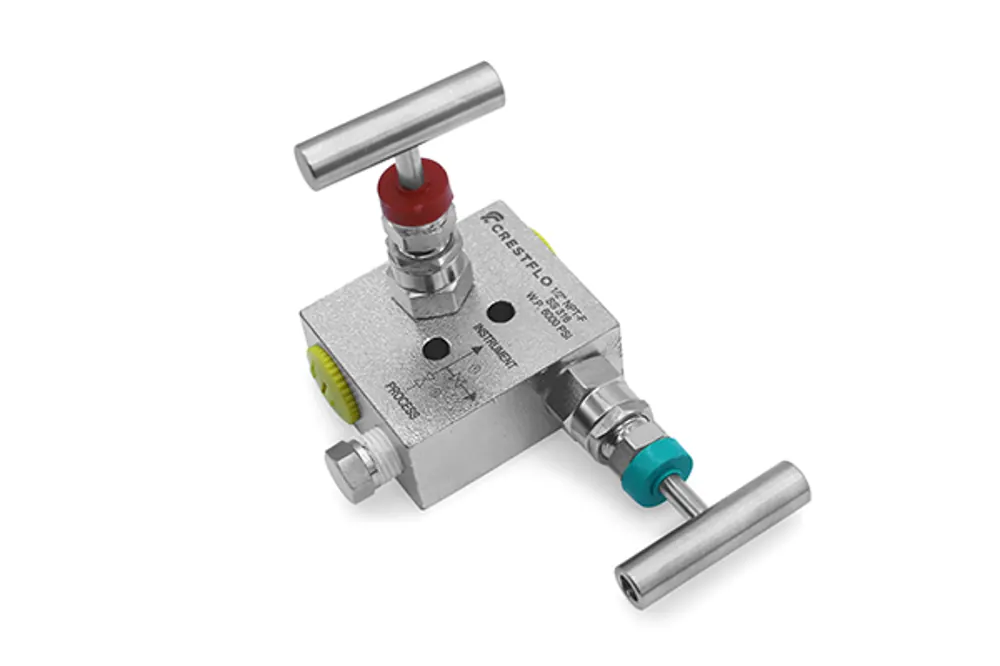
A 2-valve manifold is a single machined body that combines one block (isolate) valve and one bleed (vent) valve. It isolates and vents a single-pressure instrument (a pressure gauge, transmitter or switch) from a process tap, so the instrument can be calibrated, removed or replaced safely; you don't need to shut the line down to do it. Crestflo builds these two-valve manifolds in 316/316L and a full range of exotic alloys, rated up to 10,000 psi, with a non-rotating stem tip and 100% seat and shell leak testing on every unit. Standard items are usually in stock; other configurations are made to order. Either way, delivery runs 6-8 weeks.
To keep the scope clear: on this page, manifold means an instrument valve manifold, a block-and-bleed manifold for gauges and transmitters. It doesn't mean an engine or exhaust manifold, a PEX or plumbing distribution manifold, or an HVAC/hydraulic manifold block.
What Is a 2-Valve Manifold & What Is a 2-Way Manifold Valve?
A 2-valve manifold is the simplest design in the instrument-manifold range, made for a single-pressure instrument. One valve shuts off the process connection. The other bleeds trapped media out to atmosphere. That's the job of every manifold valve: isolate, vent, and on 3- and 5-valve types, equalise an instrument so it can be installed, calibrated and maintained safely without shutting the process down.
You'll also see this product called a two-valve manifold, a 2-way manifold valve (2V manifold), a block-and-bleed manifold, an isolate-and-bleed manifold, a gauge manifold, a pressure-transmitter manifold, or a single-pressure instrument manifold. When placing an order, specifiers typically call out the mounting (direct/hard-mount or remote/pipe-to-pipe), the end connections (NPT, flanged or tube-fitting), the body alloy, and the packing. It stands apart from the 3-valve manifold and 5-valve manifold used on differential-pressure instruments, and from the monoflange and double block-and-bleed valve too.
How a 2-Valve Manifold Works: Block-and-Bleed Isolation Sequence
A two-valve manifold runs on a simple block-then-bleed sequence. In service, the block valve stays open and the bleed valve stays shut, so the instrument reads process pressure. Taking it out of service starts with closing the block valve, which isolates the gauge or transmitter from the process tap. Then you open the bleed valve to vent the trapped pressure to atmosphere. The instrument drops to zero and can be pulled or calibrated safely at that point. Returning it to service just reverses the order: close the bleed valve, then reopen the block valve. A non-rotating stem tip meters against the seat without spinning. That protects the seat finish and keeps performance repeatable through many cycles. This matters for PED-rated assemblies, where seat integrity over the long haul isn't optional.
2-Valve Manifold Mounting: Direct-Mount vs Remote-Mount
Two-valve manifolds get configured based on how they couple to the instrument. Both mounting styles below are standard, and each can be customized to requirement.
| Mounting style | How it couples | Typical use |
|---|---|---|
| Direct / hard-mount (close-coupled) | Manifold bolts or threads straight onto the gauge or transmitter | Compact take-offs where the instrument sits at the process tap |
| Remote / pipe-to-pipe mount | Manifold connects process and instrument by tubing, often panel-mounted | Panel and enclosure installs where the instrument is set away from the tap |
Direct-mount cuts down on leak paths and keeps the envelope tighter. Remote-mount fits panel layouts well and handles vibration isolation with ease. A panel-mount collar's available on remote-mount bodies as well.
2-Valve Manifold Specifications: Pressure Rating to 10,000 psi & Stem Design
Crestflo instrument manifolds carry a rating up to 10,000 psi (689 bar). The actual working pressure for any given unit depends on material, size and temperature, following pressure, temperature ratings set out in the applicable valve design standard, and it can be customized to requirement. The maximum service temperature, though, comes down to the packing rather than the body alloy. Check the packing table below for that.
| Attribute | Value | Notes |
|---|---|---|
| Configuration | 2-valve (block + bleed), single-pressure isolation | For gauge, transmitter or switch |
| Maximum pressure | Up to 10,000 psi (689 bar) | Varies by material, size and temperature; per applicable standard |
| Stem / tip design | Non-rotating tip, rising-stem (OS&Y / outside-screw) needle-pattern isolation | Protects seat finish and repeatability |
| Bore / Cv / orifice | Set per configuration and confirmed on the dimensional drawing | Customizable to requirement; available on request |
| Port arrangement | Process end + instrument end, with vent port on the bleed valve | Single-pressure |
| Testing | 100% seat and shell leak test on every manifold | Standard |
| Traceability | Heat/lot number marked on every part | EN 10204 MTC 3.1 standard, 3.2 on request |
| Finishes | Material finish, electropolish, passivation, silver anti-galling plating, oxygen-clean on request | Customizable to requirement |
2-Valve Manifold Packing & Seat: PTFE, Graphite & PEEK Temperature Limits
Packing selection sets the temperature envelope. The figures below are the commonly published service limits for each seal material. Crestflo supplies the packing best matched to your service, and it can be customized to requirement. Fire-safe (fire-tested) packing and design can be specified on request, where the service calls for a fire-safe manifold.
| Packing / seal | Typical continuous-service temperature (published seal limits) |
|---|---|
| PTFE | –65°F to +450°F (–54°C to +232°C) |
| Reinforced PTFE (RPTFE) | up to approx. +500°F (+260°C) |
| PEEK | up to approx. +550°F (+288°C) |
| Flexible graphite (Grafoil-type) | up to approx. +1,000°F (+538°C) |
2-Valve Manifold Connections: NPT, Flanged & Tube-Fitting Ends
Two-valve manifolds come with threaded, flanged or tube-fitting ends, in both imperial fractional and metric sizes. Threaded ends follow NPT per ASME B1.20.1; flanged and tube-fitting/compression ends are available to match the instrument and process tap. A common setup for an instrument manifold uses 1/2" NPT for both process and instrument connections. Thread and flange dimensions follow the applicable standard, and Crestflo can customize them to your requirement. Before you finalize the panel layout, request the dimensional drawing / diagram for the exact envelope, bore and Cv of your configuration.
| End type | Standard reference | Sizing | Notes |
|---|---|---|---|
| NPT (threaded) | ASME B1.20.1 | Imperial fractional | Common on gauge and transmitter roots |
| Flanged | Per applicable flange standard | Imperial / metric | Flange-to-flange remote and monoflange-style installs |
| Tube-fitting / compression | Interchange with major brands | Imperial and metric | Accepts hardened or non-hardened ferrules to requirement |
Crestflo doesn't list a fixed ordering-code series on this page. If you need to configure body material, connection, size, packing and mounting, request the ordering-code (model / series) guide from our engineering team.
2-Valve Manifold Materials: 316L, Duplex, 6Mo, Monel, Inconel & Hastelloy
Bodies come machined from bar stock to ASTM A479/A276, in stainless, duplex, super-austenitic and nickel alloys. No brass, ever. Each grade below links to its own material page. The manifold ships in instrumentation form only; it isn't available as bar, sheet or mill product.
| Family | Grade (UNS) | When to choose | NACE-suitable |
|---|---|---|---|
| Stainless | 316/316L (S31600/S31603), 304/304L (S30400/S30403), 904L (N08904) | General gauge, transmitter and switch isolation; 904L for higher chloride resistance | Yes (suitable grades) |
| Duplex / 6Mo super-austenitic | Duplex 2205 (S32205), Super Duplex 2507 (S32750), 254 SMO (S31254), AL-6XN (N08367), Alloy 20 (N08020) | High-chloride, offshore and acid service needing strength plus pitting resistance | Yes |
| Nickel | Monel 400 (N04400), Monel K500 (N05500), Inconel 625 (N06625), Inconel 825 (N08825), Hastelloy C-276 (N10276) | Sour, halide and aggressive-chemical service; seawater and reducing acids | Yes |
| Titanium | Titanium Gr2 (R50400) | Seawater and oxidising-chloride service | — |
Standard product ships from Indian origin mills. US or European melt is available on request, with full material traceability for TAA/DFARS-driven projects. Browse all manifold materials, 316, Duplex, Monel, Hastelloy.
2-Valve vs 3-Valve vs 5-Valve Manifold: How to Choose
The instrument dictates the valve count. A single-pressure unit needs block-and-bleed. Differential pressure means more hardware: two blocks, plus equalisation.
| Manifold | Valves | Instrument type | Function |
|---|---|---|---|
| 2-valve | Block + bleed | Single-pressure gauge, transmitter, switch | Isolate and vent |
| 3-valve | 2 block + 1 equalise | Differential-pressure (DP) transmitter | Isolate and equalise |
| 5-valve | 2 block + 1 equalise + 2 vent/calibrate | DP transmitter with calibration | Isolate, equalise and vent/calibrate |
Crestflo lays out the full trade-off in its 2 vs 3 vs 5-valve manifold guide.
Standards, Certifications & Testing
Crestflo holds ISO 9001, ISO 14001, ISO 45001 and PED certification. Its two-valve manifolds meet the standard approvals expected of instrumentation valves. ASME B16.34 sets the design and pressure, temperature basis, backed by the applicable API test standards (API 598 / API 602). Threads follow ASME B1.20.1 for NPT, and bar stock is governed by ASTM A479. For sour service, material options are supplied to NACE MR0175 / ISO 15156.
Every manifold goes through a 100% seat and shell leak test, gets a heat/lot number marked right on the part, and ships standard with an EN 10204 MTC 3.1 certificate; there's also an MTC 3.2 option with third-party endorsement, available on request. We run hydraulic proof and burst testing, pneumatic testing, and positive material identification (PMI) as needed. Non-destructive testing happens in-house; destructive testing goes out to ISO/IEC 17025-accredited laboratories. Third-party inspection can be arranged on request. Certificates live in Crestflo's quality system, and content pages state conformance rather than certificate numbers.
2-Valve Manifold Applications & Industries
Two-valve manifolds isolate gauges, pressure transmitters and pressure switches across the plants where a mistake simply isn't an option. That covers oil and gas operations, spanning upstream, midstream and refining, along with petrochemical and chemical sites, offshore and subsea production, power generation, and hydrogen and LNG/cryogenic service. Wherever a single-pressure instrument needs positive isolation and venting, with full material traceability, that's where they go to work.
Drop-In Interchange with Swagelok, Parker, Hoke & Fitok Manifolds
Crestflo two-valve manifolds match the dimensions of the major instrument-manifold brands. They're qualified by test to ASME B16.34 and the applicable API standards. Swagelok®, Parker®, Hoke® and Fitok® remain trademarks of their respective owners; these parts are interchange/equivalent, not "compatible/intermix." Need a drop-in replacement for an existing installation? Request your Swagelok®, Parker®, Hoke® or Fitok® cross-reference and specify the size, ends and material.
Why Buy Crestflo 2-Valve Manifolds
Crestflo is the instrumentation division of an export house that's been operating for four decades and holds Government of India recognition, with a proven delivery record across the Middle East. That's established heritage standing behind a new, focused manufacturing brand. For US buyers, the offer is clear:
- Drop-in dimensional interchange for Swagelok®, Parker®, Hoke® and Fitok® manifolds. Skip the panel re-engineering and just request your part-number cross-reference.
- Stock on standard items, made-to-order for specials, 6-8 week delivery. Compare that to the 20-week-plus lead times you'll typically wait out with the majors.
- Alloy coverage runs wide, 316 through Duplex, 6Mo, Monel, Inconel and Hastelloy. Most competitors stock stainless and little else.
- 100% seat and shell leak test, MTC 3.1 and heat-number traceability on every manifold.
- Small MOQ and private-label programs for OEMs and distributors, with kitting to print.
Indian-origin material, with US or European melt available if you need it, and full traceability documented for TAA/DFARS work.
We Engineer Confidence. Want to see it for yourself? Request a quote, ask for a sample, or find out about becoming a distributor. Crestflo's US sales team is reachable at sales@crestflousa.com or +1 346 594 9005. We're based in Houston, TX.
2-Valve Manifold FAQs
How does a two-valve manifold work?
The block valve isolates the instrument from the process line. The bleed valve then vents the trapped pressure to atmosphere, so the gauge or transmitter reads zero and can be pulled or calibrated safely. To put the instrument back in service, just reverse the order: close the bleed, then open the block.
What is a 2-way manifold valve?
It is a two-valve instrument manifold, one block and one bleed valve in a single body, used to isolate and vent a single-pressure instrument such as a pressure gauge, transmitter or switch.
What is the purpose of a manifold valve?
It isolates, vents, and (on 3- and 5-valve types) equalizes an instrument so it can be installed, removed, calibrated, and maintained safely, all without shutting down the process.
What is the difference between a 2-valve and a 3-valve manifold?
A 2-valve manifold is built for single-pressure instruments, with one block valve and one bleed valve. Differential-pressure instruments call for something more capable: the 3-valve manifold, fitted with two block valves and an equalising valve. For more on DP applications, see our 3-valve manifold page.
What materials are Crestflo 2-valve manifolds available in?
316/316L and 304/304L stainless lead the list, alongside 904L, Duplex 2205 and Super Duplex 2507. 254 SMO, AL-6XN and Alloy 20 round out that group. Monel 400 and K500 are available too, as are Inconel 625 and 825. Hastelloy C-276 is on offer, and so is Titanium Gr2. Brass, however, isn't. Bodies get machined from ASTM A479/A276 bar stock.
What pressure can a 2-valve manifold handle?
Crestflo instrument manifolds carry a rating of up to 10,000 psi (689 bar). Where a given unit falls within that range depends on material, size and temperature, and it follows the applicable valve design standard. Builds can be customized to requirement. Don't assume that top figure applies to your setup; confirm the certified rating for your configuration on the RFQ.
Are Crestflo manifolds NACE-compliant for sour service?
Yes. NACE MR0175 / ISO 15156-compliant material options are available in alloys suited to sour and H2S service, and they're supplied with the corresponding material traceability.
Is a 2-valve manifold leak-tested?
Every manifold goes through a 100% seat and shell leak test before it ships. Each one comes with an EN 10204 MTC 3.1 certificate, and we'll provide a 3.2 on request. The heat/lot number gets marked right on the part.
Can I get a 2-valve manifold that interchanges with Swagelok, Parker, Hoke or Fitok?
Yes. We engineer the manifolds for dimensional interchange with those brands, and testing qualifies them to ASME B16.34 and the applicable API standards. Swagelok®, Parker®, Hoke® and Fitok® remain trademarks of their respective owners; our parts are interchange/equivalent. Ask our engineering team for a part-number cross-reference.
Do you offer direct-mount and remote-mount 2-valve manifolds?
Yes. Both configurations are standard: direct, hard-mounted units that sit close-coupled to the instrument, and remote, pipe-to-pipe versions built for panel mounting. Either can be customized to suit your requirement.
What is the lead time and minimum order?
Ready stock covers the standard items. Specials are made to order, and delivery runs 6 to 8 weeks. Small MOQs are available, and we offer private-label options too. Standard product comes from India, but US or European melt is available on request wherever domestic-melt or TAA compliance is needed.
How much does a 2-valve manifold cost and how do I buy one?
Pricing runs by quotation only, so there's no online cart to speak of. Send an RFQ or sample request that spells out mounting style, end connections, material and pressure rating, and our engineering team will get back to you with a quote and lead time.
Related Pages
Crestflo's 3-valve manifold and 5-valve manifold cover both configurations, so it depends on how many process connections need isolating.
For flange-mounted instruments, the Monoflange valve packs isolation into a single body. The Double block-and-bleed valve, on the other hand, adds a second isolation point plus a bleed port for extra margin.
Rounding out the lineup: the Gauge-root valve handles direct gauge connections, and the Bleed valve lets you vent trapped pressure before servicing anything downstream.