
Instrument Air Systems: Tubing, Fittings, Valves, Manifolds & Regulators
Instrument air is clean, dry, oil-free compressed air, and it's what runs pneumatic instruments, transmitters, control-valve actuators, positioners, solenoids and analyzers across industrial plants. Crestflo builds the point-of-use instrument-air train: 316/316L stainless and CRA-alloy instrumentation tubing, compression tube fittings, isolation and bleed valves, 2/3/5-valve manifolds, pressure regulators and inline and tee filters. Every component carries heat-number traceability. Delivery runs 6–8 weeks, serving US plants, EPC contractors, panel fabricators and OEMs.
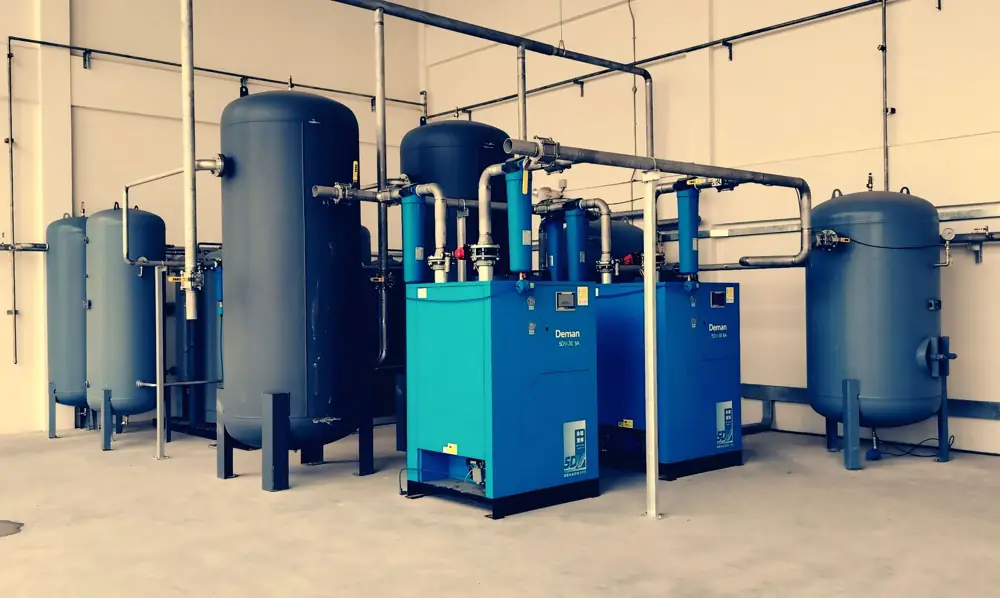
On this page, "instrument air" means the plant's pneumatic utility: clean, dry, oil-free compressed air for instruments and actuators. It isn't medical air, the healthcare breathing gas governed by NFPA 99. Nor is it a musical "air instrument." Crestflo supplies the distribution and point-of-use hardware that carries instrument air to each instrument, but it doesn't manufacture the air compressor, dryer, or receiver that generate and dry the air upstream.
Also Known As: Instrument Air System, Clean Dry Air (CDA) & Control Air
On a drawing, line list or RFQ, this utility shows up under a dozen different names, and Crestflo's hardware set covers all of them. Call it an instrument air system, plant abbreviation IA, instrument-quality air, clean dry air (CDA), control air, pneumatic supply air, or utility air for instruments, it's the same thing. The distribution network goes by instrument air header, supply line, or air-distribution header. Point-of-use hardware falls under one umbrella: instrument air tubing, fittings, valves, manifolds, regulators and filters. Instrument air stays separate from plant air, utility air, service air and process air. Those are lower-quality streams, not clean or dry enough to feed a transmitter or a PED.
What Is an Instrument Air System?
Think of an instrument air system as two distinct halves. On one side sits generation: the compressor, dryer and receiver tank that make and dry the air. That part falls outside Crestflo's scope. The other half, distribution and point of use, is where Crestflo comes in: the tubing, fittings, isolation and bleed valves, manifolds, regulators and filters that carry instrument air from the header out to each instrument. This utility actuates control valves, drives positioners and solenoids, and delivers the familiar 3-15 psi pneumatic signal. Every connection along the way, then, needs to be leak-tight, moisture-tight, and clear of any internal scale that might foul an instrument. The air itself isn't the hard part. It's benign by nature. What actually drives the specification is the environment outside it: chloride exposure, marine air, sour service, plus how reliable each individual joint turns out to be.
Instrument Air vs Plant Air vs Process Air
The difference between instrument air and plant (utility) or compressed process air comes down to dryness, oil content and filtration. Instrument air gets dried to a low dew point, kept essentially oil-free and finely filtered so it won't corrode, freeze or clog a pneumatic instrument. Plant air is looser and unsuitable for instruments. Process air, on the other hand, is defined by whatever process it enters. The table below summarizes the distinction.
| Property | Instrument air | Plant / utility air | Process air |
|---|---|---|---|
| Purpose | Pneumatic instruments and actuators | Air tools, general utility | Enters or contacts the process |
| Dryness | Dried, low pressure dew point | Often undried | Application-dependent |
| Oil content | Oil-free (≤ 1 ppm w/w) | May contain oil | Varies |
| Filtration | Fine (≤ 3 micron) | Coarse | Varies |
| Governing standard | ISA-7.0.01 / ISO 8573-1 | Looser / none | Process spec |
Qualitative rows reflect general engineering practice, while the numeric targets below follow the published standards.
Instrument Air Quality Requirements: Dew Point, Oil, Particulate & Header Pressure
Instrument air quality, the air's composition expressed as dew point, oil content and particulate load, falls under ISA-7.0.01, Crestflo's "Quality Standard for Instrument Air," and under the ISO 8573-1 compressed-air purity classes. The table lists the standard's published targets. Exact figures, like pressure dew point and header pressure, are plant-specific; that's set on the project datasheet.
| Parameter | Typical requirement (per standard) | Basis |
|---|---|---|
| Pressure dew point | At least ~10 °C (18 °F) below the minimum system temperature; commonly ≤ −40 °C / −40 °F for outdoor or cold service | ISA-7.0.01 |
| Maximum particulate | ≤ 3 micron | ISA-7.0.01 |
| Maximum oil content | ≤ 1 ppm w/w (essentially oil-free) | ISA-7.0.01 |
| ISO 8573-1 target class | Commonly Class 2 or better for particulate, water and oil | ISO 8573-1 |
| Header pressure (typical) | ~80–120 psig at the header; reduced at point of use; 3–15 psi pneumatic signal | ISA-7.0.01 |
Standard published values. The dew point, header pressure and purity class for any given plant get customized to requirement and confirmed on the project specification.
Instrument Air Tubing & Headers: 316/316L Stainless Distribution Lines
Seamless 316/316L stainless instrumentation tubing has become the standard choice for instrument-air distribution. It won't corrode, it stays moisture-tight, and it carries no internal scale that could foul downstream instruments. Crestflo supplies instrumentation tubing to ASTM A269 / A213 in both imperial and metric OD. Common air-distribution runs use 1/4″, 3/8″ and 1/2″ OD, though sizes from 1/16″ up to 2″ are available. Instrument-air piping gets specified as tube rather than schedule pipe for good reason: tube bends around obstructions, needs fewer joints, and seals on a ferrule instead of a thread. So in practice, an instrument-air piping run is a compression-fitting tube run, not a threaded or welded pipe. OD and wall values follow the published tubing size chart, with values set per applicable standard and customizable to requirement.
The air inside the tube is benign, but the outside is not. Coastal and offshore chloride and sour (H₂S) environments attack the tube externally and drive the specification into corrosion-resistant alloys even for an air line, see the offshore chloride selection and sour-service (NACE) selection guides, and the 316 vs 316L comparison for the baseline grade.
Instrument Air Fittings & Connectors: Compression, Pneumatic & Quick-Connect
Compression tube fittings handle instrument-air joints, and Crestflo's tube fittings meet ASTM F1387. They come in single and double ferrule, hardened and non-hardened, and cover imperial and metric sizes up to 2″ (50 mm) OD. Dimensionally, they interchange with the major brands, and each one gets flexure, rotary-flex and vibration testing to handle the pulsating conditions typical of a pneumatic line. For tool and actuator drops, Crestflo also makes pneumatic push-to-connect fittings and quick-connect couplings that let you make and break connections fast, and you won't need tools to do it. Not sure which ferrule style fits your application? The single vs double ferrule guide walks through the choice.
Instrument Air Valves: Isolation Ball, Needle, Bleed, Purge, Check & Toggle
Instrument-air lines call for instrumentation valves, not plumbing or automotive hardware, to isolate, throttle, vent and protect each drop. Crestflo builds the full set in SS and CRA alloys, 1/16″ to 1″, with threaded or tube-fitting ends. Ball valves handle block and isolation duty. Needle valves take care of throttling and root service. For venting and depressurizing there are bleed and purge valves; pneumatic check valves guard against reverse flow, and toggle valves give a quick on-off option. Every one of these is built to ASME B16.34 and the relevant API valve standards, with elastomer or PTFE seat and packing choices picked to suit temperature and service conditions.
Instrument Air Manifolds & DP Transmitter Hook-Ups: 2/3/5-Valve
Instrument manifolds sit at the heart of differential-pressure transmitter hook-ups on instrument-air and impulse lines, and Crestflo builds 2-valve, 3-valve and 5-valve manifolds that handle isolation, equalization and block-and-bleed right at the instrument. Every manifold gets 100% seat and shell leak testing, carries a rating up to 10,000 psi, and comes with full material traceability. Need header branching or air-supply distribution instead? Air-distribution manifolds are built to customer spec, available in flanged, screwed or socket-weld configurations.
Instrument Air Regulation & Filtration: Pressure Regulators, Inline & Tee Filters
An instrument air header runs at ~80–120 psig, but most instruments need a reduced, held supply pressure, so a pressure regulator, also called an air set, and commonly a single-stage reducing regulator, sets the instrument supply pressure at each drop. A last-chance filter guards the instrument against pipe scale, rust and moisture carried down the header; Crestflo supplies filters in inline and tee-type configurations for particulate and coalescing protection at the point of use.
Instrument Air Hardware Map: Function → Product → Alloy
Each row of the table ties one function in the instrument-air train to the Crestflo product built for it, along with the alloys that product comes in. Click through any row and you land on the product page, where the full ordering detail lives. Datasheets and CAD files aren't posted publicly, but customers can request them.
| Function | Crestflo product | Alloys | Product page |
|---|---|---|---|
| Distribution tubing | Instrumentation tubing | 316/316L, CRA | Instrumentation tubing |
| Connect | Compression tube fittings | SS, high-nickel, titanium | Tube fittings |
| Pneumatic connect | Push-to-connect / quick-connects | SS | Pneumatic push fittings |
| Isolate | Ball valve | SS, CRA | Ball valve |
| Throttle / root | Needle valve | SS, CRA | Needle valve |
| Vent / depressurize | Bleed / purge valve | SS, CRA | Bleed, purge valves |
| Non-return | Pneumatic check valve | SS | Pneumatic check valve |
| DP hook-up | 2/3/5-valve manifold | SS, high-nickel, 6Mo, DSS | 3-valve manifold |
| Header branch | Air-distribution manifold | SS | Air-distribution manifolds |
| Regulate | Pressure regulator | SS | Regulators |
| Filter | Inline / tee filter | SS | Filters |
Alloy Selection for Instrument Air Lines: 316/316L Through CRA
316/316L serves as the baseline grade for most indoor instrument-air service. What drives the alloy choice isn't the air. It's the external environment. Chloride exposure, coastal sites, offshore platforms and sour service push tubing, fittings and valves toward corrosion-resistant alloys instead. Each material page covers composition and PREN in detail, while the table lays out the selection logic.
| External service / corrosion driver | Recommended alloy(s) | Material page |
|---|---|---|
| General indoor instrument air | 316/316L | 316/316L stainless |
| Coastal / offshore chloride | 254 SMO, AL-6XN, Super Duplex 2507 | 254 SMO, AL-6XN, Super Duplex 2507 |
| Sour (H₂S) atmosphere (NACE) | Duplex 2205, Inconel 825, Monel 400 | Duplex 2205, Inconel 825 |
Crestflo covers each grade in broad terms and supplies it only as instrumentation hardware: fittings, valves and tubing. Bar, sheet, plate and mill product aren't part of the offering. For a fuller, structured breakdown, consult the material selection by service guide.
Air Generation Equipment: What Crestflo Does Not Supply
Crestflo doesn't make the equipment on the generation side of the system, instrument air compressors, desiccant or refrigerated dryers, air receiver tanks. Those units produce and dry the air before it ever reaches the header. What Crestflo supplies is everything after that: the distribution and point-of-use hardware that carries instrument air from the header out to each instrument. Drawing that line keeps the specification honest, and it stops customers from ending up with a mismatched supply.
Where Instrument Air Is Used
Instrument air does a lot of the physical work in these plants: it actuates control-valve actuators and positioners, drives solenoid valves, and keeps transmitters, analyzers and pneumatic instruments supplied across oil and gas, petrochemical, power, LNG and offshore facilities. Crestflo's distribution hardware handles these applications. From here you can also reach the related oil and gas, petrochemical & chemical, LNG / cryogenic, analytical sampling systems and steam-tracing industry pages, plus the full list of served industries.
Standards, Testing & Traceability for Instrument Air Hardware
Crestflo holds the standard approvals that apply to each product line. Fittings for instrument air meet ASTM F1387, covering dimensional interchange and performance. Valves are held to a higher bar: ASME B16.34, plus the applicable API valve standards. Governing references are listed in the table below.
| Requirement | Standard / spec | Applies to | Standard page |
|---|---|---|---|
| Fitting performance & interchange | ASTM F1387 | Compression tube fittings | ASTM F1387 |
| Valve design basis | ASME B16.34 + API 598 / 602 | Isolation & block-and-bleed valves | ASME B16.34, API 598 |
| Tubing base spec | ASTM A269 / A213 | Air-distribution tubing | ASTM A269, A213 |
| Sour service | NACE MR0175 / ISO 15156 | Wetted parts in H₂S atmospheres | NACE MR0175, ISO 15156 |
| Material traceability | EN 10204 3.1 (3.2 on request) | Every part | EN 10204 MTC |
Each part carries a heat/lot number, backed by EN 10204 MTC 3.1 as standard, with 3.2 available on request. Positive material identification (PMI) confirms the alloy. In-house NDT gets backed up by destructive testing at ISO/IEC 17025-accredited labs, and every manifold undergoes 100% seat and shell leak testing. Crestflo holds ISO 9001 / 14001 / 45001 & PED certification, and the certificates themselves sit in the quality area. Values follow the applicable standard. Customizable to what you need.
Why Source Instrument Air Hardware from Crestflo
Crestflo runs as the instrumentation arm of an export house that's been in business for four decades and carries Government-of-India recognition, with a track record of deliveries across the Middle East. Today it sells directly into the US market, working with plants, EPC contractors, panel fabricators and OEMs as a US-serving manufacturer. Here's what actually matters to someone buying instrument air:
- Delivery built around your schedule. Standard items ship from stock, specials get made to order, and lead time runs 6–8 weeks, not the 20-plus weeks you'd wait on from the majors.
- Interchange you can trust. Our instrument-air fittings match dimensions and meet ASTM F1387, so nothing gets lost in translation. Ask our engineering team for a Swagelok® cross-reference instead of guessing at part numbers. Swagelok® is a trademark of Swagelok Company; Crestflo isn't affiliated with it and carries no endorsement from it.
- Alloys that go the distance. 316/316L, Duplex 2205, Super Duplex 2507, 254 SMO, AL-6XN, Inconel 825, Monel 400, all built for coastal, offshore and sour environments.
- Imperial or metric, your call. Fittings, valves and tube come in fractional and metric sizes alike, and every part carries heat-number traceability plus an MTC.
- Low minimums, your label. Private-label programs, kitting and VMI, and made-to-print work suit panel fabricators and equipment builders equally well.
- No hiding where it's from. Material is Indian origin, though US and European melt is available on request, backed by full material traceability and country-of-origin support.
We Engineer Confidence. Reach our US sales team at sales@crestflousa.com or call +1 346 594 9005 in Houston, TX. That's Crestflo.
Frequently Asked Questions
What is instrument air?
Instrument air is compressed air that's clean, dry and free of oil, and plants rely on it to run pneumatic instruments, transmitters, control-valve actuators, positioners and solenoids. Some call it instrument-quality air. Others say clean dry air, or CDA, or simply control air. Whatever the name, its quality has to meet ISA-7.0.01 and the purity classes set out in ISO 8573-1.
What is an instrument air system?
An instrument air system runs on two halves. First comes the air-generation train: compressor, dryer and receiver. Then there's the distribution and point-of-use hardware that actually delivers the air to each instrument, tubing, fittings, isolation and bleed valves, manifolds, regulators and filters. Crestflo handles that second half. The generation equipment isn't part of what they supply.
What is the difference between instrument air and plant or compressed air?
Instrument air gets dried to a low dew point, kept essentially oil-free, and filtered finely enough to satisfy ISA-7.0.01 / ISO 8573-1. That standard is what keeps it from corroding, freezing or clogging a pneumatic instrument. Plant air, sometimes called utility air, follows a looser standard. It can carry oil, and it isn't suitable for instruments.
Is instrument air the same as medical air?
No. Medical air is a healthcare breathing and medical-device gas, and NFPA 99 governs it, produced and monitored under medical-gas rules. Instrument air, on the other hand, is an industrial pneumatic utility. Different standards apply, and the equipment isn't the same either.
What quality does instrument air need for dew point, oil and particulate?
ISA-7.0.01 calls for a pressure dew point that sits at least 10 °C below the minimum system temperature, often −40 °C or colder for outdoor service. Particulate must stay at or below 3 microns, oil at or below 1 ppm. That's typically ISO 8573-1 Class 2 or better. Exact numbers vary by plant, though, and they're set on the project datasheet.
What tubing is used for instrument air?
Seamless 316/316L stainless instrumentation tubing built to ASTM A269 / A213 remains the standard choice. It resists corrosion, keeps moisture out, and carries no internal scale. When chlorides or sour service attack the tube from outside, engineers turn to tougher alloys: 254 SMO, AL-6XN, Super Duplex 2507, or Inconel 825.
What valves are used on instrument air lines?
Isolation calls for ball valves. Needle valves handle throttling and root duty, while bleed and purge valves manage venting. Pneumatic check valves cover non-return service, and toggle valves give quick on-off control. All of them come in stainless steel or CRA alloys, sized from 1/16″ to 1″, in imperial or metric, and built to ASME B16.34 along with the applicable API valve standards.
Does Crestflo supply instrument air compressors or dryers?
Crestflo makes the downstream distribution and point-of-use hardware, tubing, fittings, valves, manifolds, regulators and filters. It doesn't make compressors, desiccant or refrigerated dryers, or receiver tanks.
Do your fittings interchange with Swagelok on existing instrument air lines?
Crestflo compression fittings match Swagelok dimensions and carry performance qualification to ASTM F1387. We call them interchange or equivalent, never "compatible" or "intermix." Ask our engineering team for your part-number cross-reference. Swagelok® is a trademark of Swagelok Company, and Crestflo has no affiliation with it.
What is the lead time and minimum order quantity?
Standard items ship from stock, while specials are made to order. Delivery typically takes 6 to 8 weeks, minimum order quantities stay small, and private-label options are available. Compare that to the 20-plus weeks that's typical from the major brands.
What material traceability do you provide?
Every part comes with a heat/lot number, backed by an EN 10204 MTC: 3.1 as standard, 3.2 on request. We back that up with PMI, in-house NDT, and destructive testing at labs accredited to ISO/IEC 17025. Every manifold also gets 100% seat and shell leak testing.
Where are the parts made and are they TAA-compliant?
Our standard product comes from India, with full material traceability built in. Need domestic-melt or TAA-eligible material instead? US or European melt is available on request. Check the country-of-origin and compliance note for the full details.
Related Pages & Next Steps
Take a look at the instrumentation tubing, tube fittings, instrumentation valves, pressure regulators and filters product hubs. There's also the air-distribution manifolds accessory page, the 316/316L material page, and the full list of served industries. If you're ready to move forward, you can request a quote, request a sample, or become a distributor with Crestflo.