
Instrumentation Bleed Valves: Stainless Steel & High-Nickel Alloy
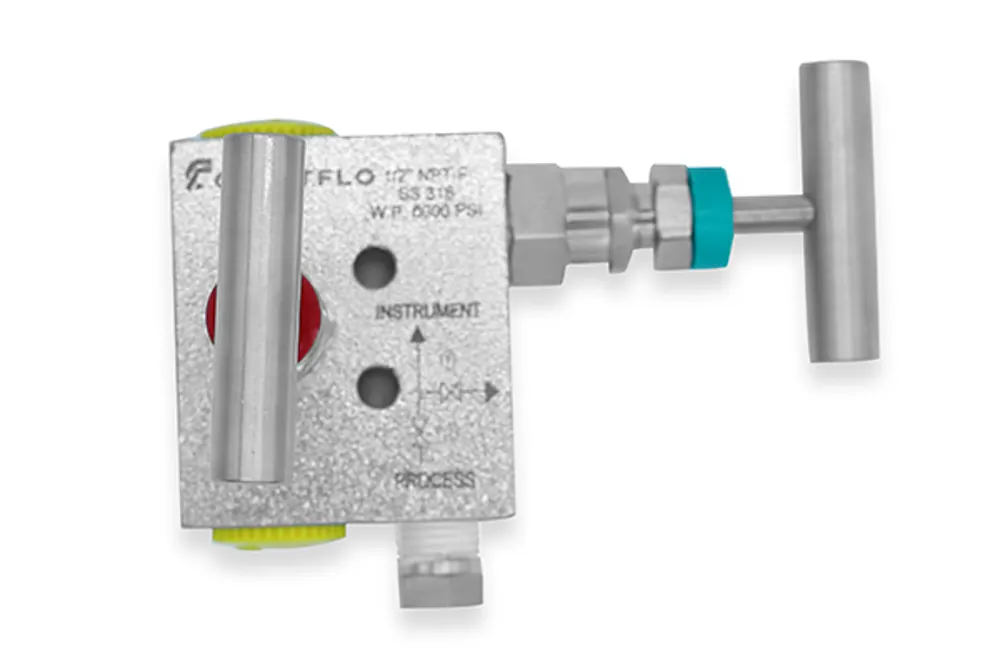
A bleed valve is a small valve, normally closed, used in instrumentation work. It vents trapped pressure, drains leftover fluid, or lets atmosphere into a pressure gauge, valve manifold, or process test point. That's what lets the device be calibrated, proven, or pulled out of service safely. On this page, "bleed valve" refers only to an instrumentation bleed or vent valve for gauges, manifolds, and instrument hook-ups. It doesn't mean a radiator, brake, cooling-system, turbo/wastegate, or gas-turbine bleed valve.
Crestflo builds instrumentation bleed and vent valves for customers across the US, working in stainless steel and high-nickel alloys. Ends come as NPT or tube-fitting, sizes run imperial and metric, and every valve ships with full material traceability. Standard items sit in ready stock. Specials get made to order, with delivery running 6-8 weeks. Reviewed by the Crestflo Engineering Team.
What Is a Bleed Valve? Function & Bleed Valve Working Principle
A bleed valve, sometimes called a bleeder valve, bleed-off valve, or vent valve, is a compact screw-down component that relieves or vents pressure from an instrument line to atmosphere or a test point. It stays closed under normal conditions and gets opened by hand only when a line needs depressurizing, draining, calibrating, or proving. The orifice is small, so this is a shut-off or vent device, not something meant for throttling or flow control. On a piping and instrumentation diagram (P&ID), it's shown with the standard manual-valve symbol, tied to a gauge root, manifold, or hook-up assembly.
Bleed Valve, Vent Valve, Bleeder Valve & Bleed Screw: Also Known As
Across the industry, this single component goes by many names. Buyers call it a bleed valve, bleeder valve, bleed-off valve, bleed screw valve, bleed plug valve, or bleed-and-vent valve. When it's used for venting, people usually call it a vent valve, instrument vent valve, or instrumentation vent valve. Function drives other names too: hex bleed valve, male-x-female bleed valve, gauge bleed valve, test-point bleed valve, calibration bleed valve, and manifold bleed screw. Every one of these names points to the same discrete instrumentation vent component discussed here.
How an Instrument Bleed Valve Works
Turning the screw-down stem lifts its tip off the seat and opens a small vent port to atmosphere or to a test connection. Close the stem, and it reseats metal-to-metal or against a soft seal, isolating the port again. An operator typically cracks the valve open to relieve residual pressure before pulling a gauge, to drain off condensate or trapped process fluid, or to let atmosphere in so an instrument can be zeroed and checked. In normal service, though, the valve stays closed.
Bleed Valve Types: Hex Bleed Screw, Bleed Plug, Angle & Straight Patterns
Standalone instrumentation bleed valves usually come as bar-stock, hex-body designs, sold as a bleed screw or bleed plug in straight or angle patterns. Operators vary too: a T-bar, a knurled cap, or a screwdriver slot. These discrete valves aren't the same thing as the integral bleed port machined directly into a valve manifold or a double-block-and-bleed assembly. Reach for a standalone bleed valve when a gauge, root valve, or hook-up simply needs an extra vent point. Choose an integral manifold or double block and bleed valve instead when the block and bleed functions need to live in one body. A monoflange valve takes a different route, building its own external bleed right onto a flanged block.
Bleed Valve Sizes & End Connections: NPT, Tube-Fitting & Male-x-Female
Instrumentation bleed valves come from Crestflo's 1/16″–1″ instrumentation valve range, with threaded or tube-fitting ends available in both imperial and metric sizes. The typical setup pairs a male inlet with a vent outlet in a male-by-female arrangement.
| Connection / end type | Standard | Typical sizes |
|---|---|---|
| Male NPT (MNPT) inlet | ASME B1.20.1 | 1/8″, 1/4″, 1/2″ |
| Female NPT (FNPT) | ASME B1.20.1 | 1/8″, 1/4″ |
| Tube-fitting end (compression) | Instrument tube OD | 1/8″–1/2″; 6–12 mm |
| Vent / outlet port | Open vent or tubing stub | per hook-up |
Thread and end sizes match the standard spec, and end configuration can be built to whatever you need. Just note your inlet and vent setup on the RFQ.
High-Pressure Bleed Valve Ratings & Temperature Limits
Working pressure follows the ASME B16.34 pressure-temperature rating tied to the body material and connection you select. Instrument bleed and vent valves often see high-pressure service, and cold-working-pressure ratings of 6,000 psi and 10,000 psi are available depending on size and material. Crestflo builds to whatever rating the service calls for. Temperature capability comes down to the sealing element: a metal-tip seat handles the widest span, while PTFE soft seats stay within the standard PTFE service limit of roughly −54 °C to +232 °C (−65 °F to +450 °F).
| Parameter | Basis / value |
|---|---|
| Pressure design basis | ASME B16.34 pressure-temperature rating for the body material |
| High-pressure ratings | 6,000 / 10,000 psi CWP class commonly specified; per material & size |
| Seat / tip | Integral metal tip and/or PTFE soft seat |
| PTFE seat temperature | approx. −54 °C to +232 °C (standard PTFE limit) |
| Metal-seat temperature | to the body-material limit per ASME B16.34 |
Values follow the applicable standard, and they can be adjusted to your requirements. For certified ratings on your exact configuration, contact the engineering team directly.
Bleed Valve Materials: 316 Stainless, Monel, Inconel, Hastelloy & Duplex
The standard stainless steel bleed valve comes in 316/316L, and a full lineup of high-nickel and corrosion-resistant alloys is available when the service turns sour, chloride-heavy, or otherwise aggressive. Sour-service builds can be supplied in NACE MR0175 / ISO 15156 compliant materials on request. Brass isn't offered on the US range.
| Grade | UNS | Family | Instrumentation form |
|---|---|---|---|
| 316 / 316L | S31600 / S31603 | Austenitic stainless | 316/316L valves |
| 304 / 304L | S30400 / S30403 | Austenitic stainless | 304/304L |
| 904L | N08904 | Super-austenitic | 904L valves |
| Duplex 2205 | S31803 / S32205 | Duplex | Duplex 2205 |
| Super Duplex 2507 | S32750 | Super duplex | Super Duplex 2507 |
| 254 SMO | S31254 | 6Mo super-austenitic | 254 SMO |
| Alloy 20 | N08020 | Nickel-alloy | Alloy 20 |
| Monel 400 | N04400 | Nickel-copper | Monel 400 valves |
| Inconel 625 | N06625 | Nickel-chromium | Inconel 625 |
| Inconel 825 | N08825 | Nickel-iron-chromium | Inconel 825 |
| Hastelloy C-276 | N10276 | Nickel-molybdenum | Hastelloy C-276 |
| Titanium Gr2 | R50400 | Titanium | Titanium Gr2 |
UNS designations serve as the standard published reference for each grade. Browse the full instrumentation valve material range, or just specify your grade on the RFQ.
Bleed Valve vs Vent, Relief & Purge Valve: Selection
It's easy to mix up "bleed," "vent," "relief," and "purge." The table below sorts out each function and points to the correct component.
| Valve type | Function | Normal state | Component |
|---|---|---|---|
| Bleed valve | Manually vents/drains a trapped line for service or calibration | Closed | This page |
| Vent valve | Manually opens a line to atmosphere (same core component) | Closed | This page |
| Relief valve | Opens automatically at a set pressure to protect a system | Closed until set point | Relief valve |
| Purge valve | Admits a continuous purge/inert flow | Set for flow | Purge valve |
| Gauge root valve | Isolates the gauge; frequently paired with a bleed | Open in service | Gauge root valve |
Standards, Certifications & Traceability
Crestflo bleed valves meet the ASME B16.34 pressure-temperature standard, with NPT threads cut to ASME B1.20.1. Materials compliant with NACE MR0175 / ISO 15156 are available for sour service. The company holds ISO 9001, ISO 14001, ISO 45001 and PED certification. Every part carries heat and lot-number marking and ships with an EN 10204 3.1 material test certificate as standard; 3.2 certification is available on request. Testing covers hydraulic proof, burst and impulse, pneumatic, vibration, thermal cycling and vacuum, backed by PMI and in-house NDT. Destructive testing takes place at ISO/IEC 17025-accredited laboratories, and third-party inspection can be arranged on request. Crestflo holds the standard approvals expected of instrumentation valves of this type.
Bleed & Vent Valves: Cross-Reference & Request a Quote
Crestflo builds dimensional drop-in bleed and vent valves designed to interchange with the instrument valves you already specify. There's no need to intermix brands. Specify your existing part, and you'll get an equivalent Crestflo build. Just request your Swagelok®, Parker®, or Hoke® cross-reference from the engineering team. The catalog is available to download. Per-product datasheets and CAD models come to customers on request. Standard items ship from ready stock. Specials are made to order, with a 6-8 week delivery.
Get in touch with Crestflo US at sales@crestflousa.com or call +1 346 594 9005; the office is in Houston, TX. Request a quote or request a sample. Distributors should look at the distributor program, while OEMs will want the private-label program.
Why Crestflo for Instrumentation Bleed Valves
Crestflo is the instrumentation arm of an export house that's been around for four decades, recognized by the Government of India, with a proven delivery record across the Middle East. Now it's bringing drop-in instrumentation valves to the US market. Bleed and vent valves come in stainless and high-nickel alloys, in both imperial and metric sizes. Every part ships with heat-number traceability and EN 10204 material certificates.
Standard product is of Indian origin. US or European melt is available on request, with full material traceability intact either way. Small minimum order quantities, private-label and made-to-print options, and a 6-8 week lead time: these make Crestflo a low-risk second-source supplier and manufacturer, whether you're a distributor, an OEM, an equipment manufacturer, or an end user. We Engineer Confidence.
Bleed Valve FAQ
What does a bleed valve do?
A bleed valve releases trapped pressure, drains leftover fluid, or admits atmosphere into an instrument line, gauge, or manifold so the device can be calibrated, proven, or removed safely. Normally closed. It opens only for that one service action.
How does a bleed valve work?
Turning the screw-down stem lifts its tip off the seat and opens a small vent port to atmosphere or a test point. Closing the stem reseats it, either metal-to-metal or against a soft seal, and isolates the port again.
What is a bleeder valve called?
Some call it a bleed valve, a bleed-off valve, or a bleed screw. When it's used to open a line to atmosphere, people often call it a vent valve or an instrument vent valve instead. Don't let the different names confuse you: they all point to the same discrete instrumentation vent component.
What is the difference between a relief valve and a bleed valve?
A relief valve pops open on its own once pressure hits a set point, protecting the system from over-pressurization. A bleed valve works differently: someone opens it by hand to vent or drain a line, usually for service or calibration work. Check out our relief valves if set-pressure protection is what you need.
What sizes and connections are available for a bleed valve?
NPT ends threaded to ASME B1.20.1, male or female, are available alongside tube-fitting ends, both offered in imperial and metric sizes across the full 1/16″–1″ instrumentation valve range. Need something different? End configurations can be tailored to your exact requirement; just specify what you need on the RFQ.
What materials can a Crestflo bleed valve be made from?
Standard construction is 316/316L stainless, though the range extends further: 904L, Duplex 2205, Super Duplex 2507, 254 SMO, Alloy 20, Monel 400, Inconel 625/825, Hastelloy C-276 and Titanium Gr2 are all available. The US range doesn't include brass. For sour service, materials meeting NACE MR0175 / ISO 15156 can be supplied.
What pressure can an instrument bleed valve handle?
Working pressure has to match the ASME B16.34 pressure-temperature rating for whichever body material you choose. Depending on size and alloy, instrument bleed and vent valves are typically rated at 6,000 or 10,000 psi cold working pressure. Ask for certified ratings on your exact build before you commit.
Do you provide material certificates for bleed valves?
Yes. We mark every part with its heat and lot number, and each one ships standard with an EN 10204 3.1 material test certificate. Need 3.2 certification instead? That's available on request.
What is the lead time and minimum order for bleed valves?
Standard items ship from ready stock. Specials are made to order, with delivery running 6-8 weeks. Minimum order quantities stay small, and customers can choose private-label or made-to-print options as well.
Where are Crestflo bleed valves made?
Crestflo serves the US market as a manufacturer, though its standard product comes from India. Need US or European melt instead? That's available on request, and full material traceability comes standard either way. Sales contacts for US customers work out of Houston, TX. Where TAA compliance or domestic-melt sourcing matters, the melt-on-request option covers it.
Can a Crestflo bleed valve replace a Swagelok, Parker, or Hoke bleed valve?
Crestflo builds dimensional drop-in instrumentation valves. Specify your existing part on the RFQ, and you'll get an equivalent build back.
Swagelok® is a trademark of Swagelok Company. Parker® belongs to Parker Hannifin Corporation, and Hoke® to Hoke Inc. These names are used here strictly for identification. Crestflo has no affiliation with these companies, and none of them has authorized or endorsed this reference.
Ask the engineering team for your cross-reference.
Related Instrumentation Valves & Resources
Take a look at the full instrumentation valves range, or dig into specific types: the double block and bleed valve, monoflange valve, gauge root valve, 2-valve manifold, and purge valve. On the standards side, there's ASME B16.34 for design, NACE MR0175 for sour service, and EN 10204 material certificates, commonly called MTC.