
316 / 316L Stainless Steel for Instrumentation Fittings, Valves & Tubing
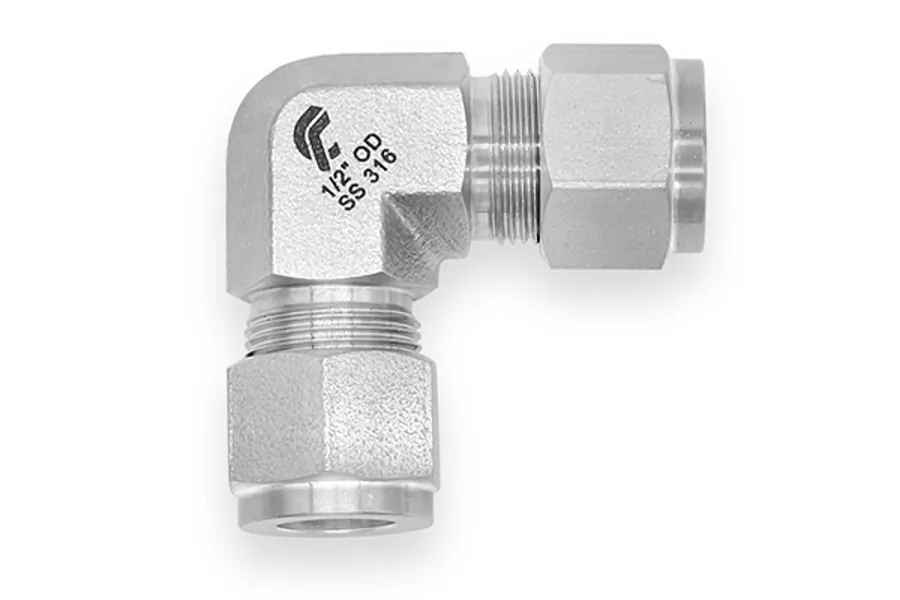
316/316L is the molybdenum-bearing austenitic stainless steel that's become the default choice for corrosion resistance in instrumentation fluid systems. Its UNS designations are S31600 for 316 and S31603 for 316L. Werkstoff numbers: 1.4401 and 1.4404.
Crestflo manufactures compression tube fittings, instrumentation valves, manifolds, face-seal fittings, ferrules, and instrumentation tubing, using 316/316L as its standard stainless grade. Every part carries a heat-number mark. Each shipment comes with EN 10204 material test certificates, and for US projects, standard items ship from ready stock while specials are made to order.
Here, 316/316L refers specifically to the instrumentation-grade wetted alloy used in fluid-system fittings, valves, and tubing. It doesn't mean sheet, plate, cookware, or jewelry.
What Is 316 / 316L Stainless Steel? Designations (UNS S31600 / S31603, 1.4401 / 1.4404)
316/316L belongs to the chromium-nickel-molybdenum family of austenitic stainless steels. Adding 2–3% molybdenum to the base 18-8 chromium-nickel structure pushes its resistance to pitting, crevice attack, and many acids well past what 304 offers. The "L" variant is simply the low-carbon version of that same alloy.
This grade goes by many names worldwide, and buyers reach for all of them without hesitation. You'll find it as 316 stainless steel, 316L stainless steel, SS 316, 316 SS, Type 316, and Type 316L. Under the SAE/AISI system, it's simply 316 and 316L. The Unified Numbering System labels it S31600 for 316 and S31603 for 316L. EN 10088 assigns it material numbers 1.4401 and 1.4404, with the descriptive names X5CrNiMo17-12-2 and X2CrNiMo17-12-2. Engineers use their own shorthand, too: molybdenum stainless steel, marine-grade stainless, low-carbon 316, "18-8 with molybdenum," or just an acid-resistant austenitic grade.
| System | 316 | 316L |
|---|---|---|
| AISI / SAE / trade | 316, SS 316, Type 316 | 316L, SS 316L, Type 316L |
| UNS | S31600 | S31603 |
| Werkstoff (EN 10088) | 1.4401 | 1.4404 |
| EN name | X5CrNiMo17-12-2 | X2CrNiMo17-12-2 |
316Ti (1.4571) is closely related to 316, titanium-stabilised, but it's a grade of its own. Same goes for 316H, the high-carbon version, and 316N, boosted with nitrogen. All three fall outside this page's US instrumentation scope.
316 vs 316L Stainless Steel: The Carbon Difference & Weldability
316 and 316L differ in exactly one place: maximum carbon content. 316 allows up to 0.08% carbon; 316L caps it at 0.03%. Chromium, nickel, molybdenum, every other element matches across the two grades.
Crestflo supplies 316/316L as its standard dual-certified material. That distinction matters most at the weld. Hold 316 in the 425–815 °C range during welding, and chromium carbides can precipitate at the grain boundaries, a process called sensitization. This depletes chromium locally and leaves the weld zone open to intergranular corrosion. 316L's lower carbon content suppresses that precipitation, which is exactly why welders reach for it on welded assemblies and orbital-welded tube runs. The two chemistries overlap enough that mill material very often carries both certifications at once, meeting the mechanical minimums of 316 while staying under the carbon ceiling of 316L. For a deeper treatment, see the 316 vs 316L comparison guide.
316 / 316L Chemical Composition (Cr, Ni, Mo Content, wt%)
The composition below follows the standard published wrought ranges for UNS S31600 and S31603. These figures come straight from the applicable ASTM/ASME material specifications, and they're confirmed on Crestflo's 316 parts through positive material identification, or PMI.
| Element | 316 (S31600) wt% | 316L (S31603) wt% |
|---|---|---|
| Carbon (C) | 0.08 max | 0.030 max |
| Chromium (Cr) | 16.0–18.0 | 16.0–18.0 |
| Nickel (Ni) | 10.0–14.0 | 10.0–14.0 |
| Molybdenum (Mo) | 2.0–3.0 | 2.0–3.0 |
| Manganese (Mn) | 2.0 max | 2.0 max |
| Silicon (Si) | 0.75 max | 0.75 max |
| Phosphorus (P) | 0.045 max | 0.045 max |
| Sulfur (S) | 0.030 max | 0.030 max |
| Nitrogen (N) | 0.10 max | 0.10 max |
| Iron (Fe) | Balance | Balance |
Carbon's the only row where the two differ. That 2–3% molybdenum content is what actually gives 316 and 316L the edge over 304 and 304L when chloride or acid gets involved.
316 Stainless Steel Mechanical Properties: Yield Strength, Tensile & Hardness
Carbon's the reason 316 and 316L differ only modestly in strength once annealed. The figures below are the standard published minima for annealed wrought or bar product, drawn from the applicable ASTM specifications. Values follow whichever standard applies and can be tailored to specific forms as needed.
| Property | 316 (S31600) | 316L (S31603) |
|---|---|---|
| Tensile strength, min | 515 MPa (75 ksi) | 485 MPa (70 ksi) |
| Yield strength (0.2% offset), min | 205 MPa (30 ksi) | 170 MPa (25 ksi) |
| Elongation, min | 40% | 40% |
| Hardness (Brinell HB / Rockwell B HRB) | ≤ 217 HB (Brinell) / ≤ 95 HRB (Rockwell B) | ≤ 217 HB (Brinell) / ≤ 95 HRB (Rockwell B) |
Instrumentation tubing meant for compression-fitting service usually ships fully annealed, at the softer end of the hardness range (commonly ≤ 90 HRB). That softness matters: it lets the ferrule bite into the tube wall and seal properly.
316 Stainless Steel Physical Properties: Density, Melting Point & Magnetic Response
The physical constants listed below are the standard published values for 316/316L, and they apply broadly to both grades.
| Property | Value (316 / 316L) |
|---|---|
| Density | 8.0 g/cm³ (0.289 lb/in³) |
| Melting range | 1,370–1,400 °C (2,500–2,550 °F) |
| Modulus of elasticity | 193 GPa (28 × 10⁶ psi) |
| Thermal conductivity (100 °C) | ≈ 16.3 W/m·K |
| Mean coefficient of thermal expansion (0–100 °C) | ≈ 16.0 µm/m·°C |
| Specific heat (0–100 °C) | ≈ 500 J/kg·K |
| Electrical resistivity | ≈ 0.074 µΩ·m |
| Magnetic response | Essentially non-magnetic when annealed; slight permeability after cold work |
316/316L is austenitic. In the annealed state, it's essentially non-magnetic. Cold-worked spots, though, such as machined threads or swaged ferrules, can show a touch of magnetic permeability. That doesn't mean the grade has changed.
316 / 316L Corrosion Resistance, PREN & Chloride SCC Limits
316 and 316L hold up well against many acids, chlorides, and marine air. Add molybdenum to the mix, and you get better pitting and crevice resistance than 304 or 304L offer. Performance in a given service is usually gauged with the Pitting Resistance Equivalent Number:
PREN = %Cr + 3.3 × %Mo + 16 × %N. For 316/316L, that usually lands somewhere around 24–28, depending on where the chromium, molybdenum, and nitrogen fall within their ranges.
Two limits deserve attention. In high-chloride service, 316/316L can still develop localized pitting and crevice attack; when chloride loads run severe, the right answer is a higher-PREN alloy. There's also the matter of stress-corrosion cracking. Austenitic stainless steels, 316/316L included, are prone to chloride SCC once metal temperatures climb above roughly 50–60 °C in the presence of chlorides and tensile stress. Aggressive chloride environments, seawater, brackish water, hot-chloride duty, call for something sturdier: a duplex, super-austenitic, or nickel alloy.
| Service / media | 316 / 316L suitability | Step-up alloy where limits are exceeded |
|---|---|---|
| Fresh water, mild/marine atmosphere | Good | — |
| Dilute / many organic acids | Good to fair | Alloy 20 for sulfuric |
| Chlorides (low temperature) | Fair; watch pitting/crevice | Duplex 2205 / 904L |
| Hot or concentrated chlorides, seawater | Limited; SCC risk above ≈ 50–60 °C | Super Duplex 2507 / 254 SMO |
| Sulfuric acid | Limited | Alloy 20 |
| Sour service (H₂S) | Acceptable within hardness limits | Confirm per NACE MR0175 / ISO 15156 |
316/316L works for sour hydrocarbon service under NACE MR0175 / ISO 15156, as long as you stay within the specified hardness limits (commonly ≤ 22 HRC). You'll still need to confirm the environmental envelope fits the application. Looking to step up? The 904L vs 316 and Alloy 20 vs 316 pages lay out the selection guidance.
316 Stainless Steel Temperature Rating & Pressure Derating
316/316L holds onto useful oxidation resistance up to about 870 °C in intermittent service, and it can handle around 925 °C when service runs continuous. Creep and allowable-stress limits, though, govern what any pressure-containing part can actually do well before those temperatures ever come into play. On the cold side, the alloy's austenitic structure stays tough all the way down to cryogenic temperatures. That's what makes it a workhorse for LNG and cryogenic instrumentation.
Working ratings on pressure parts have to be derated with temperature, based on the allowable-stress basis in the governing code. For instrumentation tube systems, that's typically ASME B31.3. Ratings follow the applicable standard, and Crestflo can customize them to the specific tube OD, wall, and temperature on request.
Welding 316 / 316L: Sensitization, Carbide Precipitation & Why 316L
316/316L welds easily with the standard fusion processes, and orbital welding on high-purity tube systems is routine practice. Where a joint calls for welding, spec favors low-carbon 316L, or dual-certified 316/316L, since it keeps clear of the carbide precipitation and sensitization that'd otherwise weaken corrosion resistance in the heat-affected zone. Filler metal is typically matched: 316L or 316LSi. Passivation after welding brings back the passive chromium-oxide film on both machined and welded surfaces; Crestflo offers electropolishing and passivation as part of its finishing services.
Applicable ASTM / ASME Specs for 316/316L Instrumentation Forms (A269, A213, A276, A182)
316/316L is procured against different product-form standards, and which one applies depends on the shape. The table sets out the specifications that apply. Crestflo doesn't supply mill product like plate, sheet, or structural pipe; it only supplies the instrumentation forms noted here.
| Product form | Governing spec | Crestflo instrumentation form |
|---|---|---|
| Seamless / welded tubing | ASTM A269 / A213 | Yes, instrumentation tubing |
| Bar / wrought | ASTM A276 / A479 | Yes, machined fitting & valve bodies |
| Forged fittings | ASTM A182 (F316 / F316L) | Yes, forged-body components |
| Pipe | ASTM A312 | Not supplied (out of instrumentation scope) |
| Plate / sheet | ASTM A240 | Not supplied |
| Bolting | ASTM A193 B8M | Not supplied |
316 / 316L Instrumentation Fittings, Valves & Tubing from Crestflo
Crestflo uses 316/316L as the default stainless grade across its instrumentation range, in both imperial and metric sizes:
- Compression tube fittings: single- and double-ferrule designs, end connections up to 2″ (50 mm) OD. Tested per ASTM F1387. NACE-compliant options are also available.
- Ferrules, hardened or non-hardened to requirement.
- Instrumentation valves: needle, ball, check, manifold (2/3/5-way), bleed, and more. Valve bodies are qualified to the applicable ASME B16.34 / API basis for their type.
- Face-seal fittings: metal-gasket (VCR) and O-ring (VCO) designs built for high-purity service.
- Instrumentation tubing and seamless tubing: supplied annealed and ready for ferrule seating.
Available finishes cover material finish, passivation, electropolish, silver anti-galling plating, and oxygen cleaning. This is a material page, so it's worth stating plainly: Crestflo supplies 316/316L only in these instrumentation forms. Not as bar. Not as sheet, plate, or mill pipe.
When to Choose 316/316L Stainless (and When to Step Up to 904L, Duplex or 6Mo)
For the bulk of general instrumentation work, 316/316L is the right call: instrument air, hydraulics, steam tracing, most hydrocarbon and petrochemical process lines, and marine atmospheres. Unless hot chlorides or strong reducing acids dominate the environment, it's the default that makes sense.
Move to a higher grade once service conditions outstrip what's currently installed. For hot or high-concentration chlorides and seawater, that means Duplex 2205, Super Duplex 2507, 254 SMO, or 904L. Sulfuric-acid duty calls for a different approach; Alloy 20 is the one worth considering there. Wondering how 316/316L measures up against its neighbors? The 304 vs 316 and titanium vs stainless guides sort that out, and the full grade range is laid out on the materials hub.
Why Source 316/316L from Crestflo
Crestflo operates as the instrumentation division of a four-decade-old export house recognized by the Government of India, with a long record of delivery across the Middle East. That's engineering depth standing behind a focused instrumentation brand. Buyers specifying 316/316L get:
- Drop-in interchange for the major tube-fitting brands: compression fittings are tested to ASTM F1387, the anchor standard for performance qualification.
- Lead time you can plan around: standard items ship from ready stock. Specials are made to order. Plan on a 6-8 week lead time in the US.
- Honest origin: these fittings are made in India. US or European melt is available on request, and full material traceability comes standard. There's no "made in USA" claim to be found.
- Cost-competitive landed price, even after US duties and tariffs, with small MOQ and private-label options available.
- ISO 9001 / 14001 / 45001 & PED certified manufacture.
The best place to start is with Request a Quote. If you'd rather test things out first, you can request a sample. Crestflo's distributor program is worth a look if partnering interests you. Need a part matched to a Swagelok® or Parker® number? Our engineering team can handle that. Just request your Swagelok®/Parker® cross-reference.
Traceability, Testing & Certifications for 316/316L Parts
Every 316/316L part carries a heat/lot number for full traceability. Each one ships with EN 10204 material test certificates (MTC): 3.1 as standard, 3.2 on request. Chemistry gets confirmed by PMI. The testing and inspection regime is thorough, covering hydraulic proof, burst and impulse testing, pneumatic and leak testing, and in-house non-destructive testing. Destructive testing takes place at ISO/IEC 17025-accredited laboratories, with third-party inspection available on request. Crestflo handles TAA and domestic-melt questions honestly, and it's all laid out on the US origin & compliance page.
Frequently Asked Questions About 316 / 316L Stainless Steel
What is the difference between 316 and 316L stainless steel?
316L and 316 differ only in maximum carbon content. 316L caps it at 0.03%, while 316 allows up to 0.08%. That lower ceiling stops carbide precipitation, sometimes called "sensitization," from forming during welding, so corrosion resistance holds up in welded assemblies. Every other element matches between the two grades. That's why you'll often see parts stamped as dual-certified 316/316L.
Is 316 better than 304 stainless steel?
For chloride, marine, and most acid environments, yes: 316 adds 2–3% molybdenum, which sharpens its resistance to pitting and crevice corrosion compared with 304. Dry or mild service is a different story. There, 304/304L usually holds up fine, and it's cheaper. The 304 vs 316 guide walks through that whole decision.
Is 316 the same as 18/8 stainless steel?
No, "18/8" typically means 304 (roughly 18% chromium, 8% nickel). 316 sits at 16–18% chromium and 10–14% nickel, and it adds something 304 doesn't: 2–3% molybdenum. That addition is what gives it noticeably better resistance to chlorides than 18/8.
Is 316 stainless steel rust-proof?
No stainless steel is completely immune to rust. 316/316L holds up well against corrosion, but it can pit under high-chloride conditions and grows vulnerable to chloride stress-corrosion cracking once temperatures climb past roughly 50–60 °C. When chloride exposure gets severe, move up to duplex, 904L, or a 6Mo alloy instead.
What is the PREN of 316 stainless steel?
Run the numbers with PREN = %Cr + 3.3 × %Mo + 16 × %N, and 316/316L lands around 24–28. Once chloride levels climb, you'll need something with a higher PREN, like super duplex or 254 SMO.
Is 316/316L suitable for sour (NACE) service?
316 and 316L are acceptable under NACE MR0175 / ISO 15156, provided the material stays within the specified hardness limits, commonly ≤ 22 HRC. Confirmation of the environmental limits for the application is still required, though. Crestflo's NACE MR0175 page covers the details.
Which ASTM specifications apply to 316/316L instrumentation parts?
Instrumentation tubing comes in under ASTM A269/A213, machined bodies under A276/A479, and forged components under A182 (F316/F316L). Crestflo supplies these instrumentation forms only, not mill product like plate or structural pipe.
Can I get 316/316L fittings that interchange with Swagelok or Parker?
Yes. Crestflo compression fittings are dimensionally interchangeable, and we test them per ASTM F1387. We don't publish a fixed chart, though. Instead, we put together a mapping for your specific parts. Request your cross-reference, and our engineering team will send back the equivalents. Swagelok® and Parker® are trademarks of their respective owners.
Is 316 stainless steel food or medical grade?
Crestflo makes 316/316L only as instrumentation-grade fittings, valves, and tubing for fluid systems, and this passage draws a line between that and food-contact or medical use. The 316/316L alloy shows up constantly in food, dairy, brewing, pharmaceutical, and medical equipment. Its low carbon content and molybdenum resist corrosion and clean up well, which is why mill product often carries a food grade or medical grade label.
Crestflo's offering is different, though. The company supplies 316/316L strictly as instrumentation-grade fittings, valves, and tubing for fluid systems, not as food-contact, surgical, or implant product. Anyone considering hygienic or medical service should qualify that use against the FDA, 3-A, or ASTM F138 requirements that actually govern the application, rather than assuming the 316 label alone covers it.
Related Materials, Standards & Resources
- Compare grades: 316 vs 316L · 304 vs 316 · 904L vs 316 · Alloy 20 vs 316
- Step-up alloys: 904L · Duplex 2205 · Super Duplex 2507 · 254 SMO
- Product forms: tube fittings · instrumentation valves · instrumentation tubing