
Instrumentation Quick-Connects: Stainless & Alloy Quick-Disconnect Couplings
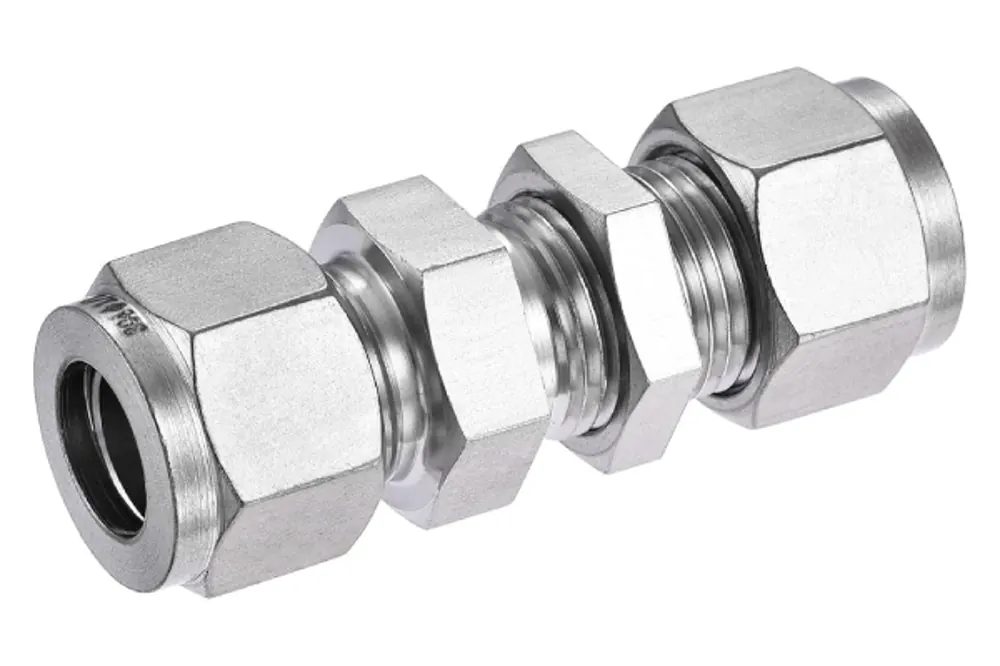
An instrumentation quick-connect is a two-piece coupling, stem and body, that lets you join and separate an instrument, tube run, or sampling line by hand. No tools needed, and you can do it over and over. Valved versions go a step further: the moment the two halves come apart, flow shuts off instantly.
Crestflo builds these quick-connect couplings for the US market as drop-in instrumentation components, spanning 316L through Hastelloy. Standard items ship from stock. Specials get made to order, with a 6-8 week delivery window. The Crestflo Engineering Team reviewed this.
Scope: On this page, "quick-connect" refers to an instrumentation or process quick-disconnect coupling made from stainless steel or a corrosion-resistant alloy. It does not mean push-in plumbing/water connectors, garden-hose quick-connects, air-tool couplers, or electrical/wire "ferrule" connectors.
Request a quote · Request a sample
What Is an Instrumentation Quick-Connect Coupling (Quick-Disconnect / QC)?
A quick-connect coupling is a mating stem (plug) and body (socket) that connect and disconnect a fluid line by hand, without tools, over many repeat cycles. The terms quick-connect, quick-disconnect, quick coupling, quick-release coupling, QC and QD all name the same tool-free coupling family. On valved (self-sealing) versions, internal shut-off valves and an elastomer seal close each half on separation to minimize spill and air ingress.
A quick-connect fitting isn't the same thing as two related families. Take a push-to-connect fitting: it locks the tube in place by pushing it in, a push-in tube-retention design, nothing more. A face-seal (VCR/VCO) fitting works differently again, sealing through a gasket that's made and broken with each connection. Neither is a repeat-cycle stem-and-body coupling.
Looking for permanent, gauged tube connections instead? See compression tube fittings.
Also Known As: Quick-Disconnect, Quick Coupling, QC / QD Fitting
Buyers and specifiers know this component under a dozen different names, and Crestflo ships it under every one of them: quick-connect fitting (sometimes written closed up as quickconnect), quick-connect tube fitting, quick-disconnect coupling, quick coupling, quick-release coupling, self-sealing coupling, shut-off coupling, snap-connect, and the shorthand QC and QD (sometimes called out as a QC coupling or QC fitting). Shut-off behavior gives it another set of labels: double-end shut-off (DESO), single-end shut-off (SESO), or full-flow / straight-through / non-valved. Configuration adds more still: keyed or keyless, panel-mount / bulkhead, or in-line. Teams working in instrument air, gas, and analytical service ask for it differently again, calling it an instrument gas coupling or a sampling quick connect.
Valved vs Full-Flow Quick-Connect Types: DESO, SESO & Straight-Through Shut-Off
Pick valved couplings when you need the media to stop the instant you disconnect, keeping spill and air ingress to a minimum. If line shut-off is handled somewhere else, go with full-flow couplings instead. They give you maximum flow with nothing holding it back.
| Configuration | Shuts off on disconnect? | Typical use |
|---|---|---|
| Double-end / dual shut-off (DESO) | Yes, both stem and body seal | Toxic, costly, or air-sensitive media; analytical and gas lines where spill and ingress must be minimized |
| Single-end shut-off (SESO) | One half seals | One side must stay pressurized/closed while the other is open to atmosphere |
| Full-flow / straight-through (non-valved / valveless) | No | Maximum flow / minimum restriction; shut-off provided by a separate valve upstream |
Spill class, no-spill/low-spill/dripless behavior, and flow coefficient (Cv) change from series to series and by size. All of it gets confirmed on the RFQ: request the specification for your line size.
How a Quick-Connect Works: Stem, Body & Latch Anatomy
The body (socket) holds the locking mechanism, usually a sleeve-actuated ball or a collet latch, and on valved types, a spring-loaded poppet as well. The stem (plug) fits into the body. Retract the sleeve, or press the release, and the latch either grabs or lets go. Connecting is simple: push the stem into the body until the latch seats. Disconnecting works the same way in reverse, retract the sleeve and pull the stem free. Valved halves seal shut as they come apart. Latch style, keying, and locking detail differ from series to series, so confirm these at quotation.
Quick-Connect Materials: 316/316L Stainless, Duplex, Monel, Hastelloy & Inconel
Crestflo builds its quick-connect couplings only in stainless steel and corrosion-resistant alloys. Brass, aluminum and copper aren't offered on this US instrumentation range. Compositions follow standard published designations, with values set per the applicable standard and customizable to requirement.
| Alloy | UNS | Family | Material page |
|---|---|---|---|
| 304 / 304L | S30400 / S30403 | Austenitic stainless | 304/304L |
| 316 / 316L | S31600 / S31603 | Austenitic stainless | 316/316L |
| 904L | N08904 | Super-austenitic | 904L |
| Duplex 2205 | S31803 / S32205 | Duplex | Duplex 2205 |
| Super Duplex 2507 | S32750 | Super duplex | Super Duplex 2507 |
| Alloy 20 | N08020 | Super-austenitic | Alloy 20 |
| Monel 400 | N04400 | Nickel-copper | Monel 400 |
| Inconel 625 | N06625 | Nickel | Inconel 625 |
| Inconel 825 | N08825 | Nickel-iron-chromium | Inconel 825 |
| Hastelloy C-276 | N10276 | Nickel-molybdenum-chromium | Hastelloy C-276 |
| Titanium Gr 2 | R50400 | Titanium | Titanium Gr 2 |
The full range also covers 254 SMO, AL-6XN, Inconel 600/601/718, Incoloy 800/800H, Monel K500, Hastelloy C-22/B-2/B-3/X, and Nickel 200/201. Surface options include electropolish, passivation, and silver anti-galling plating. For clean-gas service, oxygen and UHP cleaning is available.
Quick-Connect Seals & Temperature Limits: FKM, EPDM, PTFE & Perfluoroelastomer
Working temperature depends on two things: the seal elastomer and the body alloy. Standard elastomer service limits are published values, so specify your media and temperature on the RFQ to confirm the right selection. For more detail, see Crestflo's seal material temperature selection guide.
| Seal elastomer | Typical continuous service range | Media notes |
|---|---|---|
| FKM (fluoroelastomer, e.g. Viton) | approx. −20 °C to +200 °C | Broad hydrocarbon / general process; poor with hot amines, ketones |
| EPDM | approx. −45 °C to +150 °C | Steam, water, polar fluids; not for mineral oils |
| PTFE | approx. −200 °C to +260 °C | Near-universal chemical resistance; low resilience |
| Perfluoroelastomer (FFKM, e.g. Kalrez) | approx. −15 °C to +260 °C+ | Aggressive chemistries, high-purity and semiconductor service |
Values per applicable elastomer standard; customizable to requirement.
Quick-Connect Sizes & End Connections: NPT, BSP, Tube-Fitting & Tube-Stub Ends
Across the instrumentation range, quick-connect couplings come in both imperial and metric, and the end connections are matched to suit the mating line. Port sizes typically run 1/8″, 1/4″, 3/8″ and 1/2″, with metric options at 6, 8, 10 and 12 mm. OD and port availability vary by series, though, so the exact figures get confirmed at quotation.
| End type | Standard | Reference |
|---|---|---|
| Tube-fitting (compression) end | Gauged double-ferrule, imperial & metric | Compression tube fittings |
| NPT (male / female) | ASME B1.20.1 | Thread identification guide |
| BSPP / BSPT | ISO 228 / ISO 7 (parallel / taper) | Thread identification guide |
| Tube-stub / weld end | For instrumentation tubing | Butt- or socket-weld |
Where the coupling has a compression tube-fitting end, that end meets ASTM F1387 performance criteria. The coupling body interchange itself is dimensional and functional in nature. Values follow the applicable standard and can be adjusted to requirement.
Quick-Connect Pressure & Temperature Ratings
Series, body alloy, seal, and size all play a part in setting the working pressure, and each build gets checked against the relevant standard before it ships. Crestflo doesn't quote one blanket figure across the whole range, and pressure ratings from other fitting families don't carry over. Temperature limits come down to the seal elastomer and body alloy, per the tables above. Give your working pressure, temperature, and media on the RFQ, and the engineering team will confirm the certified rating for your exact configuration. It can be tailored to what you need.
Quick-Connect Configurations: Keyed, Panel-Mount & In-Line
Couplings ship keyed or keyless. Keyed versions prevent cross-connection of incompatible media. Mounting comes in-line, panel-mount/bulkhead, or other patterns. Keying schemes and mounting hardware aren't fixed either; they're configured to the application at quotation.
Quick-Connect Applications: Instrument Gas, Analytical Sampling, Semiconductor & Hydrogen
Instrumentation quick-connects give tool-free connect and disconnect points across process and analytical systems. Consider instrument-air and pneumatic gas distribution first. Then there are analytical and sampling systems, where grab-sample lines (hygienic and sanitary sampling service included) get made and broken again and again. Semiconductor and UHP gas panels belong on this list too, as does hydrogen service run in alloys built to handle it. For clean-gas and oxygen service, pin down the cleanliness target that applies. That's what Crestflo's oxygen / UHP cleaning page covers.
Standards, Certifications & Traceability
Crestflo holds ISO 9001 / 14001 / 45001 and PED certification, and its quick-connect couplings meet NACE MR0175 / ISO 15156 for sour service in suitable alloys. Each part carries a heat/lot number, so tracing it back isn't a problem. EN 10204 MTC 3.1 comes standard, with 3.2 available on request. Positive material identification (PMI), in-house NDT, third-party inspection on request, and destructive testing through ISO/IEC 17025-accredited labs round out what's on offer. Any coupling with a compression tube-fitting end meets ASTM F1387.
| Item | Standard | Evidence |
|---|---|---|
| Sour-service capability | NACE MR0175 / ISO 15156 | Compliant alloys, on request |
| Traceability | EN 10204 MTC 3.1 (3.2 on request) | Heat/lot number on every part |
| Tube-fitting end qualification | ASTM F1387 | Applies to compression ends |
| Quality system | ISO 9001 / 14001 / 45001 & PED | Certificates in /quality/ |
Swagelok® & Parker® Quick-Connect Interchange
Crestflo builds instrumentation quick-connect couplings that are dimensionally and functionally interchangeable. Swagelok® and Parker® are trademarks of their respective owners; Crestflo has no affiliation with either company, and neither endorses nor sponsors this product line. Need to match an existing part? Request your Swagelok® cross-reference or Parker® CPI cross-reference from the engineering team. Send the part number, and you'll get the equivalent back. Datasheets and CAD files go out to customers on request.
Why Crestflo for Quick-Connect Couplings
Crestflo is the instrumentation division of a Government-of-India-recognized export house with four decades behind it and a delivery track record across the Middle East. The guiding principle is simple: We Engineer Confidence. For quick-connect couplings, that translates into concrete terms. Made-to-order lead time runs 6-8 weeks, against the 20-plus weeks typical of the major suppliers. Standard items sit in ready stock, while specials are built to order. A small MOQ opens the door to private-label and made-to-print work. The range covers everything from stainless steel to exotic alloys. And every part carries heat-number traceability with MTC.
Origin is Indian, though US and European melt can be arranged on request, with full material traceability throughout. For more detail, see US origin & compliance and lead time.
Request a Quote or Sample
Tell us your media, pressure, temperature, size, end connections, shut-off type, and alloy. Our engineering team will send back a specified quotation. Request a quote · Request a sample · Become a distributor. Reach us in the US at sales@crestflousa.com · +1 346 594 9005 (Houston, TX).
Quick-Connect FAQ
What is an instrumentation quick-connect?
A quick-connect is a stem-and-body coupling. It connects and disconnects a fluid line by hand, no tools required, and it's built to handle that again and again. You'll find these on instrument, gas, and sampling systems. Valved versions go further: each half shuts off flow the moment you pull it apart.
Is a quick-connect the same as a quick-disconnect?
Yes, that's correct. "Quick-connect," "quick-disconnect," "quick coupling," "quick-release coupling," "QC" and "QD" are simply different names for the same tool-free coupling family.
Valved or full-flow, which quick-connect do I need?
Go with a valved coupling, double-end shut-off, when you need media stopped at both halves on disconnect; it keeps spill and air ingress to a minimum. Need maximum, unrestricted flow instead? Choose full-flow, non-valved, and let a separate valve handle shut-off. Spill class and Cv get confirmed on the RFQ.
Do quick-connects leak?
Valved quick-connects seal at disconnect through internal shut-off valves and an elastomer seal. Get the seal, alloy, and rating selection right for the service, and a properly specified coupling won't leak. Confirm seal and media on the RFQ.
What materials are quick-connects available in?
Brass isn't part of this US instrumentation range. What is: 304, 316, 316L and 904L stainless, duplex and super-duplex grades, high-nickel alloys such as Monel, Inconel, Hastelloy and Alloy 20, and titanium.
Are quick-connects NACE / sour-service capable?
Yes, Crestflo supplies quick-connect couplings compliant with NACE MR0175 / ISO 15156 in suitable alloys. See the NACE MR0175 standard page.
Do you provide material certificates and traceability?
Every part comes with a heat/lot number, backed by an EN 10204 MTC 3.1 as standard, with 3.2 available on request. PMI is included, and NDT along with third-party inspection can be arranged as needed.
What sizes and end connections are available?
Available in both imperial and metric sizes, with tube-fitting (compression), NPT, BSPP/BSPT, and tube-stub/weld ends. The exact size and end menu for each series gets confirmed at quotation.
Can I get a Swagelok® or Parker® quick-connect equivalent?
Yes. Crestflo makes quick-connect couplings that match Swagelok and Parker units, both dimensionally and functionally. Swagelok® and Parker® are trademarks of their respective owners, and Crestflo isn't affiliated with either company. Send us your part number and we'll send back a cross-reference.
How is a quick-connect different from a push-to-connect fitting?
A push-to-connect fitting works on push-in tube retention, holding the tube in place without extra hardware. A quick-connect isn't the same thing: it's a mating stem-and-body coupling built for repeated tool-free disconnection. Crestflo covers this in more detail here: push-to-connect fittings.
What is the lead time and minimum order?
Standard items ship from ready stock. Specials are made to order, with delivery running 6-8 weeks and a small MOQ required. Private-label and made-to-print options are also on offer.
Are these quick-connects made in the USA?
Crestflo manufactures for the US market, and its standard product is Indian in origin. US or European melt is available on request, backed by full material traceability. Parts are engineered as drop-in replacements and ship in 6-8 weeks. See US origin & compliance.