
Instrumentation Check Valves (Non-Return Valves) in Stainless & High-Nickel Alloys
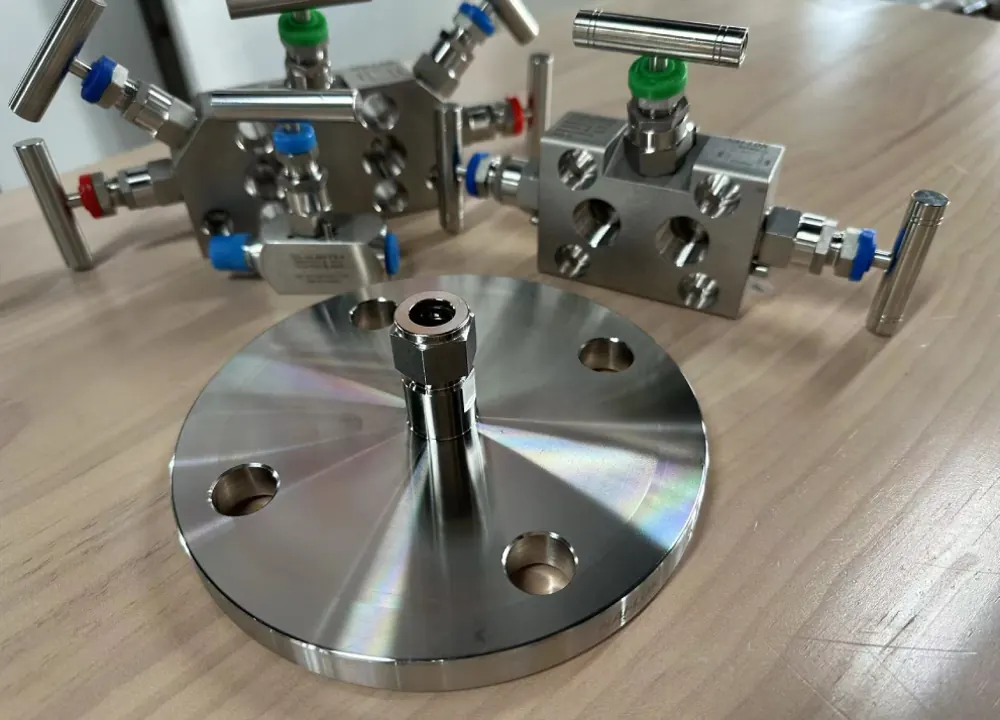
A check valve is a one-way, directional valve. It opens to let flow move forward and seals shut automatically, blocking reverse flow or backflow in instrument, sampling, and process-tubing systems. Crestflo builds instrumentation check valves in 316/316L stainless and high-nickel alloys, sized from 1/16" to 1", with tube-fitting (compression) or NPT ends. Cracking pressures are spring-set and selectable. Each valve is engineered as a drop-in replacement for the major instrumentation brands, and it's delivered in 6-8 weeks.
Crestflo builds every instrument check valve for instrument, sampling, and process-tubing systems in stainless and high-nickel alloys. This isn't a PVC, bronze, plumbing, water-line, sump-pump, or automotive check valve.
Also Known As: Non-Return Valve (NRV), One-Way Valve & Related Designations
On instrument datasheets and P&IDs, you'll find this component listed under a handful of different names. A check valve also goes by non-return valve (NRV or non return valve), one-way valve (also written one way valve or 1-way valve), in-line or inline check valve, poppet check valve, ball check valve, spring check valve, lift check valve, forward-flow valve, or backflow-prevention valve in instrumentation contexts. Crestflo lists it as the "check / NRV" valve. Searching by the exact abbreviation? Our NRV valve page covers the full name too. Need an air-piloted variant instead, check the pneumatic check valve.
How a Check Valve Works: One-Way Flow & Backflow Prevention
Pressure in the line pushes the poppet or ball off its seat, opening a path for flow in the direction it's meant to travel. Once flow slows down, stops, or tries to reverse, the spring inside the valve, aided by back-pressure from downstream, forces the sealing element back onto the seat. Reverse flow gets blocked. Because the valve only works one way, it has to be installed with the body's flow arrow pointing in the same direction as the intended flow, matching the check valve symbol on the P&ID, which marks where flow is allowed to go. That automatic, one-directional action is what sets a check valve (forward-flow / anti-backflow valve) apart from a set-pressure device such as a relief valve.
Check Valve Types: Ball, Poppet, Spring-Loaded & Lift Configurations
Instrumentation check valves rely on just a handful of sealing mechanisms, and each one gets matched to a particular service profile.
| Type | Sealing element | How it seals | Typical instrumentation use |
|---|---|---|---|
| Poppet check valve | Spring-loaded poppet | Poppet re-seats on a conical/flat seat under back-pressure | General instrument lines, panels, sampling loops |
| Ball check valve | Spring-loaded ball | Ball is pushed onto its seat by spring + reverse flow | Compact in-line backflow protection |
| Spring check valve | Poppet or ball + calibrated spring | Spring sets a defined cracking pressure | Where a specific opening pressure is required |
| Lift check valve | Guided disc/poppet | Disc lifts on forward flow, drops/re-seats on reversal | In-line, low-pressure-drop service |
Every one of these is an in-line configuration, threaded or connected straight into the tube run. Values follow the applicable standard, and they can be customized to whatever the requirement calls for.
Check Valve Specifications: Size, Cracking Pressure, Cv & Ratings
Crestflo instrumentation check valves are built to order. Standard engineering values are listed below, and per-service settings can be adjusted to fit your requirements.
| Attribute | Value / specification |
|---|---|
| Function | One-way (directional) valve, opens on forward flow, seals against backflow |
| Size range | 1/16" to 1" imperial fractional, 1/16", 1/8", 1/4", 3/8", 1/2", 3/4" and 1", plus common metric tube ODs of 6, 8, 10 and 12 mm; miniature and micro check valves at the small end |
| End connections | Tube-fitting (compression) ends or threaded (NPT) ends; metric or imperial |
| Thread standards | NPT per ASME B1.20.1; BSPP / BSPT and others on request |
| Cracking pressure | Spring-set with adjustable cracking pressure; selectable from a low cracking pressure of about 1 psi up to higher settings such as 10 or 25 psi, values per applicable standard, customizable to requirement |
| Working pressure | Rated to the applicable ASME B16.34 pressure class for the selected body alloy, bore and temperature; customizable to requirement |
| Flow coefficient (Cv) | Varies with size and orifice, request the Cv for your configuration |
| Temperature | Governed by body alloy and seat/seal material (see seat options below) |
| Ferrules (tube ends) | Hardened and non-hardened ferrules to requirement |
| Traceability | Heat/lot number marked on every part; EN 10204 3.1 MTC standard, 3.2 on request |
What really defines a check valve is its cracking pressure: the minimum upstream pressure needed to open the valve and start forward flow. An internal spring sets that figure, and it's adjustable, chosen when you place the order. Need minimal opening resistance? A low cracking pressure check valve handles that. For a high pressure check valve, the body alloy and pressure class get matched to whatever rating you specify, so you cover high-pressure check valve duty simply by picking the body and class that fit your working pressure.
Check Valve Materials: 316 Stainless, Hastelloy, Monel, Inconel & Duplex
Crestflo's stainless steel check valves start with 316/316L for general service. The same platform reaches further, into high-nickel and corrosion-resistant alloys that most instrumentation stockists rarely carry. For sour, chloride, or aggressively corrosive media, machined bodies and trim step up to duplex, super-austenitic, and nickel alloys. Each grade page walks through the alloy and links to its instrumentation forms.
| Alloy | UNS | Best-for service |
|---|---|---|
| 316 / 316L stainless | S31600 / S31603 | General corrosion, standard instrument lines |
| 304 / 304L stainless | S30400 / S30403 | Lower-corrosion utility service |
| 904L | N08904 | Sulfuric acid, higher chloride resistance |
| Duplex 2205 | S32205 | Chloride stress-corrosion resistance, strength |
| Super Duplex 2507 | S32750 | Seawater, high-chloride, offshore |
| 254 SMO | S31254 | Brackish/seawater, high-PREN service |
| AL-6XN | N08367 | High-chloride, pharmaceutical/process |
| Alloy 20 | N08020 | Sulfuric and mixed-acid service |
| Hastelloy C-276 | N10276 | Wet chlorine, oxidising/reducing acids |
| Hastelloy C-22 | N06022 | Broad-spectrum severe corrosion |
| Monel 400 | N04400 | Hydrofluoric acid, seawater, reducing service |
| Monel K500 | N05500 | As Monel 400 with higher strength |
| Inconel 625 | N06625 | High-temperature, seawater, sour service |
| Inconel 825 | N08825 | Sulfuric/phosphoric acid, sour wells |
| Inconel 718 | N07718 | High-strength, high-temperature sour/gas-well service |
| Titanium Gr2 | R50400 | Seawater, chlorides, oxidising media |
Sour-service (NACE) check valves come in suitable alloys; see the standards below. For grades not listed here, browse the full alloy selection.
Check Valve End Connections: Tube-Fitting & NPT Ends (1/16"–1")
Check valves come with tube-fitting (compression) ends for a direct connection into a tube run, or with male/female NPT threaded ends. Both are available in imperial fractional and metric sizes, from 1/16" to 1". You'll find the full imperial ladder below, alongside the equivalent metric tube ODs. Tube-fitting ends take hardened or non-hardened ferrules as needed, and they pair directly with Crestflo tube fittings, letting you add inline backflow protection anywhere along the run. BSPP/BSPT and other thread forms are available on request.
| Imperial size | Metric equivalent | Tube-fitting end | NPT end | Notes |
|---|---|---|---|---|
| 1/16" | — | Yes | Yes | Miniature / micro check valve |
| 1/8" | ~3 mm | Yes | Yes | Small impulse and pilot lines |
| 1/4" | 6 mm | Yes | Yes | Most-specified instrument size |
| 3/8" | 10 mm | Yes | Yes | Higher-flow sampling lines |
| 1/2" | 12 mm | Yes | Yes | Process and utility tubing |
| 3/4" | — | Yes | Yes | Larger process tubing |
| 1" | — | Yes | Yes | Top of the instrumentation band |
The 1/4" check valve gets specified more than any other size for instrument impulse lines, gauge lines, and sampling lines. Every size in the ladder comes with either compression or NPT ends. Metric tube ODs of 6, 8, 10 and 12 mm all map onto the same body platform.
Seat & Seal Materials and Temperature Limits
Sealing defaults to soft-seat, and the elastomer chosen sets the working-temperature window. Standard published limits apply, though they can be adjusted to fit requirements. PTFE covers broad chemical compatibility. FKM/Viton handles general hydrocarbon and process service. Perfluoroelastomer, or FFKM/Kalrez, is for aggressive or high-temperature media. Metal-seat options exist too, for cases where an elastomer just won't hold up. Specify the media and temperature on the RFQ, and the seat or seal gets matched to it.
Cleaning, Finish & Oxygen / UHP Check Valve Service
Check valves come with electropolished and passivated surfaces, and they can be cleaned for oxygen and ultra-high-purity (UHP) service. Standard UHP cleanliness and oxygen-clean targets follow the applicable standard, so state your target on the RFQ. For high-purity requirements, see oxygen and UHP cleaning and semiconductor applications.
Standards, Certifications, Testing & Traceability
Crestflo's ISO 9001, 14001, and 45001 certified, and it holds PED certification too. Instrumentation check valves carry the standard approvals that fit their particular product type. Design and testing reference the current editions of the relevant standards throughout.
| Item | Standard / basis |
|---|---|
| Valve design / pressure class | ASME B16.34 |
| Valve inspection & test | API 598; API 6D; API 602 where applicable |
| NPT threads | ASME B1.20.1 |
| Sour service | NACE MR0175 / ISO 15156 |
| Material traceability | EN 10204 3.1 standard, 3.2 on request |
Testing includes hydraulic proof and burst, pneumatic, and seat-leak testing, along with PMI and in-house NDT. Destructive testing happens at ISO/IEC 17025-accredited labs, and third-party inspection is available on request. Every part carries a heat-number mark for full material traceability; the complete regime is laid out at testing & inspection. Datasheets and CAD models go to customers on request.
Ordering & Cross-Reference: Replacing a Swagelok or Parker Check Valve
Crestflo check valves are built for dimensional drop-in interchange with the major instrumentation brands. Valve qualification follows ASME B16.34 and the applicable API test standards. To match an existing part, request your Swagelok® or Parker® cross-reference from our engineering team, and we'll send back the equivalent Crestflo configuration along with the ordering code. Swagelok® is a trademark of Swagelok Company, and Parker® is a trademark of Parker-Hannifin Corporation. Crestflo isn't affiliated with or endorsed by either one. Start at the cross-reference hub, or go straight to the Swagelok check valve cross-reference.
Standard items ship from stock. Specials are made to order, and delivery runs 6-8 weeks. Request a quote or request a free sample to configure your check valve.
Why Source Check Valves From Crestflo
Crestflo operates as the instrumentation division of an export house that's been operating for four decades, carrying formal recognition from the Government of India and a solid delivery record across the Middle East. That heritage backs Crestflo as a check valve supplier serving the USA, with a program built around what engineers actually need: a wide range of alloys and quick turnaround.
- 6–8 week delivery versus 20+ weeks typical for the majors, see lead time.
- Stainless plus high-nickel and CRA alloys in-house, 316/316L through Hastelloy, Monel, Inconel, duplex, and titanium, all handled under one roof.
- Dimensional drop-in interchange for the major brands, qualified to ASME B16.34 / API.
- Small MOQ and private label for OEMs and distributors.
- Heat-number marked, MTC-traceable parts on every order.
- Made in India, with US or European melt available on request and full material traceability, see US origin & compliance for details.
We Engineer Confidence. Get in touch with our team through Request a Quote, take a look at the distributor program, or find out why Crestflo.
Check Valve FAQ
What is a check valve (NRV)?
A check valve does one simple job: it lets flow move in a single direction and shuts the door on anything trying to come back the other way. Some call it a non-return valve, or NRV, or just a one-way valve. Crestflo makes instrumentation-grade versions of these in stainless steel and high-nickel alloys, built for instrument lines, sampling systems, and process tubing.
How does a check valve work?
Pressure from the forward line shoves the poppet or ball off its seat, and that's what opens the valve. Once flow reverses or simply stops, the internal spring and downstream back-pressure push the sealing element back against the seat, sealing off any backflow. Because the valve only works in one direction, it has to go in with the body's flow arrow pointing the way the fluid is meant to travel.
What is the difference between a check valve and a backflow preventer?
A check valve is just one sealing element, built to let flow move in a single direction. Backflow preventers are bigger: often several checks combined with vents, engineered and tested specifically for potable-water protection. Crestflo doesn't make plumbing backflow preventers. It supplies instrumentation check valves instead.
What is cracking pressure on a check valve?
Cracking pressure is the minimum upstream pressure required to open the valve and start forward flow. The internal spring sets this figure, and it's selectable at order time. Common nominal settings run to values like 1, 10, or 25 psi, and these can be customized to your service requirement.
Which alloys are available for check valves?
304/304L, 316/316L, 904L, Duplex 2205, Super Duplex 2507, 254 SMO, AL-6XN, Alloy 20, Inconel 625/718/825, Monel 400/K500, Hastelloy C-276/C-22, and Titanium Gr2 are all part of the lineup, among others. For sour service, versions meeting NACE MR0175 / ISO 15156 are available in suitable alloys.
What end connections and sizes do Crestflo check valves use?
Compression (tube-fitting) ends or NPT threads come in imperial or metric, sized from 1/16" to 1". BSPP/BSPT and other thread forms are available on request. Tube-fitting ends connect directly to Crestflo tube fittings.
Are Crestflo check valves NACE / sour-service compliant?
Yes. We offer check valves compliant with NACE MR0175 / ISO 15156, built in alloys suited for sour-service and H2S-bearing applications. Just confirm the alloy and hardness limits you need on your RFQ.
Do you provide material certificates for check valves?
Every part carries a heat-number mark, and an EN 10204 3.1 material test certificate comes standard. Need 3.2 certification instead? That's available on request. Together, this gives full traceability from mill to finished valve.
Can Crestflo check valves replace a Swagelok or Parker check valve?
Yes. Our valves are engineered for dimensional drop-in interchange, with qualification referenced to ASME B16.34 and the applicable API test standards. Send along your Swagelok or Parker cross-reference, and we'll return the equivalent Crestflo configuration. Both marks belong to their respective owners. Crestflo is independent and unaffiliated.
What is the lead time and minimum order for check valves?
Standard items ship from ready stock. Specials are made to order, with delivery running six to eight weeks. MOQs stay small, and private-label options are available for OEMs and distributors.
Where are Crestflo check valves made?
These originate in India, though buyers can request US or European melt along with full material traceability. Crestflo's a US-serving manufacturer. Anyone with TAA or domestic-melt requirements should check the US origin & compliance page for details.
What is the maximum working pressure and Cv of a check valve?
Working pressure follows the applicable ASME B16.34 pressure class for whatever body alloy, bore, and temperature you've selected, and Cv shifts with size and orifice. Ask for the certified rating and Cv for your specific configuration when you submit the RFQ.