
Hastelloy C-276 Instrumentation Valves (UNS N10276)
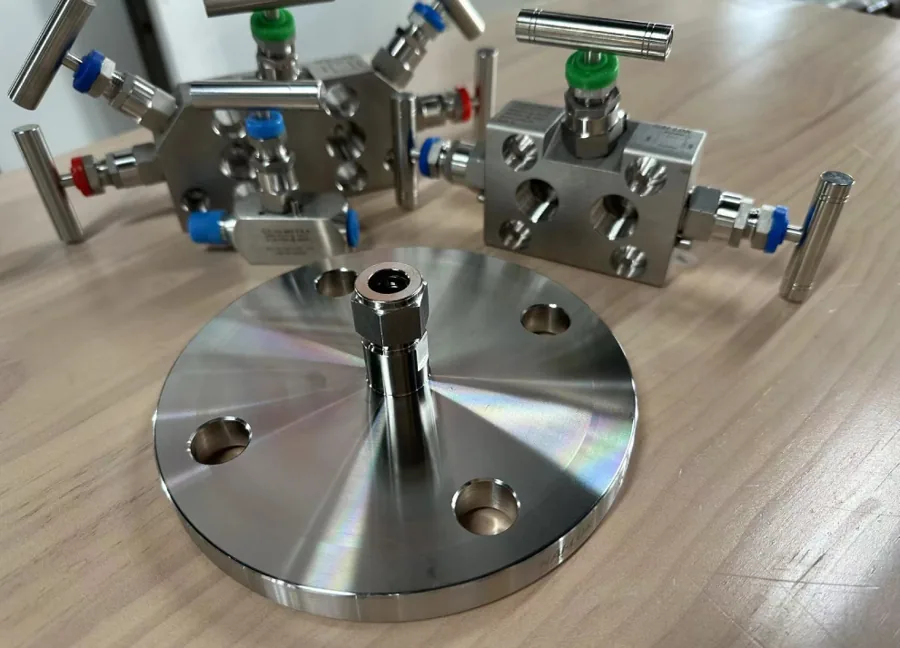
Hastelloy C-276 instrumentation valves are small-bore isolation, throttling, and block-and-bleed valves machined from nickel alloy C-276 (UNS N10276, W.Nr. 2.4819). Crestflo builds the whole valve family in this grade: needle, ball, check, 2/3/5-valve manifolds, monoflange, double block-and-bleed, and bleed valves, sized 1/16-inch through 1-inch. You reach for C-276 bodies and trim when the media is a sour gas loaded with H₂S, CO₂, and chlorides, or a hot acid stream that eats through 316 stainless and takes duplex trim with it. Design follows ASME B16.34, sour-service builds are offered to NACE MR0175 / ISO 15156, and seat and shell leak testing follows the applicable API 598 / BS EN 12266 practice. Standard items ship from stock; specials are built to order, with delivery running 6-8 weeks. Request a quote to price your configuration.
Hastelloy® is a registered trademark of Haynes International, Inc. Swagelok®, Parker®, and Hy-Lok® are trademarks of their respective owners; Crestflo is not affiliated, and interchange is dimensional.
Why Specify a Hastelloy C-276 Valve Body and Trim
A valve is a harder corrosion problem than a straight run of tube. The media sits trapped in body cavities, dead legs, and the packing bore. It cycles across the seat. It concentrates at crevices under the stem and in thread roots. That is exactly the geometry where chloride pitting, crevice attack, and stress-corrosion cracking start, so a valve in the wrong alloy fails long before the pipe around it does.
Hastelloy C-276 is a nickel-molybdenum-chromium-tungsten alloy that holds up in both oxidising and reducing media, a combination few alloys manage. The high molybdenum and tungsten drive its resistance to pitting, crevice corrosion, and chloride stress-corrosion cracking; the chromium handles the oxidising side. For a valve that sees wet sour gas, hot contaminated HCl, ferric and cupric chlorides, or seawater injection, that chemistry is the whole reason to pay the alloy premium. Where 316 stainless and even 2205/2507 duplex trim pit, crack, or seize, a C-276 stem and seat keep sealing.
The full metallurgical picture, composition ranges, mechanical and physical properties, PREN, and corrosion-by-media data, lives on the Hastelloy C-276 alloy grade page. This page stays on the valve.
Also Specified As: Alloy C-276 Valves, C276 Needle Valve, UNS N10276 Valves
Buyers and specifiers call these valves several ways, and they all point to the same Ni-Mo-Cr-W material. A requisition might read "Alloy C-276 needle valve," "C276 ball valve," "UNS N10276 manifold valve," or "Hastelloy C-276 instrument valve," and each one lands here. Hastelloy® C-276 is the trademarked designation; Alloy C-276, C-276, and C276 are the generic forms; the material is registered as UNS N10276 and Werkstoff 2.4819, ISO name NiMo16Cr15W.
Scope: these are instrumentation valves, the small-bore kind that isolate and throttle gauge, transmitter, analyzer, impulse, and sample lines. A ball valve here means an instrument ball valve, not a plumbing valve; a needle valve means a flow-metering instrument valve, not a carburetor part; a manifold means a valve manifold, not an exhaust or PEX manifold.
Hastelloy C-276 Valve Types: Needle, Ball, Check, Manifold, Monoflange & DBB
Crestflo machines the full instrumentation valve family in C-276, so you can standardise an entire hookup, primary isolation through bleed, on a single corrosion-resistant alloy. Each type links to its own detail page for dimensions and ordering.
| Valve type | Function in a C-276 hookup | Typical service | Detail page |
|---|---|---|---|
| Needle valve | Fine throttling and primary isolation, multi-turn non-rotating tip | Gauge and DP-transmitter roots, calibration, sampling | Needle valve |
| Ball valve (2-way, 3-way, L-/T-port) | Quarter-turn on/off isolation and diverting | Sample shut-off, gauge selection, switching | Ball valve |
| Check valve / NRV | Spring-loaded one-way, non-return flow | Back-flow protection on analyzers and pumps | Check valve |
| 2/3/5-valve manifold | Combined block, bleed, and equalise in one body | DP-transmitter and gauge isolation | 3-valve · 5-valve |
| Monoflange valve | Integral block-and-bleed on a flanged connection | Compact direct-mount gauge/transmitter isolation | Monoflange |
| Double block-and-bleed (DBB) | Two blocks plus a bleed in one body, per ASME B16.34 | Positive double isolation, custody and hazardous lines | DBB valve |
| Bleed / vent valve | Small stem bleed to vent, drain, or depressurise | Manifold bleed ports, gauge venting | Bleed valve |
Beyond these, C-276 is available in gauge/root, metering, toggle, plug, relief, and packless (bellows and diaphragm) patterns. Spell out the function on the RFQ and the engineering team confirms the build. For the complete family and the specialty patterns, start at the instrumentation valves pillar.
C-276 Manifold Valves: 2-, 3- & 5-Valve for DP Transmitters
The manifold is where C-276 earns its keep on a sour or acidic DP measurement. A 3-valve manifold gives you two block valves plus an equalise valve to protect the transmitter cell during zeroing; a 5-valve adds two bleed/vent valves for calibration and purging. Crestflo builds these in C-276 with non-rotating stem tips to protect the seat, and every manifold gets 100% seat and shell leak testing before it ships. Direct-mount and remote-mount patterns both carry over to the alloy.
Actuation: Manual and Pneumatic C-276 Valves
Most instrumentation C-276 valves are hand-operated, bar-stock or forged-body construction, with the handle chosen for the duty: lever and phenolic or metal T-bar handles on ball valves, vernier and locking/lockout handles where throttling repeatability or line-identification matters, and color-coded handles for service marking. Where a line needs remote or automated operation, ball and needle patterns are available with pneumatic actuation. Panel-mount and low-profile builds support instrument-rack and enclosure installations.
Seat & Packing Materials for Hot Sour and Acid Service
The C-276 body and trim handle the corrosion; the soft-goods set the temperature ceiling and the seat-leakage class. This is the choice that most often gets a C-276 valve wrong, picking a packing that can take the chemistry but not the heat, or the reverse. The seat and stem-seal options below pair with a C-276 body, and the temperature limits are the standard published limits for each material. Confirm the certified rating for your build on the RFQ.
| Seat / packing material | Typical temperature limit | Why choose it |
|---|---|---|
| PTFE (virgin) | up to ~450°F (232°C) | Default soft seat, excellent chemical resistance, tight bubble-tight shut-off |
| Reinforced / glass-filled PTFE (RTFE) | up to ~450°F (232°C) | Higher load capacity and cold-flow resistance than virgin PTFE |
| PCTFE | cryogenic to ~250°F (121°C) | Low-temperature and gas service where PTFE creep is a concern |
| PEEK | up to ~600°F (315°C) | High-pressure, higher-temperature throttling with good chemical resistance |
| Graphite (flexible, Grafoil-type) | up to ~850°F (454°C) | High-temperature stem packing and fire-exposed service |
| Metal-to-metal seat | limited by the C-276 body (to ~1000°F / 538°C) | Highest temperature and severe-cycling throttling, where soft seats cannot survive |
For hot sour gas, the usual pairing is a C-276 body and trim with graphite packing where temperatures run high, or reinforced PTFE where they sit in the moderate band and a bubble-tight soft seat matters. The point of C-276 is that the metal in contact with the media does not become the weak link; the soft-good choice then tunes the valve to the temperature and the leak class. Seat and packing figures follow the applicable standard and are customisable to requirement.
Hastelloy C-276 Valve Sizes (1/16″–1″) & End Connections: NPT, BSPP, Tube & Weld
C-276 instrumentation valves ship in imperial fractional sizes from 1/16-inch to 1-inch and in a matching metric menu, with the port and end connection configured to the hookup. Tube-fitting (compression) ends land as single or double ferrule and interchange dimensionally with the major brands; threaded ends follow published thread dimensions and can be tailored.
| Attribute | Options | Standard |
|---|---|---|
| Size range | 1/16″, 1/8″, 1/4″, 3/8″, 1/2″, 3/4″, 1″ (imperial); metric menu | Imperial and metric |
| Tube-fitting ends | Compression, single or double ferrule | Dimensional interchange with major brands |
| Tapered pipe threads | NPT (male/female), NPTF, BSPT | ASME B1.20.1 (NPT); BSP |
| Parallel pipe threads | BSPP / ISO parallel | ISO parallel |
| Flare / port | SAE / JIC 37°, SAE ORB | Per applicable standard |
| Welded ends | Socket-weld, butt-weld | Per applicable standard |
| Flanged ends | On DBB and monoflange builds | ASME flange standards |
Port configuration, bore, and Cv depend on the valve type and size; the engineering team confirms the orifice and flow coefficient for your pattern at quotation. Values per applicable standard; customisable to requirement.
Pressure & Temperature Ratings for C-276 Instrumentation Valves
Pressure rating is set by the valve design and its governing standard, not by the alloy. Manifolds are rated up to 10,000 psi and double block-and-bleed valves to 3,000 psi under ASME B16.34; other types carry their own ratings on their detail pages, and higher-pressure requirements are handled on the high-pressure line. The temperature ceiling is the lower of two limits: what the C-276 body can take (the alloy holds strength and toughness from cryogenic up to roughly 1000°F / 538°C) and what the seat and packing material allows. In practice the soft-good sets the limit until you move to a metal seat. Confirm the exact certified rating for your build on the RFQ.
| Valve type | Max pressure | Rating basis |
|---|---|---|
| 2/3/5-valve manifold | up to 10,000 psi | ASME B16.34 |
| Double block-and-bleed | up to 3,000 psi | ASME B16.34 |
| Needle, ball, check & other patterns | Type- and design-specific; confirmed per configuration | ASME B16.34 / applicable API standard |
| Higher-pressure builds | See the high-pressure line | Per applicable standard |
Standards, Testing & NACE MR0175 Sour-Service Compliance
A valve's pressure boundary and its seat are qualified against different standards than a fitting is, and C-276 valves follow the valve standards, not the compression-fitting standard. Pressure-boundary design follows ASME B16.34. Seat-leakage and pressure testing follow the applicable API 598 / BS EN 12266 regime for the valve type. For sour service, C-276 valve material is offered to NACE MR0175 / ISO 15156: in the solution-annealed condition, UNS N10276 is an accepted nickel-base corrosion-resistant alloy for sour (H₂S-containing) service under NACE MR0175 / ISO 15156-3; confirm the hardness and material-condition limits in the standard against your application. Crestflo holds the standard approvals that apply to instrumentation valves.
| Standard | Scope | Applies here |
|---|---|---|
| ASME B16.34 | Valve pressure-boundary design and pressure-temperature rating | Yes |
| API 598 / BS EN 12266 | Valve inspection and seat/shell leak testing | As applicable to type |
| NACE MR0175 / ISO 15156 | Sour-service material requirements | Sour-service builds |
| ASME B1.20.1 | NPT thread dimensions | Threaded ends |
| EN 10204 MTC 3.1 / 3.2 | Material test certification | Yes |
| ISO 9001 / 14001 / 45001 & PED | Quality, environmental, safety, pressure | Certified |
Every valve runs through a deep test battery: hydraulic proof, burst, and impulse; pneumatic; flexure-fatigue, rotary-flex, vibration, and thermal-cycling work; plus pull-out and vacuum checks. Hydrostatic shell and seat-leak testing verify the pressure boundary and the shut-off, and helium leak testing is available where a gas-tight, low-fugitive seal must be proven. Positive material identification (PMI) confirms the alloy on every part, which matters for an exotic grade where substitution is a real risk, and non-destructive testing is done in-house. Manifolds all get 100% seat and shell leak testing. Destructive testing goes out to ISO/IEC 17025-accredited labs, and third-party inspection is available on request.
Material Traceability & Certification
Every Hastelloy C-276 valve carries its own heat/lot number, and each order ships with an EN 10204 MTC 3.1 certificate as standard, with 3.2 available on request. PMI confirms the grade at the part level, every time. That documentation backs the audit trails that offshore, subsea, and sour-service jobs demand, the kind of work where a mis-specified valve body is not a small problem.
Applications for Hastelloy C-276 Instrumentation Valves
C-276 valves earn their place wherever chlorides, H₂S, or aggressive acids rule stainless and duplex out of the valve body:
- Sour upstream and offshore oil & gas, wellhead and manifold instrument hookups in H₂S + CO₂ + chloride service, where NACE MR0175 governs the trim. See the oil & gas industry page.
- Acid and chemical processing, hot contaminated HCl, H₂SO₄, and organic-acid streams on analyzers, sample systems, and dosing lines.
- Flue-gas desulfurization (FGD), scrubber and absorber instrument isolation in wet, chloride-laden gas.
- Seawater and brackish-water injection, chloride pitting and crevice service on offshore platforms.
- Pharmaceutical and fine-chemical, corrosive batch processes needing a clean, traceable alloy.
Pairing C-276 Valves With C-276 Fittings and Tubing
A valve is one part of the hookup. For a corrosion-matched instrument run, pair these valves with Hastelloy C-276 tube fittings and Hastelloy C-276 tubing so the whole assembly, body, ferrules, and tube, carries the same corrosion resistance and the same traceability. Mixing a C-276 valve onto 316 tube and fittings just moves the failure point downstream.
Drop-In Interchange With Swagelok, Parker & Hy-Lok
Crestflo C-276 instrumentation valves are built as dimensional interchange / equivalent valves for the major brands, with performance qualified against ASME B16.34 and the applicable API valve standards, not against marketing language. These are not "compatible" or "intermix" parts. Swagelok®, Parker®, and Hy-Lok® remain trademarks of their respective owners, and Crestflo is not affiliated; the interchange is strictly dimensional. We don't publish a part-number table. Instead, our engineering team prepares an interchange reference per project: request your cross-reference and we'll map your existing valve part numbers to Crestflo C-276 equivalents.
Origin & US-Serving Positioning
Crestflo manufactures for the US market. Standard product comes from India; US or European melt is available on request, with full material traceability. Valves are engineered as US drop-in replacements and ship in 6-8 weeks, well under the 20+ weeks typical of the majors. If a project calls for a specific melt origin or TAA/DFARS handling, specify it on the RFQ, and we'll address it straight.
Why Crestflo for Hastelloy C-276 Valves
Crestflo operates as the instrumentation division of an export house with four decades behind it and formal recognition from the Government of India, with a proven Middle-East delivery record. That backing grounds a focused instrumentation brand built on a handful of clear advantages:
- Lead time of 6-8 weeks versus 20+ weeks typical of the majors.
- The full valve family in one alloy, needle, ball, check, manifold, monoflange, and DBB, all in C-276.
- Small MOQ and private label for distributors and OEMs.
- Both imperial and metric sizing, with the seat and packing tuned to your temperature and leak class.
- Heat-number marking plus MTC 3.1/3.2 on every order, PMI-confirmed, with 100% seat and shell leak testing on manifolds.
- ISO 9001 / 14001 / 45001 & PED certified, cost-competitive after US duties and tariffs.
We Engineer Confidence.
Request a Quote for Hastelloy C-276 Valves
Give us the details: valve type, size, port and end connections, seat and packing, and the line conditions (media, pressure, temperature, sour-service requirement). We'll confirm the rating, build it to order, and schedule it.
- Request a quote, the fastest path to pricing and lead time.
- Request your Swagelok®/Parker® valve cross-reference and we'll map your part numbers.
Datasheets and CAD models are available to customers on request. Reach Crestflo's US sales desk at sales@crestflousa.com or +1 346 594 9005 (Houston, TX). Round out the system with C-276 tube fittings and C-276 tubing, and see where these valves serve in sour and offshore oil & gas.
Frequently Asked Questions
What is a Hastelloy C-276 instrumentation valve?
It's a small-bore isolation, throttling, or block-and-bleed valve, needle, ball, check, manifold, monoflange, or DBB, with the body and trim machined from nickel alloy C-276 (UNS N10276). The alloy resists pitting, crevice corrosion, and chloride stress-corrosion cracking in both oxidising and reducing media, which is why it's specified for sour, acid, and chloride service where stainless or duplex trim would fail.
Why use C-276 instead of 316 or duplex for valve trim?
Because a valve concentrates corrosion where stainless and duplex are weakest: trapped media in body cavities, cyclic seat contact, and crevices at the stem and threads. In wet sour gas (H₂S + CO₂ + chlorides) and hot contaminated acids, 316 and even 2205/2507 duplex trim can pit, crack, or seize. C-276 holds its corrosion resistance through those conditions, so the metal in contact with the media stays the reliable part of the valve.
Are Crestflo C-276 valves NACE MR0175 compliant for sour service?
Yes. In the solution-annealed condition, UNS N10276 is an accepted nickel-base corrosion-resistant alloy for sour (H₂S-containing) service under NACE MR0175 / ISO 15156-3. Crestflo offers C-276 valve material to that standard with full traceability; confirm the hardness and material-condition limits in the standard against your application and note the sour-service requirement on the RFQ.
What valve types does Crestflo offer in Hastelloy C-276?
Needle, ball (2-way, 3-way, L-port, T-port), check/NRV, 2/3/5-valve manifolds, monoflange, double block-and-bleed, and bleed valves, plus gauge/root, metering, toggle, plug, relief, and packless bellows/diaphragm patterns on request. Sizes run 1/16-inch to 1-inch in imperial and metric.
What are the pressure and temperature ratings?
Pressure is design- and type-specific: manifolds are rated up to 10,000 psi and double block-and-bleed valves to 3,000 psi under ASME B16.34, with other patterns confirmed per configuration. Temperature is set by the seat and packing: virgin and reinforced PTFE to about 450°F (232°C), PEEK to about 600°F (315°C), graphite packing to about 850°F (454°C), and metal seats up to the alloy limit of roughly 1000°F (538°C). Confirm the certified rating on the RFQ.
Which seat and packing materials should I choose for hot sour service?
For hot sour gas, a C-276 body and trim with graphite packing suits the high-temperature band, while reinforced PTFE works where temperatures are moderate and a bubble-tight soft seat matters. PCTFE suits cold and gas service; metal-to-metal seats handle the hottest, highest-cycle duty. The C-276 handles the chemistry; the soft-good is tuned to the temperature and the required seat-leakage class.
What standards do C-276 valves meet?
Pressure-boundary design follows ASME B16.34, seat and shell leak testing follows the applicable API 598 / BS EN 12266 regime, sour-service material follows NACE MR0175 / ISO 15156, NPT threads follow ASME B1.20.1, and material certification follows EN 10204 (3.1 standard, 3.2 on request). Crestflo manufactures under an ISO 9001 / 14001 / 45001 and PED certified system.
What end connections are available?
Tube-fitting (compression) ends in single or double ferrule, NPT, NPTF, BSPT, BSPP / ISO parallel, SAE / JIC 37° and SAE ORB, socket-weld and butt-weld ends, and flanged ends on DBB and monoflange builds. National, international, and custom threads are supported.
What testing and certification come with the valves?
Each valve carries a heat/lot number and ships with an EN 10204 MTC 3.1 certificate (3.2 on request). PMI confirms the alloy on every part. Testing covers hydrostatic shell and seat-leak, hydraulic proof/burst/impulse, pneumatic, fatigue, vibration, thermal cycling, and vacuum, with helium leak testing available; manifolds get 100% seat and shell leak testing. NDT is in-house; destructive testing goes to ISO/IEC 17025-accredited labs, and third-party inspection is available on request.
Do C-276 valves interchange with Swagelok, Parker, or Hy-Lok?
They're built as dimensional interchange / equivalent valves, with performance qualified to ASME B16.34 and the applicable API valve standards. They are not "compatible" or "intermix" parts, and every brand name belongs to its respective owner; Crestflo is not affiliated. Send us your valve cross-reference request and we'll map your part numbers.
Are these valves made in the USA?
Crestflo manufactures for the US market. Standard product is of Indian origin, with US or European melt available on request and full material traceability. Valves are engineered for a US drop-in fit and ship in 6-8 weeks. Specify any TAA/DFARS or melt-origin requirement on the RFQ.
What is the lead time and minimum order?
Standard items ship from ready stock; specials are made to order, with a 6-8 week US-serving delivery. Small minimum order quantities apply, and private-label and made-to-print builds are available.