
8 mm Tube Fittings: Instrumentation, Stainless Steel & High-Alloy
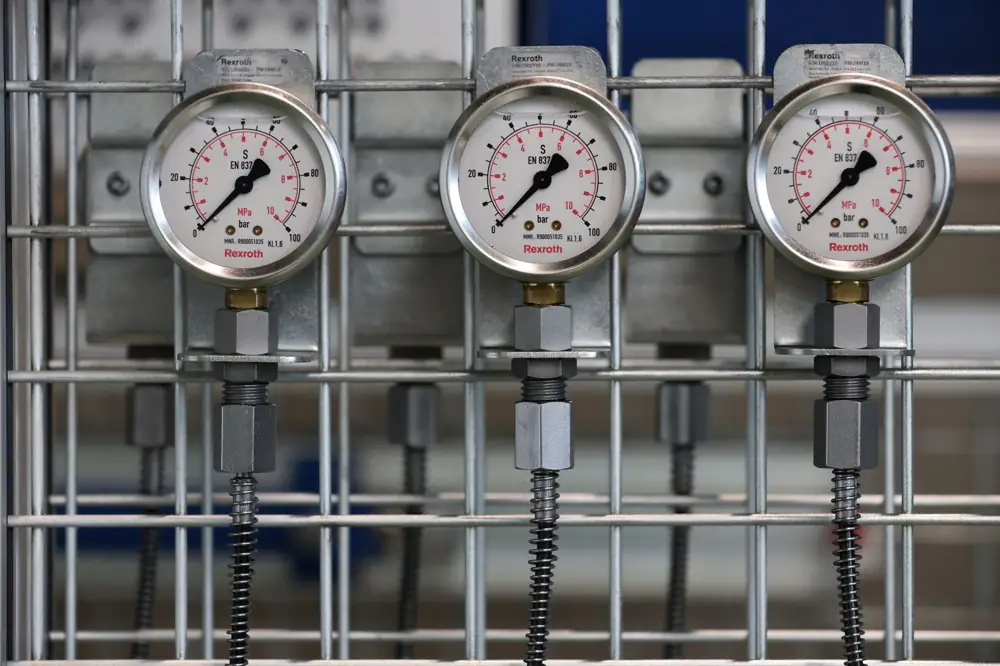
An 8 mm tube fitting is a metric compression fitting. Its ferrules swage onto 8 mm outside-diameter tubing under nut torque, forming a mechanical seal that's leak-tight and holds against both gas and vacuum. Crestflo builds these fittings in 316 and 316L stainless, along with corrosion-resistant alloys. They come in single- and double-ferrule designs, meet the dimensional interchange requirements of ASTM F1387, and every part carries a heat number stamped on it.
These aren't brass plumbing fittings, copper compression parts, push-to-connect pneumatic hardware, or plastic-pipe couplings. They're instrumentation-grade metric compression fittings, made from stainless steel and corrosion-resistant alloys. Their job is landing 8 mm OD analyzer, sample-system, and instrument-line tubing on European-spec skids, imported analyzers, and OEM equipment sold into the US.
Also Specified As: 8 mm Compression Fitting, Metric Double-Ferrule & 8 mm OD Tube Connector
Engineers and buyers know this part by a lot of different names. You'll see it called an 8 mm compression fitting, 8 mm compression tube fitting, 8 mm double-ferrule (twin-ferrule) fitting, 8 mm single-ferrule fitting, 8 mm ferrule fitting, 8 mm stainless steel tube fitting, 8 mm 316 fitting, 8 mm instrumentation fitting, 8 mm OD tube fitting, 8 mm metric fitting, Ø8 fitting, or 8 mm tube connector. Sometimes it's spelled out as eight-millimeter or 8 millimeter tube fitting. The size designation points to the tube OD the fitting accepts: 8 mm, or 0.315 in nominal. That figure sits under the same product standards as the rest of the tube-fitting family: ASTM A269/A213 covers the tubing, ASTM F1387 governs fitting performance, and NACE MR0175 / ISO 15156 applies for sour service.
What "8 mm" Means: Metric Tube OD, the 5/16" Difference & Internal Diameter
"8 mm" refers to the outside diameter of the tube that the fitting grips and seals. It isn't a thread size, and it isn't a bore measurement. A compression fitting has to match the tube's OD precisely. That's why 8 mm fittings take 8 mm tube, and nothing else.
8 mm comes out to 0.315 in nominal. The closest fractional size, 5/16 in, equals 0.3125 in (7.9375 mm), roughly 0.0625 mm smaller. That's close enough to cause confusion, but the two aren't interchangeable. Ferrules and nuts for 8 mm and 5/16 in are built to different OD targets, so they won't seal reliably against each other. Order fittings that match your actual tube OD.
Internal diameter depends on wall thickness: ID equals OD minus twice the wall. An 8 mm OD tube with a 1.0 mm wall yields a 6.0 mm ID; increase the wall to 1.5 mm and the ID drops to 5.0 mm. Because the fitting seals on the OD, wall thickness and ID have no bearing on fit. They only affect flow and pressure rating (dimensions per standard metric tube tables; customizable to requirement).
Don't force a mismatched tube when moving between metric and fractional lines. Use a metric-to-fractional reducing union instead. Check the full metric tube fitting range, consult the tube fitting size chart for OD and wall data, and pair it with the matching 8 mm instrumentation tubing. For a more thorough explanation, read metric vs imperial tube fittings.
8 mm Tube Fitting Configurations: Unions, Elbows, Tees, Connectors & Bulkheads
The compression family comes in the 8 mm size across every configuration, and that's true whether you need single- or double-ferrule designs. Hardened or non-hardened ferrules, too, as required.
| Configuration | Description | Ends | Page |
|---|---|---|---|
| Union | Straight tube-to-tube joiner | 8 mm × 8 mm tube | Union |
| Union elbow | 90° tube-to-tube turn | 8 mm × 8 mm tube | Elbow |
| Union tee | Three-way branch | 8 mm tube ports | Tee |
| Union cross | Four-way branch | 8 mm tube ports | Cross |
| Reducing union | Metric/fractional size change (e.g. 8 mm–6 mm, 8 mm–1/4") | Mixed tube | Reducer |
| Adapter | Tube-to-thread or thread-to-thread size/standard change | Tube × thread / thread × thread | Adapter |
| Male connector | Tube to male pipe thread (e.g. 8 mm × 1/4 NPT) | Tube × NPT/BSPT | Male connector |
| Female connector | Tube to female pipe thread | Tube × NPT/BSPP | Female connector |
| Bulkhead union | Panel / enclosure pass-through | 8 mm tube, bulkhead | Bulkhead union |
| Port connector | Instrument / port interface | Tube × port | Port connector |
| Cap / plug | Close a tube end / a fitting body | 8 mm | Cap · Plug |
| Nut & ferrule set | Replacement / spare grip components | 8 mm | Nut & ferrule · Ferrules |
Need bite-type metric hydraulic connectors? Take a look at DIN 2353 fittings. Still weighing ferrule designs? The single vs double ferrule comparison lays out the differences, or you can go straight to the single-ferrule build.
8 mm Ferrule Design & Make-Up: Single vs Double (Twin) Ferrule, Gap-Gauge Installation
An 8 mm ferrule fitting achieves its seal by advancing the nut, not by hitting some set torque figure. Tighten the nut, and the ferrules swage onto the 8 mm tube OD, gripping and sealing it as they go. In a double-ferrule (twin-ferrule) 8 mm fitting, the back ferrule handles the grip while the front ferrule makes the seal. A single-ferrule 8 mm fitting, by contrast, combines both jobs into one component. Ferrules come hardened or non-hardened, depending on what the application calls for.
An 8 mm tube fitting isn't set to an arbitrary torque. The standard method is pull-up by turns, not a nut-torque value: hand-tighten the nut, mark it at the finger-tight position, then bring it up the specified fraction of a turn per the double-ferrule make-up instructions, roughly 1-1/4 turns for 8 mm and larger sizes, less for the smallest ones. Confirm the pull-up with a gap gauge (a no-go gauge) before pressurizing. Because make-up is turn-based, over-tightening gets checked, not dialled in. This follows standard double-ferrule practice; see single vs double ferrule.
End Connections & Thread Types for 8 mm Fittings: NPT, BSPT, BSPP, ISO & JIC
The 8 mm tube end connects by compression, and it's threadless. Threads only show up on the connection at the opposite end. Here are the available thread and end families:
| Thread / end family | Standard | Page |
|---|---|---|
| NPT tapered pipe | ASME B1.20.1 | NPT |
| NPTF dryseal | ASME B1.20.3 | NPTF |
| BSPT tapered | ISO 7 | BSPT |
| BSPP parallel | ISO 228 | BSPP |
| ISO parallel | ISO 228 | ISO parallel |
| JIC 37° flare | ISO 8434-2 | JIC-37 |
| SAE-ORB | SAE J1926 | SAE-ORB |
| Weld connector, socket / butt weld | ASME B16.11 / B16.25 | Weld connector · Socket-weld · Butt-weld |
Thread dimensions are per the applicable standard; customizable to requirement.
8 mm Tube Fitting Materials: 316/316L Stainless, Duplex, Inconel, Monel & Hastelloy
Crestflo supplies 8 mm fittings across the full instrumentation alloy range: stainless, super-austenitic, duplex, and nickel alloys. Each one links to its own grade page, where you'll find composition and properties.
| Alloy | UNS | When to choose | Grade page |
|---|---|---|---|
| 316 / 316L | S31600 / S31603 | Default instrumentation grade; broad corrosion resistance | 316/316L |
| 304 / 304L | S30400 / S30403 | General service, lower chloride exposure | 304/304L |
| 904L | N08904 | Higher chloride and sulfuric resistance | 904L |
| Duplex 2205 | S32205 | Chloride stress-corrosion and strength | Duplex 2205 |
| Super Duplex 2507 | S32750 | Seawater / high-chloride, high-strength | Super Duplex 2507 |
| 254 SMO | S31254 | Severe chloride / bleach service | 254 SMO |
| AL-6XN | N08367 | High-purity, chloride-rich media | AL-6XN |
| Alloy 20 | N08020 | Sulfuric-acid processes | Alloy 20 |
| Inconel 625 | N06625 | High-temp, oxidising and reducing media | Inconel 625 |
| Inconel 825 | N08825 | Acids and sour hydrocarbons | Inconel 825 |
| Monel 400 | N04400 | Hydrofluoric acid, seawater | Monel 400 |
| Hastelloy C-276 | N10276 | Wet chlorine, severe reducing/oxidising | Hastelloy C-276 |
| Titanium Gr 2 | R50400 | Chloride and oxidising acids, low weight | Titanium Gr2 |
UNS designations follow published ASTM/UNS references. For sour (H₂S) service, 8 mm fittings come in NACE MR0175 / ISO 15156-compliant alloys; see NACE MR0175. The full range of instrumentation fitting materials is available to browse.
8 mm Fitting Pressure Ratings, Temperature Limits & Standards Compliance
An 8 mm fitting's working pressure and temperature come down to the tube wall and alloy, not the fitting alone. Rated pressures follow standard tube working-pressure tables, and those derive from ASME B31.3 allowable stresses for whichever wall is selected (commonly 8 × 1.0 mm or 8 × 1.5 mm) and whichever alloy is chosen. 316/316L stainless handles service from cryogenic conditions up through elevated temperatures, while high-nickel alloys push the upper range further still. Figures follow the applicable standard and can be tailored to the requirement. For a number specific to size, wall, and alloy, run the tube pressure calculator or request the rating with your RFQ.
Quality and traceability on every 8 mm fitting:
- Certifications: We hold ISO 9001, 14001, and 45001 certification, plus PED. Our compression fittings are performance-qualified to ASTM F1387.
- Standards referenced: Tubing meets ASTM A269, sour-service applications follow NACE MR0175 and ISO 15156, and threads conform to ASME B1.20.1.
- Traceability: Every part carries a heat/lot number. EN 10204 MTC 3.1 comes standard; 3.2 is available on request.
- Testing: We run hydraulic proof, burst, impulse, pneumatic, fatigue, vibration, thermal-cycling, pull-out, and vacuum tests, plus positive material identification (PMI). NDT happens in-house, and third-party inspection can be arranged on request.
- Finishes: material finish, electropolish, passivation, and silver anti-galling plating; oxygen-clean on request.
Datasheets and CAD models are available to customers on request.
8 mm Tube Fitting Applications: Instrument Air, Hydraulics, Analytical Sampling, Oil & Gas & Power
European-built instrument, analyzer, and OEM skids commonly run 8 mm metric tube, so 8 mm fittings show up across process and utility systems in US plants. Typical service spans instrument air and impulse lines, hydraulic power and control lines (the 8 mm hydraulic tube fitting size), analytical and sampling systems, oil & gas production and metering, chemical and petrochemical process work, and power generation. Alloy gets picked to match the medium and environment from the material range above. Browse all served industries.
8 mm Swagelok Cross-Reference & Metric Interchange
Crestflo 8 mm fittings are built to swap in dimensionally with metric fittings from Swagelok®, Parker®, Hy-Lok®, Fitok® and other makers, qualified under ASTM F1387. We don't publish a part-number table. Our engineering team works out the exact equivalents for your line: request your Swagelok metric cross-reference, or start at the cross-reference hub. Swagelok® and other names are trademarks of their respective owners, used for identification only.
Products & How to Order 8 mm Tube Fittings
Crestflo works on an RFQ model, not e-commerce, and there's no live pricing. Standard items ship from ready stock. Specials are made to order, with delivery running 6-8 weeks. Small MOQs, private-label, and made-to-print builds are all available.
- Request a Quote, send size, configuration, material, and end connection for an 8 mm RFQ.
- Request a Sample, evaluate the fit and finish before committing.
- Private-label program, for distributors and OEMs.
- US origin & compliance, origin, melt, and traceability options.
Origin: India. US and European melt options are available on request, each backed by full material traceability. Houston, TX is home to Crestflo's US contact point; reach sales@crestflousa.com or call +1 346 594 9005.
Why Crestflo for 8 mm Instrumentation Tube Fittings
Crestflo is the instrumentation division of an export house that's four decades old and recognized by the Government of India, with a long record of delivering into the Middle East. That heritage sits behind a focused instrumentation offer. Every fitting comes in both metric and imperial sizes, so metric buyers who've been under-served by fractional-only US distributors can get their 8 mm size directly, including the 8 mm-versus-5/16" distinction that generic catalogs tend to blur. Fittings carry ASTM F1387 interchange qualification. Each part carries a heat number, backed by an EN 10204 MTC 3.1 (3.2 on request), across the full alloy range from stainless steel through nickel. Lead time runs 6-8 weeks, against the 20-plus weeks typical of the majors. We Engineer Confidence.
8 mm Tube Fitting FAQs
Is 8 mm the same as 5/16" tube?
No. 8 mm works out to 0.315 in, while 5/16 in comes to 0.3125 in (7.9375 mm), a difference of roughly 0.0625 mm. Close enough to mix up. Not close enough to trust. Ferrules and nuts made for 8 mm won't seal reliably on 5/16-inch tubing, and the reverse is just as true. Match your fittings to the actual tube OD, and use a reducing union to move between metric and fractional lines.
Do you make 8 mm push-to-connect or push-fit fittings?
No. Crestflo 8 mm fittings are metal compression fittings, either double-ferrule or single-ferrule, built for pressurized instrumentation service. They aren't push-to-connect or push-fit pneumatic couplers, nor are they plastic-pipe or brass plumbing fittings.
What is the internal diameter of 8 mm tubing?
Internal diameter isn't something you look up separately: it's the 8 mm outside diameter minus twice the wall thickness, or ID = OD − 2 × wall. Take an 8 mm OD tube with a 1.0 mm wall and you land at a 6.0 mm ID. Go to a 1.5 mm wall instead, and that drops to 5.0 mm. Fit isn't touched by any of this. Compression fittings seal against the tube's OD, not its bore, so the ID only matters once you start thinking about flow area and pressure rating.
What are the different types of 8 mm tube fittings?
The 8 mm family covers unions, union elbows, union tees and crosses, reducing unions, and adapters. It also includes male and female connectors, bulkhead unions, port connectors, and weld connectors, both socket and butt weld. Caps, plugs, and nut-and-ferrule sets round out the range. All of it is available in single- and double-ferrule designs, across a wide range of alloys.
How is an 8 mm ferrule fitting made up, is there a torque spec?
For 8 mm double-ferrule fittings, make-up runs by turns, not by a torque figure on the nut. Hand-tighten the nut, mark it at finger-tight, then pull it up the specified fraction of a turn (about 1-1/4 turns for 8 mm, per the double-ferrule make-up instructions). Check that pull-up with a gap gauge, or no-go gauge, before pressurizing. Since make-up is turn-based, an 8 mm tube fitting is never set to an arbitrary torque value.
What materials are 8 mm fittings available in?
8 mm fittings come in 304/304L, 316/316L, 904L, Duplex 2205, Super Duplex 2507, 254 SMO, AL-6XN, Alloy 20, Inconel and Incoloy grades, Monel, Hastelloy, and Titanium Grade 2. For sour (H₂S) service, they're also available in alloys compliant with NACE MR0175 / ISO 15156-.
Do Crestflo 8 mm fittings interchange with Swagelok metric fittings?
Engineers built these parts for dimensional interchange with metric fittings from Swagelok®, Parker®, Hy-Lok® and others, qualified under ASTM F1387. Skip the generic table. Ask the engineering team for your part-specific cross-reference instead.
What certification, traceability, and lead time come with 8 mm fittings?
Every part leaves an ISO 9001 / 14001 / 45001 & PED certified system, stamped with a heat/lot number and backed by an EN 10204 MTC 3.1 (3.2 on request). Standard items sit in ready stock; specials get made to order, and delivery typically runs 6-8 weeks.
Related Tube Fitting Sizes, Configurations & Resources
- Adjacent metric sizes: 6 mm tube fittings · 10 mm tube fittings · 12 mm tube fittings
- Closest fractional match: 1/4 inch · 3/8 inch
- For the wider range: tube fittings hub · metric range · size chart
- Worth a read: single vs double ferrule · metric vs imperial tube fittings · tube sizing & wall thickness