
DIN 2353 Bite-Type (Flareless) Tube Fittings: Metric 24° Cutting-Ring, in Stainless & High-Nickel Alloys
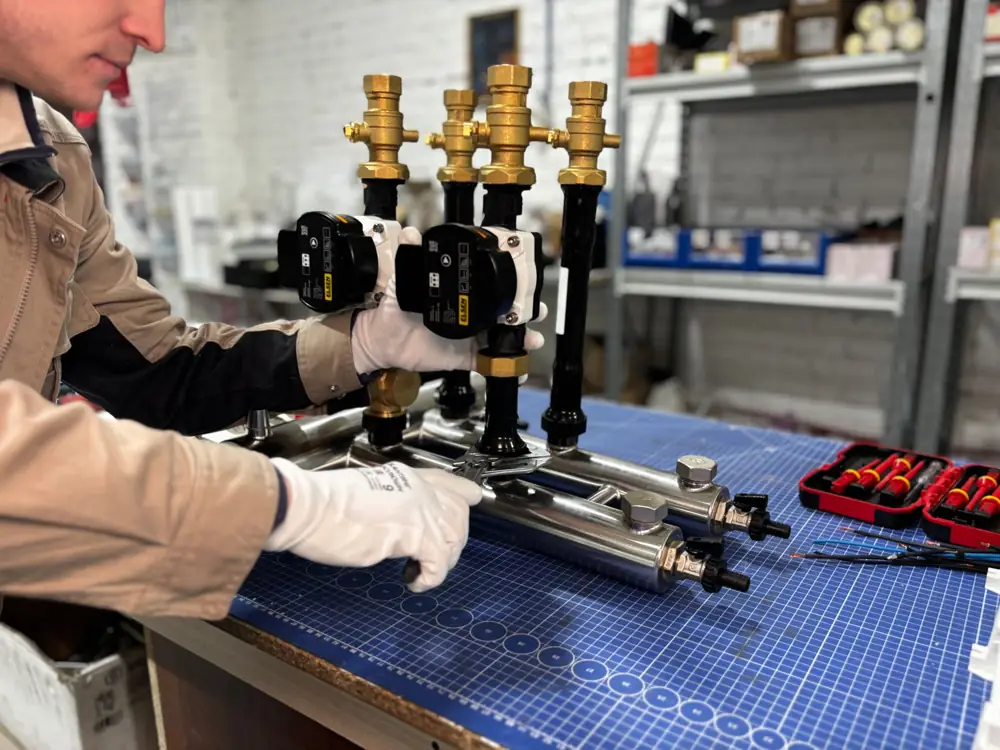
A DIN 2353 fitting is a metric bite-type, or flareless, tube fitting. Inside it, a hardened 24° cutting ring bites onto the tube's outside diameter against a 24° internal cone, forming a mechanical grip and a metal-to-metal seal as the nut tightens. Crestflo builds the full DIN 2353 / ISO 8434-1 line in two series, Series L for light duty and Series S for heavy, spanning the 6-42 mm metric OD range plus imperial sizes. These aren't the carbon-steel parts standard hydraulics use. Crestflo makes them instead in stainless steel and high-nickel corrosion-resistant alloys, with a heat-number material certificate on every part. On this page, "DIN 2353 fitting" means the instrumentation- and hydraulic-grade metal 24° cutting-ring tube fitting, not a brass or copper plumbing compression fitting.
Also Specified As: Bite-Type, Flareless, Cutting-Ring & 24° Cone Fittings
Across drawings, purchase specs and catalogs the same connection is written many ways. Engineers and buyers commonly specify it as a bite-type fitting, a flareless fitting, a cutting-ring or progressive-ring fitting, a 24° cone or 24-degree flareless fitting, a metric compression fitting or 24° compression fitting, or simply a DIN or DIN hydraulic fitting. Its international equivalent is ISO 8434-1, the fitting bodies are covered by DIN 3861 and the metric port threads by DIN 3852, while the Ermeto® pattern (a Parker Hannifin trademark) is a common trade-name reference for the 24° system. Component call-outs include the male stud connector, union, bulkhead union, elbow, tee, cross, reducer, adapter, cap and plug, together with the DIN 2353 nut and cutting ring. All of these designate one entity: the metric 24° flareless connection covered on this page.
What DIN 2353 Covers: Deutsches Institut für Normung 24° Tube-Fitting System
DIN is Germany's national standards body, the Deutsches Institut für Normung, and DIN 2353 sets out the metric flareless 24° tube-fitting system. That covers the cutting-ring principle, the 24° cone seat, the series classes, and the dimensional envelope. Fitting bodies follow DIN 3861. Metric parallel port threads follow DIN 3852. Put those together and a complete DIN 2353 joint references all three standards. It seals through mechanical deformation, not a flare or a soft gasket, which is exactly why it sits in the compression-fitting family even though it's an all-metal connection through and through. Values per DIN 2353 / DIN 3861 / DIN 3852; customizable to requirement.
DIN 2353 vs ISO 8434-1: Are They the Same Standard?
ISO 8434-1 is the international counterpart to the DIN 2353 24° cutting-ring system. The two are dimensionally interchangeable: a fitting made to one standard mates with tube and components made to the other, since both share the same 24° geometry. DIN 2353 is the older German designation, and most catalogs still cite it. ISO 8434-1 is simply the ISO-numbered version of that same flareless standard.
| Attribute | DIN 2353 | ISO 8434-1 | Interchange note |
|---|---|---|---|
| Sealing method | 24° cone + cutting ring | 24° cone + cutting ring | Same geometry |
| Series classes | L (light), S (heavy) | L (light), S (heavy) | Directly equivalent |
| Body / thread refs | DIN 3861 / DIN 3852 | ISO 8434-1 body & thread | Dimensionally aligned |
| Scope | Metric flareless tube fittings | Metric flareless tube fittings | Parts interchange on 24° geometry |
Values per DIN 2353 / ISO 8434-1; customizable to requirement.
How the Bite-Type (Flareless) Cutting-Ring Seal Works
The DIN 2353 joint comes together from three parts: the fitting body with its 24° internal cone, the cutting ring, and the compression nut. Torque the nut down and the ring gets driven into that 24° cone; its leading edge bites into the tube's outside diameter, cutting a small collar of material. That collar does two jobs at once, it anchors the tube mechanically and forms the metal-to-metal seal. Standard practice calls for pre-assembly first, setting the ring on the tube in a body or pre-setting tool, then final make-up in the fitting itself. This controls how deep the bite goes and gives you a connection you can repeat and remake reliably. Bite-type designs come in two flavors: a single hardened cutting ring, or a progressive ring with two edges. Both sit within the flareless family, alongside 24° cone-and-ring designs and soft-seal variants. For make-up and gauging practice, see the cutting-ring installation and gauging guide.
Is DIN 2353 a Metric Compression Fitting?
DIN 2353 fittings are metal metric compression fittings. A cutting ring bites into the tube, gripping it and sealing the joint, which puts them in the same family as double-ferrule and single-ferrule instrumentation fittings. Don't confuse them with the brass and copper compression fittings used on water and gas lines. DIN 2353 is built entirely of metal and rated for high pressure, meant for instrumentation and hydraulic work rather than household plumbing. For a closer look at how this flareless bite-type design compares with ferrule designs, see single vs double vs ferrule-less fittings and hardened vs non-hardened ferrules.
DIN 2353 Series L (Light) vs Series S (Heavy): Pressure Classes
DIN 2353 comes in two series. Both share the 24° geometry, but they differ in wall thickness and how much pressure they can handle. Series L, for Leicht, or light, covers lower- and medium-pressure service and spans the widest range of outside diameters. Series S, for Schwer, or heavy, uses a thicker body and ring so it can carry higher working pressure at the same tube OD. Which one you pick comes down to service pressure and tube wall: light circuits call for L, high-pressure hydraulics call for S.
| Series | Meaning | Typical OD range | Nominal pressure band | Typical use |
|---|---|---|---|---|
| L | Light (Leicht) | 6–42 mm | Up to ~315 bar (≈4,500 PSI) | Low- and medium-pressure lines |
| S | Heavy (Schwer) | 6–38 mm | Up to ~630 bar (≈9,100 PSI), smaller sizes higher | High-pressure hydraulics |
Pressure bands follow published DIN 2353 and ISO 8434-1 values. They shift with size, series, alloy, and service temperature. Ratings track whatever standard applies, and they can be tailored to specific requirements.
DIN 2353 Sizes, Dimensions & Metric Threads: 6 mm to 42 mm OD
DIN 2353 sizing works off the metric tube OD plus a series letter, so you'll see designations like 12L or 12S. Each size carries a fixed metric stud thread, set out under DIN 3861 / DIN 3852. The two series don't share one common ladder of sizes; instead their OD sets interleave. Series L, the light range, covers 6, 8, 10, 12, 15, 18, 22, 28, 35 and 42 mm, while Series S, the heavy range, covers 6, 8, 10, 12, 14, 16, 20, 25, 30 and 38 mm. That means a given nominal OD, say 15 mm L or 16 mm S, sits in only one series, never both. The tables below match each per-series size to its metric stud thread. Crestflo also stocks imperial tube sizes for this same connection type.
Series L (light):
| Tube OD (mm) | Series | Stud thread |
|---|---|---|
| 6 | L | M12 × 1.5 |
| 8 | L | M14 × 1.5 |
| 10 | L | M16 × 1.5 |
| 12 | L | M18 × 1.5 |
| 15 | L | M22 × 1.5 |
| 18 | L | M26 × 1.5 |
| 22 | L | M30 × 2 |
| 28 | L | M36 × 2 |
| 35 | L | M45 × 2 |
| 42 | L | M52 × 2 |
Series S (heavy):
| Tube OD (mm) | Series | Stud thread |
|---|---|---|
| 6 | S | M14 × 1.5 |
| 8 | S | M16 × 1.5 |
| 10 | S | M18 × 1.5 |
| 12 | S | M20 × 1.5 |
| 14 | S | M22 × 1.5 |
| 16 | S | M24 × 1.5 |
| 20 | S | M30 × 2 |
| 25 | S | M36 × 2 |
| 30 | S | M42 × 2 |
| 38 | S | M52 × 2 |
Thread and OD dimensions follow DIN 2353 / DIN 3861 / DIN 3852, and Crestflo can adjust them to your requirement. Check the tube fitting size chart for the full metric ladder. Imperial equivalents live under metric and imperial-fractional sizes. Need the exact per-size dimensional schedule or an ordering-code guide? Ask our engineering team directly through the RFQ form.
DIN 2353 Fitting Types & Configurations: Male Stud, Union, Elbow, Tee, Bulkhead
Crestflo makes the full DIN 2353 configuration set. That means one alloy family can carry an entire panel, skid or process line, with heat traceability matched all the way through.
| Configuration | Function | End options |
|---|---|---|
| Male stud connector | 24° tube end to a threaded port | Metric, BSPP, BSPT, NPT, SAE-ORB |
| Union | Straight tube-to-tube joint | 24° cone both ends |
| Bulkhead union | Through-panel pass-through | 24° cone with lock-nut |
| Elbow | 45° / 90° directional routing | 24° cone / threaded |
| Tee and cross | Line branching and distribution | 24° cone ends |
| Reducer / adapter | Size or standard transition | Mixed ends |
Port ends come in metric parallel (DIN 3852), BSPP, BSPT, NPT, NPTF and SAE-ORB. Check the NPT, BSPP, BSPT and ISO-parallel thread pages for details.
DIN 2353 Fitting Materials: 316L Stainless, Duplex, Inconel & Nickel Alloys
Crestflo sells the corrosion-grade version of DIN 2353 hydraulic fittings, while the commodity market for these fittings stays in carbon steel. Fittings get machined across stainless, duplex and high-nickel corrosion-resistant alloys. That's the material depth ordinary hydraulic sellers just don't reach. The lineup includes 304/304L and 316/316L stainless, 904L, Duplex 2205, Super Duplex 2507, 254 SMO, AL-6XN and Alloy 20. Add to that the Inconel, Incoloy, Monel and Hastelloy nickel grades, plus Nickel 200/201 and Titanium Gr2.
| Family | Representative grades | Best for |
|---|---|---|
| Stainless | 316/316L, 304/304L, 904L | General instrumentation and hydraulics |
| Duplex / super-austenitic | Duplex 2205, Super Duplex 2507, 254 SMO | Chloride and seawater exposure |
| Nickel alloys | Inconel 625, Inconel 825, Monel 400, Hastelloy C-276 | Sour, acidic and high-temperature media |
| Titanium | Titanium Gr2 | Light-weight, high corrosion resistance |
Crestflo makes its DIN 2353 fittings only in stainless steel and corrosion-resistant alloys. No carbon steel, no brass. Cutting rings come hardened or non-hardened, depending on what the job calls for. Standard origin is Indian; US or European melt is available on request, and every batch carries full material traceability.
DIN 2353 Pressure, Temperature & Sealing Options
Working pressure depends on the series, size, alloy and service temperature. Series L covers the light-duty band; Series S handles the high-pressure band, both set out in the published DIN 2353 / ISO 8434-1 tables. Temperature suitability tracks the seal type. The standard all-metal cutting-ring joint has no elastomer, so it works across the full alloy temperature range. Soft-seal variants, whether functional or O-ring, are capped by whichever elastomer is used. For derating across pressure and temperature, consult Crestflo's pressure-temperature derating guide. Ratings follow the applicable standard and can be adjusted to fit specific requirements.
DIN 2353 Standards, Certifications & Traceability: ISO 8434-1, NACE & ASTM F1387
Crestflo builds its DIN 2353 fittings to DIN 2353 / ISO 8434-1. That covers the standard approvals instrumentation compression fittings call for. On the certification front, the company carries ISO 9001 / 14001 / 45001 and PED, and sour-service grades are available too, NACE MR0175 / ISO 15156-compliant. Dimensional interchange with the major 24° flareless lines isn't left to chance; it's backed by ASTM F1387 performance qualification of compression tube fittings.
| Item | Standard | Basis |
|---|---|---|
| Fitting conformance | DIN 2353 / ISO 8434-1 | Manufacturing standard |
| Interchange qualification | ASTM F1387 | Performance basis |
| Sour service | NACE MR0175 / ISO 15156 | Compliant grades |
| Quality systems | ISO 9001 / 14001 / 45001, PED | Certified |
| Traceability | EN 10204 MTC 3.1 (3.2 on request) | Heat / lot number on every part |
Every part carries a heat or lot number, giving full material traceability. Testing runs the gamut: hydraulic proof, burst and impulse, pneumatic, flexure fatigue, rotary flex, vibration, thermal cycling, pull-out and vacuum, plus PMI and in-house NDT. Destructive testing takes place at ISO/IEC 17025-accredited labs, and third-party inspection can be arranged on request. Country-of-origin and TAA questions? Those get answered on US origin & compliance. Datasheets and CAD go out to customers whenever they ask.
DIN 2353 vs JIC & Double-Ferrule: Which Connection to Choose
DIN 2353 relies on a 24° cone and a cutting ring for metric tube, and it's flareless. JIC works differently: a 37° flare sits on the tube nose, and its sizing runs imperial. These two won't interchange, since the seat angle and the sealing method don't match. Set against double-ferrule instrumentation fittings, DIN 2353 stands as the metric bite-type standard of choice in hydraulics, while double-ferrule designs hold the lead in analytical and process instrumentation. See DIN 2353 vs JIC, 37° JIC flare fittings, and single-ferrule tube fittings for a side-by-side comparison.
DIN 2353 / Ermeto®-Type Interchange
DIN 2353 and ISO 8434-1 are dimensional standards, so Crestflo fittings interchange with other 24° cutting-ring lines, including the Ermeto® pattern (Ermeto® is a trademark of Parker Hannifin; Crestflo isn't affiliated with or endorsed by Parker). That interchange holds on the standard geometry, and it's backed by ASTM F1387 performance qualification. Crestflo sticks to "interchange" and "equivalent" language here and doesn't publish competitor-to-Crestflo part numbers. Want to confirm a specific line? Ask our engineering team for a cross-reference through the cross-reference desk or the Parker interchange page.
DIN 2353 Applications: Hydraulics, Instrument Air & Marine
A bite-type 24° joint delivers a repeatable, all-metal seal for medium- and high-pressure lines. That reliability is why DIN 2353 shows up everywhere in fluid power and process instrumentation: hydraulic power circuits and mobile equipment, instrument air and sampling lines, and marine and shipbuilding systems, where corrosion-grade alloys and traceability aren't optional. Need matching tube? Crestflo pairs these fittings with hydraulic tubing.
Why Crestflo for DIN 2353 Fittings
Crestflo manufactures and supplies DIN 2353 / ISO 8434-1 fittings for customers across the US. It's the instrumentation division of an export house with four decades of history, recognized by the Government of India, with a proven record of deliveries across the Middle East, and it now brings that same drop-in fitting capability to American buyers. The line covers the full 24° geometry in Series L and S, spanning a range from 6 mm up to 42 mm, and it includes a corrosion-grade alloy depth that few hydraulic sellers carry. Fittings come in both metric and imperial, with hardened or non-hardened cutting rings, and every part ships with a heat-number MTC. Standard items sit in ready stock; specials are made to order, with delivery running six to eight weeks. Small minimum order quantities and private-label programs make it practical to standardize a line without waiting on a major supplier's lead time. We Engineer Confidence.
Request a Quote for DIN 2353 Fittings
Give us your sizes, series, alloy and configurations and we'll turn around a fast quote. Order a sample if you want to see it firsthand, or set up a distributor, OEM or private-label program. Request a quote · request a sample · private-label program · why Crestflo. Reach US sales at sales@crestflousa.com or +1 346 594 9005. We're based in Houston, TX.
Frequently Asked Questions: DIN 2353 Fittings
What does DIN mean in DIN 2353 fittings?
DIN, short for Deutsches Institut für Normung, is Germany's national standards body. Its standard DIN 2353 sets out the metric flareless 24° bite-type tube-fitting system. Fitting bodies follow DIN 3861; port threads, metric ones, follow DIN 3852.
Is DIN 2353 the same as ISO 8434-1?
Yes, essentially. ISO 8434-1 is the international counterpart to the DIN 2353 24° cutting-ring system. Parts built to either standard interchange dimensionally, since both share the same 24° geometry.
How do I identify a DIN 2353 fitting and its size?
Check for the 24° internal cone, the cutting ring, and the metric tube OD it takes; it's paired with either a metric or a BSPP port thread. Size comes from the tube OD in millimeters plus a series letter, say 12L or 12S. The metric stud thread itself follows DIN 3861 / DIN 3852.
What is the difference between DIN 2353 Series L and Series S?
Series L, the light version, handles lower and medium pressures and spans the full 6-42 mm range. Series S is the heavy-duty counterpart: a thicker body and ring let it hold higher working pressure at the same tube OD. Choose L for light circuits. When the job calls for high-pressure hydraulics, S is the one you want.
What is the difference between DIN 2353 and JIC fittings?
DIN 2353 relies on a 24° cone with a cutting ring, fitted to metric tube, and it's flareless by design. JIC takes a different approach: a 37° flare on imperial tube. Seat angles differ, sealing methods differ, and the two simply won't interchange.
Are DIN 2353 fittings a type of compression fitting?
Yes. These are metal bite-type compression fittings. A cutting ring bites into the tube to grip it and form a seal. That's a different animal from the brass and copper plumbing compression fittings you'd find on water lines.
What materials can Crestflo supply DIN 2353 fittings in?
We work in stainless and corrosion-resistant alloys, not carbon steel or brass. That covers 316/316L and 304/304L stainless, along with 904L, Duplex 2205, and Super Duplex 2507. It also includes 254 SMO, AL-6XN, and Alloy 20. On the nickel side, there's Inconel, Incoloy, Monel, and the Hastelloy grades, plus Nickel 200/201. Titanium Gr2 rounds out the list.
Do Crestflo DIN 2353 fittings come with material certificates?
Yes. We supply EN 10204 MTC 3.1 as standard, and 3.2 is available on request. Every part also carries a heat or lot number, so full traceability is never in question.
Are DIN 2353 fittings available for sour (NACE) service?
Yes. We supply material that's NACE MR0175 / ISO 15156-compliant. Available in 316/316L, duplex and nickel grades, suited to sour hydrocarbon service. ISO 15156 sets the standard here, and we build every alloy to it.
Can I get DIN 2353 fittings in both metric and imperial sizes?
Crestflo covers the full range on the connection side, standard metric OD from 6 up to 42 mm, plus imperial tube sizes built to that same 24° geometry.
What is the lead time and where are they made?
Standard items ship from stock. Specials are made to order, and delivery runs 6 to 8 weeks. Small MOQs are available, and private-label options can be arranged too. Fittings are of Indian origin, though US or European melt is available on request. Full material traceability comes standard.