
Air Distribution Manifolds (Instrument-Air Headers)
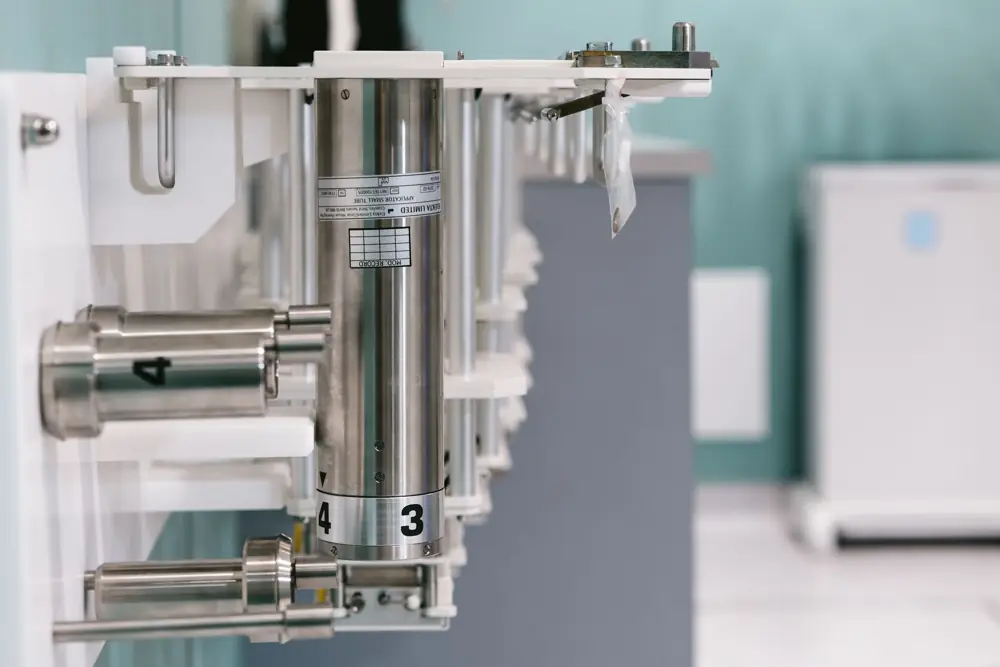
An air distribution manifold is a multi-port header. It takes one instrument-air or pneumatic supply and splits it into several isolatable branch outputs, feeding multiple field instruments, valve actuators, purge lines and panel take-offs from a single body.
Crestflo builds these headers flanged, screwed or socket-weld, to your specification, in stainless steel and high-nickel alloys. Every part carries heat-number traceability, and delivery across the US runs 6-8 weeks.
Instrument-air / pneumatic distribution header. It's not an HVAC air-duct manifold, not a shop-air or automotive air-tool block, and not a solenoid pneumatic-valve manifold either. The Crestflo Engineering Team reviewed it.
What an Air Distribution Manifold Is (Instrument-Air Header & Distribution Block)
An air distribution manifold takes a single air inlet and splits it into a bank of controlled outlets, all within one machined or fabricated body. Rather than tapping a separate branch line off the header pipe for every device, the manifold gives you a row of ports, each one able to carry its own isolation valve. That lets an instrument-air ring be commissioned, expanded and maintained from a single point. Fewer fittings, fewer joints, fewer places for a leak to start. That's the real reason headers like this sit downstream of the air dryer and filter-regulator, and upstream of the field devices.
The distinction that matters on a datasheet: an air distribution manifold is a distribution device (one supply in, many outputs), whereas a 2-, 3- or 5-valve manifold is an isolate-and-equalize hook-up block for a differential-pressure transmitter. They share the word "manifold" and nothing else. See the instrument valve manifolds (2/3/5-valve) pages for that entity.
Also Known As: Instrument Air Header, Air Manifold Block & Pneumatic Distribution Manifold
Specifiers and EPC documents don't agree on what to call this component, though they're all describing the same header. You'll see it listed as an air distribution header, air header manifold, air header distribution manifold, air supply header, instrument air manifold, instrument air distribution manifold, instrument air distribution system, instrument air header, instrument air supply manifold, air distribution block, air manifold block, multi-port air manifold, pneumatic distribution manifold, or pneumatic air manifold. In process-air service, it often shows up instead as a compressed air manifold or compressed air distribution manifold. Port-count labels like 4-port, 6-port, 8-port, or a 10-way air header simply mark the same product built with a different number of outlets.
Air Distribution Manifold Configurations: Multi-Port, Flanged, NPT & Socket-Weld
Because Crestflo builds to print, the header takes its shape from your air-loop, not from some fixed catalog block. A few common configuration variables come into play here.
- Port / outlet count: multi-port headers built to match your branch count (four-port, six-port, eight-port, or ten-port, for example). Drilling pattern and centers follow your drawing.
- Inlet and outlet connections: flanged, screwed (NPT/BSP), socket-weld, or compression tube-fitting take-offs for direct tube runs to instruments.
- Per-branch isolation: each outlet carries its own needle or ball isolation valve, so a single branch can be shut in without stopping the whole header. On the standard side, these valves qualify to the applicable valve standard, ASME B16.34 or API, not to a fitting standard.
- Drain / vent port: a low-point drain or vent take-off added to the body, used to bleed condensate or depressurize the header.
- Mounting, panel-mount, bulkhead or bracket-mounted rail/rack styles to suit an enclosure or a field stand.
- Custom / made-to-print: Tell us the port count, sizes, connections, alloy and service, and the header gets machined to that exact spec. Minimum order quantities stay small, and private-label options are available.
Air Distribution Manifold Specifications
The values listed here meet the relevant industry standard, and you can adjust them to your requirements. Ordering codes specific to Crestflo, along with certified per-build ratings, get confirmed once your RFQ comes through.
| Attribute | Value |
|---|---|
| Function | Splits one instrument-air / pneumatic supply into multiple isolatable branch outputs |
| Product class | Instrumentation accessory, air-distribution header / block |
| Body form | Bar-stock or fabricated header, built to customer specification |
| Port / outlet count | Multi-port to specification (e.g. 4 / 6 / 8 / 10-way) |
| End connections | Flanged · screwed (NPT per ASME B1.20.1) · socket-weld (per ASME B16.11) · compression tube-fitting take-off |
| Threads | National, international and custom threads; NPT standard |
| Working pressure | Set by alloy, body form and end-connection class per the applicable ASME/ASTM standard; instrument-air service is low-pressure, rating confirmed per build |
| Temperature range | Governed by the selected alloy and any integral valve seal/elastomer; per applicable standard |
| Materials | 304/304L, 316/316L, 904L, Duplex 2205, Super Duplex 2507, 254 SMO, AL-6XN, Alloy 20, Inconel, Incoloy, Monel, Hastelloy, Titanium Gr2 |
| Surface finish | Material finish, electropolish, passivation, silver anti-galling plating, oxygen-clean, or custom |
| Testing available | Pneumatic and hydraulic leak/pressure testing, PMI, in-house NDT; third-party inspection on request |
| Traceability | Heat/lot number on every part + EN 10204 3.1 MTC standard (3.2 on request) |
| Origin | Indian origin; US / European melt available on request, with full material traceability |
| Delivery | Ready stock for standard items · made-to-order for specials · 6–8 week delivery |
End Connection Options: Flanged, Screwed (NPT), Socket-Weld & Tube-Fitting Take-Offs
| End type | Governing standard | Notes |
|---|---|---|
| Flanged | Applicable flange spec / ASME class | Bolted inlet or outlet for larger headers and skid tie-ins |
| Screwed / NPT | ASME B1.20.1 | Threaded ports; BSP and custom threads also available |
| Socket-weld | ASME B16.11 | Welded branch or inlet for permanent, leak-tight joints |
| Compression tube-fitting take-off | ASTM F1387 | Ferrule outlets for direct instrument tube runs; dimensional interchange qualified per F1387 |
Selecting an Air Distribution Manifold vs a Valve Manifold
The job comes first when choosing a header. Need to distribute one air supply across many points? An air distribution manifold does that. A DP transmitter that needs to isolate and equalize calls for something different: a valve manifold. Compare the options in the 2 vs 3 vs 5 valve manifold guide and the monoflange vs manifold guide. Once the function's settled, three things drive the choice: outlet count, end connection, and alloy. Alloy matters most when the instrument air is corrosive, sour, or marine.
Air Distribution Manifold Materials: 316L Stainless, Duplex, 254 SMO, Inconel, Monel & Hastelloy
316/316L stainless is the default header material for clean, dry instrument air. When the air stream, the ambient conditions (offshore, coastal) or process contamination turn aggressive, the header is cut from a corrosion-resistant alloy instead. Each grade gets its own material page, covered in depth; the header itself doesn't come as bar, plate or mill product, only as an instrumentation form: manifold body, valves and fittings.
- 316 / 316L stainless, the standard clean-air header alloy.
- 904L, Duplex 2205, and Super Duplex 2507: these bring added strength plus better chloride and pitting resistance, suited to marine and offshore conditions.
- 254 SMO, 6-moly grade for chloride-laden and brackish environments.
- Inconel 625, Inconel 825, Monel 400 and Hastelloy C-276: nickel alloys suited to sour service, acidic media, and high-temperature conditions.
- Titanium Gr2: reserved for the harshest chloride and seawater duties.
For sour instrument-air service, headers can be supplied to meet NACE MR0175 / ISO 15156 material requirements. Take a look at the full lineup on Crestflo's materials hub. Given the US scope, though, brass, aluminum and copper don't make the cut as headline manifold materials.
Standards, Quality & Traceability for Instrument-Air Manifolds
Crestflo holds ISO 9001, 14001, 45001 and PED certification. It also carries the standard approvals that apply to instrumentation products. Rather than listing certificate numbers on this page, we keep them on file; you'll find them through the quality pages.
Every Crestflo header carries a heat/lot number and ships standard with an EN 10204 3.1 material test certificate; 3.2's available on request. See the traceability page and the EN 10204 MTC reference for the details. Bodies get machined from bar stock to ASTM A479; where forgings apply, they're forged instead to ASTM A182. In-house testing covers pneumatic and hydraulic leak and pressure checks, PMI, and non-destructive examination. Third-party inspection can be arranged on request. Compression tube-fitting take-offs are dimensionally qualified per ASTM F1387. Any integral isolation valve conforms to ASME B16.34 and whatever API valve standard applies.
Order a Custom Air Distribution Manifold: Built to Your Spec
Crestflo keeps ready stock on hand for standard items. Specials are made to order, with delivery running 6-8 weeks. Minimum order quantities stay small, and OEMs can go the private-label route. Datasheets and CAD models are there for customers who ask.
Pricing isn't fixed. Every header gets quoted against its own configuration, so send the branch/port count, inlet and outlet sizes, end connections, alloy, whether you need an isolation valve, and the service conditions. For air distribution manifold price, cost or a unit for sale, request a quote.
- Request a quote, end users, MRO, EPC and panel fabricators.
- Request a sample, evaluate build quality before you commit.
Talk to our engineers directly, send us a print for a made-to-print header, or ask about the distributor program at Crestflo.
US sales contact: sales@crestflousa.com · +1 346 594 9005 (Houston, TX).
Why Buy Air Distribution Manifolds from Crestflo
Crestflo is an air distribution manifold supplier and a US-serving manufacturer, the instrumentation division of a four-decade-old, Government-of-India-recognized export house with a long Middle-East delivery record. That engineering depth now applies to a US-serving product line. For air-distribution headers, this means a few concrete things. Lead time runs 6-8 weeks, against the 20-plus weeks typical of the majors. The full alloy range is available: stainless, duplex, 6-moly, nickel and titanium, where most competitors offer stainless only. Every part carries heat-number traceability and an EN 10204 MTC. Compression take-offs are F1387-qualified for drop-in interchange on the tube outlets. And there's flexibility on small MOQs, made-to-print work and private labeling.
Origin is Indian, though US and European melt is available on request, with full material traceability throughout. We Engineer Confidence.
Where Instrument-Air Distribution Manifolds Are Used
Air distribution headers carry pneumatic and instrument-air loads across the process industries. They serve instrument-air systems, oil and gas operations, and petrochemical and chemical plants. You'll also find them on offshore platforms, in steam-tracing distribution, and within analytical sampling systems. In each case, a clean, isolatable air supply must reach a great many points.
Air Distribution Manifold FAQ
What is the purpose of an air distribution manifold?
It runs a single instrument-air or pneumatic supply out to several branch lines, so a number of field instruments, valve actuators or purge points draw off one header instead of each getting its own separate tap. Each can be isolated on its own, too. Fewer fittings, fewer joints, fewer places for the air loop to leak.
What is the purpose of a manifold in general?
A manifold takes one inlet, or one outlet, and consolidates it into multiple ports within a single body. In fluid and pneumatic systems, this cuts down on separate fittings and connections. It also lowers installation labor. And it gives you one organized point to isolate, drain, and maintain the branches.
What is the purpose of a pneumatic manifold?
A pneumatic manifold performs the same distribution role for compressed-air or instrument-air service: one supply in, many controlled outputs, typically with per-branch isolation so any leg can be shut in without interrupting the rest of the header.
What is the difference between a valve and a manifold?
A valve manages flow inside a single line. A manifold is different: it's a multi-port body that routes or distributes flow to, or from, several lines at once, and it can contain valves itself, say, a per-branch isolation valve sitting on each outlet. Here's where people get tripped up. A Crestflo air distribution manifold works as a distribution header. A 2/3/5-valve manifold, by contrast, is a transmitter hook-up block. Two different products entirely.
What materials are air distribution manifolds available in?
The lineup covers 304/304L, 316/316L and 904L stainless, along with Duplex 2205, Super Duplex 2507, 254 SMO, AL-6XN and Alloy 20. There's also a nickel alloy group: Inconel, Incoloy, Monel and Hastelloy, plus Titanium Gr2. For clean instrument air, 316L is the standard choice. Corrosive, sour or marine conditions call for the other alloys instead. Brass isn't offered on the US line.
What end connections can I get on an air distribution manifold?
You get these flanged, screwed/NPT or socket-weld, built to your specification. NPT threads follow ASME B1.20.1, and socket-weld ends follow ASME B16.11. Compression tube-fitting (ferrule) take-offs are also available for direct instrument tube runs. They're dimensionally qualified per ASTM F1387; F1387 governs the fitting dimensions here.
Can you build an air distribution manifold to my drawing or a custom port count?
Yes. We make headers to print, and the minimum order quantity is small. Give us the port or branch count, inlet and outlet sizes, end connections, alloy, and service conditions, and we'll machine the body to that exact specification. Private-label options are available for OEMs.
What is the pressure and temperature rating of an air distribution manifold?
Instrument-air service runs low-pressure. The rating itself gets set per build, driven by the alloy chosen, the body form, and the end-connection class, all per the applicable ASME/ASTM standard. Temperature limits come from the alloy and whatever integral valve seal is fitted. Values follow the applicable standard, but they can be adjusted to fit your requirement. Ask for the confirmed rating on your specific configuration.
Do air distribution manifolds come with material certificates and traceability?
Yes. Every part carries a heat/lot number, and an EN 10204 3.1 material test certificate ships as standard with each one (3.2 is available on request). PMI backs this up, and leak, pressure and non-destructive testing can be arranged too. Third-party inspection is available on request as well.
Are Crestflo air distribution manifolds made in the USA? What about TAA?
Crestflo serves US clients with 6-8 week delivery. The standard product comes from India with full material traceability, though US or European melt is available on request when domestic-melt or TAA-eligible material is needed. Origin and compliance details are laid out openly on the US origin & compliance page.