
Pneumatic Push Fittings: Stainless Steel & Alloy Push-to-Connect for Instrument Air
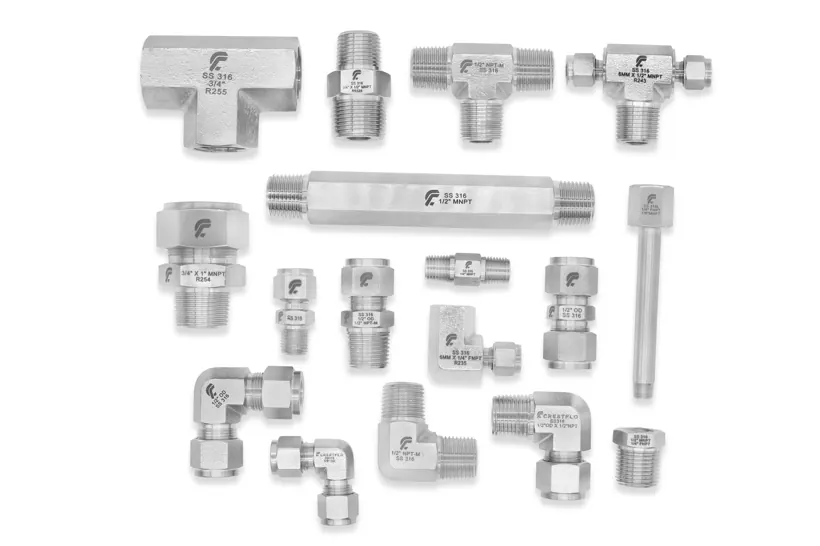
A pneumatic push fitting is a tool-free push-to-connect tube connector for pneumatic and instrument-air lines. It's the metal, instrumentation-grade answer to the plastic and brass pneumatic tube fittings that dominate the commodity market, and Crestflo builds it in stainless steel and high-nickel alloys, running from 316/316L up through Hastelloy, with a heat number marked on every part. Push the tube in, and an internal collet grips it while an energized elastomer seal closes the joint. No wrenches. No ferrule swaging.
Here the term means an instrumentation-grade metal push-to-connect fitting for pneumatic and instrument-air tube lines. It's not a plastic or brass commodity air fitting, and it isn't a plumbing or PEX push-fit connector either. Standard items ship from ready stock; specials are made to order, and delivery runs 6-8 weeks. Request a quote.
Also Specified As: Push-to-Connect, Push-in & One-Touch Pneumatic Fittings
Buyers and specifiers call this part by many names, though they're all pointing to the same instrumentation connector. It gets ordered as a pneumatic push-to-connect fitting, push to connect air fitting, pneumatic push-in fitting, push-in pneumatic fitting, push-fit pneumatic connector, pneumatic push-fit connector, or pneumatic push connect fitting. Specifiers who lead with the mechanism instead list them as push-to-connect pneumatic fittings. The tool-free mechanism also goes by a handful of generic names: one-touch fittings, instant fittings, instant tube fittings, no-tool tube connectors, collet-lock tube fittings, or push-lock fittings. Once the material gets specified, the part turns into a stainless steel push-to-connect fitting, push to connect fittings stainless steel, stainless steel push to connect air fittings, 316 stainless push-to-connect fitting, SS push fitting, or nickel-alloy push-to-connect fitting. Frame it by application, and it becomes an air line push fitting, airline quick fittings, or instrument-air push fitting.
How Pneumatic Push-in Fittings Work: Collet Grip & Elastomer Seal
A push-to-connect fitting joins a tube in one motion. The tube slides through a release collar and an internal gripping collet, then seats against an energized elastomer seal. The collet's teeth bite into the tube's outside diameter to resist pull-out, while the seal, compressed on the tube OD, closes the pneumatic joint. Press the release collar and the collet lets go, so the tube can be pulled free. That's what makes the connection releasable and reusable. Since the grip comes from a collet rather than a swaged ferrule, there's no tube deformation and no assembly tooling needed. Clean, burr-free, correctly sized tube ends remain the single biggest factor in leak-free performance.
Pneumatic Push Fitting Materials: 316/316L Stainless, Monel, Hastelloy & Duplex
Crestflo makes these only in stainless steel pneumatic fittings and corrosion-resistant nickel or CRA-alloy push fittings. No brass, no plastic bodies, and that's the line separating them from the commodity air-fitting crowd. This is the niche: a metal, alloy-capable, traceable push-to-connect fitting built for corrosive and high-purity service. Grade selection depends on the medium and the environment it's working in. The UNS numbers listed below are standard published designations.
| Alloy | UNS | Typical service driver | Grade page |
|---|---|---|---|
| 304 / 304L stainless | S30400 / S30403 | General clean, dry instrument air | 304/304L |
| 316 / 316L stainless | S31600 / S31603 | Standard corrosion resistance, chloride exposure | 316/316L |
| 904L super-austenitic | N08904 | Higher chloride / acid resistance | 904L |
| Duplex 2205 | S32205 | Strength plus chloride SCC resistance | Duplex 2205 |
| Super Duplex 2507 | S32750 | Severe chloride / offshore service | Super Duplex 2507 |
| Alloy 20 | N08020 | Sulfuric-acid and mixed-acid service | Alloy 20 |
| Monel 400 | N04400 | Seawater, hydrofluoric acid | Monel 400 |
| Hastelloy C-276 | N10276 | Wet chlorine, oxidizing/reducing acids | Hastelloy C-276 |
| Inconel 625 | N06625 | High-temperature and marine corrosion | Inconel 625 |
| Titanium Gr2 | R50400 | Chloride and oxidizing environments | Titanium Gr2 |
Duplex, super-duplex, and the full nickel range (Inconel, Monel, Hastelloy, Incoloy) come as machined instrumentation forms, with values set per the applicable standard and customizable to whatever the job needs. For higher-temperature or aggressive-media lines, Crestflo's nickel-alloy tube-fitting range covers the same material scope.
Pneumatic Push Fitting Sizes (Metric & Inch) & End Connections: NPT, BSPT, BSPP
Crestflo makes push-to-connect tube fittings in both metric and inch sizes. Threaded ends come in national, international, and custom patterns. The standard tube outside diameters appear below. Individual sizes and end options can be tailored to what the application requires.
| Tube OD (metric) | Tube OD (inch) | End connections | Thread standards |
|---|---|---|---|
| 4, 6, 8, 10, 12, 16 mm | 1/8, 5/32, 1/4, 5/16, 3/8, 1/2 in | Tube-to-tube, male thread, female thread, bulkhead | NPT, BSPT, BSPP, ISO parallel |
Standard configurations include straight unions, union elbows, union tees, union crosses, male and female connectors, bulkhead unions, and branch tees. Bodies come in both metric and inch sizes, so a single line can be specified using either system.
| Configuration | Description |
|---|---|
| Union (straight) | Inline tube-to-tube joint |
| Union elbow | 90° tube-to-tube turn |
| Union tee | Three-way tube junction |
| Cross | Four-way tube junction |
| Male connector | Tube to male NPT/BSPT/BSPP thread |
| Female connector | Tube to female thread |
| Bulkhead union | Panel/enclosure pass-through |
| Branch / run tee | Tube branch off a run |
Instrument-Air & Pneumatic Applications for Stainless Push-to-Connect Fittings
Metal push-to-connect fittings suit lines where a plastic or brass fitting would corrode, embrittle, or fail traceability. Typical uses include instrument-air distribution, pneumatic control and actuation lines, and analytical or sampling systems that call for a clean, corrosion-resistant metal joint. These instrument air fittings also handle facility and process air in demanding plants. Relevant application pages include instrument air, analytical & sampling systems, and semiconductor facilities. For separable pneumatic quick-connect fittings, a stem-and-body coupling rather than a fixed joint, see quick-connect couplings from Crestflo.
Pneumatic Push Fitting Pressure & Temperature Limits
Pneumatic push fittings serve air and instrument-air lines. What sets the working envelope is the body alloy, though the elastomer seal matters more. Crestflo won't publish a certified rating it hasn't qualified. Certified pressure ratings for a given size, seal, and configuration come on request. These aren't high-pressure push-to-connect fittings. For higher-pressure or severe-service lines, compression tube fittings are the right pick, and they carry a higher working-pressure envelope. Temperature depends on the seal compound. The table below lists standard published elastomer ranges, so specify the compound you need on the RFQ.
| Seal elastomer | Standard temperature range | Notes |
|---|---|---|
| NBR (nitrile) | approx. −30 to +100 °C | General dry air |
| EPDM | approx. −40 to +150 °C | Broad chemical compatibility |
| FKM (fluoroelastomer) | approx. −20 to +200 °C | Higher-temperature service |
| FFKM (perfluoroelastomer) | approx. −15 to +260 °C | Aggressive media, high purity |
The stated values follow standard published elastomer limits. That said, the qualified rating for any given fitting can be tailored to what's actually required, and we'll confirm it on request.
Standards, Certifications & Traceability
Crestflo holds ISO 9001 / 14001 / 45001 & PED certification, along with the standard approvals for instrumentation fittings. Each part gets a heat/lot number. Material test certificates to EN 10204 MTC 3.1 come standard, and 3.2 is available on request. Where sour-service conditions apply, alloy fittings meet NACE MR0175 / ISO 15156. The certificates themselves live in the quality area rather than showing up on product pages.
| Item | Detail |
|---|---|
| Quality system | ISO 9001 / 14001 / 45001 & PED certified |
| Material certificate | EN 10204 MTC 3.1 standard; 3.2 on request |
| Traceability | Heat/lot number marked on every part |
| Sour-service alloys | NACE MR0175 / ISO 15156 where applicable |
| Testing regime | Pneumatic, pull-out, vacuum, vibration, thermal-cycling and PMI; in-house NDT |
| Inspection | Third-party inspection on request |
Datasheets and CAD models are available to customers on request. For guidance on ordering codes and part numbers, the engineering team at Crestflo can help, request the ordering-code guide.
Request a Quote, Sample or Cross-Reference
Crestflo runs on an RFQ model: no cart, no live pricing. End users and MRO buyers can request a quote or a sample. Equipment manufacturers can send over a print for made-to-print parts. Distributors can request the line card, and OEMs can ask about the private-label program. If you're replacing another brand's push fittings, request your cross-reference, and the engineering team will send back an equivalent. For US sales, reach out at sales@crestflousa.com or +1 346 594 9005 (Houston, TX).
Why Crestflo for Pneumatic Push-to-Connect Fittings
Crestflo is the instrumentation arm of an export house that's been recognized by the Government of India for four decades, with a proven delivery record across the Middle East. Fittings get machined in-house on CNC, VMC, and EDM equipment, in both imperial and metric, and finishes run the gamut: electropolish, passivation, nickel-plated, silver anti-galling plating. Lead time runs 6-8 weeks, compared with the 20-plus weeks you'd wait on from the majors. Small MOQ and private-label options are both on the table. Product origin is India; US and European melt can be arranged on request, and full material traceability comes standard. Built as drop-in replacements for US parts, and shipped fast. We engineer confidence.
Frequently Asked Questions
Are Crestflo pneumatic push fittings stainless steel or plastic?
All-metal, every part. Crestflo builds these in stainless steel (304, 304L, 316, 316L, 904L) and nickel/CRA alloys, not the brass or plastic bodies most commodity air fittings rely on. That's what suits them to corrosive, high-purity, and traceability-critical service.
Do push-to-connect air fittings leak?
Crestflo's push-to-connect fittings, when sized and installed correctly, seal on an energized elastomer against the tube's outer diameter. How well that seal holds depends on tube tolerance, the seal compound, and tube ends that are clean and free of burrs. To back this up, Crestflo runs both pneumatic and pull-out testing as part of its QA process, and certified leak-acceptance criteria for any given configuration are available on request.
What are the disadvantages of pneumatic push connectors versus compression fittings?
Push-to-connect fittings give up some pressure headroom and resistance to vibration in exchange for tool-free speed and reusability. For higher-pressure or severe-service lines, compression tube fittings are the better choice. Crestflo would rather point you to the right product than oversell what a push fitting can handle.
What tube sizes are available, metric or inch?
Both, actually. Standard metric runs 4 to 16 mm, and inch sizes span 1/8 to 1/2 inch, available in tube-to-tube and threaded-end forms. Odd sizes can be made to order, so confirm your exact OD on the RFQ.
What thread and end connections can I get?
Thread options run the gamut: national, international, and custom, covering NPT, BSPT, BSPP, and ISO parallel. Each comes in male, female, and bulkhead forms. Tube-to-tube unions, elbows, and tees round out the lineup.
What pressure and temperature can pneumatic push fittings handle?
These fittings serve air and instrument-air applications. Their working envelope comes down to two things: the body alloy and the seal elastomer. Temperature limits track whichever seal compound is fitted, with NBR running roughly −30 to +100 °C and FKM reaching up to about +200 °C. Certified pressure ratings aren't published outright. They're supplied on request instead.
What are the different types of pneumatic push-in fittings?
Straight unions, union elbows, union tees, male and female connectors, bulkhead unions, branch tees, we make them all. The full configuration range can be customized to whatever the job calls for.
Can I get these in nickel alloys like Hastelloy or Monel?
Yes. We cover duplex and super-duplex, Inconel, Monel, Hastelloy, Incoloy, Alloy 20, and Titanium Gr2, all machined into instrumentation forms. Pick your grade from the materials range.
Is there a food grade pneumatic push fitting option?
For food, dairy, and hygienic air lines, Crestflo's food grade pneumatic push fitting comes in 316/316L stainless with an electropolished or passivated finish. The elastomer seal gets specified to your FDA or USP Class VI target compound. Crestflo doesn't hold a blanket food certification, though. The wetted material and seal can be customized to what you need, and we'll confirm specifics on request.
Do parts come with material certificates?
Yes. We supply EN 10204 MTC 3.1 as standard, and 3.2 is available on request. Every part carries a heat and lot number, so full traceability is never in question.
Where are they made and can they ship fast in the US?
These serve the US market and are built as drop-in replacements, shipping in 6-8 weeks. The product itself is of Indian origin. US or European melt can be arranged on request, and full material traceability comes standard. Standard items sit in ready stock. Specials, though, aren't stocked that way; they're made to order.