
Inline Filters: Instrumentation Particulate Filters in Stainless & High-Nickel Alloy
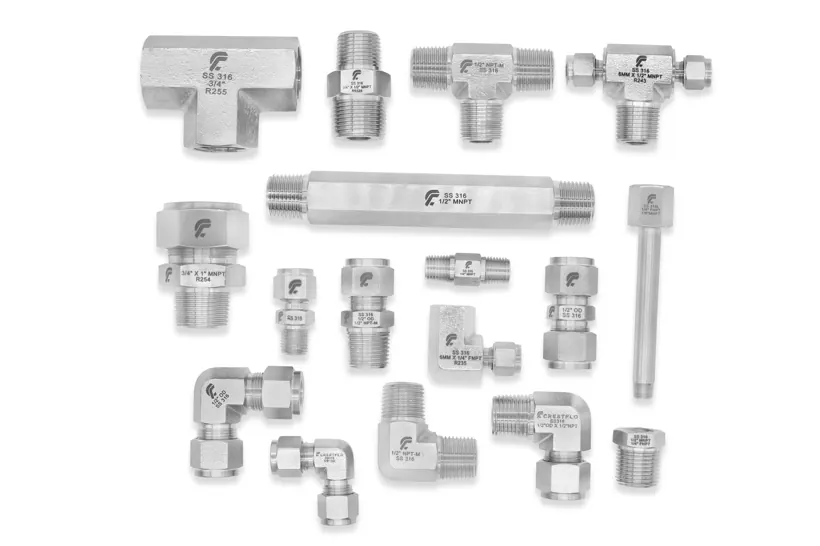
Crestflo builds an inline filter as a straight-through fluid-system component, plumbed directly into an instrument, gas or sample line. It strips out particulate before that stream reaches a gauge, transmitter, regulator, valve or analyzer. The flow passes through a porous element, and anything above the element's micron rating gets trapped there.
These filters span the full stainless and high-nickel alloy range. Elements come in sintered porous metal or wire mesh, and ends are available in tube-fitting or NPT. Every unit carries heat-number traceability. Crestflo serves customers across the US, with delivery running 6-8 weeks.
On this page, "inline filter" refers to an instrumentation in-line particulate filter used on gas or liquid tube lines. It's not a household or plumbing inline water filter, not a refrigerator or drinking-water filter, and not an HVAC air filter. Looking for the T-shaped, service-in-place body? Check out the tee-type filter. For a broader look at the filter category, see instrumentation filters. The Crestflo Engineering Team reviewed this page.
What an Inline Filter Is: In-Line Particulate Protection for Instrument & Gas Lines
An inline filter is a compact, straight-through particulate filter fitted at the point of use on an instrument tubing or gas line. Flow enters one end of the filter body, moves through a porous filter element, and exits the other end free of solids larger than the element's micron rating. The trapped particulate doesn't go anywhere until someone cleans or replaces the element. Gauges, pressure transmitters, regulators, mass-flow controllers, control valves and analyzers all need clean, particle-free media to read and operate correctly, so a small inline filter placed ahead of them keeps those instruments accurate and stretches their service life.
The device is entirely mechanical: no electronics, no moving parts. Four attributes define its performance: the filter element (sintered porous metal or woven wire mesh), the micron rating, the body material, and the end connection. Those choices go on the RFQ so they match the media, the particle size that has to be stopped, and the corrosion service. An instrumentation inline filter isn't the same thing as a coarse in-line strainer on a pipeline, which uses a mesh screen to catch large debris. It's also different from a laboratory membrane or 0.22-micron sterilizing filter, and from an inline coalescing filter, which removes moisture and oil rather than solid particulate. That adjacent type is covered under the filters category.
Also Known As: In-Line Filter, Inline Particulate Filter, Gas & Sintered Element Filter
Process and instrumentation documents don't agree on what to call this component, and the same filter turns up under a dozen labels. Technicians call it an in-line filter, in line filter or inline particulate filter. Engineers might write instrument line filter, process line filter or sample-line filter. Depending on the service, it shows up as an inline gas filter, natural gas inline filter, inline liquid filter, inline air filter or instrument air filter, and on higher-rated hook-ups you'll see it stamped high-pressure inline filter. Classify it by its element instead, and the names shift again: sintered filter, sintered element filter, porous metal filter, or wire-mesh and screen filter. The part that actually gets swapped out is the filter element or replacement element/cartridge, while the body around it goes by filter housing, filter fitting or inline filter body. Some people, loosely and not quite correctly, call the whole thing an in-line strainer in instrumentation contexts. A strainer, though, uses a coarser mesh and isn't the same device.
No UNS, Werkstoff or trade name exists for this assembly as a whole. What governs it instead is the material specification covering its body and element, plus whatever end-connection standard the unit is built to.
Inline Filter Specifications: Element, Micron Rating, Body Material & End Connections
The figures below meet the applicable industry standard, and they can be adjusted to fit your requirements. Crestflo-specific ordering codes and certified per-build ratings get confirmed on your RFQ.
| Attribute | Value |
|---|---|
| Function | Removes particulate from a gas or liquid instrument line to protect downstream gauges, regulators, valves, transmitters and analyzers |
| Product class | Instrumentation accessory, straight-through (in-line) particulate filter |
| Body configuration | Straight-through in-line body; distinct from the tee-type / T-type body |
| Filter element | Sintered porous-metal element and woven wire-mesh (screen) element; serviceable and replaceable |
| Micron rating | Offered across the industry-typical instrumentation range, approximately 0.5, 2, 7, 15, 40, 60 and 90 µm, values per applicable standard and customizable to requirement; specify the particle size to be stopped on the RFQ |
| Body / housing material | 304/304L, 316/316L, 904L; Duplex 2205, Super Duplex 2507, 254 SMO, AL-6XN, Alloy 20; Inconel 625/825, Monel 400, Hastelloy C-276, Nickel 200/201; Titanium Gr2 |
| End connections | Tube-fitting (compression) ends in imperial and metric; NPT per ASME B1.20.1; other threads and weld ends on request |
| Size range | Tube-fitting ends in standard imperial (1/8", 1/4", 3/8", 1/2") and metric (6 mm, 8 mm, 10 mm, 12 mm) sizes, per applicable standard and customizable to requirement; larger sizes on request |
| Flow direction | Uni-directional, install with the inlet-to-outlet flow arrow pointing downstream |
| Pressure rating | Governed by body, element and end connection; confirmed per build and customizable to requirement, including high-pressure options |
| Temperature range | Set by the selected body and element material; per applicable standard |
| Surface finish / cleaning | Material finish, electropolish and passivation; oxygen / UHP cleaning available on request |
| Testing available | In-house NDT and hydraulic proof; PMI on alloy; destructive testing at ISO/IEC 17025 labs; third-party inspection on request |
| Traceability | Heat/lot number on every part + EN 10204 3.1 MTC standard (3.2 on request) |
| Sour service | NACE MR0175 / ISO 15156 material requirements in compliant alloys |
| Origin | Indian origin; US / European melt available on request, with full material traceability |
| Delivery | Ready stock for standard items · made-to-order for specials · 6–8 week delivery |
Which Way Does an Inline Filter Go? Flow Direction & Installation
An inline filter only works in one direction. The body carries a flow arrow, or a clearly marked inlet and outlet, and you have to install it so that marking points downstream. Flow enters the inlet, passes through the element the way it was designed to, and the trapped particulate builds up on the upstream face of the element, ready for cleaning or replacement. Put it in backward and it'll still pass flow, but it won't hold onto debris the way it's supposed to. On tube-fitting ends, the filter drops straight into an existing instrument hook-up. Hardened and non-hardened ferrules are supplied to requirement, including for PED applications.
Inline Filter Elements: Sintered Porous-Metal vs Wire-Mesh & Micron Rating
Instrumentation inline filter elements are built in two ways. A sintered porous-metal element, sometimes called a porous metal frit, is a rigid matrix of sintered metal powder. It catches particulate all through its depth, which gives fine, repeatable filtration and a high capacity for holding dirt. A woven wire-mesh, or screen, element works differently: it filters right at the surface, runs coarser, and cleans up easily for reuse. Both types come in stainless steel or the same high-nickel alloys as the body, and both can be serviced. A clogged element gets back-flushed clean or swapped out, and a spare can be ordered right along with the filter.
| Element type | Construction | Typical use | Micron rating |
|---|---|---|---|
| Sintered porous metal | Sintered metal-powder matrix (porous frit) | Fine, depth filtration; high dirt-holding | Fine ratings, industry-typical ~0.5, 2, 7 and 15 µm |
| Wire mesh / screen | Woven or pleated metal screen | Coarser, cleanable surface filtration | Coarser ratings, industry-typical ~40, 60 and 90 µm |
We select micron rating to match your service across the full instrumentation range typical to the industry. A 2 micron or 7 micron sintered element handles fine protection, a 0.5 micron element suits the most sensitive downstream devices, 15 micron covers general service, and where coarser filtration will do, 40, 60 or 90 micron mesh elements take over. Values follow the applicable standard and can be tailored to your requirement. Pick the largest micron rating that still protects your most sensitive downstream device; that's what keeps clean-element pressure drop low and stretches the service interval. Element type and micron rating both drive flow capacity (Cv) and clean-element pressure drop, so ask for the flow-versus-ΔP data for your configuration when you submit the RFQ. Construction and micron rating are configured to order: spell out on your RFQ the particle size the downstream device needs protection from, and request the ordering-code guide from our engineering team.
Inline Filter Materials: 316 Stainless Steel, 904L, Duplex, Hastelloy, Monel & Titanium
Inline filter bodies and elements come across the full Crestflo stainless and corrosion-resistant alloy set, chosen by media and corrosion service. Each grade gets its own material page with full detail; the filter itself is offered only as an instrumentation form, meaning the body and element assembly, not as bar, sheet, plate or mill product. Given the US scope, brass, aluminum and copper aren't offered as inline filter materials.
| Family | Grades | When to choose | Material page |
|---|---|---|---|
| Austenitic stainless | 304/304L, 316/316L, 904L | General instrument, gas and sample service | 316/316L · 904L |
| Duplex & super-austenitic | Duplex 2205, Super Duplex 2507, 254 SMO, AL-6XN, Alloy 20 | Chloride, seawater and higher-strength service | Super Duplex 2507 · Duplex 2205 |
| Nickel alloys | Inconel 625/825, Monel 400, Hastelloy C-276, Nickel 200/201 | Sour, acidic and high-temperature duty | Hastelloy C-276 · Monel 400 · Inconel 625 |
| Titanium | Titanium Gr2 | Chloride and oxidizing media | Titanium Gr2 |
316/316L stainless is the standard choice for general instrument, gas and liquid service. For chlorides and seawater, step up to duplex or 6-moly grades; for sour, acidic and high-temperature media, move to Hastelloy, Monel or Inconel. Inline filters for sour service are supplied in compliant alloys, built to NACE MR0175 / ISO 15156 material requirements. Browse the full range on the Crestflo materials hub.
Inline Filter End Connections & Sizes: Tube-Fitting, NPT & High-Pressure Ends
Crestflo inline filters come with tube-fitting (compression) ends in standard imperial (1/8", 1/4", 3/8" and 1/2") and metric (6 mm, 8 mm, 10 mm and 12 mm) sizes. They're also available with NPT threaded ends per ASME B1.20.1, so the filter fits straight into an existing instrument hook-up. Larger sizes, weld ends and other thread forms can be supplied on request. Tube OD sizes follow the applicable standard and can be customized to requirement. Ferrules, hardened or non-hardened, are supplied on tube-fitting ends as needed. Working pressure depends on the body, the element and the end connection, and it's confirmed for each configuration. Where the line calls for it, high-pressure inline filter options are available. Port size, thread form and pressure rating get set on the RFQ; values follow the applicable standard and can be customized to requirement.
Where Inline Filters Are Used: Instrument Air, Sample Gas, Natural Gas & Analyzer Protection
Inline filters go ahead of instruments anywhere particulate could foul, wear or block sensitive equipment. Common service includes:
- Instrument air and compressed-air supply, an instrument-air or compressed-air inline filter that protects regulators, controllers and valves on an instrument air header.
- Natural-gas and process-gas lines, an inline gas filter guarding regulators and analyzers on a fuel-gas or process-gas supply in oil and gas service.
- Analytical and sample-gas systems, a point-of-use sample-line filter that shields an analyzer within an analytical sampling system or a grab-sampling system.
- Liquid instrument lines, an inline liquid filter protecting gauges, transmitters and metering devices on process-liquid hook-ups.
- High-purity and semiconductor gas, cleaned in-line filters sit upstream of semiconductor and hydrogen equipment.
These responsibilities show up again and again across oil and gas, petrochemical and chemical, semiconductor, and hydrogen facilities. Clean media is what keeps expensive instrumentation safe in each of them, and that's exactly where Crestflo comes in.
Selecting an Inline Filter vs a Tee-Type Filter & Adjacent Accessories
Serviceability is where the choice between inline and tee-type filters really begins. An inline (straight-through) filter suits a single line that needs compact, point-of-use protection and won't see frequent element changes; it plumbs straight into the run and takes up almost no space. When the element needs cleaning or replacement often, though, the tee-type (T-type) filter wins out, since its T-body lets you service the element without breaking into the tubing. Material, element and micron options stay the same across both; only the body shape and the access method differ. The inline filter is just one piece of a complete instrument hook-up. It works alongside several neighboring accessories:
| Component | Role in the hook-up | Link |
|---|---|---|
| Inline filter | Straight-through particulate protection | this page |
| Tee-type filter | Serviceable-element particulate protection | tee-type filters |
| Pressure regulator | Reduces and controls line pressure | regulators |
| Gauge saver | Over-range protection for gauges | gauge savers |
| Snubber | Damps pulsation and pressure spikes | snubbers |
Standards, Quality & Traceability for Inline Filters
Crestflo holds ISO 9001 / 14001 / 45001 and PED certification, along with the standard approvals that apply to instrumentation products. Rather than list certificate numbers on this page, we keep them on file and make them available through the quality pages.
Every inline filter carries a heat/lot number and ships with an EN 10204 3.1 material test certificate as standard (3.2 on request), see traceability and the EN 10204 MTC reference. NPT threads follow ASME B1.20.1, and sour-service builds meet NACE MR0175 / ISO 15156 in compliant alloys. Available in-house testing includes hydraulic proof, PMI on alloy material and non-destructive examination, with destructive testing routed to ISO/IEC 17025-accredited labs and third-party inspection on request. Passivation on stainless and oxygen / UHP cleaning are available where the service demands it. Standard product is of Indian origin with full material traceability; US / European melt is available on request where domestic-melt or TAA-eligible material is required, addressed on the US origin & compliance page.
Request an Inline Filter Quote: Built to Your Spec
Getting a quote on an inline filter starts with a handful of details: body material, element construction and micron rating, the end connection and size, and the service conditions it'll run under. Or just send a datasheet, and the filter gets built to that spec. Crestflo builds made-to-print with a small minimum order quantity and offers private-label supply for OEMs. Datasheets and CAD models? Available to customers on request. Pricing isn't fixed on a list; each filter is quoted per configuration, and the ordering-code guide comes from our engineering team.
- Request a quote, end users, MRO, EPC and panel fabricators.
- Request a sample, evaluate build quality before you commit.
- Contact our engineers to send a print, or ask them about the distributor program.
US sales contact: sales@crestflousa.com · +1 346 594 9005 (Houston, TX).
Why Buy Inline Filters from Crestflo
Crestflo is an inline filter manufacturer and US-serving supplier, the instrumentation division of a four-decade-old export house recognized by the Government of India, with a long record of deliveries into the Middle East and real engineering depth behind its US-facing product line. For inline filters that translates into a 6-8 week lead time, against the 20-plus weeks typical of the major suppliers. It also means the full stainless and high-nickel alloy range: Hastelloy, Monel, duplex and titanium filter bodies, in a market where most distributors carry stainless only. Every part carries heat-number traceability and an EN 10204 MTC. Machining, NDT and hydraulic proof testing are all done in-house, and small-MOQ orders, made-to-print work and private-label arrangements are all on the table. Crestflo's inline filters serve as functionally and dimensionally equivalent drop-in replacements; for a specific part-number interchange, ask our engineering team for a cross-reference through the cross-reference program. Parts originate in India, though US and European melt can be arranged on request, with full material traceability throughout. We Engineer Confidence.
Inline Filter FAQ
What is an inline filter?
It's a straight-through instrumentation particulate filter, fitted directly into a gas or liquid tube line. Fluid moves through a porous element, either sintered or wire-mesh, that catches particles above the rated micron size. The result: downstream gauges, regulators, transmitters, valves and analyzers stay protected.
Inline filter vs strainer, what is the difference?
A strainer clears out coarse debris using a mesh screen, and you'll typically find it on larger pipelines. An instrumentation inline filter is a different animal: it relies on a fine sintered or woven element to strip out particulate at the micron level, protecting precision instruments. Each is specified for its own duty and its own particle size.
Which way does an inline filter go?
This filter only works one way. Install it with the flow arrow, or the inlet-to-outlet mark, pointing downstream, so the element filters in the right direction and catches particulate on its upstream face. Put it in backward and flow still passes through, but it won't hold on to debris the way it's supposed to.
What micron ratings are available?
Instrumentation inline filters come in the industry-typical range, roughly 0.5, 2, 7, 15, 40, 60 and 90 micron. Fine sintered elements cover the low end, and coarser mesh elements take over at the high end; values are set per the applicable standard and can be customized to requirement. Pick the largest micron rating that still protects the most sensitive downstream device, that's what keeps pressure drop low. Spell out the particle size to be stopped on your RFQ, and ask our engineering team for the ordering-code guide.
What filter element is used, sintered or mesh?
Both, actually. Sintered porous-metal elements deliver fine, depth filtration and hold a lot of dirt before they need attention. Woven wire-mesh (screen) elements are coarser, but they're simple to clean and reuse. We configure element construction and micron rating to match your service, and both are specified on your RFQ.
Are inline filter elements cleanable or replaceable?
Both, actually. If an element gets clogged, you can back-flush it clean or swap it out, and we're happy to include a spare replacement element with the filter order. Just note your service and change-out preference on the RFQ, and we'll match the element construction to it.
What materials can the inline filter body be made from?
Stainless options run to 304/304L, 316/316L and 904L. On the duplex side there's 2205, plus Super Duplex 2507, 254 SMO, AL-6XN and Alloy 20. For nickel alloys, the line covers Inconel 625/825, Monel 400, Hastelloy C-276 and Nickel 200/201. Titanium Gr2 rounds out the list. Brass, aluminum and copper don't fall within US scope.
Can I get an inline filter for sour (NACE) service?
Yes. We supply inline filter bodies and elements that meet NACE MR0175 / ISO 15156 material requirements, using compliant alloys matched to your service conditions. Each one comes with heat-number traceability and an EN 10204 3.1 MTC. Just note the requirement on your RFQ.
What end connections and sizes are available?
We offer tube-fitting (compression) ends in standard imperial sizes (1/8", 1/4", 3/8", 1/2") and metric sizes (6, 8, 10-12 mm), NPT threaded ends per ASME B1.20.1, and weld ends on request. Port size, end type and pressure rating get set on the RFQ. Values follow the applicable standard, but we'll adjust them to your requirement.
What is the maximum pressure rating of an inline filter?
The working pressure comes down to the body, the element and the end connection, and every configuration gets confirmed against it. If the line calls for something tougher, high-pressure inline filter options are ready to go. Just put your working pressure on the RFQ, and the build is rated and verified to match.
What is the lead time, and where are inline filters made?
Six to eight weeks, usually, well ahead of the 20-plus weeks you'd wait on with the majors. The standard product comes from India, with full material traceability. Need US or European melt instead? It's available on request, for jobs that call for domestic-melt or TAA-eligible material.
Do you offer a Swagelok or Parker inline filter equivalent?
Crestflo builds inline filters that match the originals in both function and dimension, so they drop right in as replacements. Need a specific part-number interchange? Ask our engineering team for a cross-reference through the cross-reference program.
Related Products & Resources
Browse All instrumentation accessories or go straight to the Instrumentation filters (category) if that's what you're after.
Within that category you'll find Tee-type filters, Grab-sampling systems, Gauge savers, and Spare ferrules & nuts.
Crestflo also stocks Pressure regulators, Snubbers, and Sampling cylinders.
These parts serve Instrument air systems, Analytical sampling systems, and work across Oil and gas operations.
For material questions, check Instrumentation fitting materials; fittings are rated against NACE MR0175 and threaded to ASME B1.20.1.