
60,000 PSI Instrumentation Fittings & Valves: Ultra-High-Pressure (UHP) Systems, Engineered to Order
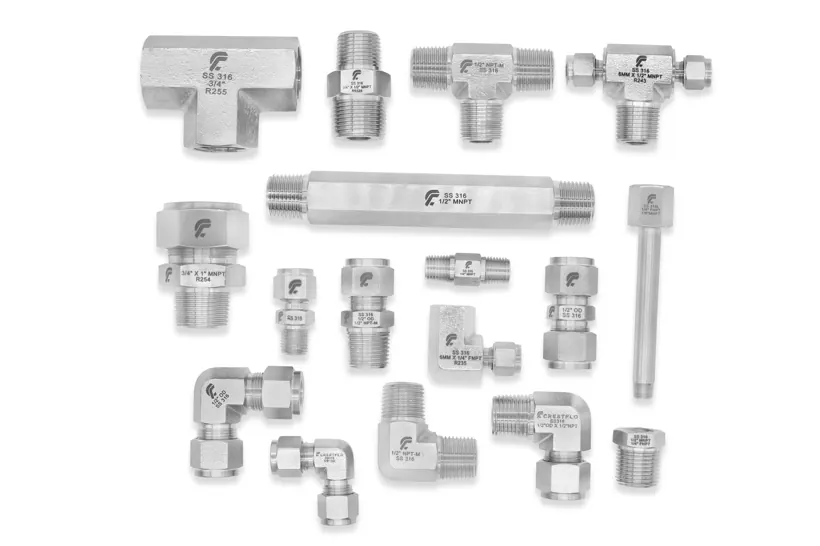
60,000 PSI (ultra-high-pressure, or UHP) instrumentation fittings and valves are metal-to-metal, coned-and-threaded parts rated for a 60,000 psi (roughly 4,137 bar, or 413.7 MPa) maximum allowable working pressure in controlled process, test, and injection service. At this pressure class, the pressure boundary comes from a machined cone and a left-hand thread, held by a gland and collar. Not a compression ferrule. Not an elastomer seal. Crestflo builds ultra-high-pressure fluid-system components to your specification. Send the pressure, bore, alloy, and connection you need, and our engineering team will review it for an engineered quote.
Engineers and buyers know this pressure class by several names. It shows up as 60,000 psi, 60,000 PSI MAWP, 60k psi and 60 ksi, or in metric terms as 4,136.9 bar and 413.7 MPa. The hardware carries its own set of labels too: ultra-high-pressure fittings, UHP fittings, UHP valves, coned-and-threaded fittings, and gland-and-collar or autoclave-style connections. One scope note keeps things precise. On this page, 60,000 psi means instrumentation and ultra-high-pressure fluid-system components: coned-and-threaded fittings, valves and tubing built for process, test and injection service. It excludes waterjet nozzle consumables, hydraulic-press rams and oilfield frac iron. UHP waterjet cutting sits in the same pressure band, but its consumable geometries aren't the same at all.
What "60,000 PSI" Service Means: MAWP, Proof & Burst Pressure
A 60,000 psi rating stands for maximum allowable working pressure, or MAWP: the ceiling for continuous service. Higher still are proof pressure, a non-destructive over-pressure test, and burst pressure, the point where the component finally gives out, with design margin setting both limits. At these extremes, only a metal-to-metal seal will hold. Elastomer O-rings extrude and ferrule grips lose their bite well before reaching 60,000 psi, so the connection has to shift to a coned-and-threaded gland-and-collar joint instead. This pressure class isn't the same thing as the forged-fitting "pound classes," things like 3000# or 6000#. Those come from ASME B16.11, and their actual psi rating swings with size, material and temperature. They aren't a fixed 60,000 PSI figure.
| Pressure class | bar | MPa | ksi |
|---|---|---|---|
| 15,000 psi | ≈1,034 | ≈103.4 | 15 |
| 20,000 psi | ≈1,379 | ≈137.9 | 20 |
| 30,000 psi | ≈2,068 | ≈206.8 | 30 |
| 60,000 psi | ≈4,136.9 | ≈413.7 | 60 |
Conversions follow the standard SI/imperial pressure equivalence. Ratings shown are class values, and they can be adjusted to fit specific requirements.
The 60,000 PSI Connection System: Coned-and-Threaded Gland & Collar
At the UHP class, the joint takes the form of a coned-and-threaded connection. The tube end gets coned, a matching thread is cut into it, and then a gland with a left-hand thread, along with a collar, draws the cone into the fitting's seat, forming a metal-to-metal seal. That's a different approach from medium-pressure (MP) practice, which runs through roughly 20,000 psi, and from the compression and ferrule joints used at lower instrumentation pressures. There's no elastomer anywhere in the pressure boundary. That absence is exactly why the joint can hold 60,000 psi and keep cycling without failing. For more on the connection type and Crestflo's published high-pressure line, see coned-and-threaded high-pressure fittings.
60,000 PSI Fittings, Adapters & Tubing: Tees, Crosses, Glands & Bulkheads
The UHP fitting family means coned-and-threaded tube fittings and tubing fittings that terminate and route small-bore UHP tube, not compression fittings at this class. It spans straight and shaped bodies: tees, crosses, elbows, couplings, nipples, glands, collars and bulkhead fittings. Adapters round out the group, carrying a process end such as NPT on one side. UHP tubing is small-bore and cold-worked, so the wall itself carries the pressure at a modest outside diameter. Typical UHP bores run 1/16″, 9/16″ nominal, with 1/4″, 3/8″ and 9/16″ as the common sizes under standard UHP practice, though sizing can be customized to the job. Small bore isn't a limitation. It's a deliberate choice for integrity. When a flexible connection is needed, UHP hose assemblies are available on request. See flexible hose assemblies. Forms and sizes can be explored on the small-bore instrumentation tubing and stainless steel & alloy tubing pages. For service that doesn't call for full UHP, step down through the lower pressure tiers (3,000, 20,000 psi).
| Pressure tier | Typical connection | Page |
|---|---|---|
| 3,000 psi | compression / cone-and-thread | 3,000 psi |
| 6,000 psi | compression / cone-and-thread | 6,000 psi |
| 10,000 psi | cone-and-thread | 10,000 psi |
| 15,000 psi | cone-and-thread | 15,000 psi |
| 20,000 psi | cone-and-thread (MP) | 20,000 psi |
| 60,000 psi | coned-and-threaded (UHP) | this page |
60,000 PSI Valves: Needle, Ball, Check & Relief
Metal-seated needle valves are the typical pick for ultra-high-pressure work, chosen for fine throttling and a stem-and-seat that holds a metal-to-metal shutoff at UHP class. Ball, check and relief configurations exist too, though which one you use depends on the specific design at these pressures. Trim, packing and body alloy get matched to the medium and temperature: graphite, PEEK or PTFE packing cover standard temperature limits, and these can be customized to requirement. UHP valves qualify to the applicable valve standards, ASME B16.34 and API. That's separate from ASTM F1387, the compression-fitting standard. Needle-valve manifolds handle instrument hook-ups: 2-valve, 3-valve and 5-valve manifold blocks isolate gauges and transmitters, built to the applicable pressure class. To match the valve type to your service, check out ultra-high-pressure needle valves, ball valves, check valves and relief valves.
Materials for 60,000 PSI Service: 316L, Inconel 718, Monel K500 & CRA Alloys
At UHP, strength comes first in alloy selection, corrosion second. The material has to carry the hoop stress at the bore before it ever has to resist the medium. Cold-worked 316/316L sets the high-strength stainless baseline. Nickel alloys with high strength, along with corrosion-resistant alloys (CRA), take over for sour, chloride and severe-service duty.
| Alloy | Why at 60,000 psi | Grade page |
|---|---|---|
| 316 / 316L (cold-worked) | high-strength stainless baseline for general UHP | 316/316L |
| Inconel 718 | very high strength and fatigue resistance | Inconel 718 |
| Monel K500 | high strength with seawater and HF resistance | Monel K500 |
| Super Duplex 2507 | strength plus chloride stress-corrosion resistance | Super Duplex 2507 |
| Hastelloy C-276 | severe sour and acidic service | Hastelloy C-276 |
Composition and mechanical properties follow the applicable ASTM or ASME material standard. The final alloy can be tailored to your specific requirement.
60,000 PSI Attribute Reference
| Attribute | Value / guidance |
|---|---|
| Pressure class | 60,000 psi MAWP ultra-high-pressure (UHP) service class |
| Conversions | ≈4,136.9 bar · ≈413.7 MPa · 60 ksi |
| Connection system | coned-and-threaded gland & collar, metal-to-metal (no elastomer in boundary) |
| Thread designations | UHP coned/gland threads (left-hand); autoclave-style MP thread and HP thread call-outs; NPT process ends on adapters, per standard UHP practice |
| Bore range | typical UHP bores 1/16″–9/16″ nominal (1/4″, 3/8″, 9/16″ common), per standard UHP practice, customizable to requirement |
| Cleanliness | standard passivation; oxygen-clean (O2-clean) for hydrogen/oxygen service on request |
| Product forms | tees, crosses, elbows, couplings, glands, collars, bulkhead fittings, adapters; needle/ball/check/relief valves and 2-/3-/5-valve manifolds; small-bore tubing; UHP hose assemblies on request |
| Materials in scope | cold-worked 316/316L, Inconel 718, Monel K500, Super Duplex 2507, Hastelloy C-276 and other high-strength/CRA grades |
| Testing regime | hydraulic proof, burst and impulse; PMI; valve seat & shell leak; in-house NDT; destructive testing at ISO/IEC 17025 labs |
| Certifications | ISO 9001 / 14001 / 45001 & PED certified; ASTM F1387 (fittings); NACE MR0175 / ISO 15156 where the alloy applies |
| Standards conformance | ASME B16.34 / API (valves); ASTM A276 / A479 (bar); ASTM A269 (tube) as applicable to form |
| Traceability | EN 10204 MTC 3.1 (3.2 on request) plus heat/lot number marked on every part |
| Origin | Indian origin; US / European melt available on request, with full material traceability |
| Lead time | ready stock for standard items · made-to-order for specials · 6–8 week delivery |
Values per applicable standard; customizable to requirement.
Standards, Testing & Traceability
Crestflo backs every UHP build with its own quality system: hydraulic proof, burst and impulse testing, pneumatic testing, positive material identification (PMI), and 100% seat and shell leak testing on valves. In-house teams handle the non-destructive testing. Destructive testing goes out to ISO/IEC 17025-accredited laboratories, and third-party inspection is available on request. Crestflo holds ISO 9001 / 14001 / 45001 and PED certification. Fittings are performance-qualified to ASTM F1387, valves conform to ASME B16.34 / API, and sour-service builds meet NACE MR0175 / ISO 15156 where the specified alloy qualifies. Hydrogen and oxygen duty can call for oxygen-clean (O2-clean) treatment: degreasing and cleaning to an oxygen-service standard, available on request per the customer's specification, on top of standard passivation. Each part carries its heat/lot number and ships with an EN 10204 MTC 3.1 certificate, or 3.2 if requested. Certificates stay on file in Quality.
Crestflo Capability at 60,000 PSI: Engineered to Order
Crestflo's published high-pressure line tops out at 30,000 psi for cone-and-thread fittings and 15,000 psi for compression and flare fittings. Anything beyond that is handled as an engineered-to-order build, including the 60,000 psi UHP class. Send us your service conditions. Our engineering team then checks the connection, bore, alloy and test basis against the standard before quoting. In-house CNC, VMC and EDM machining and custom manufacturing carry designs from print to finished part; testing and inspection is qualified to the standards listed above. Crestflo is the instrumentation division of a four-decade-old, Government-of-India-recognized export house with a delivery track record across the Middle East, so the UHP capability rests on manufacturing and QA depth that's already in place. To start a UHP inquiry, request an engineered quote or talk to us at sales@crestflousa.com or +1 346 594 9005 (Houston, TX sales office).
Autoclave-Style UHP Interchange
UHP components often get specified against autoclave-style catalogs: Parker Autoclave Engineers®, High Pressure Equipment (HiP®), Aminco, Butech and Maximator, among others. Parker Autoclave® and Butech® are trademarks of Parker Hannifin, HiP® belongs to its respective owner, and Aminco® and Maximator® are trademarks of their respective owners. Crestflo isn't affiliated with, endorsed by or sponsored by any of them. These named brands show up only as interchange-equivalent references, so an existing UHP specification can be matched by connection style, bore and alloy. Rather than copying a competitor's catalog, Crestflo builds interchange-equivalent engineered products by connection style, bore and alloy. To match an existing UHP specification, request your cross-reference and our engineering team will map it to a Crestflo build.
Applications & Industries
The 60,000 psi class covers ultra-high-pressure well testing, chemical-injection skids, hydrogen systems, autoclave and HIP research rigs, subsea test packages, and process lines running in the UHP band. A lot of ground. For the specifics by application, the industry pages go deeper: hydrogen, oil and gas, and subsea. UHP waterjet cutting runs in the same pressure range, but the consumable geometry differs, and it isn't part of this page's instrumentation scope.
Why Crestflo for Ultra-High-Pressure Fittings & Valves
Crestflo is a US-serving manufacturer built around drop-in replacement, and its compression line carries ASTM F1387 performance qualification, backed by full traceability across every product. Buyers get made-to-print engineering, in-house CNC/VMC/EDM machining, capability in high-nickel and CRA alloys, small minimum order quantities, private-label options, and a landed price that stays competitive even after US duties. Stock and delivery follow one simple rule: that's ready stock for standard items, made-to-order for specials, and a 6-8 week delivery window either way. The product itself is of Indian origin, though US and European melt is available on request, with full material traceability throughout. We Engineer Confidence. You can reach the Houston, TX sales office at sales@crestflousa.com or by phone at +1 346 594 9005.
Frequently Asked Questions
Does Crestflo manufacture 60,000 psi fittings and valves?
Crestflo's published, qualified high-pressure line tops out at 30,000 psi for cone-and-thread fittings; compression and flare fittings are rated to 15,000 psi. Anything in the 60,000 PSI ultra-high-pressure class gets treated differently, as an engineered-to-order build. Send in your specification, and our engineering team checks it against the applicable standard before quoting. That 60,000 psi tier isn't off a catalog page. It's built to the job.
What connection is used at 60,000 psi?
This is a metal-to-metal coned-and-threaded connection, built with a gland and collar. No compression ferrules here, and no elastomer seals either. The tube itself is coned and threaded, and the gland pulls that cone into its seat, that's what holds the UHP pressure boundary.
What is 60,000 psi in bar and MPa?
60,000 psi works out to roughly 4,136.9 bar, or 413.7 MPa if you prefer metric. That's the same as 60 ksi under standard pressure conversion. For reference, 9 bar sits nowhere near that range, it's a small fraction by comparison.
What alloys are used for 60,000 psi service?
For strength, we turn to high-strength, cold-worked 316/316L, Inconel 718 and Monel K500. When conditions call for corrosion resistance, alloys like Super Duplex 2507 and Hastelloy C-276 handle sour, chloride and severe service. Strength and corrosion resistance drive the choice, and the selection can be tailored to whatever the job requires.
What is the pressure rating for class 3000 or 6000# fittings?
Pound classes like 3000# and 6000# for forged fittings come from ASME B16.11, and the designation alone doesn't tell you the actual pressure a fitting can handle. Size matters. Material matters too. So does temperature. None of these classes correspond to one fixed psi figure, and none of them match a 60,000 psi (60,000 PSI) UHP rating.
How much pressure can a fitting hold?
That depends on connection type, bore, material and temperature. Instrumentation compression fittings commonly reach 15,000 psi. Crestflo's coned-and-threaded fittings are rated to 30,000 psi. Beyond that, ultra-high-pressure designs go even higher, but only as an engineered build.
Are 60,000 psi parts NACE and sour-service compliant?
When the specification calls for a NACE MR0175 / ISO 15156-compliant alloy, yes. The build meets that standard for the alloy in question, and it ships with material test certificates confirming it.
What certifications and traceability come with the parts?
Crestflo holds ISO 9001, 14001, and 45001 certification, along with PED certification. Each part carries its own heat and lot number, so it's fully traceable. Standard documentation is an EN 10204 MTC 3.1 certificate; a 3.2 is available on request. We also run hydraulic proof and burst testing, plus PMI.
Where are 60,000 psi parts made and how fast is delivery?
Product is Indian origin, and US or European melt is available on request, with full material traceability built in. It's engineered as a drop-in replacement for US material. Standard items ship from ready stock; specials are made to order, with 6-8 week delivery.