
Flexible Hose Assemblies: Stainless Steel & High-Alloy, US-Serving
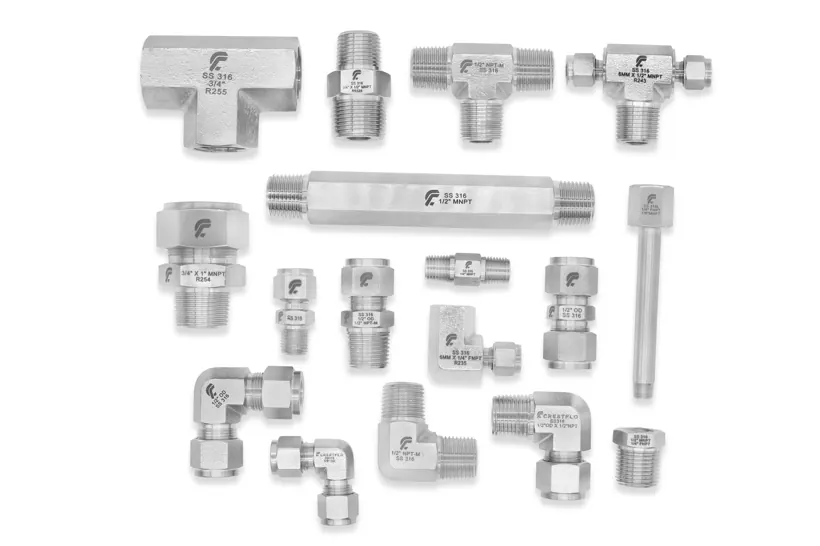
A flexible hose assembly, sometimes called a flex hose assembly, is a finished, cut-to-length line built from a flexible hose core, end fittings, and, on metal hose, an outer braid. Terminated and ready to install, it drops in between two connection points. It absorbs vibration, thermal growth, pressure pulsation, and misalignment while carrying process fluid or gas. Three families cover the range: corrugated metal hose, braided metal hose, and PTFE-lined hose. Crestflo builds these as instrumentation and process assemblies in stainless steel and high-performance alloys, engineered for US drop-in and shipped on a fast lead time.
Scope note: on this page, "flexible hose" refers specifically to an instrumentation or process fluid-system hose assembly built in stainless steel, a corrosion-resistant alloy, or fitted with a PTFE liner. It doesn't cover garden or plumbing flexi-hoses, electrical flexible conduit, or consumer braided plumbing connectors.
Also Known As: Flexible Metal Hose, Braided Hose & PTFE Hose Assembly
Buyers and specifiers call this product by a lot of different names. Some ask for a flexible metal hose or flexible metal hose assembly, others specify a corrugated metal hose or convoluted hose, an annular or helical corrugated hose, a braided metal hose, braided hose assembly, or stainless steel braided hose. You'll also hear SS flex hose, stainless steel flexible hose, PTFE-lined or Teflon® hose assembly, convoluted hose, instrument hose or instrumentation hose, pigtail hose, pump connector hose, and vibration eliminator. Trade nomenclature such as T304 and T316 metal hose points to 304 and 316 stainless cores. That same assembly might get called a stainless steel hose assembly, a metal hose assembly, or just a flexible hose connector. Teflon® is a trademark of The Chemours Company.
Types of Flexible Hose Assembly: Corrugated Metal, Braided Metal & PTFE-Lined
Corrugated (Annular) Metal Hose
Corrugated metal hose goes by a few other names: corrugated flexible hose, flexible metal hose, convoluted metal hose. Whatever the label, the construction stays the same. A thin-wall stainless or alloy core, shaped into ring-style (annular) or helical corrugations. Those corrugations do the work. They give the hose its flexibility and let it handle heat that would destroy elastomer or polymer hose outright. So when temperature is the deciding factor, when a tight bend radius is unavoidable, or when the job calls for a core that's fully metallic and gas-tight, this is what gets specified.
Braided Metal Hose
A braided metal hose wraps one or more layers of stainless steel wire braid around a corrugated core. That braid holds the core against pressure and takes on the axial load. It's why stainless steel braided hose does the heavy lifting for pressure containment and vibration control on pumps, compressors, and instrument runs. Single-braid, double-braid, and unbraided constructions each trade pressure capacity for flexibility.
PTFE-Lined Hose (PTFE / Teflon® Hose Assembly)
A PTFE-lined hose, known as a PTFE hose assembly or Teflon® hose assembly, uses a smooth-bore or convoluted PTFE liner inside a stainless braid. PTFE's chemical inertness and low surface energy make it well suited to aggressive chemicals, high-purity media, and non-stick service. If fluid static is a concern, a static-dissipative, or conductive, liner is available on request.
Flexible Hose Materials: 316/316L Stainless, Duplex, Inconel, Hastelloy & PTFE
Metal cores and braids come in the full stainless, duplex, and nickel-alloy range. PTFE liners take care of the chemical and high-purity duties. Grade compositions and mechanical properties follow the applicable ASTM/UNS standards; each grade below links to its material page for full data.
| Alloy family | Grades | Choose when |
|---|---|---|
| Austenitic stainless | 304/304L, 316/316L, 904L | General instrumentation, mild corrosion, 316/316L is the default |
| Duplex / super-austenitic | Duplex 2205, Super Duplex 2507, 254 SMO, AL-6XN, Alloy 20 | Chloride and seawater service, higher strength |
| Nickel alloys | Inconel 625, Inconel 825, Monel 400, Hastelloy C-276 | Sour, acidic, and high-temperature corrosive media |
| Titanium | Titanium Gr2 | Seawater and chloride environments at low weight |
| Liner (PTFE) | Smooth-bore / convoluted PTFE | Aggressive chemicals, high purity, non-stick |
For grade selection by service, review the full instrumentation fitting materials range on Crestflo's site.
End Connections & Hose Fittings: Tube-Fitting, NPT, Flare, Flange & Face-Seal
Every assembly ends in Crestflo hose fittings and instrumentation end connections, male or female, offered in both imperial and metric sizes. Compression tube-fitting ends run up to 2" (50 mm) OD. Joining two hoses isn't complicated: match the end connection on each, a tube-fitting end to a tube-fitting port, say, or a flange to a flange.
| End type | Standard | Configuration |
|---|---|---|
| Tube-fitting (compression) | Single / double ferrule | Male or female, imperial + metric |
| NPT | ASME B1.20.1 | Male or female |
| 37° flare (JIC) | ISO 8434-2 | Male or female |
| Flange | ASME B16.5 pattern | Raised / flat face |
| Face-seal (VCR/VCO-type) | Metal / elastomer gasket | High-purity service |
Flexible Hose Sizes, Lengths & High-Pressure/Temperature Ratings
Bore and overall length aren't fixed dimensions: specify the required bore, live length, and end-to-end dimension on the RFQ, in either imperial or metric units. Working and burst pressure depend on how a hose is built and sized. Core wall, corrugation, braid layers, and bore diameter all play a part, so ratings get confirmed per build rather than issued as one number for every hose. Send in the service conditions, and the assembly will be rated accordingly. High-pressure hose assemblies use a double-braided core to carry the axial load and lift the working-pressure rating, since it's the braid, not the corrugation, that actually contains the pressure. Specify the pressure class needed on the RFQ, and the hose will be built to suit. PTFE-lined hose stays within PTFE's standard service window, roughly −70 °C to +260 °C (−94 °F to +500 °F), per the polymer's published properties. Metal hose runs hotter still; its temperature capability depends on the alloy and typically climbs far higher. Values follow the applicable standard and can be adjusted to whatever the job requires.
Which Flexible Hose Is Best? Type Selection Guide
The right flexible hose choice hinges on whichever service condition governs the application: pressure, temperature, or chemical compatibility. Consult the guide below. Then verify the alloy and rating against your RFQ before finalizing.
| Type | Construction | Best for | Temperature | Pressure |
|---|---|---|---|---|
| Corrugated metal hose | Annular/helical metal core | High temperature, tight bends, gas-tight metallic path | Highest (alloy-dependent) | Moderate (unbraided) |
| Braided metal hose | Corrugated core + wire braid | Pressure containment, pump/vibration connection | High (alloy-dependent) | Highest (braid-dependent) |
| PTFE-lined hose | PTFE liner + metal braid | Aggressive chemicals, high purity, non-stick | Per PTFE service range | Moderate to high |
When designing flexible hoses, three failure modes deserve attention: braid fatigue caused by over-flexing, corrosion from an under-specified alloy, and over-bending past the minimum bend radius. Choosing the right alloy, braid, and length guards against all three.
Standards, Testing & Certifications
Assemblies carry the standard approvals that apply to flexible hose and its end connections: ASME B1.20.1 for NPT ends, ISO 8434-2 for 37° flare ends, and NACE MR0175 / ISO 15156 for sour service, paired with suitable alloys. Crestflo holds ISO 9001 / 14001 / 45001 certification and is PED certified as well.
| Proof element | Applies to |
|---|---|
| Hydraulic proof, burst & pneumatic test | Pressure integrity of the assembly |
| Flexure fatigue, rotary flex & vibration test | Dynamic-service durability |
| Thermal cycling & vacuum test | Temperature and vacuum service |
| PMI (positive material identification) | Alloy verification |
| In-house NDT; destructive testing at ISO/IEC 17025 labs | Weld and material integrity |
| Heat/lot number on every part | Traceability to the melt |
Every assembly ships with a heat/lot number and carries an EN 10204 MTC 3.1 material certificate as standard. A 3.2 certificate is available on request. Cleaning is handled to oxygen-clean and high-purity standards under ASTM G93, and sour-service compliance with NACE MR0175 / ISO 15156 gets specified at the RFQ stage. Third-party inspection can also be arranged on request.
Applications & Industries
Flexible hose assemblies handle pump and compressor vibration connections, instrument pigtails, steam hose and jacketed hose runs on steam-traced lines, sample lines, and cryogenic and hydrogen transfer. Common destinations include analytical sampling systems, LNG and cryogenic service, hydrogen systems, steam tracing, hydraulics, and instrument air. Crestflo supplies assemblies built for each of these applications.
Custom & Made-to-Length Hose Assemblies
Every assembly gets built to order: specify the bore, length, alloy, both end connections, braid, and cleaning, and Crestflo supplies a made-to-print custom hose assembly. Standard items ship from ready stock; specials get made to order, with delivery running 6-8 weeks. Small minimum quantities are no problem, and OEM private-label programs are available too. Datasheets and CAD go out to customers on request. Placing an order is simple: request a quote with your specification, or just send your print. No dead ends, no catalog login required. Take a look at the full instrumentation accessories range, or weigh it against rigid instrumentation tubing and coiled tubing.
Why Crestflo for Flexible Hose Assemblies
Crestflo is the instrumentation division of an export house that's been in business for four decades, recognized by the Government of India, with a proven record of delivery across the Middle East. It works as a flexible hose manufacturer and flexible hose supplier that builds direct; it doesn't resell anyone else's product. Assemblies ship in 6 to 8 weeks, against the 20-plus weeks typical of the major suppliers, and they're engineered as drop-in replacements for US products. Every part carries a heat number and is traceable through an EN 10204 MTC.
The alloy range covers the full spread of stainless, duplex, and nickel grades, something pure stockists rarely stock in full. Minimum order quantities stay small, and private labeling is available. Standard product comes from India; US or European melt can be supplied on request, with complete material traceability behind it. We Engineer Confidence.
US sales: sales@crestflousa.com · +1 346 594 9005 · Houston, TX.
Flexible Hose Assembly FAQ
What are the three types of flexible hose assembly?
Three families cover the field: corrugated (annular) metal hose, braided metal hose, and PTFE-lined hose. Which one to pick depends on whatever condition governs the application, whether that's pressure, temperature, or compatibility with the media.
Which flexible hose is best for my application?
It really depends on the service. Braided metal hose handles pressure containment and vibration best. Corrugated metal hose is the pick for high temperature and tight bends, while PTFE-lined hose suits aggressive chemicals and high-purity media. Send over your service conditions, and we'll recommend the right type and alloy.
What materials are available for flexible hose assemblies?
Stainless steel options span 304 and 304L, 316 and 316L, and 904L. For tougher corrosion demands, duplex and super-duplex grades are on offer: 2205, 2507, 254 SMO, AL-6XN, and Alloy 20. Nickel alloys fill out the list too, including Inconel 625 and 825, Monel 400, and Hastelloy C-276. There's also Titanium Gr2. And for chemical work or high-purity service, PTFE liners get the job done.
Can I get a flexible hose assembly for sour (NACE) service?
Yes. We can supply assemblies that meet NACE MR0175 and ISO 15156 by using suitable alloys. Just spell out your sour-service requirements when you submit the RFQ.
Do the assemblies come with material certificates?
Yes. Every part's marked with a heat/lot number, and we supply an EN 10204 MTC 3.1 material certificate as standard. A 3.2 version's available too, on request.
How are the ends connected, can I specify tube-fitting or NPT ends?
Yes. Every assembly terminates in a Crestflo hose fitting, and those fittings are available with tube-fitting, NPT, 37° flare, flange, or face-seal ends, either male or female, in imperial or metric sizes. Joining two hoses isn't complicated: you just match the end connection on each one.
What pressure and temperature can flexible hose assemblies handle?
Ratings depend on both construction and size, so a single number gets confirmed per build rather than quoted in general terms. Send your service conditions with the RFQ if you need a rated assembly. PTFE-lined hose follows the standard service range for PTFE, roughly −70 °C to +260 °C. Metal hose temperature capability, by contrast, depends on the alloy and typically runs higher.
What is the lead time for a flexible hose assembly?
Standard items come from ready stock. Specials are made to order. Delivery typically takes 6 to 8 weeks, well short of the 20-plus weeks common among the major brands.
Are these flexible hose assemblies made in the USA?
Crestflo serves the US market and is built for a straightforward US drop-in. The standard product comes from India. US or European melt is available on request, and every shipment carries full material traceability.
Related Pages
- Instrumentation accessories, full accessory range
- Snubbers and tube clamps, hardware that pairs with Crestflo instrumentation
- 316/316L stainless and Hastelloy C-276, the material data behind the flexible hose line, including Hastelloy for harsher service conditions
- EN 10204 MTC and NACE MR0175, where to find traceability documentation and the sour-service standard
- Request a quote, send your flexible hose specification