
Seamless Tubing: Stainless Steel & High-Nickel Alloy Instrument Tube, US-Serving
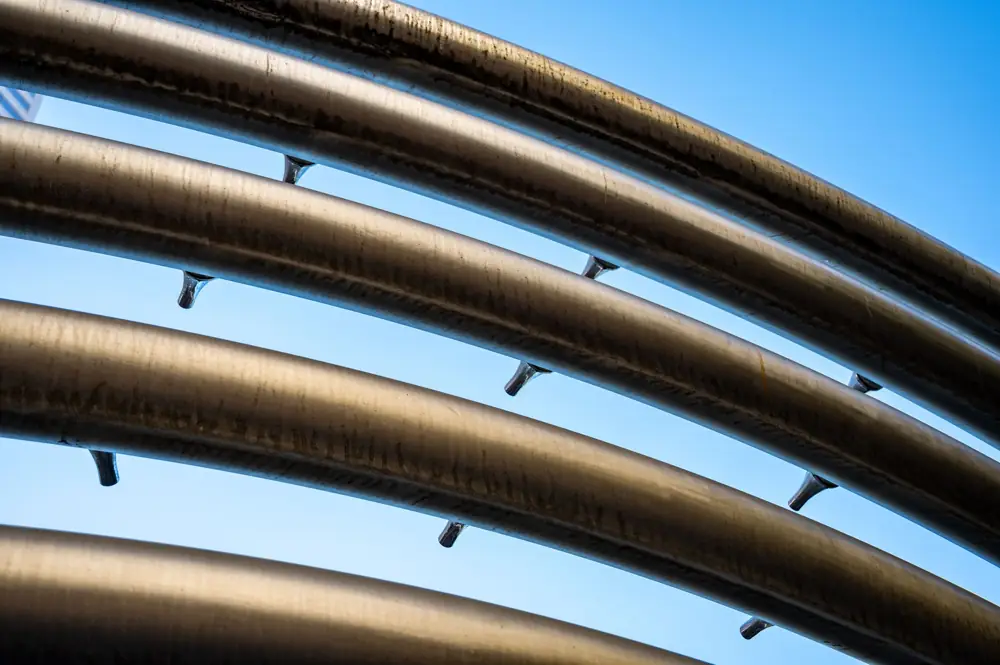
Seamless tubing has no longitudinal weld seam. It's pierced from a solid billet, then cold-drawn over a mandrel, which gives it a uniform wall and a consistent grain structure all the way through. That's why engineers specify it for high-pressure lines and critical instrument service.
Crestflo produces cold-drawn, fully-annealed seamless tube in stainless steel and high-nickel/CRA alloys. Every length carries heat-number traceability, and it comes in both imperial and metric OD. Standard items ship from ready stock; specials are made to order, with delivery running 6–8 weeks. Request a quote with your OD, wall, alloy and quantity, or request a sample.
Seamless tubing, as used here, means small-OD, cold-drawn stainless and alloy tube built for instrumentation, impulse and hydraulic fluid systems. It doesn't cover oilfield coiled tubing used in well intervention. Structural or mechanical tube is excluded too, and so is seamless pipe.
What Is Seamless Tubing?
Seamless tubing is fluid-system tube made without a longitudinal weld. A solid billet gets pierced to form a hollow, then cold-drawn over a mandrel to its final outside diameter and wall. The result has no seam at all, just a continuous, uniform grain running around the circumference. It's measured and controlled by actual OD and wall thickness rather than nominal pipe size, and it's supplied soft enough that a compression-fitting ferrule can grip and seal it without threading or welding. Because there's no weld line, seamless tube is the traditional choice where wall uniformity and pressure integrity matter most. Tradespeople abbreviate it SMLS tube.
Seamless tube and seamless pipe aren't the same thing. Tube gets specified by its exact outside diameter and wall thickness: a 1/2″ tube really does measure 0.500″ across. Pipe, on the other hand, goes by nominal pipe size (NPS) plus schedule. What's covered here is instrument and hydraulic seamless tube, sized by OD, not pipe.
Seamless Tubing Also Known As: Seamless Tube, Cold-Drawn (CDS) & SMLS Tubing
Engineers who write specifications don't all call this product the same thing. Seamless tubing shows up as seamless tube, seamless steel tubing, or SMLS tube. In stainless grades, it's also written as seamless stainless steel tubing, seamless stainless tube, or stainless steel seamless tube. The manufacturing route supplies another name: cold-drawn seamless tubing, or CDS tube, since the tube is pierced and then drawn. Temper contributes further labels, fully-annealed or bright-annealed seamless tube. Application does the same, giving seamless instrumentation tubing and seamless hydraulic tubing.
A handful of standards govern the product. ASTM A269 covers seamless and welded austenitic stainless tubing, while ASTM A213 applies to seamless boiler, superheater, and heat-exchanger tube. Small-diameter seamless tube falls under ASTM A632. ASME SA-269 and SA-213 serve as the code equivalents, and metric stock follows EN 10216-5 and DIN 17458. Alloys carry a UNS number as well, S31600 or S31603 for 316 and 316L, along with a Werkstoff number, 1.4401 or 1.4404.
Seamless Tubing Quick-Spec Summary
| Attribute | Value |
|---|---|
| Manufacturing route | Cold-drawn seamless (billet pierced, drawn over mandrel, annealed), no weld seam |
| Condition | Fully annealed / hardness-controlled for reliable ferrule set |
| OD range | 1/8″ to 1″ imperial · 3 mm to 25 mm metric (customizable to requirement) |
| Wall gauges | 0.028″, 0.035″, 0.049″, 0.065″, 0.083″ and metric equivalents |
| Materials | 316/316L, 304/304L, 904L, duplex, super-duplex, 254 SMO, AL-6XN, Alloy 20, Inconel, Incoloy, Monel, Hastelloy, Nickel 200/201, Titanium Gr2 |
| Standards | ASTM A269 / A213 / A632; ASME SA-269 / SA-213; EN 10216-5 / DIN 17458; NACE MR0175 / ISO 15156 for sour service |
| Surface finish | Bright-annealed (BA) or pickled & passivated; electropolished on request |
| Traceability | Heat/lot number on every part · EN 10204 MTC 3.1 (3.2 on request) |
| Origin | Indian origin; US / European melt available on request |
| Delivery | Ready stock for standard items · made-to-order for specials · 6–8 weeks |
Seamless vs Welded Tubing (and DOM): Which Tube to Specify
Seamless and welded tube can both meet ASTM A269 for instrument and hydraulic service. The real difference comes down to the seam, and that's what drives cost and availability. Seamless has no weld line at all. It's the choice for the highest pressures, for sour and critical duty, or whenever a spec simply calls for it. Welded-and-drawn tube starts as strip, gets welded, then cold-worked into a smooth wall with tight dimensional control; for most instrument service it holds up just as well mechanically, and it costs less. DOM (drawn-over-mandrel) is a different animal: a welded mechanical tube with a worked, redrawn seam, common in structural and cylinder work. It's not a seamless product. The table below sums up the choice, and the full decision guide lives on welded tubing.
| Attribute | Seamless | Welded (redrawn) | DOM |
|---|---|---|---|
| Weld seam | None | Welded then cold-drawn | Welded then drawn over mandrel |
| Wall uniformity | Homogeneous grain, no seam | Uniform, smooth after redraw | Worked seam remains |
| Relative cost | Higher | Lower | Lower (mechanical grade) |
| Availability / lead | Wider walls; longer for exotics | Broad; economical | Structural, not fluid-instrument |
| Typical service | High-pressure, sour, critical | General instrument & air lines | Structural / cylinder (out of scope) |
| Covering spec | ASTM A269 / A213 | ASTM A269 | SAE mechanical grades |
How Seamless Tube Is Made: Piercing, Cold Drawing & Annealing
Seamless tube starts life as a solid round billet, heated and pierced to form a hollow shell. That shell gets cold-drawn through a die and over an internal mandrel, which brings the OD and wall down to the target dimensions and work-hardens the metal along the way. Next comes a full anneal, restoring ductility and giving the tube the soft temper needed for fitting fit-up. It's then straightened and finished, either by bright-annealing or by pickling and passivation. Testing comes last: hydrostatic or eddy-current methods, plus flare and flattening checks, all per ASTM A269 / A213. What comes out the other end is a weld-free tube with a uniform wall and controlled hardness.
Seamless Tubing Materials: 316/316L Stainless to Duplex, 254 SMO & High-Nickel Alloys
Crestflo covers the full range in stainless, high-nickel and titanium, with 316/316L stainless as the default choice for most instrument service. When media get more aggressive, you move up the alloy ladder to duplex, super-austenitic and high-nickel/CRA grades. Nothing in the US instrumentation scope uses brass, copper or aluminum. Compositions and UNS designations listed here are standard published values. Selection should be based on media, chloride level, temperature and pressure; the material selection by service resource walks through that process. All values follow the applicable standard, and everything can be customized to the requirement at hand.
| Alloy | UNS | Werkstoff | Tube spec | When to choose | Learn more |
|---|---|---|---|---|---|
| 316 / 316L | S31600 / S31603 | 1.4401 / 1.4404 | A269 / A213 | Default for most instrument and process service | 316/316L |
| 304 / 304L | S30400 / S30403 | 1.4301 / 1.4307 | A269 / A213 | Non-chloride, budget-driven duty | 304/304L |
| 904L | N08904 | 1.4539 | A269 / A213 | Sulfuric and phosphoric acids | 904L tubing |
| Duplex 2205 | S32205 | 1.4462 | A789 | Chloride stress-corrosion resistance | Duplex 2205 tubing |
| Super Duplex 2507 | S32750 | 1.4410 | A789 | Offshore, seawater, high chloride | Super Duplex 2507 tubing |
| 254 SMO | S31254 | 1.4547 | A269 / A213 | Aggressive chlorides and acids | 254 SMO tubing |
| AL-6XN | N08367 | — | A269 / A213 | Seawater and bleach service | AL-6XN |
| Alloy 20 | N08020 | 2.4660 | A269 / A213 | Hot sulfuric acid | Alloy 20 |
| Inconel 625 | N06625 | 2.4856 | A213 | High temperature and corrosion | Inconel 625 tubing |
| Inconel 825 | N08825 | 2.4858 | A213 | Reducing and oxidizing acids | Inconel 825 tubing |
| Monel 400 | N04400 | 2.4360 | A213 | Seawater, HF, salt | Monel 400 tubing |
| Hastelloy C-276 | N10276 | 2.4819 | A213 | Severe reducing/oxidizing media | Hastelloy C-276 tubing |
| Titanium Gr2 | R50400 | 3.7035 | — | Seawater and chloride cooling | Titanium Gr2 |
On request, we also supply Nickel 200/201, Incoloy 800/800H and Hastelloy C-22/B-2/B-3/X in seamless tube. Crestflo's full range sits on the alloy tubing page.
Seamless Tubing Sizes: Imperial (1/8″–1″) & Metric (3–25 mm) OD With Wall Gauges
Seamless tube comes in both imperial fractional and metric OD, so it matches whichever fitting standard you're working to. Instrument ODs typically span 1/8″ to 1″, and 1/4″, 3/8″ and 1/2″ carry most of the load on panel and tubing runs. On the metric side, OD runs from 3 mm to 25 mm; 6 mm, 8 mm, 10 mm and 12 mm come up most often. The tube pairs with Crestflo compression fittings up to 2″ (50 mm) OD. Wall thickness gets chosen alongside the alloy to hit the required working pressure. Figures below follow the standard fractional-tube gauge series. Full OD, wall and pressure data sits on the tubing size chart; sizing theory is covered in tube sizing and wall thickness. Values follow the applicable standard and can be customized to requirement.
| OD (imperial) | OD (metric) | Common wall thicknesses | Typical use |
|---|---|---|---|
| 1/8″ | 3 mm | 0.028″, 0.035″ | Low-flow sensing, analytical sample lines |
| 1/4″ | 6 mm | 0.028″, 0.035″, 0.049″ | General instrument, impulse & air lines |
| 3/8″, 1/2″ | 10 mm, 12 mm | 0.035″, 0.049″, 0.065″ | Higher-flow process & hydraulic lines |
| 5/8″, 3/4″, 1″ | 16 mm, 20 mm, 25 mm | 0.065″, 0.083″ | High-pressure and larger-bore runs |
Both imperial and metric systems are in stock. For matching hardware, see metric vs imperial tube fittings from Crestflo.
Seamless Tubing Pressure Rating: Working Pressure by OD, Wall & Alloy
Seamless tubing doesn't carry one fixed pressure rating. Allowable working pressure depends on OD, wall thickness and the alloy's allowable stress, all worked out per ASME B31.3. Go with a heavier wall, or a stronger alloy like super-duplex, and the rating for a given OD goes up. The tube pressure calculator will give you the figure for any OD-wall-alloy combination, and the tubing size chart has the per-size table. Need something for high-pressure or impulse service? That's covered on hydraulic tubing. Values follow the applicable standard, and Crestflo can tailor them to your requirement.
Fully Annealed Temper & Bright-Annealed / Pickled Surface Finish
Instrument tube drawn without a seam has to be fully annealed, fully softened, before a fitting ferrule can bite into the wall and swage it without cracking. Tube that's too hard springs back, or it fractures right at the ferrule and leaks. Crestflo supplies fully-annealed, hardness-controlled tube of this kind; for austenitic stainless grades, ASTM A269 caps hardness at 90 HRB in the annealed condition, and softer targets get specified when a fitting needs premium engagement. Standard tube ships bright-annealed (BA) or pickled and passivated. For high-purity and semiconductor work, though, electropolished tubing gives you a low-Ra internal surface; just specify the target Ra on the RFQ. Surface and hardness targets follow the applicable standard, and they can be adjusted to whatever the job requires.
Seamless Tubing Standards: ASTM A269, A213, A632 & EN 10216-5
Seamless stainless tube ships to ASTM A269 as standard, and to ASTM A213 when the job calls for seamless boiler or heat-exchanger grade. Small-diameter seamless tube follows ASTM A632. For Boiler & Pressure Vessel Code work, the ASME SA-269 / SA-213 equivalents apply. Metric tube follows EN 10216-5 / DIN 17458. Duplex and super-duplex seamless tube is supplied to ASTM A789. Sour-service lines go out to NACE MR0175 / ISO 15156. Crestflo holds ISO 9001 / 14001 / 45001 and PED certification, with certificates kept at quality.
| Standard | Scope | Applies to |
|---|---|---|
| ASTM A269 | Seamless & welded austenitic SS tubing, general service | 304/316 seamless instrument tube |
| ASTM A213 | Seamless ferritic/austenitic alloy boiler & HX tube | Seamless boiler/HX-grade & alloy tube |
| ASTM A632 | Seamless small-diameter SS tube | Small-OD seamless tube |
| EN 10216-5 / DIN 17458 | Seamless SS tube (metric) | Metric-OD seamless tube |
| NACE MR0175 / ISO 15156 | Sour-service materials | H2S / sour-gas lines |
| EN 10204 | Inspection documents | MTC 3.1 standard, 3.2 on request |
Certifications, Testing & Traceability: MTC 3.1, PMI & NDT
Every length of seamless tube carries a heat/lot-number mark and comes with EN 10204 MTC 3.1 as standard, with 3.2 available on request. We verify tube by hydrostatic or eddy-current testing, backed by flare and flattening checks per ASTM A269 / A213, positive material identification (PMI), and in-house non-destructive testing. Destructive testing happens at ISO/IEC 17025-accredited laboratories. Third-party inspection can be arranged on request. Crestflo holds ISO 9001 / 14001 / 45001 and PED certification, and certificates run through the traceability function.
Seamless Tube + Compression Fittings as a Matched, F1387-Qualified System
Crestflo makes fittings up to 2″ OD, and testing follows ASTM F1387, so buyers get one system that's been checked start to finish.
A compression fitting is the mechanical connector, a single- or double-ferrule fitting, that grips and seals seamless tube without threading or welding it. Crestflo makes the mating compression tube fittings in single- and double-ferrule designs, up to 2″ OD, tested to ASTM F1387. Buy the tube and the fitting from the same manufacturer, and the OD tolerance, hardness and ferrule are matched as a system that's already proven to work. Most tube distributors simply can't offer that kind of control.
Seamless Tubing Applications: Impulse, Sampling, Instrument-Air & Hydraulic Lines
Seamless tube carries impulse and sensing lines to gauges and transmitters, sample lines to analyzers, instrument-air lines, and high-pressure hydraulic power runs across the process plant. Plants specify it wherever a weld seam simply can't be there. Typical sectors include oil and gas, offshore and subsea, petrochemical and chemical, power generation, semiconductor and UHP, hydrogen, instrument air, hydraulics and analytical sampling systems. For how this fits instrument service specifically, see instrumentation tubing.
Ordering & Lead Time: Ready Stock, Made-to-Order & 6–8 Week Delivery
Order by alloy, OD (imperial or metric), wall or gauge, temper, finish (BA or pickled), spec (A269 / A213), length or coil form, certificate (3.1 / 3.2), sour-service requirement, and quantity. Standard items ship from ready stock. Specials are made to order, and delivery typically runs 6–8 weeks; see lead time for details. Tube comes from India, though US or European melt is available on request, along with full material traceability. If TAA or country-of-origin questions come up, they're answered on US origin & compliance. Want the ordering-code guide for your configuration? Reach out to the Crestflo engineering team through request a quote, email sales@crestflousa.com, or call +1 346 594 9005 in Houston, TX. Distributors should look at the distributor program; OEMs will want the private-label program.
Why Buy Seamless Tubing From Crestflo
Crestflo runs as the instrumentation division of an export house that's been in business for four decades, recognized by the Government of India, with a long track record delivering into the Middle East. Engineering-grade manufacturing sits behind a brand built for the US market. For seamless tubing, that means cold-drawn, weld-free tube across the full alloy range: 316, 316L, super-duplex, 254 SMO, Inconel, Monel, Hastelloy and Titanium Gr2. Tube and F1387-qualified compression fittings come as a matched system. Both imperial and metric OD are available. Temper is fully annealed, so ferrule set stays reliable. Every batch carries heat-number marking with MTC 3.1, and 3.2 on request. Certification covers ISO 9001, 14001 and 45001, plus PED. Small MOQs and private-label options are on the table too. Delivery runs 6 to 8 weeks, well under the 20-plus weeks typical of the major suppliers. We Engineer Confidence. Buyers in Texas can also start from the Texas tubing supplier page.
Seamless Tubing FAQ
What is seamless tubing?
Seamless tubing is a tube with no longitudinal weld seam. It's pierced from a solid billet, then cold-drawn over a mandrel, which leaves it with a uniform wall and a grain structure that's the same all the way through. You'll find it in high-pressure work and in critical instrument and hydraulic service.
What is the difference between DOM tubing and seamless tubing?
DOM, short for drawn-over-mandrel, is a welded mechanical tube whose seam gets worked and redrawn. It's mainly used for structural and cylinder work. Seamless tube, by contrast, has no seam at all. For instrument and hydraulic fluid service, Crestflo supplies both seamless and welded-and-drawn tube to ASTM A269.
Is a seamless tube the same as seamless pipe?
No. You spec tube by actual outside diameter and wall thickness. Pipe gets specified differently, by nominal pipe size (NPS) plus schedule. For instrument and hydraulic service, seamless tube is sized by OD, not by pipe.
How is a seamless tube made?
The process starts with a solid billet, pierced to form a hollow shell. From there it's cold-drawn over a mandrel until it reaches its final outside diameter and wall thickness. Annealing follows, then straightening. Depending on the finish required, the tube is bright-annealed or pickled. Testing comes last: hydrostatic or eddy-current methods, non-destructive, carried out per ASTM A269 / A213.
What alloys does Crestflo offer in seamless tube?
The grade lineup covers 304/304L, 316/316L, 904L, Duplex 2205, Super Duplex 2507, 254 SMO, AL-6XN, Alloy 20, Inconel 600/601/625/718/825, Incoloy 800/800H/825, Monel 400/K500, Hastelloy C-276/C-22/B-2/B-3/X, and Nickel 200/201, plus Titanium Gr2. Stainless and high-nickel/CRA only. No brass, no copper.
What sizes and wall thicknesses does seamless tubing come in?
Instrument tubing typically runs from 1/8″ to 1″ OD in imperial sizes, or 3 mm to 25 mm in metric, with wall gauges spanning 0.028″ to 0.083″. It pairs with Crestflo fittings up to 2″ OD. Need the full breakdown? The tubing size chart lays out OD, wall, and pressure ratings in one table.
Which standards does seamless tube meet?
Stainless tube made without a weld seam ships to ASTM A269 and A213, with ASME SA-269 and SA-213 as the code equivalents. Small-diameter tube follows ASTM A632. For metric sizes, the standards are EN 10216-5 and DIN 17458. Sour service calls for NACE MR0175 and ISO 15156.
Is the tube fully annealed, and will it fit my compression fittings?
Yes. Crestflo supplies fully-annealed, hardness-controlled seamless tube, which gives a reliable ferrule set. Its compression fittings are tested to ASTM F1387, so you can specify tube and fitting as one matched system. ASTM A269 caps annealed austenitic hardness at 90 HRB.
Do you provide material test certificates and traceability?
Each length carries heat and lot-number marking, and comes standard with EN 10204 MTC 3.1; 3.2 is available on request. We run PMI and NDT in-house, while destructive testing goes out to labs accredited to ISO/IEC 17025.
Where is Crestflo seamless tube made, and is it TAA-compliant?
The tube's Indian in origin as standard, though US or European melt is available on request, with full material traceability included either way. Need domestic melt or TAA eligibility? We offer the US/European-melt option for that. Details sit on the US origin & compliance page.
What is the lead time and minimum order for seamless tubing?
Ready stock covers the standard items. Specials get made to order, and delivery usually runs 6–8 weeks. Small MOQs are available, along with private-label options, just send a quote request with your OD, wall, alloy and quantity.
Related Tubing, Materials & Standards
For broader context, start with the parent stainless steel & alloy tubing hub. From there, several related tubing types are worth a look: instrumentation tubing, welded tubing, hydraulic tubing, coiled tubing, and electropolished tubing. Need dimensions? The tubing size chart has them. Pair any of this tubing with the matching compression tube fittings, and take a look at the ASTM A269 and ASTM A213 standards as well. If the application involves sour service, the sour-service selection to NACE guidance walks through the selection process. The Crestflo Engineering Team reviewed this page.