
Electropolished (EP) Stainless Steel & Alloy Tubing
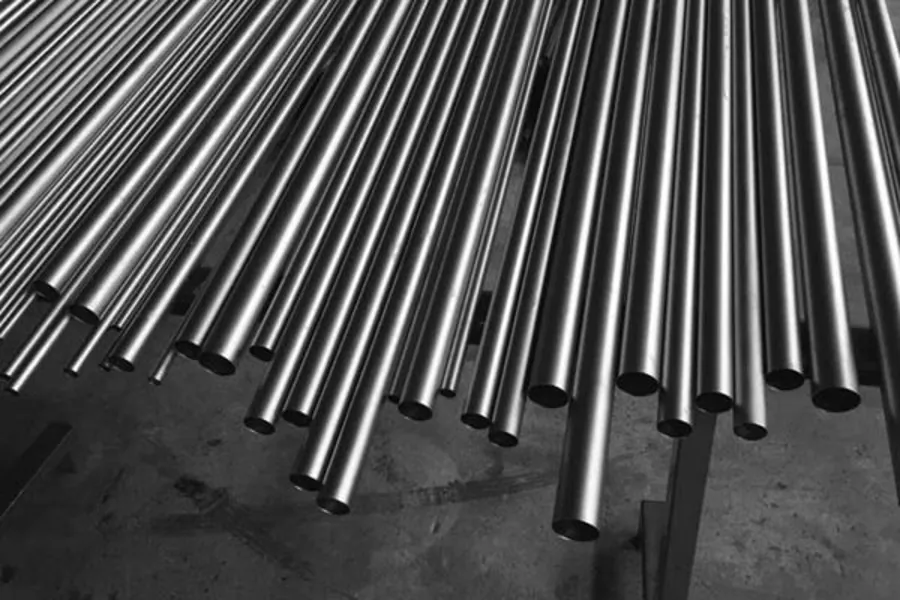
Electropolished tubing starts life as stainless steel or alloy instrumentation tubing, then gets an electrochemical finish that strips away a thin surface layer. That process lowers roughness (Ra), clears out micro-burrs, and thickens the chromium-oxide passive layer. What's left is a smooth, clean, corrosion-resistant bore built for high-purity and sanitary fluid systems. Crestflo supplies this tubing in 316L and corrosion-resistant alloys, electropolished to whatever ASME BPE surface designation you specify, and it conforms to ASTM A269. Heat-traceable, too. Every piece ships with an EN 10204 3.1 material test certificate.
A quick scope note: when we say electropolished tubing, we mean low-Ra stainless and alloy fluid-system tubing built for instrumentation, high-purity, and sanitary service. We're not talking about ornamental railing tube or electrical conduit.
Also Known As: EP Tubing, UHP Tubing, High-Purity & BPE Tubing
Specifiers know this product by a long list of names. Most call it EP tubing, electropolished stainless steel tubing (often shortened to electropolished SS tubing), or electro-polished tube. Others specify it by grade: electropolished 316L tubing or electropolished 304L tubing. Still others reach for a purity class instead: high-purity (HP) tubing, ultra-high-purity (UHP) tubing, or semiconductor-grade tubing. Sanitary and bioprocess engineers use a different vocabulary altogether, calling it BPE tubing, sanitary stainless tubing, low-Ra tubing, or mirror-finish tubing. Whatever the label, the product underneath doesn't change: instrumentation tubing with an electropolished, low-roughness interior.
Electropolished Tubing Surface Finish & Ra (ASME BPE SF4, SF5, SF6)
Surface finish defines EP tubing above all else. Engineers measure it as arithmetic mean roughness, Ra, expressed in microinches (µin) or micrometers (µm). ASME BPE sets out standard surface designations for hygienic tubing, and the electropolished classes below list their published maximum Ra values.
| Surface designation | Process | Ra max (µin) | Ra max (µm) |
|---|---|---|---|
| SF1 | Mechanically polished | 20 | 0.51 |
| SF2 | Mechanically polished | 15 | 0.38 |
| SF3 | Mechanically polished | 10 | 0.25 |
| SF4 | Electropolished | 20 | 0.51 |
| SF5 | Electropolished | 15 | 0.38 |
| SF6 | Electropolished | 10 | 0.25 |
These figures are the published maxima from ASME BPE, so note your target surface designation on the RFQ. Semiconductor and standard UHP systems usually need the smoothest electropolished class available. Electropolishing strips away embedded iron and the micro-peaks left by drawing or mechanical polishing. That's why an electropolished surface tends to run smoother and more passive than a bright-annealed (BA) or mechanically polished surface at the same nominal Ra. Passivation can follow the electropolishing step, and oxygen (O₂) cleaning to ASTM G93 / CGA G4.1 is available on request for oxygen and UHP service.
Electropolished vs Bright Annealed vs Mechanically Polished Tubing
| Attribute | Electropolished | Bright annealed | Mechanically polished |
|---|---|---|---|
| Surface mechanism | Electrochemical layer removal | Clean-atmosphere anneal | Abrasive polishing |
| Typical Ra | Low (to ≤10 µin, SF6) | Low–moderate | Moderate (embeds abrasive) |
| Passive layer | Enriched Cr-oxide | Reduced oxide | As-drawn |
| Cleanability | Highest | High | Moderate |
| Best use | UHP, semiconductor, BPE | HP gas, general clean | Cost-sensitive sanitary |
Electropolished Stainless Steel & Alloy Tubing Materials: 316L, 304L, 904L & CRA
316L (UNS S31603) is the standard alloy for electropolished UHP and BPE systems. Its low carbon content resists sensitization at welds, unlike standard 316, and it takes on a smooth, consistently passive electropolished surface. For more aggressive or halide-bearing high-purity media, move up to super-austenitic and nickel corrosion-resistant alloys.
| Alloy | UNS | Common EP / UHP use | Grade data |
|---|---|---|---|
| 316 / 316L | S31600 / S31603 | Standard UHP, semiconductor, BPE | 316 / 316L |
| 304 / 304L | S30400 / S30403 | General high-purity, clean gas | 304 / 304L |
| 904L | N08904 | Chloride / acid high-purity | 904L |
| 254 SMO (6Mo) | S31254 | Halide-bearing UHP media | 254 SMO |
| Alloy 20 | N08020 | Sulfuric-acid service | Alloy 20 |
You'll find higher nickel alloys like Inconel and Hastelloy, used for corrosive service, on the exotic-alloy tubing page. Each grade page walks through composition and properties. Crestflo doesn't sell these alloys as mill forms; it supplies them as instrumentation tubing and fittings.
Seamless vs Welded Electropolished Tubing
Both seamless and welded-and-drawn constructions can be electropolished. Seamless EP tubing is often specified for the highest-purity and higher-pressure work where a homogeneous wall is required. Welded-and-drawn tubing offers cost advantage and long continuous lengths, with the weld cold-worked and annealed before electropolishing. Choose per your purity, pressure, and length requirements.
Electropolished Tubing Sizes: OD (1/16″–2″ & 3–50 mm), Wall & Coil Form
Electropolished tubing comes in the full instrumentation range, covering both imperial and metric outside diameters. It spans from 1/16″ up to 2″ OD, and from 3 mm to 50 mm, available as straight lengths or continuous coils. Common sizes like 1/4″, 1/2″ and 6 mm are standard. The figures below reflect published instrument-tube dimensions per ASTM A269, though they're customizable to what's required.
| OD (in) | OD (mm) | Typical walls (in) | Form |
|---|---|---|---|
| 1/16″ | — | 0.010 / 0.014 | Straight / coil |
| 1/8″ | 3 mm | 0.028 | Straight / coil |
| 1/4″ | 6 mm | 0.028 / 0.035 | Straight / coil |
| 3/8″ | 8 / 10 mm | 0.035 / 0.049 | Straight / coil |
| 1/2″ | 12 mm | 0.035 / 0.049 / 0.065 | Straight / coil |
| 3/4″ | 18 / 20 mm | 0.049 / 0.065 | Straight / coil |
| 1″ | 25 mm | 0.065 / 0.083 | Straight / coil |
| 1-1/2″ | 38 mm | 0.083 / 0.109 | Straight |
| 2″ | 50 mm | 0.109 / 0.134 | Straight |
Wall thickness and working pressure depend on OD × wall and alloy, following the applicable tube-pressure standard (ASTM A269 / ASME B31.3 basis). Values follow the applicable standard and are customizable to your requirement. Want the full OD, wall, and working-pressure matrix? Check Crestflo's tubing OD & wall size chart. Continuous electropolished coil lengths are also available through electropolished coiled tubing, with coil length confirmed on request.
Standards & Conformance: ASTM A269, ASTM A213 & ASME BPE
| Standard | Scope | Application to EP tubing |
|---|---|---|
| ASTM A269 | Seamless & welded austenitic SS tubing, general service | Base tube specification |
| ASTM A213 | Seamless ferritic/austenitic tube | Seamless option |
| ASME BPE | Bioprocessing equipment surface finish (SF designations) | Electropolished surface class |
| EN 10204 3.1 | Material test certificate | Heat-traceable documentation |
We manufacture tubing to ASTM A269, and to ASTM A213 for seamless runs. It's electropolished to whichever ASME BPE surface designation you specify, then shipped with heat and lot-number marking plus an EN 10204 3.1 MTC. A 3.2 is available on request. PMI confirms the grade. Oxygen cleaning follows ASTM G93, the standard Crestflo cites for the process.
Applications: Semiconductor, Pharma, Analytical, Hydrogen & Instrument Gas
Electropolished tubing belongs in systems that demand surface cleanliness and minimal particle shedding:
- Semiconductor, UHP process-gas and specialty-gas delivery.
- Pharmaceutical & biotech, sanitary and BPE-grade fluid systems built for Crestflo's clients in the sector.
- Analytical & sampling systems, sample transport lines with low adsorption.
- Hydrogen, high-purity H₂ handling.
Instrument air, gas, and data centers (instrument-air, data-centers), Crestflo keeps instrument and cooling loops clean.
Testing, QA & Traceability
Each length carries heat and lot-number marking, along with an EN 10204 3.1 material test certificate; a 3.2 version is available if you need it. Quality checks cover hydrostatic and pneumatic testing to the applicable specification, PMI, non-destructive testing done in-house, and destructive testing carried out at ISO/IEC 17025-accredited laboratories. Third-party inspection can be arranged on request. Want surface-finish or borescope verification against your specified Ra target? That's available too, just ask. Datasheets and CAD files are there for customers who request them.
Why Crestflo for Electropolished Tubing
Crestflo makes and supplies electropolished tubing, and it's the instrumentation arm of an export house that's been recognized by the Government of India for four decades, with a proven record of delivery across the Middle East. That engineering depth now backs a dedicated instrumentation line built for the US market. EP tubing is engineered as a drop-in fit for US systems: standard items ship from ready stock, specials are made to order, and delivery runs 6-8 weeks. The material is of Indian origin, though US or European melt is available on request, and every batch carries full traceability. Buyers can order small quantities, request private-label runs, or work from their own prints, in either imperial or metric sizes. Crestflo holds ISO 9001, 14001, and 45001 certification, along with PED. We Engineer Confidence.
Talk to our engineering team to specify alloy, construction, OD × wall, surface designation, and cleanliness, then request a quote: sales@crestflousa.com · +1 346 594 9005 (Houston, TX). If you are moving from a Swagelok®, Parker®, or other-brand line, request your cross-reference from our engineers.
Electropolished Tubing FAQ
What metals can be electropolished?
Austenitic stainless steels like 304/304L, 316/316L, and 904L electropolish well, and so do many nickel and corrosion-resistant alloys. For UHP and BPE tubing, 316L is the standard pick. Its low carbon content and stable chromium-oxide passive layer give you a consistently smooth, clean electropolished surface. Crestflo electropolishes stainless and high-nickel/CRA tube.
Is electropolishing better than passivation?
Each process serves a different purpose. Passivation works chemically, restoring and strengthening the chromium-oxide passive layer while leaving roughness untouched. Electropolishing goes further. It strips away a thin surface layer, lowers Ra, removes micro-burrs, and enriches the passive layer, so cleanability and corrosion resistance both improve. The result is typically a smoother, more passive surface, one passivation can still follow. Which process you specify isn't decided by some blanket claim that one is "better" than the other; it comes down to the system's actual requirements.
What chemical is used for electropolishing?
Stainless electropolishing relies on an acidic electrolyte bath, usually built around phosphoric and sulfuric acid, paired with an applied current that dissolves the surface's high points first. The exact chemistry varies by process and stays proprietary to whoever's doing the finishing.
What Ra surface finish do you offer on electropolished tubing?
Electropolished tube is finished to the ASME BPE surface designations: SF4 (≤20 µin), SF5 (≤15 µin), and SF6 (≤10 µin Ra max). These are the published standard maxima, not a starting point for negotiation. Spell out your target surface designation on the RFQ, and we'll finish and verify to it. Customizing to your requirement is standard practice here.
Which alloy should I choose for EP tubing?
If you're speccing standard UHP, semiconductor, or sanitary service, 316L is the choice. When halides or acids are in the mix and purity is non-negotiable, step up to 904L, 254 SMO (6Mo), or a nickel alloy. Composition and property data live on the 316 / 316L grade page.
Does your electropolished tubing meet ASTM A269 and ASME BPE?
Yes. We manufacture tubing to ASTM A269, or ASTM A213 when seamless construction is required, then electropolish it to whatever ASME BPE surface designation you specify. Each length gets heat/lot-number marking. It also ships with an EN 10204 3.1 material test certificate, and we'll provide 3.2 on request.
What is the strongest metal tubing?
Instrumentation service calls for higher-strength options too, and that's where cold-worked stainless and nickel alloys like Inconel 718 come in. What counts as strongest really depends on your pressure, temperature, and corrosion conditions. 316L is the go-to choice for electropolished UHP service, since it strikes a good balance between strength, weldability, and cleanability. You'll find the comparative mechanical data on each grade's individual page.
Can you supply electropolished coiled tubing?
Yes, electropolished tube comes in both continuous coil and straight lengths. Maximum continuous coil length gets confirmed on request. See electropolished coiled tubing.
Where is your electropolished tubing made and how fast can I get it?
Crestflo serves the US market, using material of Indian origin, with US and European melt available on request. Standard items ship from ready stock. Specials are made to order and take 6 to 8 weeks. Small MOQs are available, and private-label options too.
Can electropolished tubing be oxygen (O₂) cleaned?
Oxygen cleaning to ASTM G93 / CGA G4.1 is available on request for oxygen and UHP service, alongside passivation. Just specify the cleanliness standard on your RFQ.
Related Tubing, Materials & Standards
- All stainless & alloy tubing, back to the tubing hub
- Instrumentation tubing, base annealed spec
- Seamless tubing and welded tubing
- Tubing size chart, OD, wall & pressure
- ASTM A269 · ASME BPE · EN 10204 MTC