
254 SMO Tubing (UNS S31254)
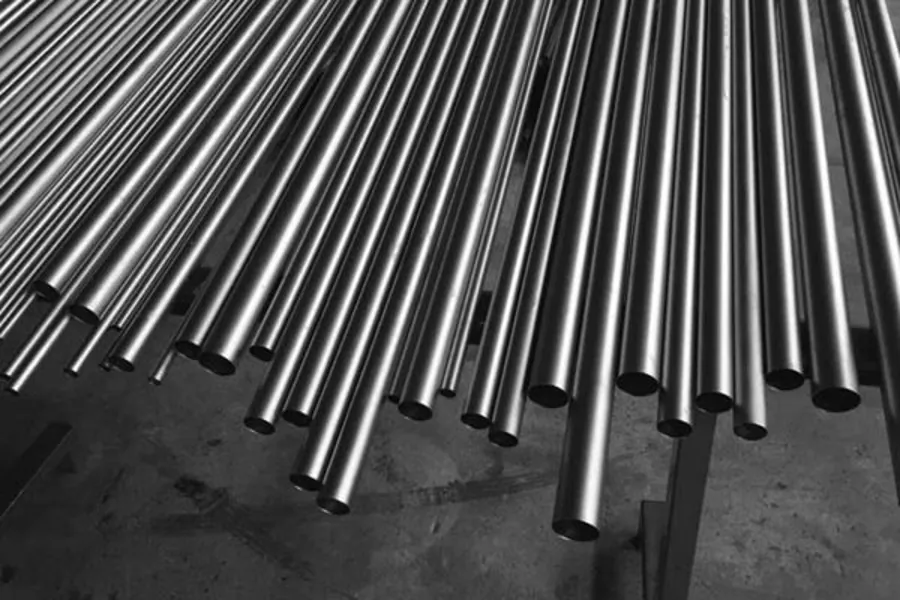
254 SMO tubing is OD-sized, round instrumentation tube drawn from super-austenitic stainless 254 SMO (UNS S31254, EN / W.Nr. 1.4547), a 6% molybdenum, nitrogen-alloyed grade running roughly 20Cr-18Ni-6Mo with about 0.2% nitrogen and a small copper addition. It carries process fluid or gas between components and seats into a compression fitting's ferrule set to make a leak-tight, make-and-break joint. Crestflo supplies 254 SMO tube seamless to ASTM A213 / A269 and welded to ASTM A249, in both imperial and metric sizes, shipped solution-annealed so it bends and cones cleanly into a ferrule. You reach for 254 SMO tube when a line runs seawater, brine, or high chloride, the service where 316 pits and cracks and even 904L is reaching its limit, because with a PREN around 43 this is a genuine seawater-grade alloy, and it stays fully austenitic and non-magnetic doing it. Standard items ship from stock; specials are built to order, with delivery running 6-8 weeks. Request a quote to price your run.
254 SMO® is a registered trademark of Outokumpu OYJ. Swagelok® and Parker® are trademarks of their respective owners; Crestflo is not affiliated, and interchange is dimensional.
Why Specify 254 SMO Tubing
Tube is the long, continuous wetted surface of an instrument hookup. Unlike a fitting or a valve, it has no dead legs or packing bores, but it has length, every inch of it exposed to the media, and it has to survive the cold work of bending and ferrule make-up without cracking. On a seawater or high-chloride line that rules out most stainless. A tube that pits or stress-corrosion cracks midway along a run is as dead as one that fails at the fitting, and in raw chloride service standard 316 does exactly that.
254 SMO is a super-austenitic stainless carrying about 6% molybdenum, roughly three times the molybdenum of 316L, paired with a deliberate nitrogen addition and a touch of copper. That chemistry is tuned for one problem above all others: chlorides. The molybdenum and nitrogen together drive pitting and crevice resistance, taking the grade's PREN to about 43, well clear of roughly 24 for 316L and about 34 for 904L, and that number tracks a high critical pitting temperature, so the alloy resists localized chloride attack at temperatures where the lower-moly grades fail. Its high nickel content and fully austenitic structure underwrite strong resistance to chloride stress-corrosion cracking, the failure mode that most often retires 304 and 316 in warm chloride service. The copper addition lends useful resistance in reducing acids such as sulfuric. One of the lowest carbon limits of any austenitic grade (0.020% max) keeps that corrosion resistance intact in the weld and heat-affected zone of a welded tube, rather than letting the weld become the first thing to attack.
Be precise about where 254 SMO sits, because it is easy to mis-position. It is a fully austenitic stainless, not a duplex and not a nickel-base alloy. Its 0.2% yield strength, around 300 MPa (44 ksi) in the solution-annealed condition, runs nearly double that of 316, a direct result of the nitrogen, but it is still an austenitic grade and not a super-duplex. So note the strength, but do not claim a duplex-style thinner-wall advantage from it: the case for 254 SMO tube is chloride corrosion resistance, not pressure-per-wall. Being fully austenitic buys two real things. It is essentially non-magnetic in the annealed condition, which is itself a reason to specify it where magnetic permeability matters, and it keeps its toughness down to cryogenic temperatures with no ductile-to-brittle transition, so it is not ruled out of cold duty. This is a corrosion grade, not a high-temperature creep grade.
What makes 254 SMO the tube to specify is that it delivers true seawater-grade chloride performance, pitting, crevice, and chloride-SCC resistance, at a cost that usually lands below the nickel alloys and titanium that would otherwise be needed in that service. It is the step past 316 and 904L, not a marginal improvement on them.
The full metallurgical picture, composition ranges, mechanical and physical properties, PREN, CPT, and corrosion-by-media data, lives on the 254 SMO alloy grade page. This page stays on the tube: how it's made, sized, finished, tested, and matched to the fitting.
Also Specified As: 254 SMO Seamless Tubing, UNS S31254 Tube, 6Mo Instrumentation Tubing
Buyers and specifiers call this tube several ways, and each one points to the same 6% molybdenum super-austenitic. A requisition might read "254 SMO seamless tubing," "SMO 254 tube," "Alloy 254 tube," "UNS S31254 tube," "S31254 instrument tube," "1.4547 tube," or "6Mo tubing," and every one of them lands here. 254 SMO, 254SMO, SMO 254, Alloy 254, 6Mo, and 6-moly stainless are the common forms; the material is registered as UNS S31254 and EN / Werkstoff 1.4547, with ASTM forging grade F44 (A182 F44). The welded form is often written "welded-and-drawn tube," the seamless form "cold-drawn seamless tube." UNS S31254 is the US number and 1.4547 is the European one; they describe one and the same alloy, and a tube labeled "254 SMO" is routinely certified to both at once.
Scope: this is round, OD-sized instrumentation and fluid-system tube for compression and tube-fitting connections. It is not oilfield coiled tubing for downhole well intervention, not structural or ornamental tube, and not pipe specified by nominal pipe size (NPS) and schedule. One caution on naming: 254 SMO is not 253 MA, a heat-resistant austenitic grade for high-temperature service, a different alloy for a different job. Crestflo supplies 254 SMO in instrumentation tube, fitting, and valve forms only, not mill bar, sheet, plate, or pipe.
Seamless vs Welded 254 SMO Tubing
Both constructions are built to their own high-alloy stainless tube specification, and both accept a compression fitting the same way. Seamless 254 SMO tube is cold-drawn from a hollow with no longitudinal weld, which makes it the default where you want maximum integrity for higher-pressure, cyclic, or critical service. Welded-and-drawn 254 SMO tube is formed from strip, seam-welded, then cold-drawn to size; it is dimensionally consistent and cost-effective for general instrument and fluid-system work. The grade's very low carbon limit is what keeps corrosion resistance intact in the weld and the heat-affected zone, so welded 254 SMO holds up in chloride service that would attack a leaner austenitic at the seam. Because 254 SMO is fully austenitic rather than duplex, there is no ferrite-balance check to run on the weld, which is one fewer acceptance step than a 2205 or super-duplex 2507 tube carries.
| Attribute | Seamless 254 SMO tube | Welded-and-drawn 254 SMO tube |
|---|---|---|
| Product-form standard | ASTM A213 / A269 (ASME SA-213 / SA-269) | ASTM A249 / A269 (ASME SA-249 / SA-269) |
| Method | Cold-drawn from a hollow, no seam | Strip formed, seam-welded, cold-drawn |
| Typical use | Higher-pressure, cyclic, and critical service | General instrument and fluid-system service |
| Condition | Solution-annealed | Solution-annealed |
Not sure which construction to call out? The deep dives on seamless tubing and welded tubing walk through the trade-off before you commit a spec.
254 SMO Tube Attributes at a Glance
| Attribute | Value (per applicable standard; customizable to requirement) |
|---|---|
| Alloy | 254 SMO / Alloy 254 (UNS S31254, EN / W.Nr. 1.4547, ASTM F44) |
| Family | 6% molybdenum, nitrogen-alloyed super-austenitic stainless (~20Cr-18Ni-6Mo-0.2N-Cu) |
| Construction | Seamless (ASTM A213 / A269) and welded (ASTM A249 / A269) |
| Common OD | 1/8″, 1/4″, 3/8″, 1/2″, 5/8″, 3/4″, 1″ and 6, 8, 10, 12 mm; 1/16″ small-bore and larger to 2″ (50 mm) to order |
| Common wall | 0.028″–0.083″ for instrument service, to the OD and wall tolerances of ASTM A213 / A269 / A249 |
| Units | Imperial and metric |
| Condition / temper | Solution-annealed for bending and ferrule seating; fully austenitic, so no ferrite-balance check |
| Strength (annealed, typical min) | Tensile ≥ 650 MPa (94 ksi); 0.2% yield ≥ 300 MPa (44 ksi); elongation ≥ 35%; hardness ≤ ~96 HRB |
| Magnetic response | Austenitic; essentially non-magnetic in the annealed condition |
| PREN (Cr + 3.3×Mo + 16×N) | ≈ 43–45 |
| Corrosion position | Seawater-grade chloride resistance; above 316 (~24 PREN) and 904L (~34); toughness retained to cryogenic temperatures |
| Form | Straight lengths; continuous coils for tracing and long runs |
| Finish | Bright-annealed / pickled; passivation; electropolish (EP); oxygen/UHP cleaning on request |
| Working pressure | A function of OD × wall × allowable stress per ASME B31.3, stated per size, no blanket rating |
| Testing | Hydrostatic or nondestructive (eddy-current) electric test per spec; PMI; dimensional |
| Traceability | Heat/lot number on every part; EN 10204 MTC 3.1 standard, 3.2 on request; PMI |
| Origin | Indian origin; US / European melt available on request, with full traceability |
254 SMO Tube Sizes: OD, Wall & Imperial/Metric
Instrument tube is specified by its actual outside diameter and wall thickness, given in both imperial and metric units, never by NPS and schedule. The common instrument range runs fractional 1/8″ to 1″ and metric 6 to 12 mm; smaller 1/16″ small-bore tube and larger diameters up to 2″ (50 mm) are available to order. Wall thickness is chosen to carry the pressure and to suit the ferrule, and both OD and wall are held to the tolerances of ASTM A213 / A269 (seamless) or A249 (welded). The higher yield of 254 SMO is real, but it is still an austenitic grade, so for tube sizing treat it like one: size the wall to the same pressure math you would run for any austenitic stainless rather than claiming a duplex-style thinner-wall credit. Working pressure is not a single blanket figure: it is calculated from OD, wall thickness, and the alloy's allowable stress per ASME B31.3, so it is stated per size and wall rather than as one rating for the grade.
| Imperial OD | Nearest metric OD | Common walls |
|---|---|---|
| 1/8″ | 3 mm | 0.028″, 0.035″ |
| 1/4″ | 6 mm | 0.028″, 0.035″, 0.049″ |
| 3/8″ | 10 mm | 0.035″, 0.049″, 0.065″ |
| 1/2″ | 12 mm | 0.035″, 0.049″, 0.065″, 0.083″ |
| 3/4″ | 18 mm | 0.049″, 0.065″, 0.083″ |
| 1″ | 25 mm | 0.065″, 0.083″ |
Values per applicable standard; customizable to requirement. For how to work back from a target pressure to a wall thickness, see the tube sizing and wall thickness guide, and for the full dimensional matrix across the range, the tubing size chart.
Temper & Hardness: Solution-Annealed for Bending and Ferrule Seating
The single most important mechanical property of instrument tube is not its peak strength but its workability. 254 SMO is a solid-solution super-austenitic that does not age-harden, so it comes in one working condition, solution-annealed, and that condition is what lets the tube bend around a radius and cone down under a ferrule without cracking, so the joint seats and seals the way a compression fitting is designed to. In the solution-annealed condition 254 SMO carries a tensile minimum around 94 ksi (650 MPa) with a 0.2% yield near 44 ksi (300 MPa) and elongation above 35%, with hardness in the annealed band (typically ≤ ~96 HRB). That yield is nearly double 316's, but it is the ductility, not the strength, that matters for making up the joint. Being fully austenitic, 254 SMO has no ferrite phase to balance and no ductile-to-brittle transition, so the same temper that makes it workable also keeps it tough from cryogenic temperatures up through its corrosion service range. The anneal matters for one more reason on a 6-moly: after heavy cold or hot work, the solution anneal is what restores corrosion resistance to its best level. Specify the hardness or condition to your own standard on the RFQ and it is confirmed on the certificate.
Finishes & Cleanliness: Bright-Anneal, Electropolish & Oxygen-Clean
254 SMO tube ships in a bright-annealed or pickled finish as standard. For high-purity gas, analytical, and oxygen service, passivation, electropolishing (EP), and oxygen/UHP cleaning with capped-and-bagged packaging are available. Electropolishing lowers surface roughness and smooths the inner diameter, which matters where particle generation, moisture dry-down, or deposit build-up is the concern. Standard UHP electropolish surface-roughness targets can be specified right on the RFQ to your own standard; electropolished tubing and oxygen and UHP cleaning cover the options in detail. Finish and cleanliness figures follow the applicable standard and are customizable to requirement.
254 SMO Tube Standards: ASTM A213, A269, A249 & ASME B31.3
254 SMO tube is covered by the high-alloy stainless tube specifications, and the construction decides which applies: seamless falls under ASTM A213 and A269, welded under ASTM A249 and A269, each with its matching ASME boiler-code SA- designation. These are the same product-form specs the 254 SMO grade page lists for the alloy. Allowable working pressure for a given size and wall is calculated per ASME B31.3. Where sour service applies, the material can be supplied to NACE MR0175 / ISO 15156 as the application qualifies. Crestflo holds the standard approvals that apply to instrumentation tube and is ISO 9001 / 14001 / 45001 and PED certified.
| Standard | Scope | Applies here |
|---|---|---|
| ASTM A213 / ASME SA-213 | Seamless ferritic/austenitic alloy-steel tube | Seamless 254 SMO tube |
| ASTM A269 / ASME SA-269 | Seamless & welded austenitic SS tube, general service | Seamless & welded 254 SMO tube |
| ASTM A249 / ASME SA-249 | Welded austenitic alloy-steel tube | Welded 254 SMO tube |
| ASME B31.3 | Process-piping allowable pressure | Wall / working-pressure calculation |
| NACE MR0175 / ISO 15156 | Sour-service material requirements | Sour service, where the application qualifies |
| EN 10204 MTC 3.1 / 3.2 | Material test certification | Every order |
| ISO 9001 / 14001 / 45001 & PED | Quality, environmental, safety, pressure | Certified |
The full family of 254 SMO product-form specifications, including bar (A276 / A479), forgings and fittings (A182 F44), and plate (A240), is set out on the 254 SMO grade page; for tube, A213, A269, and A249 are the three that apply.
Working Pressure: Calculated per ASME B31.3, Not Assumed
There is no single pressure rating for "254 SMO tube," and any supplier who quotes one is skipping the engineering. Allowable internal pressure depends on three things: the tube OD, its wall thickness, and the alloy's allowable stress at the service temperature. ASME B31.3 sets the method, relating wall thickness to pressure, diameter, the allowable stress value S, the weld-joint quality factor E, and the coefficient Y. Seamless tube carries a higher joint factor than welded, which is part of why seamless is chosen for higher-pressure work. 254 SMO's nitrogen gives it a higher allowable stress than a standard austenitic, which is a genuine advantage, but it is a corrosion grade first: do not treat it as a super-duplex, and derate it with temperature the way an austenitic derates. The thin-wall instrument sizes carry ample pressure for analyzer, sample, injection, and hydraulic-control duty. Give us the OD, wall, temperature, and medium on the RFQ and the engineering team returns the calculated working pressure for your configuration. Values per the applicable standard; customizable to requirement.
Testing, NDT & Material Verification
Every length of 254 SMO tube is verified before it ships. ASTM A213, A269, and A249 require each tube to pass either a hydrostatic test or a nondestructive (eddy-current) electric test, and dimensional checks confirm OD, wall, and straightness against the ordered tolerances. Positive material identification (PMI) confirms the alloy on the material, which matters more on a 6-moly super-austenitic than on almost any other instrument tube: the molybdenum, nitrogen, and nickel content is exactly what buys the chloride performance, and an under-alloyed tube supplied as 316 or a leaner grade looks identical but pits in service. On a long seawater run that is an expensive thing to discover in commissioning, so the grade is verified, not assumed. NDT is done in-house; destructive testing, where a job calls for it, goes to ISO/IEC 17025-accredited labs, and third-party inspection is available on request.
For sour service, 254 SMO tube material can be supplied to NACE MR0175 / ISO 15156 where the application qualifies. Confirm the hardness and material-condition limits in the standard against your application, H₂S partial pressure, temperature, and chloride content, and note the sour-service requirement on the RFQ.
| Check | What it proves | Basis |
|---|---|---|
| Hydrostatic or eddy-current test | Pressure integrity / freedom from defects | ASTM A213 / A269 / A249 |
| Dimensional inspection | OD, wall, length, straightness to tolerance | ASTM A213 / A269 / A249 |
| PMI | Alloy is genuinely S31254 (6Mo), not an under-alloyed substitute | Every part |
| Material certification | Heat chemistry & mechanicals | EN 10204 MTC 3.1 / 3.2 |
Straight Lengths & Coiled 254 SMO Tube
254 SMO tube ships as straight lengths for racked and rigidly supported runs, and as continuous coils for heat-tracing, long analyzer and sample lines, and chemical-injection and hydraulic bundles where a joint-free run is the whole point. Coiled tube keeps the count of mechanical joints down, which on a seawater, brine, or chloride line is one fewer place to leak, and 254 SMO's chloride and chloride-SCC resistance makes it a natural choice for the subsea umbilical cores, sample lines, and injection runs that live in raw seawater. Both forms are supplied solution-annealed; call out length or coil length on the RFQ. For long-run and tracing applications, see coiled tubing; for thicker-wall high-pressure control lines, hydraulic tubing.
Material Traceability & Certification
Every length of 254 SMO tube carries its own heat/lot number, and each order ships with an EN 10204 MTC 3.1 certificate as standard, 3.2 available on request. PMI confirms the grade at the part level, every time. That documentation backs the audit trails that offshore, desalination, chemical, and sour-service jobs demand, the kind of work where a mis-specified or under-alloyed tube in a long run is not a small problem. On a 6-moly specifically, under-alloying is the governing risk, so the heat number, the certificate, and the PMI result together are how a seawater-grade tube is never taken on trust. Full detail is on the traceability page.
Applications for 254 SMO Tubing
254 SMO tube earns its place wherever chlorides outrun what 316 or even 904L can handle, the seawater-grade duty where pitting, crevice attack, and chloride-SCC are the governing failure modes:
- Offshore and subsea instrument hook-ups, platform and subsea instrument lines, hydraulic control lines, and chemical-injection cores exposed to seawater, sea spray, and chloride-bearing produced fluids. See offshore and seawater service.
- Desalination and seawater cooling, SWRO, MSF, and MED plant instrumentation and seawater cooling-water lines, where raw chloride service defeats standard stainless.
- Chloride brine and coastal/marine processing, brine-handling, coastal plant, and marine instrument lines where the ambient chloride environment alone is corrosive.
- Flue-gas desulfurization (FGD) and pollution control, scrubber and absorber instrument lines in wet, chloride-laden acidic condensate.
- Pulp and paper bleaching, chlorine-dioxide and bleach-plant process instrument lines, among the most aggressive chloride environments in process industry.
- Non-magnetic and cryogenic requirements, lines where low magnetic permeability or low-temperature toughness governs, both of which the fully austenitic structure provides.
Where the service steps past 254 SMO, or across to a different alloy family, see the next section.
Where 254 SMO Fits: Super-Duplex 2507, AL-6XN, 904L & Nickel Alloys
254 SMO sits near the top of the stainless range, a clear step above 316 and 904L, but it is not the only answer in high-chloride service, so matching it to the duty matters. Where the chloride resistance has to come with far higher strength, thin-wall, high-pressure runs where yield governs, super-duplex 2507 matches 254 SMO on PREN but roughly doubles the yield, at the cost of being ferromagnetic; it is the better pick when strength-per-wall is the driver. Where the chloride load is even harsher, AL-6XN (UNS N08367) is the near-twin 6-moly super-austenitic, running slightly higher molybdenum and nitrogen (PREN ~45-47), and is the close alternative for the most aggressive chloride duty with the same non-magnetic austenitic behavior. Where the stream turns to wet chlorine or hot contaminated acid, a nickel alloy such as Hastelloy C-276 steps up. And where the duty is lighter, reducing acids or chloride beyond 316 but short of seawater-grade, step down to 904L rather than pay for a 6-moly. For the head-to-head that drives most 254 SMO decisions, see 254 SMO vs super-duplex vs AL-6XN. Match the alloy to the media and don't over-specify.
Pairing 254 SMO Tube With 254 SMO Fittings and Valves
A tube is one part of the hookup, and the joint is only as corrosion-resistant as its weakest metal. For a matched instrument run, pair this tube with 254 SMO tube fittings and 254 SMO instrumentation valves so the whole assembly, tube, ferrules, and valve body, carries the same seawater-grade resistance and the same traceability. Crestflo supplies the tube alongside compression fittings tested to ASTM F1387, so the ferrule set seats correctly on the exact OD and wall you ordered, and the joint is a dimensional match rather than a mix of two suppliers' tolerances. Putting a 254 SMO tube into a 316 fitting just moves the failure point to the ferrule, which on a seawater line is the opposite of what the alloy upgrade was for. Because 254 SMO is a tough, high-nickel super-austenitic that work-hardens and can gall, anti-galling measures such as silver plating on the ferrule are offered on request where repeated make-up or high torque is expected.
Drop-In Interchange and the Tube-Plus-Fitting System
Crestflo 254 SMO tube is cut and finished to standard OD and wall, so it drops into the compression fittings you already run, and the matching 254 SMO fittings are built as dimensional interchange / equivalent parts for the major brands, with the fitting ends qualified to ASTM F1387. These are not "compatible" or "intermix" parts. Swagelok® and Parker® remain trademarks of their respective owners, and Crestflo is not affiliated; the interchange is strictly dimensional. Moving a run off a major brand? Request your Swagelok®/Parker® cross-reference and the engineering team maps your tube and fitting part numbers to Crestflo 254 SMO equivalents. We don't publish a part-number table.
Origin & US-Serving Positioning
Crestflo manufactures for the US market. Standard product is of Indian origin; US or European melt is available on request, with full material traceability. Tube is engineered as a US drop-in and ships in 6-8 weeks, well under the 20+ weeks typical of the majors. If a project calls for a specific melt origin or TAA/DFARS handling, specify it on the RFQ and we'll address it straight, no hedging. See the US-origin compliance page for how we document it.
Why Crestflo for 254 SMO Tubing
Crestflo operates as the instrumentation division of an export house with four decades behind it and formal recognition from the Government of India, with a proven Middle-East delivery record. That backing grounds a focused instrumentation brand built on a handful of clear advantages:
- Lead time of 6-8 weeks versus 20+ weeks typical of the majors, on standard stock and made-to-order specials alike.
- A matched system, tube plus F1387-tested fittings and ferrules that seat on the exact OD and wall you ordered.
- Both seamless and welded 254 SMO tube, in both imperial and metric, straight or coiled.
- Heat-number marking plus MTC 3.1/3.2 on every order, PMI-confirmed, so a 6-moly super-austenitic is never taken on trust, the specific guard against under-alloying.
- NACE MR0175 / ISO 15156 material options where the sour-service application qualifies.
- ISO 9001 / 14001 / 45001 & PED certified, cost-competitive after US duties and tariffs, with small MOQs and private-label available.
We Engineer Confidence.
Request a Quote for 254 SMO Tubing
Give us the details: seamless or welded, OD and wall, straight length or coil, finish and cleanliness, and the line conditions (media, pressure, temperature, sour-service requirement). We'll calculate the working pressure, confirm the spec, and schedule the run.
- Request a quote, the fastest path to pricing and lead time.
- Request a sample for qualification.
- Request your Swagelok®/Parker® cross-reference and we'll map your tube and fitting part numbers.
Datasheets and CAD are available to customers on request. Reach Crestflo's US sales desk at sales@crestflousa.com or +1 346 594 9005 (Houston, TX). Round out the system with 254 SMO tube fittings and 254 SMO valves, browse the tubing pillar for other grades and constructions, and see where this tube serves in offshore and seawater service.
Frequently Asked Questions
What is 254 SMO tubing?
It's OD-sized, round instrumentation and fluid-system tube drawn from super-austenitic stainless 254 SMO (UNS S31254, EN / W.Nr. 1.4547), a 6% molybdenum, nitrogen-alloyed grade running roughly 20Cr-18Ni-6Mo with a small copper addition. Crestflo supplies it seamless to ASTM A213 / A269 and welded to ASTM A249, solution-annealed so it bends and seats into a compression fitting. It's specified for seawater, brine, and high-chloride service, where 316 pits and cracks and even 904L is reaching its limit, because with a PREN around 43 it is a genuine seawater-grade alloy.
Is 254 SMO tubing magnetic?
No. 254 SMO is fully austenitic and essentially non-magnetic in the annealed condition, unlike a super-duplex such as 2507, which is ferromagnetic. That makes 254 SMO tube a sensible pick where low magnetic permeability matters as well as chloride resistance. Heavy cold work can induce a trace of magnetism, as with any austenitic stainless, but the tube as supplied is non-magnetic.
Is Crestflo 254 SMO tubing seamless or welded?
Both. Seamless 254 SMO tube is cold-drawn with no weld seam to ASTM A213 / A269 and is the default for higher-pressure, cyclic, or critical service. Welded-and-drawn tube is formed from strip, seam-welded, and cold-drawn to ASTM A249, and is cost-effective for general instrument work. The grade's very low carbon limit keeps corrosion resistance intact through the weld, and because 254 SMO is fully austenitic there is no ferrite-balance check to run. Both take a compression fitting the same way.
What standards does 254 SMO instrumentation tubing meet?
Seamless tube follows ASTM A213 (ASME SA-213) and A269 (SA-269), and welded tube follows ASTM A249 (SA-249) and A269, the high-alloy stainless tube specifications. Allowable working pressure is calculated per ASME B31.3, sour-service material can be supplied to NACE MR0175 / ISO 15156 where the application qualifies, and material certification follows EN 10204 (3.1 standard, 3.2 on request). Crestflo manufactures under an ISO 9001 / 14001 / 45001 and PED certified system.
What sizes and wall thicknesses are available in 254 SMO tube?
The common instrument range runs fractional 1/8″ to 1″ and metric 6 to 12 mm, in walls from about 0.028″ to 0.083″, to the tolerances of ASTM A213 / A269 / A249. Smaller 1/16″ small-bore tube and larger diameters up to 2″ (50 mm) are available to order. OD and wall are specified in imperial or metric; values are per the applicable standard and customizable to requirement.
What is the working pressure of 254 SMO tubing?
There's no single rating. Allowable pressure is calculated from the tube OD, wall thickness, and the alloy's allowable stress at temperature per ASME B31.3, so it's stated per size and wall, not as one figure for the grade. 254 SMO's nitrogen gives it a higher allowable stress than a standard austenitic, a genuine advantage, but it is a corrosion grade and not a super-duplex, so don't expect duplex-level strength or a thinner-wall credit, and it derates with temperature as austenitics do. The thin-wall instrument sizes carry ample pressure for analyzer, sample, injection, and control duty. Give us the OD, wall, temperature, and medium and we return the calculated pressure.
How is 254 SMO tubing better than 316 or 904L for chlorides?
Its 6% molybdenum plus a nitrogen addition pushes PREN to about 43, well above 316L's ~24 and a clear step over 904L's ~34, so it resists chloride pitting and crevice corrosion at temperatures where those grades fail, and its high nickel resists chloride stress-corrosion cracking. That makes it a seawater-grade alloy, not a marginal improvement: offshore, desalination, brine, bleaching, and FGD service where 316 pits and cracks and 904L is at its limit. Its 0.2% yield is also nearly double 316's, though for tube the value is corrosion resistance, not strength.
Is the tube supplied annealed for bending and fitting make-up?
Yes. 254 SMO is a solid-solution super-austenitic that does not age-harden, so it ships in the solution-annealed condition, which gives it the ductility to bend around a radius and cone cleanly under a ferrule. Being fully austenitic, it has no ferrite phase to balance and no ductile-to-brittle transition, so it stays tough from cryogenic temperatures up through its corrosion service range. The anneal also restores corrosion resistance after heavy working. You can specify the condition or hardness to your own standard on the RFQ.
Is 254 SMO tubing suitable for sour (NACE MR0175) service?
254 SMO tube material can be supplied to NACE MR0175 / ISO 15156 where the sour (H₂S-containing) application qualifies. It is a stainless rather than a nickel-base CRA, so confirm the hardness and material-condition limits in the standard against your service envelope, H₂S partial pressure, temperature, and chloride content, before committing, and note the requirement on the RFQ. Crestflo supplies the material with full traceability.
What finishes and cleaning are available for 254 SMO tube?
254 SMO tube ships bright-annealed or pickled as standard. Passivation, electropolishing (EP), and oxygen/UHP cleaning with capped-and-bagged packaging are available for high-purity gas, analytical, and oxygen service. Electropolish surface-roughness targets can be specified on the RFQ to your own standard.
Can I get the tube and matching fittings from one source?
Yes. Crestflo supplies 254 SMO tube together with dimensionally matched compression tube fittings and ferrules tested to ASTM F1387, so the ferrule set seats correctly on the exact tube OD and wall you ordered. It's one drop-in system rather than a mix of two suppliers' tolerances, and the whole joint carries the same seawater-grade resistance. Putting a 254 SMO tube into a 316 fitting just moves the failure point to the ferrule. Anti-galling silver plating on the ferrule is available on request, since 254 SMO work-hardens and can gall.
Does 254 SMO tube come in straight lengths or coils?
Both. Straight lengths suit racked, rigidly supported runs; continuous coils suit heat-tracing, long analyzer and sample lines, and subsea umbilical and chemical-injection cores where a joint-free run reduces leak paths in seawater and brine. Both forms ship solution-annealed; specify length or coil length on the RFQ.
What testing and certification come with the tube?
Each tube passes a hydrostatic or nondestructive (eddy-current) electric test per ASTM A213 / A269 / A249, plus dimensional inspection of OD, wall, and straightness. PMI confirms the alloy, which matters on a 6-moly where an under-alloyed substitute looks identical but pits in service, and every length carries a heat/lot number with an EN 10204 MTC 3.1 certificate (3.2 on request). NDT is in-house; destructive testing goes to ISO/IEC 17025-accredited labs, and third-party inspection is available on request.
How does 254 SMO tube compare to super-duplex 2507 and AL-6XN?
254 SMO and super-duplex 2507 sit at about the same PREN (~43), so chloride pitting resistance is comparable, but 2507 is a ferromagnetic duplex with roughly double the yield strength, while 254 SMO is a non-magnetic austenitic that welds more forgivingly and stays tough at cryogenic temperatures. Pick 2507 for strength-per-wall, 254 SMO for austenitic behavior and weldability. AL-6XN (UNS N08367) is the sister 6-moly super-austenitic, running slightly higher molybdenum and nitrogen (PREN ~45-47), the close alternative for the harshest chloride duty.
Is Crestflo 254 SMO tubing made in the USA?
Crestflo manufactures for the US market. Standard product is of Indian origin, with US or European melt available on request and full material traceability. Tube is engineered for a US drop-in fit and ships in 6-8 weeks. Specify any TAA/DFARS or melt-origin requirement on the RFQ.
What is the lead time and minimum order for 254 SMO tube?
Standard items ship from ready stock; specials are made to order, with a 6-8 week US-serving delivery. Small minimum order quantities apply, and private-label and made-to-print runs are available.