
Instrumentation Fittings & Valves for Marine & Shipbuilding
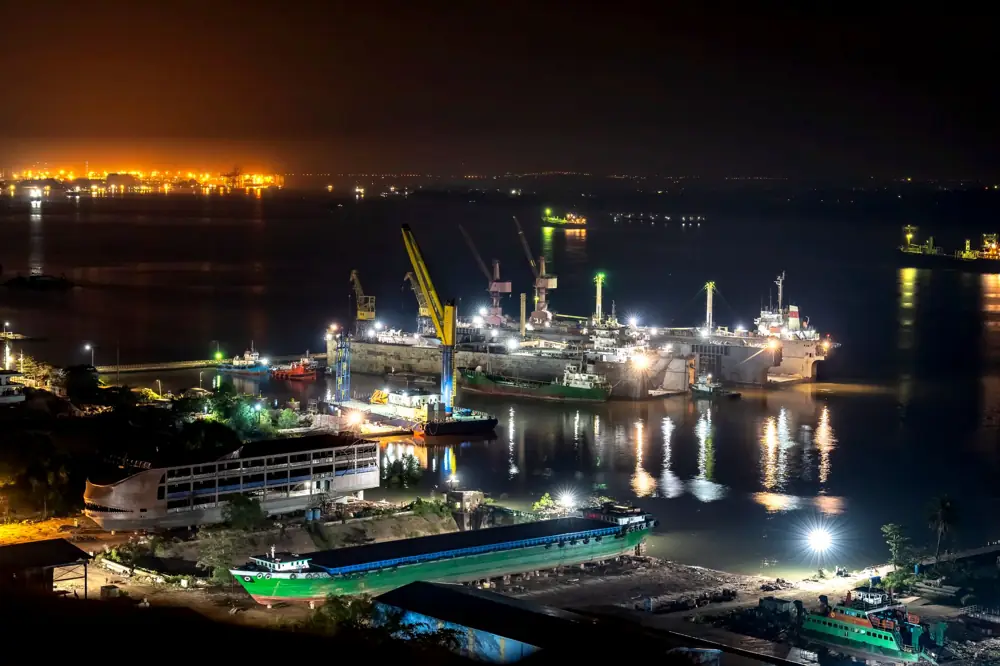
Marine and shipbuilding instrumentation fittings cover the small-bore compression tube fittings, instrumentation valves and tubing used to build leak-tight, corrosion-resistant connections on impulse, hydraulic, fuel, pneumatic and sampling lines aboard ships and workboats, and throughout shipyards. Crestflo manufactures these seawater-grade components for customers across the US. They're engineered as drop-in replacements and offered across the full chloride-resistant alloy range needed for shipboard fluid systems.
These are instrumentation and fluid-system components, not deck hardware, rigging, rail fittings or boat plumbing. The scope here is pressure, flow, hydraulic, fuel and sampling circuitry, the kind a shipyard engineer, marine OEM packager or MRO buyer specifies by alloy, connection and standard.
Marine Fittings Also Specified As: Seawater, Shipbuilding & Naval Instrumentation Components
Buyers and spec sheets call this category by a dozen different names, and Crestflo supplies under every one of them. You'll see marine instrumentation fittings and marine instrumentation valves, shipbuilding fittings and shipbuilding valves, marine tube fittings and marine-grade tube fittings, marine compression fittings, marine ferrule fittings and double-ferrule fittings, seawater fittings and seawater valves, shipyard fittings and shipyard valves, naval instrumentation fittings, ship instrumentation fittings, marine-grade stainless fittings, marine fluid-system fittings, marine hydraulic fittings, and marine instrumentation tubing. Terms differ by yard, by navy, by classification society. The parts don't. Product-level names follow the same pattern: marine ball valve, marine needle valve, marine check valve or NRV, marine manifold valve, marine relief valve, marine flow-control components, all of them pointing back to the instrumentation ranges described below. Alloy call-outs often anchor the request. Buyers ask for 316/316L (UNS S31600/S31603), 254 SMO or 6Mo (UNS S31254), AL-6XN (UNS N08367), super duplex 2507 (UNS S32750), duplex 2205 (UNS S31803/S32205), 904L (UNS N08904), Alloy 20 (UNS N08020), Inconel 625 (UNS N06625), Monel 400 (UNS N04400) and K500 (UNS N05500), and Titanium Gr2 (UNS R50400).
Marine & Shipbuilding Service Conditions: Seawater, Chloride & Salt-Fog Corrosion
Few environments in engineering punish equipment the way seawater does, day in and day out. It carries roughly 3.5% dissolved salts, on the order of 19,000 ppm chloride, and that's just the start: dissolved oxygen, biofouling, swinging temperatures and constant humidity all pile on top. Exposed connections above the waterline take a beating from salt fog and splash-zone air. Below deck and inboard, cooling and ballast lines sit in direct or intermittent contact with seawater.
The corrosion drivers that shape alloy choice for shipboard instrumentation break down into a few categories: chloride-induced pitting and crevice corrosion, galvanic corrosion where dissimilar metals meet, microbiologically influenced corrosion in stagnant seawater lines, and general marine atmospheric corrosion. Shipboard duty piles on mechanical demands too. Shock, vibration and thermal cycling all take their toll, and a fitting or valve has to survive that without loosening or leaking. The right answer, almost without exception, is a resistant alloy paired with a fitting design that's proven it can hold up under vibration and repeated make-and-break cycles.
Shipboard Systems We Supply: Fuel, Hydraulic, Ballast, Cooling & Sampling Lines
Crestflo supplies instrumentation fittings, valves and tubing across every fluid system found on a modern vessel. Below, each system points to its matching product family.
| Shipboard system | Typical media | Primary corrosion driver | Suggested alloy tier | Product family |
|---|---|---|---|---|
| Seawater cooling | Raw seawater | Chloride pitting / crevice | 6Mo, super duplex, titanium | Instrumentation valves |
| Ballast water treatment | Seawater + oxidant | Chloride + MIC | 254 SMO, AL-6XN, titanium | Ball valves |
| Steering gear, deck machinery & hydraulics | Hydraulic oil | Salt-fog atmosphere | 316L, duplex 2205 | DIN 2353 bite-type fittings |
| Fuel oil & lube oil | HFO / MGO / lube | Atmospheric salt | 316/316L | Tube fittings |
| Boiler feedwater & steam plant | Feedwater, steam, condensate | Thermal cycling / salt atmosphere | 316L, 904L | 3-valve manifolds |
| Engine-room gauge & impulse lines | Steam, water, air | Salt atmosphere | 316L, 904L | Needle valves |
| Scrubber / EGCS | Acidic washwater | Chloride + low pH | 254 SMO, super duplex | 3-valve manifolds |
| HVAC & refrigeration | Refrigerant, chilled water, brine | Condensation / salt atmosphere | 316L | Tube fittings |
| Inert gas & instrument air | Dry / wet gas | Salt atmosphere | 316L | Check valves / NRV |
| Potable & sewage systems | Potable water, greywater, sewage | Chloride / MIC | 316L, super duplex | Ball valves |
| Cargo sampling (chemical tanker) | Process chemicals | Media-dependent | Monel, Alloy 20, 254 SMO | Instrumentation tubing |
| Bilge, fire-main & pressure relief | Seawater / freshwater | Chloride | 316L, super duplex | Relief valves |
That same coverage reaches the auxiliary systems surrounding a modern vessel. Crestflo provides boiler-feedwater instrumentation on steam-plant impulse, level and gauge lines, HVAC and refrigeration marine fittings on chilled-water, brine and refrigerant circuits, and potable and sewage system instrumentation on domestic-water and treatment lines. Deck-machinery hydraulics (windlass, winches, mooring gear and hatch covers) run on the same bite-type range as the steering-gear circuit. Every line gets the seawater-grade alloys and connection standards listed below.
The alloy suggestions follow standard marine metallurgy. Final selection depends on temperature, stagnation and duty cycle, and it can be adjusted to whatever the requirement calls for.
Alloy Selection for Seawater & Marine Service: 316L, 6Mo, Super Duplex & Titanium
Choosing an alloy for marine instrumentation really comes down to chloride resistance. The industry leans on one number to judge it: the Pitting Resistance Equivalent Number, or PREN (%Cr + 3.3 × %Mo + 16 × %N). Get to roughly 40 or above, and an alloy earns the seawater-grade label. Fall short of that, and it's best kept to sheltered or indirect duty. The figures below are the standard published values for each grade.
| Alloy | UNS | ~PREN | Seawater suitability | When to choose | Material page |
|---|---|---|---|---|---|
| 316 / 316L | S31600 / S31603 | ~24 | Sheltered / indirect | Fuel, lube, dry gas, above-waterline | 316/316L |
| Duplex 2205 | S31803 / S32205 | ~35 | Moderate | Higher-strength hydraulic and structural lines | Duplex 2205 |
| 904L | N08904 | ~34 | Moderate | Warm chloride and acid service | 904L |
| Alloy 20 | N08020 | ~28 | Acid / chemical cargo | Sulfuric-acid and chemical-tanker cargo lines | Alloy 20 |
| 254 SMO (6Mo) | S31254 | ~43 | Seawater-grade | Direct seawater cooling, ballast, scrubber | 254 SMO |
| AL-6XN | N08367 | ~45 | Seawater-grade | Direct seawater, high-chloride handling | AL-6XN |
| Inconel 625 | N06625 | ~51 | Seawater-grade | Warm, high-velocity, high-chloride seawater | Inconel 625 |
| Super duplex 2507 | S32750 | ~42 | Seawater-grade | Direct seawater with strength demand | Super duplex 2507 |
| Monel 400 | N04400 | Cu-Ni (non-PREN) | Seawater-proven | Flowing seawater, high-velocity lines | Monel 400 |
| Titanium Gr2 | R50400 | Immune (non-PREN) | Seawater-immune | The harshest, warmest seawater duty | Titanium Gr2 |
In practice, 316/316L works fine for sheltered, indirect and above-waterline shipboard lines - it's the workhorse of marine instrumentation. But leave it in stagnant, warm, direct seawater and it can pit. Step up to a 6Mo grade, super duplex, Inconel 625, Monel or titanium there. Alloy 20 solves a different problem: sulfuric-acid and chemical-tanker cargo streams, where acid attack drives the choice rather than chloride pitting. For a deeper look, see the chloride and offshore alloy-selection guide, the 254 SMO vs super duplex vs AL-6XN comparison, 2205 vs 2507 and titanium vs stainless steel. Crestflo teaches each grade but only supplies it in instrumentation forms - fittings, valves and tubing - never as bar, sheet or mill product.
Marine Products: Tube Fittings, Ball & Needle Valves, Manifolds & Tubing
Crestflo's marine range covers the instrumentation fluid-system components a vessel or shipyard specifies. All of it's available in the seawater alloys listed above.
| Product family | Size range | Working pressure | End connections | Standard basis |
|---|---|---|---|---|
| Compression tube fittings (single & double ferrule) | Up to 2" (50 mm) OD | Up to 15,000 psi | Tube, NPT, BSPP/BSPT, ISO parallel, weld | ASTM F1387 |
| Instrumentation valves (ball, needle, check/NRV, bleed, gauge-root) | 1/16"–1" | Product-specific | Threaded or tube-fitting ends | ASME B16.34 / API |
| Valve manifolds (2/3/5-way, DBB) | 1/16"–1" | Manifolds up to 10,000 psi; DBB up to 3,000 psi | NPT, flanged, tube-fitting | ASME B16.34 |
| DIN 2353 bite-type hydraulic fittings | Metric series | Per series rating | DIN 2353, metric | DIN 2353 / ISO 8434 |
| Instrumentation & alloy tubing | Small-OD, seamless & welded | Per tube schedule | Tube ends | ASTM A269 / A789 / A790 |
| Accessories (thermowells, gauge savers, hose assemblies, syphons) | To specification | Product-specific | Threaded, flanged, tube | Applicable standard |
Ratings follow the applicable standard, but they're adjustable to fit specific requirements. The figures shown are the standard published values for each product class, not an upper limit. Related products include 5-valve manifolds, double block and bleed valves, bleed valves, pressure regulators, alloy tubing, thermowells, gauge savers, flexible hose assemblies and syphons. Marine thermowells, marine gauge savers, marine hose assemblies and marine relief valves all come in the seawater alloys listed above. Datasheets and CAD models are available to customers on request.
Standards, Certification & Traceability for Marine Instrumentation
Compression tube fittings are performance-qualified to ASTM F1387, the standard that underpins dimensional interchange with major brands. Instrumentation valves qualify to ASME B16.34 and the applicable API valve standards (API 6D / 598 / 602), F1387 applies to fittings, not valves. Tubing is supplied to ASTM A269 and, for duplex grades, ASTM A789 and ASTM A790. Sour-service options conform to NACE MR0175 / ISO 15156 where a marine system also handles H₂S.
Crestflo holds ISO 9001, 14001 and 45001 certification, along with PED. Every part carries a heat/lot number for full traceability. Each shipment ships with an EN 10204 MTC 3.1 as standard. 3.2 is available on request. Testing covers hydraulic proof, burst and impulse, pneumatic, vibration and thermal cycling, positive material identification (PMI), and 100% seat and shell leak testing on manifolds. In-house NDT is built in, and third-party inspection can be arranged on request. Projects that call for marine class-society type approval, such as ABS, DNV, Lloyd's Register or USCG, or for MIL-spec qualification, need a specific conversation with our engineering team first, so the requirement can be scoped against the applicable order. Class-approval status is quoted per project; it's never asserted as a blanket claim. Full detail sits at material test certificates and traceability.
Why Crestflo for Marine & Shipbuilding
Crestflo is the instrumentation division of a Government-of-India-recognized export house with four decades behind it and a proven delivery record across the Middle East. That's engineering depth channeled into a focused instrumentation range. For marine buyers, this adds up to a clear set of advantages: the full seawater alloy ladder under one roof, running from 316L through 6Mo, super duplex, Monel and titanium. Compression fittings proven to ASTM F1387 serve as drop-in replacements for Swagelok®, Parker®, Hoke®, Hy-Lok® and Fitok® tube fittings. Every part ships with heat-number traceability and MTC 3.1. Both imperial and metric sizing are available across all fittings.
Standard items sit in ready stock; specials are made to order. A 6–8 week delivery window keeps shipyard and MRO schedules on track. Small MOQs and private-label options work well for OEM packagers and distributors alike. We Engineer Confidence. Need a part-for-part interchange? Request your Swagelok® or Parker® cross-reference from our team instead of hunting through a static chart.
Standard product comes from India; US or European melt is available on request, with full material traceability. When domestic-melt or TAA-eligible material is needed, we treat that as a stated capability, see US-origin and compliance.
Marine & Shipbuilding Regions We Serve
Crestflo serves US marine buyers on a served-area basis across the major shipbuilding hubs, supplying made-to-order instrumentation into naval, workboat and commercial programs. Coverage includes Hampton Roads, VA for naval work, New Orleans, LA for Gulf workboat and commercial fleets, and Seattle, WA for Pacific Northwest naval and commercial vessels.
Frequently Asked Questions
Which alloy should I use for marine seawater service?
For direct seawater exposure, pick a seawater-grade alloy with a PREN around 40 or higher, 254 SMO, AL-6XN (6Mo), or super duplex 2507. For the harshest, warmest service, Monel 400/K500 or Titanium Gr2 fit better. 316/316L works fine for sheltered, indirect and above-waterline shipboard lines. What you end up choosing really comes down to temperature, stagnation and duty cycle.
Is 316 stainless steel OK for marine use?
316/316L (PREN ~24) holds up well against marine atmosphere and performs nicely on many sheltered shipboard lines, including fuel, lube and dry-gas service. Not so in stagnant, warm, direct seawater, though. It'll pit there. For direct seawater cooling, ballast or scrubber duty, step up to a 6Mo grade, super duplex, Monel or titanium.
What is an instrumentation fitting?
An instrumentation fitting is a precision compression tube fitting, built in either single- or double-ferrule form, designed to create a leak-tight, reusable connection on small-bore pressure, flow, hydraulic and sampling lines. It's not the same as a pipe or plumbing fitting. Instead, it's specified by tube OD, alloy and end connection.
What is instrumentation tubing?
Instrumentation tubing is small-OD stainless or alloy tubing, either seamless or welded, made to ASTM A269, and it's used for impulse, sample and hydraulic runs. Crestflo supplies it in marine alloys including 316L, 6Mo, super duplex and titanium. See instrumentation tubing.
Do you supply marine ball, needle and manifold valves?
Yes. The lineup spans instrumentation ball, needle, check/NRV, 2/3/5-way manifold, double block and bleed, and relief and bleed valves, sized from 1/16" up to 1". Ends come threaded or as tube fittings, and everything's built in marine alloys. Each valve meets ASME B16.34 and the relevant API standards.
Are your marine fittings and valves drop-in replacements?
These compression fittings undergo performance testing to ASTM F1387, and they interchange dimensionally with Swagelok®, Parker®, Hoke®, Hy-Lok® and Fitok® tube fittings. Skip the static table. Ask our engineering team for a part-for-part cross-reference built around the exact items you run.
Are your products ABS, DNV, Lloyd's or USCG type-approved?
Marine class-society type approval and MIL-spec qualification get scoped per project. Crestflo is certified to ISO 9001, 14001 and 45001, and to PED, and it issues EN 10204 MTC 3.1/3.2 with full heat traceability. A specific ABS, DNV, Lloyd's Register or USCG requirement? We'll address it on request. Just confirm the exact approval needed with our team first, so it can be quoted against your order.
What traceability and testing do you provide?
Standard documentation is MTC 3.1, though we'll provide 3.2 if you ask for it. Every part gets stamped with a heat or lot number. On the testing side, we run PMI, proof testing under both hydraulic and pneumatic pressure, and put parts through vibration and thermal cycling. Manifolds get 100% seat and shell leak testing. NDT happens in-house, and we'll bring in a third-party inspector on request.
What is your lead time and MOQ?
The framing here is simple. Ready stock covers standard items, made-to-order handles specials, and delivery runs 6 to 8 weeks, compare that to the 20-plus weeks you'd typically wait with the majors. Small MOQs are available too, along with private-label options. See lead time and private label.
Where are your marine products made and are they TAA-compliant?
Standard product comes from India. US or European melt is available on request, and we provide full material traceability. If you need domestic-melt or TAA-eligible material, that's a stated capability. See US-origin and compliance for details.
Can you match titanium or Monel for a specific seawater line?
Yes. Titanium Gr2, Monel 400, and K500 are all available across the fitting and valve range. Send along the line details and target grade with a request for quote, and we'll turn around an alloy-specific proposal.
Request a Marine Instrumentation Quote
Have a marine RFQ? Send over your shipboard system, alloy and connection requirements, or ask for a sample. Request a quote, request a sample, or take a look at the distributor program. You can also reach the Crestflo Engineering Team directly at sales@crestflousa.com · +1 346 594 9005 (Houston, TX). Datasheets and CAD files go out to customers on request.
Related Pages
- Materials: 316/316L, 904L, duplex 2205, super duplex 2507, 254 SMO, AL-6XN, Alloy 20, Inconel 625, Monel 400, Monel K500, Titanium Gr2
- Products: tube fittings, instrumentation valves, instrumentation tubing
- Standards: ASTM F1387, ASME B16.34, NACE MR0175, ISO 15156, EN 10204 MTC
- Adjacent industries: offshore, subsea, LNG & cryogenic
- Guides: material selection by service, offshore chloride selection