
Push-On Fittings: Stainless & Alloy Instrumentation Push-On Connectors
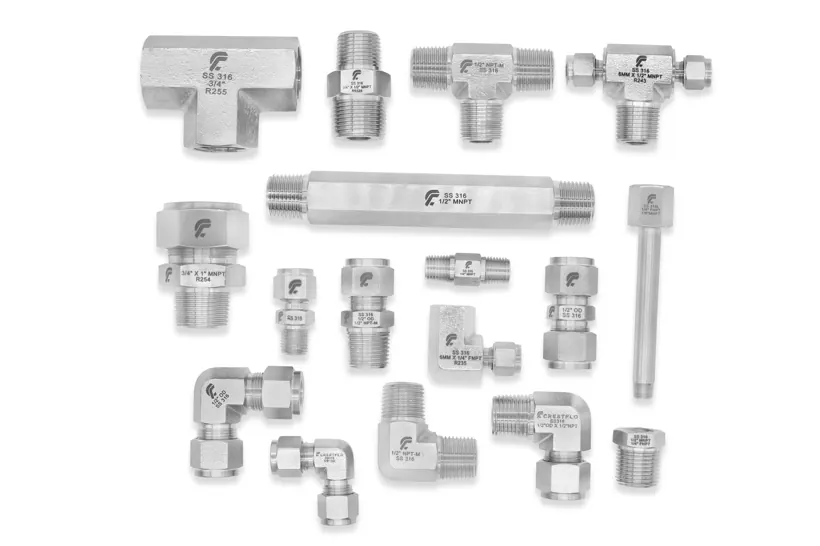
A push-on fitting is a tool-free tube connector. You push a soft or semi-rigid tube onto a barbed or stepped stem, and barb interference holds it in place, no threaded nut, no ferrule. These fittings turn up on low-pressure instrument-air, pneumatic-signal and soft-tube lines. Crestflo supplies them in instrumentation-grade stainless and alloy, not the plastic plumbing push-fit water fittings you'd see in a SharkBite-type product for household water, and not compression tube fittings.
Crestflo is the instrumentation division of a Government-of-India-recognized export house, one with four decades behind it in engineered-product delivery. Each push-on connector goes out heat-number marked, available in imperial and metric sizes alike, backed by material test certificates. It's built for US drop-in service and shipped on a ready stock for standard items · made-to-order for specials · 6-8 week delivery basis. Request a quote.
Push-On Fitting Meaning: Barb-On-Tube Retention Without Nut or Ferrule
In a push-on connector the tube fits over a barbed stem, and the barb profile bites lightly into the tube's inner diameter, holding it through mechanical interference alone. There's no nut to torque and no ferrule to swage, so you can assemble it without tools. On stems built for higher duty, a hose clamp or an O-ring stem step adds extra grip. Retention depends entirely on the tube gripping the barb, which is why push-on connectors work best with soft or semi-rigid instrument tubing, nylon, polyurethane, PTFE, and soft-annealed metal tube, under low-pressure service. This is the "push-on" branch of the push-to-connect fittings range from Crestflo, and it's a different animal from push-in (collet) geometry.
Also Known As: Push-On Connector, Push-Lock, Slip-On & Barbed Stem Fitting
Buyers call this connector by several different names. Some know it as a push-on connector, a push-on tube fitting, a push-on hose fitting, or a push-on hose barb fitting. Others use barbed push-on stem, or stem-and-barb push-on. Still others prefer push-lock (push-loc) fitting, or slip-on tube fitting and slip-on connector. None of that changes what the part actually is. It carries no dedicated UNS or ASTM entity of its own: push-on describes a fitting geometry, not a material. The alloy designation comes from whatever material is chosen for the stem and body.
Push-On Fitting Specifications: Materials, Sizes, Pressure & Connections
The table below sets out the attributes that define an instrumentation push-on connector. Figures shown are typical instrument-tube values, not fixed limits. Exact rated envelopes get confirmed against the stem material and tube you specify on your RFQ, and they can be adjusted to suit your requirement.
| Attribute | Instrumentation push-on connector |
|---|---|
| Working principle | Tube pushed onto a barbed/stepped stem; retained by barb interference against tube ID (no nut, no ferrule) |
| Body / stem material | 316/316L standard; 304/304L; high-nickel and CRA alloys on request |
| Body styles | Straight stem, elbow, tee, branch, bulkhead, stem-to-thread, stem-to-tube-fitting end |
| Service class | Low-pressure instrument-air, pneumatic-signal and soft-tube lines; rated envelope per stem material and tube, on request |
| Size range (imperial) | Common soft-tube barb sizes, 1/8″, 1/4″, 3/8″, 1/2″ across the 1/8″–1/2″ band; customizable to requirement |
| Size range (metric) | Common metric barb sizes, 4, 6, 8, 10, 12 mm across the 4–12 mm band; customizable to requirement |
| Inlet / thread options | NPT per ASME B1.20.1, BSPT, BSPP, ISO parallel, or a compression tube-fitting end |
| Retention element | Barb interference (mechanical); optional O-ring stem step on selected styles |
| Tube compatibility | Soft/semi-rigid instrument tubing, nylon, PU, PTFE, soft-annealed metal |
| Finish | Material finish, electropolish, passivation, silver anti-galling plating, custom |
| Traceability | Heat/lot number on every part; EN 10204 MTC 3.1 standard, 3.2 on request |
Push-On Fitting Materials: 316/316L Stainless, 304/304L & High-Nickel Alloys
316 and 316L stainless steel (UNS S31600/S31603) is the standard material, with 304 and 304L (S30400/S30403) also available. High-nickel and corrosion-resistant alloys, including Inconel, Monel, Hastelloy, duplex and super-duplex, ship on request for aggressive or chloride-bearing service. Compositions and mechanical properties follow the applicable ASTM material specifications and can be tailored to what's required. Heavy-duty push-on fittings destined for tougher low-pressure lines get a stem in high-nickel or CRA alloy, and an O-ring stem step or hose clamp is added for extra retention. The barb geometry and rated envelope, though, stay per the applicable standard, and these too can be tailored to requirement.
| Grade | UNS | Typical use | Learn more |
|---|---|---|---|
| 316 / 316L | S31600 / S31603 | Standard instrument-air and soft-tube service | 316/316L stainless |
| 304 / 304L | S30400 / S30403 | General low-corrosion service | 304/304L |
| High-nickel & CRA | On request | Chloride, sour or corrosive media | High-nickel & CRA alloys |
Brass isn't a material the US lineup promotes; stainless and alloy lead that range. When a brass stem, or another non-alloy option, is truly needed, we'll quote it honestly on request.
Push-On Fitting Sizes & End Connections: Imperial, Metric, NPT, BSPT & BSPP
Crestflo supplies push-on connectors in both imperial and metric barb/tube sizes across straight, elbow, tee, branch and bulkhead bodies. Common imperial barb sizes are 1/8″, 1/4″, 3/8″ and 1/2″, and common metric barb sizes are 4, 6, 8, 10 and 12 mm, both customizable to requirement. Inlet options include NPT (per ASME B1.20.1), BSPT, BSPP and ISO-parallel threads, and a compression tube-fitting end for a direct transition to a ferrule fitting. To specify a part, provide the tube ID/OD, material, inlet thread and quantity; the ordering-code guide is available from our engineering team on request.
Push-On vs Push-In vs Quick-Connect: Choosing the Right Geometry
Push-on, push-in and quick-connect tackle different jobs. Push-on means sliding soft tube over a barb. Push-in works the opposite way: it inserts rigid tube into a collet that grips the outside diameter. A quick-connect is something else entirely, a coupling built to connect and disconnect again and again.
| Attribute | Push-on (barb) | Push-in (collet) | Quick-connect (coupling) |
|---|---|---|---|
| Retention method | Barb interference on tube ID | Collet grips tube OD | Latch / locking coupling |
| Tool-free assembly | Yes | Yes | Yes |
| Designed to reconnect | Occasional | Occasional | Repeated connect/disconnect |
| Tube type | Soft / semi-rigid | Rigid / semi-rigid | Line-to-line coupling |
| Typical service | Low-pressure air / soft tube | Low-to-moderate pressure | Frequent make/break lines |
For rigid tube or one-touch pneumatic service, look at push-in (collet) fittings and pneumatic push-to-connect fittings. If a line gets connected and disconnected often, quick-connect couplings are the better fit. But when the line carries high pressure, sees vibration, or needs critical isolation, a compression tube fitting is the right call at Crestflo.
Standards, Certifications & Traceability for Push-On Fittings
Crestflo holds ISO 9001 / 14001 / 45001 and PED certification, along with the standard approvals that apply to instrumentation fittings. That includes ASTM F1387 compression-fitting performance qualification at the push-to-connect family level, plus NACE MR0175 / ISO 15156 whenever a sour-service alloy is called for. Bar stock follows ASTM A479 / A276, and thread dimensions follow ASME B1.20.1.
| Item | Basis | Availability |
|---|---|---|
| ISO 9001 / 14001 / 45001, PED | Certified | Standard |
| Material test certificate | EN 10204 MTC 3.1 | Standard (3.2 on request) |
| Heat / lot number | Marked on every part | Standard |
| PMI (positive material identification) | Alloy verification | On request |
| NACE MR0175 / ISO 15156 | Sour-service alloy | Where alloy specified |
| Oxygen / UHP cleaning | Cleanliness spec | On request |
Full traceability detail appears on the material test certificate page. The basis for sour-service work is set out under NACE MR0175 and EN 10204 MTC, while oxygen-clean options sit under oxygen & UHP cleaning.
Customers can request datasheets and CAD models directly.
Push-On Fitting Applications: Instrument Air, Pneumatics & Analytical Sampling
Instrumentation push-on connectors handle low-pressure connections across instrument-air systems, pneumatic signal and actuator lines, analytical sampling systems and general low-pressure pneumatics. They fit naturally with soft-tube runs, and they work just as well with flexible hose assemblies when a barb-and-hose build is what's called for.
Why Specify Crestflo Push-On Fittings
Crestflo speaks to the instrumentation meaning of "push-on fitting": stainless and alloy connectors backed by real traceability, not generic plumbing SKUs. No single push-on fitting works best for every line. For a low-pressure instrument-air or soft-tube run, though, the best ones share three things: the right stem material, a verified barb-to-tube fit and documented traceability. That's exactly what Crestflo supplies. Here's the proof:
Backed by ASTM F1387 performance qualification at the fitting-family level, Crestflo offers interchange proof that most commodity push-on sellers simply can't show. See the F1387 interchange documentation for details.
- 316 stainless and exotic alloys, with high-nickel and CRA grades on request, not brass-first, not plastic.
- Heat-number on every part plus EN 10204 MTC 3.1 (3.2 on request).
- Imperial and metric sizing on all body styles.
- Crestflo keeps minimum order quantities low and runs a private-label program; expect a 6-8 week lead time.
- Material origin is India, though US or European melt can be arranged on request, and every lot carries full traceability. Details are in the US origin & TAA page.
We Engineer Confidence. Searching for push-on fittings near me or near you? Crestflo is US-serving nationwide, find a distributor near you across the US through our distributor network, so a local channel partner can support delivery on the ready-stock-for-standard-items, made-to-order-for-specials, 6–8 week basis. To source push-on connectors, send tube ID/OD, material, inlet thread and quantity and request a quote; to place a stocking program, become a distributor. Reach the US sales desk at sales@crestflousa.com or +1 346 594 9005 (Houston, TX). To position Crestflo against your current brand, request your Swagelok® or Parker® cross-reference from our engineering team.
Push-On Fittings FAQ
What is a push-on fitting?
A push-on fitting connects soft or semi-rigid tubing by pushing it onto a barbed stem, where barb interference holds it in place. No nut. No ferrule. No tools required. Crestflo makes these instrumentation-grade, in 316 stainless and alloy, built for low-pressure instrument-air and pneumatic lines.
How is a push-on fitting different from a push-in push-to-connect fitting?
In a push-in fitting, the tube inserts into a collet that grips the tube's outer diameter. A push-on fitting works differently: the tube slides over a barb instead. Push-in fittings suit rigid tube and moderate pressure. Push-on fittings are the better choice for soft tube under low pressure.
What is the best push-to-connect fitting?
Push-to-connect fittings aren't one-size-fits-all; the right pick comes down to the tube and the service it's running. Rigid tube and one-touch pneumatic lines usually call for a push-in (collet) fitting. Soft, low-pressure instrument-air and soft-tube runs do better with a push-on (barb) fitting. High pressure, vibration, or a critical isolation point? That's where a compression tube fitting belongs instead. Among the push-on options, the good ones pair the right stem material and barb size with documented heat-number traceability. That's exactly what Crestflo supplies, in 316 stainless and alloy.
Are these the same as plumbing or SharkBite push-fit water fittings?
No. These are stainless and alloy instrumentation connectors, made for air and process-signal tubing. They're not plastic push-fit water fittings meant for plumbing.
What materials are push-on fittings available in?
316/316L stainless comes standard. 304/304L is available too, and for the tougher jobs we supply high-nickel and CRA alloys on request: Inconel, Monel, Hastelloy, duplex and super-duplex. Brass isn't a promoted US material.
What sizes are available, imperial or metric?
Both. Crestflo carries imperial and metric barb and tube sizes across straight, elbow, tee, branch and bulkhead bodies, and these can be customized to what you need. Ask for the ordering-code guide to get the exact sizes.
What pressure and temperature can push-on fittings take?
Push-on connectors suit low-pressure service only, and the working limit hinges on the stem material and the tube in use. We confirm the rated envelope for your configuration on request, and we'll customize it to what you need.
How reliable are push-on and push-to-connect fittings?
They're reliable within their rated low-pressure range, so long as the tubing is compatible. Push into high pressure, add vibration, or need critical isolation? Compression tube fittings or valves are the better choice.
What are the downsides of push-to-connect fittings?
They carry lower pressure and temperature limits than compression fittings, and they're picky about tube quality and how clean the cut is. You give up some ultimate performance in exchange for tool-free speed. Our engineering team will advise on the right geometry for your line.
Can I get certificates and traceability?
Yes. Every part carries a heat or lot number, and EN 10204 MTC 3.1 comes as standard, with 3.2 available on request. Certification covers ISO 9001, 14001, 45001, and PED. Where a sour-service alloy is specified, we also provide NACE documentation.
How do I order, and what is the lead time?
Send the tube ID/OD, material, inlet thread, and quantity along with your RFQ. We offer small MOQ and private label, and delivery typically runs 6-8 weeks: standard items ship from ready stock, while specials are made to order.