
Hastelloy B-3 (UNS N10675): Instrumentation Fittings, Valves & Tubing
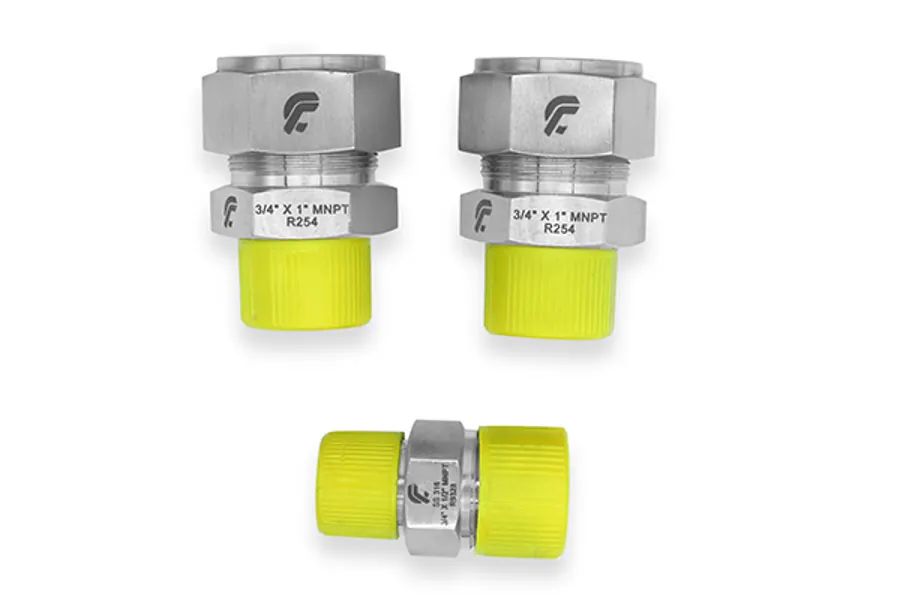
Hastelloy B-3, designated UNS N10675 and W.Nr. 2.4600, is a nickel-molybdenum (Ni-Mo) alloy built to resist corrosion. It holds up against hydrochloric acid at every concentration and temperature, along with other reducing (non-oxidising) acids. Thermal stability beats Hastelloy B-2. Weldability too.
Crestflo supplies this grade as instrumentation tube and compression fittings, instrumentation valves, and instrumentation tubing. Every piece carries heat and lot-number traceability, and each is engineered as a drop-in replacement for the majors. Delivery runs 6-8 weeks, serving customers across the US.
Below you'll find the composition, mechanical and corrosion values for the alloy. These are standard published figures, drawn from the applicable ASTM specification, and they can be adjusted to meet specific requirements.
> Scope: Here, Hastelloy B-3 refers to the wrought Ni-Mo alloy used in instrumentation fluid-system tube fittings, compression ferrules and instrumentation valves. It doesn't cover weld filler wire, coatings or commodity mill product. Crestflo supplies this alloy only in instrumentation fitting, valve and tubing forms, not as mill bar, sheet, plate or pipe.
Request a Hastelloy B-3 Quote · Request a Sample · sales@crestflousa.com · +1 346 594 9005 (Houston, TX)
Hastelloy® is a registered trademark of Haynes International, Inc.
Hastelloy B-3 Also Known As: UNS N10675, Alloy B3 & W.Nr. 2.4600
Drawings, datasheets and purchase orders don't always agree on what to call this alloy. One print says "Alloy B-3." Another says "N10675 alloy." A third just lists it as a nickel-molybdenum grade. They're all pointing at the same material: a Ni-Mo corrosion-resistant alloy built for reducing-acid service.
| Designation type | Value |
|---|---|
| Trade / common names | Hastelloy B-3, Hastelloy B3, Alloy B-3, Alloy B3, B-3, B3 alloy |
| UNS number | UNS N10675 (N10675, vendor variant N010675) |
| Werkstoff (W.Nr.) | 2.4600 (Werkstoff 2.4600, DIN 2.4600) |
| Alloy family | Nickel-base, Ni-Mo (nickel-molybdenum) B-series corrosion-resistant alloy |
| Spaced / reversed forms | Hastelloy B 3, Hastelloy alloy B-3, B-3 Hastelloy, B3 nickel molybdenum alloy |
UNS N10675 is the US designation, and W.Nr. 2.4600 is the European one. Both describe the exact same alloy. So no matter which way a part gets specified, it's still the same Hastelloy B-3.
Hastelloy B-3 Chemical Composition (Nickel-Molybdenum, per ASTM)
B-3's performance comes down to a nickel matrix loaded with molybdenum, paired with tightly controlled low iron and chromium and a very low carbon limit. It refines the Ni-Mo balance found in its predecessor, B-2, to get better thermal stability. That's what lets the alloy stand up to knife-line and heat-affected-zone attack, a problem that can crop up in B-2 near welds.
| Element | wt % (per ASTM B335 / B333) |
|---|---|
| Nickel (Ni) | Balance (~65) |
| Molybdenum (Mo) | 27.0–32.0 |
| Chromium (Cr) | 1.0–3.0 |
| Iron (Fe) | 1.0–3.0 |
| Cobalt (Co) | 3.0 max |
| Manganese (Mn) | 3.0 max |
| Tungsten (W) | 3.0 max |
| Aluminum (Al) | 0.50 max |
| Titanium (Ti) | 0.20 max |
| Carbon (C) | 0.010 max |
| Silicon (Si) | 0.10 max |
| Phosphorus (P) | 0.030 max |
| Sulfur (S) | 0.010 max |
Ranges follow the applicable ASTM product-form specification. Crestflo verifies the actual heat chemistry on the EN 10204 material test certificate that's included with every order.
Hastelloy B-3 Mechanical & Physical Properties
In the solution-annealed condition, B-3 pairs high strength with the ductility and toughness fitting and valve forming call for. The figures below are standard published minimums along with nominal physical data for the alloy.
Mechanical properties (solution-annealed, room temperature)
| Property | Value |
|---|---|
| Tensile strength | ≥ 110 ksi (760 MPa) |
| Yield strength (0.2% offset) | ≥ 51 ksi (350 MPa) |
| Elongation | ≥ 40% |
| Hardness | ≤ ~100 HRB |
Physical properties
| Property | Value |
|---|---|
| Density | 9.24 g/cm³ (0.334 lb/in³) |
| Melting range | 1370–1418 °C (2500–2585 °F) |
| Structure | Face-centered cubic (austenitic nickel matrix) |
Mechanical minimums track the applicable ASTM spec, B335 or B333, for the solution-annealed condition. They aren't the final word, though: certified properties for a given heat come straight from the material test certificate.
Hastelloy B-3 Corrosion Resistance by Media (HCl & Reducing Acids)
B-3 works best in reducing, non-oxidising environments. Its high molybdenum content gives it outstanding resistance to hydrochloric acid, across the whole range of concentration and temperature, along with resistance to other non-oxidising acids. The catch is oxidising service. This alloy isn't recommended where oxidising acids or oxidising metal ions, such as ferric or cupric, are present. The table below summarises typical service suitability, drawn from standard alloy corrosion literature.
| Media / service | Suitability | Note |
|---|---|---|
| Hydrochloric acid (HCl) | Excellent | Resists all concentrations and temperatures, the defining application |
| Sulfuric acid (H₂SO₄), reducing conditions | Good | Strong in non-oxidising, non-aerated conditions |
| Phosphoric acid (H₃PO₄) | Good | Reducing process streams |
| Acetic & formic acids | Excellent | Organic-acid process streams |
| Hydrogen chloride gas, chlorination processes | Good–Excellent | Reducing HCl-bearing service |
| Ferric / cupric chloride (FeCl₃ / CuCl₂) | Not recommended | Oxidising metal ions attack the alloy |
| Oxidising acids (nitric, chromic) & oxidising salts | Not recommended | Choose a C-series (Cr-bearing) alloy instead |
B-3 has almost no chromium in its makeup, so a pitting-resistance index (PREN) rating doesn't apply to it. Its real strength lies elsewhere: resistance to reducing acids, not resistance to chloride pitting. When you're weighing alloys against a particular process, check the corrosion-by-media × alloy matrix.
Hastelloy B-3 vs B-2: Thermal Stability & Weldability
Engineers developed B-3 to fix a metallurgical flaw in Hastelloy B-2. Both alloys sit around 65% nickel and 28% molybdenum, built for reducing acids. But B-2 has a problem: in the 550–800 °C range, it forms ordered phases that make the material brittle and leave it open to knife-line and heat-affected-zone attack once it's welded. B-3 rebalances the minor elements to stop that ordering from happening. The result is much better thermal stability, weldability, and formability, without giving up the HCl resistance that the B-series is known for. That's why B-3 has become the standard choice for new reducing-acid instrumentation work today, with B-2 now regarded as the older, predecessor grade. For more on that earlier alloy, see the Hastelloy B-2 page.
Hastelloy B-3 Product-Form Standards (ASTM B335, B333, B622 & ASME SB-)
A family of ASTM specifications covers this alloy, one for each product form, and each carries a matching ASME SB- designation. These define the grade. Crestflo doesn't supply mill product; it supplies the instrumentation forms built from certified material to these specifications: fittings, valves, tubing.
| Product form | ASTM | ASME equivalent |
|---|---|---|
| Rod & bar | B335 | SB-335 |
| Plate, sheet & strip | B333 | SB-333 |
| Seamless pipe & tube | B622 | SB-622 |
| Welded pipe | B619 | SB-619 |
| Welded tube | B626 | SB-626 |
| Forgings | B564 | SB-564 |
| Wrought & pipe fittings | B366 / B462 | SB-366 / SB-462 |
Round bar, plate and pipe in Hastelloy B-3 serve only as the ASTM feedstock basis. Crestflo doesn't sell them as commodity mill stock. Not here. What leaves this shop is finished product: instrumentation fittings, valves, tubing. Values and grades follow the applicable ASTM/ASME specification, and material certificates go out with every order.
Hastelloy B-3 Fabrication: Welding, Machining & Forming
B-3's better thermal stability means it welds and forms more easily than B-2. It's paired with matching nickel-molybdenum filler metals of the ERNiMo class, per the applicable welding standard, chosen to suit the procedure and adaptable to whatever the job calls for. Like every high-molybdenum nickel alloy, it work-hardens, so machining calls for slow speeds, positive feeds and rigid tooling. Crestflo builds B-3 instrumentation parts with in-house CNC / VMC / EDM machining, and confirms the material by PMI before any part ships.
Hastelloy B-3 for Sour Service (NACE MR0175 / ISO 15156)
Sour-service selection with H₂S present falls under NACE MR0175 / ISO 15156, and that standard spells out which nickel-base alloys qualify along with material-condition and hardness limits for each environment. Whether Hastelloy B-3 works for a particular sour application has to be checked against the current standard for that exact service and condition. This calls for engineering review, not a general assurance. When the alloy does appear on the list for the environment in question, Crestflo can provide B-3 fitting and valve material options along with the matching documentation. Check the NACE MR0175 and ISO 15156 standard pages, along with the sour-service selection guide, and send your service conditions with your RFQ so we can give you an engineered answer.
When to Choose Hastelloy B-3 vs B-2, C-276 & Inconel
B-3 handles pure reducing and hydrochloric-acid service; it's the specialist here. Below, you'll find it stacked up against the alloys buyers most often compare it to. Each one links out to its own material page or a dedicated comparison.
| Alloy | Key strength | Choose when | More detail |
|---|---|---|---|
| Hastelloy B-3 (N10675) | Outstanding HCl and reducing-acid resistance; improved thermal stability | Pure non-oxidising acid service, HCl at any concentration, with better fabricability than B-2 | This page |
| Hastelloy B-2 (N10665) | Original Ni-Mo reducing-acid alloy | Existing B-2 specifications; superseded by B-3 for new work | Hastelloy B-2 |
| Hastelloy C-276 (N10276) | Broad resistance in reducing and oxidising media; Cl-SCC immunity | Mixed acids, wet chlorine, chlorides or oxidising species are present | Hastelloy C-276 |
| Inconel 625 / 825 (N06625 / N08825) | Nickel alloys for oxidising and high-temperature service | Oxidising or elevated-temperature duty rather than pure reducing acids | Inconel 625 · Hastelloy vs Inconel |
When oxidising species or chlorides could turn up, step up to a C-series alloy. Trying to choose between the two? The Hastelloy vs Inconel guide walks through that comparison directly, and the material-selection-by-service guide rounds out the picture.
Hastelloy B-3 Applications: Chemical Processing & Acid Service
Stainless steel can't handle certain reducing acids, and C-series alloys are overkill for the job. That's where Hastelloy B-3 comes in: hydrochloric-acid production and handling, acetic and other organic-acid processes, chemical-processing equipment running under non-oxidising conditions, reaction vessels, and acid-service valves and sampling systems all rely on it. Its Ni-Mo chemistry works well in certain vacuum and heat-treat furnace components too. Crestflo supplies B-3 instrumentation for these applications across petrochemical & chemical processing and oil & gas plants.
Hastelloy B-3 Product Forms from Crestflo: Fittings, Valves & Tubing
Crestflo offers UNS N10675 across three instrumentation product forms. Each has its own detail page, with sizes, ratings and ordering laid out there. The grade doesn't stop there, though: it also goes into compression and ferrule fittings, needle, ball and manifold valves, and instrumentation tubing made without a weld seam.
- Hastelloy B-3 tube & compression fittings: These come as single or double ferrule (twin-ferrule) designs, hardened or non-hardened, in both imperial and metric sizes, with end connections up to 2" (50 mm) OD. You'll also find them listed as B-3 compression fittings, B3 ferrule fittings, or UNS N10675 fittings. Qualification for the compression tube fittings follows ASTM F1387. Check out the tube-fittings hub for the full range.
- Hastelloy B-3 instrumentation valves: Needle, ball, check, and 2/3/5-way manifold valves are all available in B-3, spanning sizes from 1/16" to 1". The pressure-boundary design sticks to ASME B16.34, with seat leak testing done per API seat-leak/test practice. Head over to the instrumentation-valves hub to browse.
- Seamless Hastelloy B-3 instrumentation tubing: This seamless B-3 / N10675 tubing comes in imperial and metric OD/wall combinations. Take a look at the alloy tubing range for details.
Every Crestflo B-3 part carries a heat/lot number and ships with an EN 10204 material test certificate. Sizes, ferrule type, and thread standard, whether that's NPT, BSP, or tube-fitting ends, are configured to requirement.
Why Crestflo for Hastelloy B-3
We Engineer Confidence. For a specialist alloy like B-3, that means PMI-verified chemistry, honest sourcing and genuine interchange, laid out in specs you can actually pull data from, not buried in some PDF. We're a US-serving Hastelloy B-3 supplier and stockist, and we quote total delivered cost, not a per-kilo mill price, on the finished instrumentation part you actually need.
Drop-in interchange for Swagelok®, Parker®, Hoke® and Hy-Lok®: dimensional interchange, with compression fitting ends backed by ASTM F1387 performance qualification (these are interchange/equivalent parts, not "compatible" or "intermix"). Need a Swagelok®/Parker® cross-reference? Our engineering team can put one together for you via the Swagelok cross-reference page.
- Lead time runs 6-8 weeks, against 20+ weeks typical for the majors. Details sit on the lead-time capability page.
- Full traceability comes standard: a heat/lot number on every part, EN 10204 MTC 3.1 by default (3.2 on request), PMI to confirm the material really is N10675, and in-house testing on top of that.
- NACE MR0175 / ISO 15156 material options are available wherever the alloy is listed for that service. Single and double ferrules come hardened or non-hardened, and every fitting is offered in both imperial and metric.
- We're ISO 9001 / 14001 / 45001 & PED certified, with in-house CNC / VMC / EDM machining, small MOQ, and private-label options on top.
- The heritage behind the brand: Crestflo is the instrumentation division of an export house recognized by the Government of India, four decades in business, with a proven track record of delivery across the Middle East. New in manufacturing, but the export pedigree runs deep. Read more about Crestflo.
Stock & delivery: We keep standard items in stock and ready to ship. Specials are made to order, and delivery runs 6-8 weeks. Origin: Material comes from India as standard. US or European melt can be arranged on request, and we back every order with full material traceability (origin & compliance).
Buyers: Ready to move forward? Request a Quote or a Sample if you're an end user, EPC, or panel fabricator. Equipment manufacturers and OEMs should talk to an engineer or send over a print. And if you're interested in becoming a distributor, we'd like to hear from you.
Hastelloy B-3 FAQs
What is Hastelloy B-3?
Hastelloy B-3, a nickel-molybdenum (Ni-Mo) alloy resistant to corrosion, carries the designations UNS N10675 and W.Nr. 2.4600. It's specified for instrumentation fittings, valves and tubing in hydrochloric-acid and other reducing-acid service. Across every concentration and temperature, it holds up against HCl. Compared with Hastelloy B-2, it delivers stronger thermal stability and welds more easily.
What is another name for Hastelloy B-3?
Hastelloy also goes by Alloy B-3 or Alloy B3. Its UNS designation is N10675, with N010675 as the vendor variant, and under the European system it's listed as Werkstoff number 2.4600. Haynes International, Inc. Holds the registered trademark on the name "Hastelloy."
What is the chemical composition of Hastelloy B-3?
Nickel makes up the balance, around 65%, and molybdenum comes in near 28.5%. Chromium stays low, 1–3%, as does iron in that same range. Cobalt, manganese and tungsten appear only in trace amounts. Carbon doesn't exceed 0.010%. The composition table above gives the full ASTM ranges.
Is Hastelloy B-3 magnetic?
No. In the solution-annealed condition, Hastelloy B-3 carries an austenitic, face-centered-cubic nickel-molybdenum matrix. That structure keeps it essentially non-magnetic, with permeability sitting very low, near 1.0. Heavy cold work can nudge that permeability up a little, but for instrumentation fittings, valves and tubing, it's still treated as non-magnetic.
How is Hastelloy B-3 better than Hastelloy B-2?
B-3 shifts the Ni-Mo balance to shut down the ordered-phase formation that made B-2 brittle. The payoff: better thermal stability, easier welding, better formability, and stronger resistance to knife-line attack and heat-affected-zone corrosion, the kind that can hit B-2 near welds. HCl resistance stays the same. For new reducing-acid work, B-3 is the current grade.
Is Hastelloy similar to Inconel?
Hastelloy B-3 and Inconel are both nickel-based, but they're built for different jobs. Hastelloy B-3 handles reducing acids like HCl. Inconel grades, on the other hand, are made for oxidising and high-temperature service. Don't swap one for the other based on service type. Check the Hastelloy vs Inconel guide to figure out which one you actually need.
What is Hastelloy B-3 used for?
Hydrochloric acid production and handling sit at the center of this equipment's use, alongside acetic and other organic-acid processes. It also covers chemical-processing equipment run under non-oxidising conditions, reaction vessels, and components for vacuum and heat-treat furnaces. Acid-service valves and sampling systems round out the list.
Can Hastelloy B-3 handle oxidising media?
No. B-3 has almost no chromium in it, so it won't hold up against oxidising acids like nitric or chromic acid, oxidising salts, or solutions with ferric or cupric ions present. In those environments, go with a C-series alloy instead, such as C-276 or C-22.
Is Hastelloy B-3 suitable for sour (NACE) service?
NACE MR0175 / ISO 15156 sets the rules for what counts as acceptable in sour service, listing alloys along with material-condition and hardness limits that vary by environment. Whether B-3 qualifies for a given application isn't something to assume; it has to be confirmed against the current standard through engineering review. Where the alloy is listed, Crestflo can supply B-3 material options, complete with the corresponding documentation.
Which ASTM/ASME specs cover Hastelloy B-3 product forms?
Rod and bar fall under ASTM B335. Plate, sheet, and strip are covered by B333, while seamless pipe and tube follow B622. Welded pipe carries the B619 spec, and welded tube goes by B626. Forgings are B564. Fittings split into two: B366 and B462. Each one also carries a matching ASME SB- designation.
What sizes and forms does Crestflo offer in Hastelloy B-3?
Crestflo offers compression and tube fittings up to 2" (50 mm) OD in single or double ferrule versions, both hardened and non-hardened. Instrumentation valves run from 1/16" to 1", and the seamless instrumentation tubing comes in imperial and metric sizing. Everything can be customized to requirement. One thing worth noting: Crestflo supplies instrumentation forms only. Mill bar, sheet, plate and pipe aren't part of the offering.
Can I get material certificates and heat traceability for Hastelloy B-3?
Yes. We issue EN 10204 3.1 certificates as standard, and we'll provide 3.2 on request. Every part gets a heat and lot number stamped on it, so it can be traced back fully. PMI confirms the alloy, and Crestflo runs all testing in-house under its own QA program.
What is the price and lead time for Hastelloy B-3 fittings?
Pricing runs by quotation only; there's no online cart. Standard items ship from ready stock, while specials are made to order and take 6-8 weeks to deliver. Standard product comes from India. US or European melt is available on request, with full traceability. To get a configured part number and price, submit an RFQ with size, form, material and rating.
Related Alloys & Resources
- Hastelloy B-2, the original Ni-Mo reducing-acid alloy that B-3 supersedes.
- Hastelloy C-276 · Hastelloy C-22, these C-series alloys handle combined reducing/oxidising conditions and mixed-acid service.
- Hastelloy X, related high-temperature Hastelloy grade.
- Hastelloy vs Inconel and the corrosion-alloy matrix decision guides.
- Material selection by service and the sour-service selection guide.
- Browse the full range from the instrumentation valves hub and the materials hub.
Request a Hastelloy B-3 Quote
Send us your form details, fittings, valves or tubing, along with size, end connections and line conditions. The Crestflo Engineering Team will send back a configured part number, ratings and a price.
Request a Quote · Request a Sample · Browse the materials hub Reach Crestflo at sales@crestflousa.com · +1 346 594 9005 · Houston, TX
Datasheets, data sheets, spec sheets and CAD files are available to customers on request. The Crestflo Engineering Team reviewed this material. Hastelloy® is a registered trademark of Haynes International, Inc. Swagelok® and Parker® belong to their respective owners.