
Alloy 20 Tube Fittings (UNS N08020 / Carpenter 20, Niobium-Stabilized Super-Austenitic Instrumentation Fittings)
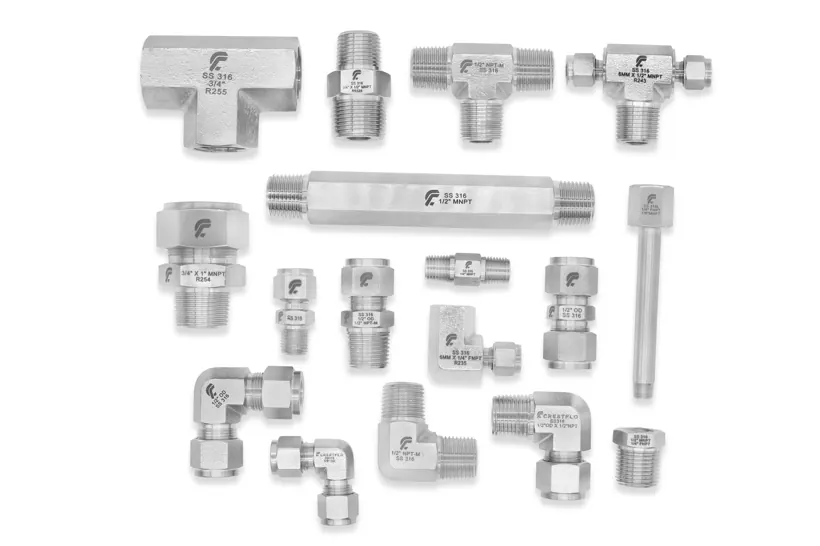
Alloy 20 tube fittings are mechanical-grip compression fittings machined from UNS N08020, a niobium-stabilized super-austenitic nickel-iron-chromium alloy with a deliberate copper and molybdenum addition. One or two ferrules swage onto the tube's outside diameter and pull up to a leak-tight, gas-tight seal with a firm mechanical grip. The reason Alloy 20 gets specified for a fitting comes down to one thing: acid. The copper-and-molybdenum chemistry was purpose-built for sulfuric acid across a broad concentration range, and it holds up in phosphoric, nitric, and mixed-acid streams where 304 and 316 simply corrode through. Its roughly 35% nickel also resists the chloride stress-corrosion cracking that retires standard 300-series stainless, and the niobium stabilization keeps welded or brazed fittings from sensitizing at the heat-affected zone. Crestflo carries these fittings from 1/8-inch through 2-inch (50 mm) tube OD, single and double (twin) ferrule, imperial and metric. They are qualified to ASTM F1387 and offered to NACE MR0175 / ISO 15156 where sour service applies. Standard items ship from ready stock; specials are built to order, with delivery running 6-8 weeks. Request a quote to price out your configuration.
Carpenter® 20 and 20Cb-3® are trademarks of CRS Holdings LLC / Carpenter Technology Corporation. Swagelok®, Parker®, and Hy-Lok® are trademarks of their respective owners. Crestflo supplies UNS N08020 to standard chemistry, is not affiliated with or endorsed by any brand or mill referenced here, and all interchange is strictly dimensional.
What Alloy 20 Compression Tube Fittings Are
An Alloy 20 compression tube fitting is built for fluid-system instrumentation: a body, a nut, and one or two ferrules that bite onto the tube's outer diameter as the nut is tightened. The joint comes apart and goes back together without losing integrity. No flaring, no welding, no elastomer seal sitting in the leak path. The seal is metal-to-metal, so the service window comes from the alloy, not from an O-ring failing first.
Scope matters here. These are instrumentation compression tube fittings in UNS N08020 super-austenitic alloy, not mill bar, not sheet or plate, not forgings or line pipe, and not a generic "20 alloy," an aluminum designation, or a weld-filler product. ("Compression fitting" here means an SS/alloy instrumentation fitting, not a copper plumbing part.) Crestflo's Alloy 20 fittings land on small-bore instrument tubing for transmitters, analyzers, sample lines, chemical-injection systems, and process taps across sulfuric-acid, mixed-acid, pickling, pharmaceutical, fertilizer, and plastics service, the acid-wetted duty where 316 is under-alloyed and a nickel alloy is overkill.
Also Known As: UNS N08020, Carpenter 20, 20Cb-3 & Werkstoff 2.4660
Buyers and specifiers write this grade several ways, and they all point to the same niobium-stabilized super-austenitic. On drawings and material call-outs it shows up as Alloy 20, Carpenter 20, 20Cb-3, Alloy 20Cb, or Incoloy 20. Its formal designations are UNS N08020 (the US number) and EN / Werkstoff 2.4660 (the European one). Ask for "Alloy 20 ferrule fittings," "UNS N08020 tube fittings," "N08020 compression fittings," "Carpenter 20 tube fittings," or "20Cb-3 ferrule fittings" and you get exactly what's described on this page, the terms are interchangeable.
| Designation type | Value |
|---|---|
| Trade / common names | Alloy 20, Carpenter 20, 20Cb-3, Alloy 20Cb, Incoloy 20 |
| UNS number | N08020 |
| EN / Werkstoff (W.Nr.) | 2.4660 (NiCr20CuMo) |
| Alloy family | Niobium-stabilized super-austenitic Ni-Fe-Cr stainless alloy |
UNS N08020 and Werkstoff 2.4660 describe one and the same alloy, so whichever designation shows up on a spec sheet, you are looking at the same Alloy 20 super-austenitic. Carpenter Technology sells the wrought grade under the trade name 20Cb-3; the UNS number N08020 is the generic specification Crestflo supplies to.
Why Choose Alloy 20 for Instrumentation Tube Fittings
Alloy 20 is a niobium-stabilized super-austenitic, nominally about 35% nickel, 20% chromium, 3-4% copper, 2-3% molybdenum, iron balance, with niobium set at eight times carbon, and that chemistry is what makes it the right pick for a fitting in sulfuric and mixed-acid service. The copper and molybdenum together give the alloy its resistance to reducing acids, sulfuric above all; the high nickel underwrites resistance to chloride stress-corrosion cracking; and the niobium (columbium) stabilization, backed by a low carbon limit, keeps the alloy from sensitizing after welding or brazing, so a welded elbow or a brazed joint does not become an intergranular-attack site in acid service. That stabilization is a genuine advantage in a fitting, where thermal history at the joint matters.
Be precise about where Alloy 20 sits. It was developed to close the gap between standard stainless and the far pricier high-nickel alloys, specifically for sulfuric acid. It is not a chloride or seawater alloy. Its pitting resistance equivalent number is only about 28 (Cr + 3.3 × Mo), above 316's ~24 but well below the 6% molybdenum super-austenitics. So the honest trade is this: for sulfuric, phosphoric, nitric, and mixed-acid instrument lines where 316 corrodes, Alloy 20; for aggressive chloride pitting, crevice attack, or seawater duty, step across to a 6-moly grade such as 254 SMO or AL-6XN or a duplex; and for the hottest or most concentrated acids that run past Alloy 20's envelope, hot HCl, wet chlorine, boiling concentrated sulfuric, step up to a nickel alloy such as Hastelloy C-276. Where the duty is milder, standard, mildly corrosive instrument service that 316 handles fine, there is no reason to pay for Alloy 20; compare the two directly in the Alloy 20 vs 316 guide. Match the alloy to the media and don't over-specify.
For the full metallurgical picture, composition, mechanical and physical properties, PREN, and corrosion-by-media detail, see the Alloy 20 grade page. The reference composition is summarized below for convenience when writing specs. Values follow the applicable ASTM specification and can be customized to requirement; actual per-heat chemistry is reported on the material test certificate that ships with each order.
| Element | wt % (per ASTM B729 / UNS N08020) |
|---|---|
| Nickel (Ni) | 32.0–38.0 |
| Chromium (Cr) | 19.0–21.0 |
| Iron (Fe) | Balance |
| Copper (Cu) | 3.0–4.0 |
| Molybdenum (Mo) | 2.0–3.0 |
| Niobium (Nb/Cb) | 8 × C min to 1.0 max |
| Manganese (Mn) | 2.00 max |
| Silicon (Si) | 1.00 max |
| Carbon (C) | 0.07 max |
| Phosphorus (P) | 0.045 max |
| Sulfur (S) | 0.035 max |
Copper and molybdenum are the elements that give Alloy 20 its acid resistance; the high nickel underwrites chloride-SCC resistance; and the niobium-to-carbon tie, with the low carbon limit, protects corrosion resistance in and around welds. The key strength and physical figures that make Alloy 20 a fitting-grade super-austenitic are summarized here.
| Property | Alloy 20 (UNS N08020) |
|---|---|
| Tensile strength (min) | 551 MPa (80 ksi) |
| Yield strength (0.2%, min) | 241 MPa (35 ksi) |
| Elongation (min) | 30% |
| Hardness | ≤ ~95 HRB |
| Density | 8.05 g/cm³ (0.291 lb/in³) |
| Melting range | 1425–1465 °C (2600–2670 °F) |
| Structure / magnetic response | Austenitic (face-centered cubic); essentially non-magnetic in the annealed condition |
| PREN (Cr + 3.3×Mo) | ≈ 28 |
Those figures are standard published minimums and nominal physical data for the solution-annealed condition; actual certified properties for a given heat are stated on the material test certificate. Alloy 20 is chosen for wet-corrosion resistance, not for strength at temperature, the moderate strength pairs with high ductility, which is exactly what fitting and ferrule forming want. For the step-up austenitic that handles sulfuric combined with chlorides, compare 904L.
Alloy 20 Tube Fitting Sizes (1/8-inch to 2-inch OD): Imperial & Metric
Crestflo machines UNS N08020 tube fittings in both imperial fractional and metric tube-OD series, with end connections up to 2-inch (50 mm) OD. The chart below covers the standard range. Working pressure for any given fitting depends on size, wall thickness, and temperature; it comes from standard tube-fitting pressure data for the tube OD and wall, following ASTM/ASME practice, and the exact rated pressure for your configuration is confirmed on the quotation. Values follow the applicable standard and can be customized to requirement.
| Tube OD, imperial | Tube OD, metric | Availability |
|---|---|---|
| 1/8", 1/4", 3/8", 1/2" | 6 mm, 8 mm, 10 mm, 12 mm | Standard range |
| 5/8", 3/4", 1" | 14 mm, 16 mm, 18 mm, 20 mm, 22 mm, 25 mm | Standard range |
| up to 2" (50 mm) | up to 50 mm | Made-to-order |
Alloy 20 Tube Fitting End & Thread Connections: NPT, BSPP, JIC & Weld
Fittings come with tube-OD compression ends, tapered or parallel threads, or weld ends. All are available in national, international, and custom thread types.
| End type | Thread / connection standards |
|---|---|
| Tube-OD (compression) | Fractional inch and metric OD |
| Male / female tapered thread | NPT, NPTF, BSPT |
| Male / female parallel thread | BSPP, ISO parallel, SAE ORB |
| Flare / port | JIC 37°, SAE ORB |
| Weld end | Socket-weld, butt-weld, orbital |
Single vs Double Ferrule & Hardened vs Non-Hardened Options
UNS N08020 fittings come in single-ferrule and double (twin) ferrule designs, with hardened or non-hardened ferrules supplied depending on the job. This choice shapes gripping action, vibration resistance, and how many times a fitting can be reassembled. Like other high-nickel austenitics, Alloy 20 is a tough, work-hardening alloy that can gall under repeated make-up, so ferrule selection and surface treatment are worth getting right, Crestflo applies anti-galling measures such as silver plating on request where high torque or repeated assembly is expected.
| Configuration | Description | When it is used |
|---|---|---|
| Double (twin) ferrule | Front ferrule seals, back ferrule grips | General instrumentation, vibration, gas-tight service |
| Single ferrule | One ferrule seals and grips | Simpler assemblies, certain hydraulic and OEM designs |
| Hardened ferrule | Case-hardened grip surface | Harder tube materials, maximum hold |
| Non-hardened ferrule | Softer grip surface | Thin-wall or softer tubing |
Replacement nuts and ferrules are stocked separately, and so are single-ferrule fittings and double-ferrule fittings.
Available Alloy 20 Fitting Shapes & Connectors
UNS N08020 covers the full geometry range, so you can build a complete instrument run in a single material:
- Union, elbow, tee, cross, and reducer fittings
- Male connectors, female connectors, and adapters for joining mismatched threads
- Bulkhead unions, port connectors, caps, and plugs for sealing off unused lines
- Weld connectors (socket, butt, and orbital)
Alloy 20 comes in related fitting families too, including 37° JIC flare fittings and DIN 2353 bite-type fittings, all combinable within the same instrument tubing system. Because the grade is niobium-stabilized, welded and brazed connectors hold their corrosion resistance at the joint. For the full geometry range and ferrule design, start at the tube-fittings product hub.
Corrosion & Service: Sulfuric Acid, Mixed Acids, Pickling & Chloride SCC
What a fitting actually sees in service is the whole reason to specify Alloy 20 over 316 or 904L. This alloy was built for sulfuric and mixed-acid duty, and that is exactly where it earns its place. The table below sums up how UNS N08020 behaves against the media that drive fitting selection. These are the grade's published, standard-referenced characteristics, not a per-fitting rating; the corrosion allowance and suitability for a specific stream stay the specifier's call, confirm the exact concentration and temperature against a corrosion chart for your duty.
| Media / service | Alloy 20 behavior | Note |
|---|---|---|
| Sulfuric acid (H₂SO₄) | Excellent | The defining application, across a broad concentration and temperature range |
| Phosphoric acid (H₃PO₄) | Good–Excellent | Fertilizer and process-acid streams |
| Nitric acid (HNO₃) | Good | Oxidizing-acid service |
| Mixed / contaminated acids | Good | Copper + molybdenum give an edge over 304/316 |
| Pickling liquors & plating baths | Good | Metal-finishing and pickling-plant acid service |
| Chloride stress-corrosion cracking (Cl-SCC) | Highly resistant | ~35% nickel, the key advantage over 304/316 |
| Chlorides (pitting / crevice) | Moderate | PREN ≈ 28; step up to a 6-moly grade for aggressive chlorides or seawater |
| Intergranular attack after welding | Resistant | Niobium stabilization plus low carbon |
| Sour service (H₂S) | Suitable | Within NACE MR0175 / ISO 15156 limits |
Where the chloride load is the governing problem rather than acid, seawater, brine, aggressive chloride pitting and crevice attack, Alloy 20's PREN of ~28 is not enough; a 6-moly super-austenitic such as 254 SMO or AL-6XN or a duplex is the right pick. Where acids run hotter or more concentrated than Alloy 20 can take, hot HCl, wet chlorine, boiling concentrated sulfuric, step up to Hastelloy C-276. And where the service is only mildly corrosive, 316 stainless does the job for less.
Standards, Testing & NACE MR0175 Sour-Service Compliance
Crestflo qualifies its compression tube fittings to ASTM F1387, the performance standard for mechanically attached fittings. That is the basis for the dimensional interchange and mechanical-integrity claims below. For sour service, UNS N08020 fittings are offered to NACE MR0175 / ISO 15156 where the application qualifies; confirm the hardness and material-condition limits in the standard against your specific service before committing. The grade's product-form specifications sit in the ASTM B-series for high-nickel alloys, B729 (seamless pipe and tube), B468 (welded tube), and B473 (bar, rod, and wire) are the forms that feed instrumentation fittings, each with a matching ASME SB designation; we hold the standard approvals that apply to instrumentation tube fittings. Mill forms such as plate, sheet, and line pipe sit outside this instrumentation scope.
| Standard / certification | Scope | Applies here |
|---|---|---|
| ASTM F1387 | Mechanically attached fitting performance | Yes |
| NACE MR0175 / ISO 15156 | Sour-service materials (where the application qualifies) | On request |
| EN 10204 MTC 3.1 / 3.2 | Material test certification | Yes |
| ASTM B729 / B468 / B473 | N08020 seamless tube, welded tube & bar feedstock | As applicable |
| ISO 9001 / 14001 / 45001 & PED | Quality, environmental, safety, pressure | Certified |
These fittings go through a wide battery of tests. Hydraulic proof, burst, and impulse come first. Then pneumatic, flexure-fatigue, rotary-flex, vibration, and thermal-cycling work, plus pull-out and vacuum checks. Positive material identification (PMI) confirms the alloy on every piece, important on an acid-service super-austenitic, where the copper, molybdenum, and nickel content is exactly what buys the acid performance and must be verified, not assumed. NDT is standard and done in-house. Destructive testing goes out to labs accredited under ISO/IEC 17025. Third-party inspection is available on request.
Material Traceability & Certification
Every UNS N08020 part is marked with its own heat/lot number. Each shipment comes standard with an EN 10204 MTC 3.1 certificate, and 3.2 is available on request. PMI confirms grade at the part level, every time. That documentation backs solid audit trails for sulfuric-acid, pharmaceutical, fertilizer, and sour-service work, the jobs where a mis-specified or under-alloyed fitting is not a small problem. On an acid-service alloy, under-alloying is the specific risk: a fitting quietly supplied as 316 or a leaner grade looks identical but corrodes through in sulfuric service. Datasheets and CAD models are available to customers on request.
Drop-In Interchange with Swagelok, Parker & Hy-Lok
Crestflo UNS N08020 fittings are built as dimensional interchange / equivalent fittings for the major instrumentation brands, and that claim rests on ASTM F1387 performance qualification, not on marketing language. These aren't "compatible" or "intermix" parts. Brand names such as Swagelok®, Parker®, and Hy-Lok® remain trademarks of their respective owners, and Crestflo is not affiliated with them; the interchange is strictly dimensional. We don't publish a part-number table. Instead, we prepare interchange references per project: request your cross-reference, and our engineering team will map your existing part numbers to Crestflo Alloy 20 equivalents.
Origin & US-Serving Positioning
Crestflo manufactures for the US market. Standard product comes from India; US or European melt is available on request, with full material traceability. Parts are engineered as US drop-in replacements and ship in 6-8 weeks. TAA/DFARS and domestic-melt requirements are handled straight, no hedging, on our US-origin compliance page. If a project calls for a specific melt origin, just specify it on the RFQ.
Applications & Industries for Alloy 20 Tube Fittings
Alloy 20 fittings show up wherever sulfuric and mixed acids outrun what 316 can handle but a nickel alloy would be overkill, the acid-wetted duty where general corrosion and intergranular attack are the governing failure modes:
- Chemical and acid processing, sulfuric-acid production and handling, sample lines, analyzer panels, and chemical-injection systems in mixed-acid and reducing-acid streams.
- Pickling and metal finishing, pickling-liquor and plating-bath instrument hook-ups, where acid attack defeats standard stainless.
- Pharmaceutical and fine-chemical, reactor and process instrument lines carrying aggressive acidic intermediates, where contamination and corrosion both matter.
- Fertilizer and phosphoric-acid plants, wet-process phosphoric acid and sulfuric feed systems, among the most corrosive duties in process industry.
- Plastics and synthetic fibers, process streams using sulfuric and mixed acids in synthesis and finishing.
Crestflo supplies UNS N08020 instrumentation components into chemical and petrochemical processing applications, among others.
Why Crestflo for Alloy 20 Tube Fittings
Crestflo operates as the instrumentation division of an export house with four decades behind it and formal recognition from the Government of India. That parent company has a proven delivery record across the Middle East. Its backing grounds a new, focused instrumentation brand built on a handful of clear advantages:
- Lead time of 6-8 weeks versus 20+ weeks typical of the majors.
- ASTM F1387 drop-in interchange proof that mill and trading suppliers rarely publish.
- Small MOQ and private label for distributors and OEMs.
- Both imperial and metric on every fitting, single or double ferrule, hardened or non-hardened.
- Heat-number marking plus MTC 3.1/3.2 on every order, PMI-confirmed, the under-alloying guard on an acid-service alloy.
- Cost-competitive after US duties and tariffs, ISO 9001 / 14001 / 45001 & PED certified.
We Engineer Confidence.
Request a Quote for Alloy 20 Fittings
Give us the details: size, shape, ferrule, thread, and quantity. We'll price it out and get your order scheduled:
- Request a quote, the fastest path to pricing and lead time.
- Request a sample for qualification.
- Become a distributor for line-card and stocking programs.
Datasheets and CAD models are available to customers on request. Reach Crestflo's US sales desk at sales@crestflousa.com or +1 346 594 9005 (Houston, TX). Round out your system with the related Alloy 20 instrumentation valves and Alloy 20 tubing, and serve the acid-critical lines in chemical and petrochemical processing.
Frequently Asked Questions
Are Alloy 20, UNS N08020, and Carpenter 20 the same thing?
Yes. "Alloy 20," "Carpenter 20," "20Cb-3," "Alloy 20Cb," and "Incoloy 20" all point to the same material: a niobium-stabilized super-austenitic nickel-iron-chromium alloy running roughly 35% nickel, 20% chromium, iron balance, with 3-4% copper and 2-3% molybdenum, designated UNS N08020 and EN / Werkstoff 2.4660. UNS N08020 is the US number and 2.4660 is the European one; they describe one and the same alloy, and a fitting labeled "Alloy 20" is routinely certified to both at once. Carpenter Technology's trade name for the wrought grade is 20Cb-3.
Why use Alloy 20 tube fittings instead of 316 or 904L?
Alloy 20 is the choice where sulfuric and mixed acids defeat lower-alloy stainless. Its copper and molybdenum give far better reducing-acid resistance than 304 or 316, and its ~35% nickel resists the chloride stress-corrosion cracking that limits 300-series stainless. That makes it the go-to for sulfuric-acid, phosphoric, nitric, and mixed-acid instrument lines in chemical, pickling, pharmaceutical, and fertilizer service. Step up to 904L for sulfuric combined with chlorides, step across to a 6-moly grade such as 254 SMO or AL-6XN for aggressive chloride pitting or seawater, and step up to Hastelloy C-276 for hot HCl, wet chlorine, or the most severe acids. Where service is only mildly corrosive, 316 is the economical baseline.
How much do Alloy 20 tube fittings cost?
Alloy 20 fittings cost more than 316 or 904L because of the higher nickel, copper, and molybdenum and because the grade work-hardens and machines tough. In sulfuric and mixed-acid service, though, it is often cheaper than the nickel alloys or titanium that would otherwise be needed. Price shifts with size, shape, ferrule type, and quantity ordered. Crestflo stays cost-competitive against the majors after US duties and tariffs, but it quotes per configuration. There's no live pricing posted anywhere. Request a quote to get a firm number.
What are Alloy 20 tube fittings used for?
They handle acid-driven instrumentation lines wherever 316 is under-alloyed: sulfuric-acid production and handling, mixed-acid and reducing-acid chemical processing, pickling liquors and plating baths, pharmaceutical and fine-chemical reactor lines, wet-process phosphoric acid in fertilizer plants, and sulfuric streams in plastics and synthetic-fiber production. In instrumentation terms, that's the fittings on impulse lines, sample systems, analyzer panels, and gauge hook-ups on those services.
Are Crestflo Alloy 20 fittings NACE-compliant?
Alloy 20 can be supplied to NACE MR0175 / ISO 15156 for sour H₂S service where the application qualifies, with material traceability backing project qualification. Confirm the exact service envelope, H₂S partial pressure, chloride level, and temperature, and the hardness and material-condition limits in the standard against your application before committing.
Do they interchange with Swagelok, Parker, or Hy-Lok fittings?
They're built as dimensional interchange and equivalent fittings, with performance backed by ASTM F1387 qualification. We don't call them "compatible" or "intermix," and every brand name mentioned belongs to its respective owner; Crestflo is not affiliated. Send us your cross-reference request and we'll map your part numbers.
What sizes are available?
Tube-OD sizes run from 1/8-inch up to 2-inch (50 mm), covering both imperial fractional and metric series, in single or double ferrule. Standard sizes span 1/8" to 1" and 6 mm to 25 mm; anything larger is made to order.
Is Alloy 20 magnetic?
No. Alloy 20 is fully austenitic and essentially non-magnetic in the annealed condition. That non-magnetic character is a property of its face-centered-cubic structure. Heavy cold work can induce a trace of magnetism, as with other austenitic alloys, but an Alloy 20 fitting as supplied is non-magnetic.
Does Alloy 20 resist sulfuric acid?
Yes, sulfuric-acid service is its signature application, and it covers a broad range of concentrations and temperatures. The copper and molybdenum additions are what carry that resistance. For the hottest or most concentrated sulfuric that runs past Alloy 20's envelope, a higher-nickel alloy such as Hastelloy C-276 is the step up. Always check the exact concentration and temperature against a corrosion chart for your specific duty before committing.
Why does niobium stabilization matter in an Alloy 20 fitting?
Niobium (columbium), tied to the carbon at eight times its content and backed by a low carbon limit, locks up carbon so it can't form chromium carbides at grain boundaries during welding or brazing. That keeps the heat-affected zone of a welded elbow or a brazed joint from sensitizing and suffering intergranular attack in acid service. It's a real advantage in a fitting, where the joint carries thermal history and still has to resist the acid.
Are single and double ferrule versions both offered?
Yes. Both single-ferrule and double (twin) ferrule designs are available, with hardened or non-hardened ferrules supplied depending on what's required. Because Alloy 20 is a tough, work-hardening super-austenitic that can gall, anti-galling measures such as silver plating are offered on request where repeated make-up or high torque is expected.
What material certification comes with the fittings?
Standard practice is an EN 10204 MTC 3.1 certificate, though 3.2 is available on request. Every part gets a heat/lot number stamped on it, and PMI confirms the alloy is genuinely N08020, which matters on an acid-service alloy, where the nickel, copper, and molybdenum content is what buys the performance, and where an under-alloyed substitute looks identical but corrodes in service.
Are these made in the USA?
Crestflo manufactures for the US market. Standard product comes from India, though US or European melt is available on request, complete with full material traceability. It's engineered for a US drop-in fit and ships in 6-8 weeks. For TAA and origin specifics, see the US-origin compliance page.
What thread and end connections are available?
Tube-OD compression ends come standard, alongside NPT, NPTF, BSPT, BSPP, and ISO parallel threads. JIC 37° and SAE ORB fittings round out the lineup, and weld ends are available in socket, butt, and orbital styles. National, international, or custom thread, they're all supported.
What is the minimum order and lead time?
Small minimum order quantities apply, and lead time for US orders runs 6 to 8 weeks. Standard items ship from ready stock; specials are made to order. Private-label and custom or made-to-print options are also available.