
Tube Installation Tools for Instrumentation Tube Fittings
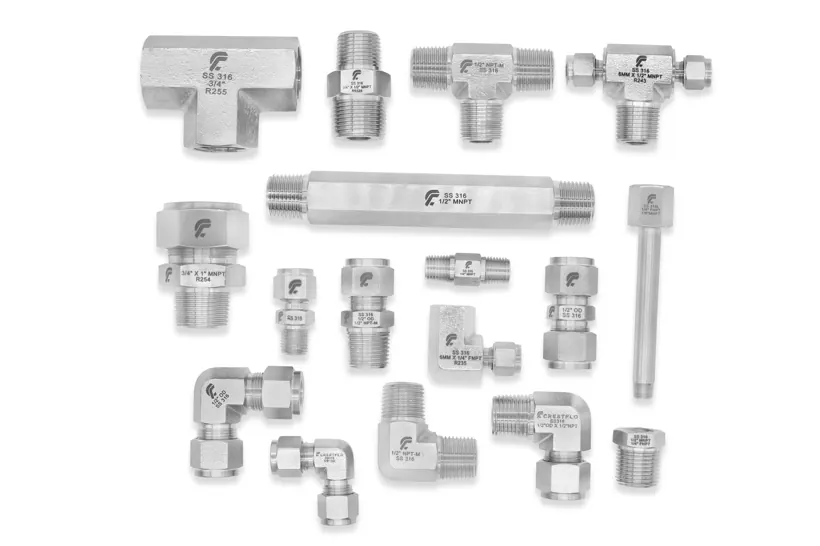
Tube installation tools are the gauges and hand tools used to prepare instrumentation tubing and to make up and inspect twin-ferrule compression tube fittings, the tube cutter, deburring tool, tube bender, depth marker, pre-swaging unit and, above all, the gap gauge that verifies a fitting has been pulled up correctly. On this page, "tube installation tools" means the make-up and inspection tools for instrumentation compression tube fittings, not heat-exchanger or boiler tube expanders and rollers, which are a different mechanical product family Crestflo does not supply. Crestflo matches these tools and gauges to its single- and double-ferrule fittings, in both imperial and metric sizes, so the tool and the fitting are qualified together.
What Tube Installation Tools Are (and What They Are Not)
Making up an instrumentation tube fitting is a repeatable sequence, and each step has its tool: cut the tube square, deburr the inside and outside edges, optionally bend it to a controlled radius, insert it to the shoulder of the fitting body, mark the insertion depth, tighten by the specified pull-up, then verify the result with a gap gauge. Get any step wrong, a burred end, an under-inserted tube, an under-tightened nut, and the joint can leak. The right tools make the sequence correct and repeatable across a whole tube run.
Two families cover the work. Make-up and inspection tools set and check the fitting itself: the pre-swaging unit that pre-sets ferrules, the depth-marking tool, the make-up wrench, and the gap (gauging) inspection gauge. Tube preparation tools ready the tubing before assembly: the tube cutter, deburring tool, reamer and facing tool, and the instrumentation tube bender. The gauges and tools are also specified as tube fitting installation tools, tube fitting make-up tools, tube fabrication tools, ferrule installation tools and tube preparation kits, the same tool set under different shop names. For step-by-step make-up procedure and pull-up-by-turns detail, see the tube-fitting installation training guide.
Tube Installation Tool Set: Gauges, Prep Tools and Make-Up Accessories
| Tool | Job | Fitting / tube sizes served | Imperial & metric | Notes |
|---|---|---|---|---|
| Gap / inspection gauge | Inspect (verify pull-up) | Sized per tube OD | Yes | If the gauge will not enter the gap between nut and body, the fitting is adequately made up |
| Pre-swaging tool / ferrule pre-setting tool | Make-up | Small to large OD | Yes | Pre-sets ferrules onto the tube before final assembly |
| Hydraulic swaging unit (HSU) / multihead unit (MHSU) | Make-up | Larger OD, high volume | Yes | For 1" and above and production assembly |
| Depth-marking tool | Make-up | All OD | Yes | Marks correct insertion depth to the fitting shoulder |
| Make-up / reverse-jaw wrench | Make-up | Per fitting hex | Yes | Controlled final pull-up |
| Tube cutter (stainless steel tube cutter) | Prep | 1/16"–2" (1.5–50 mm) | Yes | Square, burr-minimising cut on SS and alloy tube |
| Deburring tool / reamer / facing tool | Prep | ID and OD | Yes | Removes the burr that otherwise scores the ferrule seat |
| Instrumentation tube bender | Prep | 1/8"–1/2" instrument tube | Yes | Controlled-radius hand bends without kinking |
Crestflo fittings, and the matched gauges and tools that serve them, are supplied in imperial (fractional-inch) and metric (mm) sizes, with end connections up to 2" / 50 mm OD. Ordering codes, gauge part numbers and kit contents by tube OD are supplied on request; ask the engineering team for the size-matched list for your fittings.
Pre-Swaging Tools & Hydraulic Swaging Units for Ferrule Pre-Setting
A pre-swaging tool (ferrule pre-setting tool) pre-sets the ferrules onto the tube before the fitting is finally assembled onto the component. Pre-swaging is used where hand make-up is impractical or where consistency across many joints matters: larger tube OD, repeated make-ups, and higher-volume panel or skid fabrication. For 1" and larger sizes and for production work, a hydraulic swaging unit (HSU) or multihead hydraulic swaging unit (MHSU) does the same job with controlled force rather than turns. A depth-marking tool is used alongside to record that each tube was fully inserted to the fitting shoulder before swaging. For most small-diameter instrumentation joints, hand make-up followed by gap-gauge inspection is sufficient; pre-swaging is a large-size and high-throughput aid, not a universal requirement.
Gap Gauge & Inspection Gauge: How to Verify Tube-Fitting Gaugeability
A gap gauge, also called a gauging gauge, gaugeability gauge, inspection gauge or no-go gauge, confirms that a compression tube fitting has been pulled up far enough. After the nut is tightened, you offer the gauge to the gap between the nut and the fitting body: if the gauge will not enter the gap, the fitting is sufficiently made up; if it does enter, the fitting needs further pull-up. This simple go/no-go check is the standard way to inspect twin-ferrule make-up without disassembly, and it is why the inspection gauge is the single most valuable tool on the bench.
One gauge corresponds to one tube OD, in imperial and metric. Because Crestflo single- and double-ferrule fittings are dimensional-interchange equivalents of the major brands and are made up and inspected the same way, the same gauging discipline applies whether you are replacing a Swagelok® or Parker® fitting or specifying Crestflo new. (Swagelok® is a trademark of Swagelok Company and Parker® is a trademark of Parker Hannifin; Crestflo is not affiliated with, authorised by, or endorsed by either.) Use the gauge matched to the fitting size, and, if you are moving between brands, request your cross-reference so the correct size-matched gauge is supplied. For the difference between the ferrule systems the gauge inspects, see single vs double ferrule; for the risks of combining brands in one joint, see mixing tube-fitting brands.
Tube Preparation Tools: Cutter, Deburring Tool, Reamer & Instrumentation Tube Bender
Sound make-up starts with a clean tube. A tube cutter, a stainless steel tube cutter rated for hard SS and alloy tube, produces a square cut with a minimal burr, which matters because an out-of-square or burred end prevents the ferrule from seating evenly. A deburring tool (reamer or facing tool) then removes the inner and outer burr so nothing scores the sealing surface. Where the run changes direction, an instrumentation tube bender (hand tube bender) forms a controlled radius on 1/8"–1/2" instrument tube without kinking or thinning the wall, keeping bends clear of fittings so nuts can be turned. Scope every prep tool to instrumentation tubing, seamless or welded SS and alloy, rather than plumbing or DIY tube.
| Step | Tool used | What "good" looks like |
|---|---|---|
| 1. Cut | Tube cutter / stainless steel tube cutter | Square, clean cut, minimal burr |
| 2. Deburr | Deburring tool / reamer / facing tool | Smooth ID and OD, no raised edge |
| 3. Bend (if needed) | Instrumentation tube bender | Controlled radius, no kink, bends clear of fittings |
| 4. Insert & mark | Depth-marking tool | Tube seated to the fitting shoulder |
| 5. Pull up | Make-up wrench (or pre-swaging / hydraulic unit) | Tightened per the size's pull-up procedure |
| 6. Inspect | Gap / inspection gauge | Gauge will not enter the gap between nut and body |
Deeper make-up procedure lives on the tube-fitting installation training page; if a made-up joint leaks, troubleshooting covers the usual causes. Choose the tube to prepare from instrumentation tubing and confirm sizes on the tubing size chart.
Tube Materials These Tools Prepare: Stainless, Duplex & Nickel Alloys
The prep and make-up tools serve the full instrumentation alloy range, not only 316. Harder alloys raise the effort to cut, deburr and pull up, which is worth planning for on a large run.
| Tube alloy family | Grades | Prep consideration |
|---|---|---|
| Austenitic stainless | 304 / 304L, 316 / 316L, 904L | Standard cutting and deburring; the baseline case |
| Duplex / super-austenitic | Duplex 2205, Super Duplex 2507, 254 SMO, AL-6XN, Alloy 20 | Harder and tougher, expect higher cutting and make-up effort |
| Nickel alloys | Inconel, Incoloy, Monel, Hastelloy, Nickel 200/201 | High work-hardening; sharp tooling and controlled make-up matter |
| Titanium | Titanium Gr2 | Prep to avoid galling; clean, square ends |
The fittings these tools install are the twin-ferrule tube fittings and ferrules themselves; grade behavior is educational here, and Crestflo offers these alloys in instrumentation forms, see instrumentation fitting materials. Consumable spare ferrules and nuts and tube clamps complete the installation.
Standards & Proof: ASTM F1387 Make-Up Qualification and Traceability
The fittings that these tools install are performance-qualified to ASTM F1387, the standard that governs the mechanical qualification of instrumentation compression tube fittings, the same standard that underpins Crestflo's dimensional-interchange claim against the major brands. Tube and ferrule materials conform to the applicable ASTM A269 / A276 / A479 specifications, and every part carries a heat/lot number for full traceability, shipped with EN 10204 MTC 3.1 certificates as standard and 3.2 on request. Values are stated per the applicable standard and are customizable to requirement. Crestflo is ISO 9001 / 14001 / 45001 and PED certified. Read the ASTM F1387 make-up qualification basis and the EN 10204 MTC and material traceability detail; for origin and TAA/DFARS questions see US origin compliance.
Order Tube Installation Tools & Gauges: Request a Quote
Crestflo supplies tube installation tools and matched gap gauges alongside the fittings they serve, on an RFQ basis, no cart, no live pricing. To get the right kit, specify your tube OD and wall, the fitting size and ferrule type, and whether you need imperial or metric. Ready stock for standard items · made-to-order for specials · 6–8 week delivery. Request a quote or request a sample; distributors and OEMs can explore the distributor program and private-label options, or contact the team directly at sales@crestflousa.com or +1 346 594 9005 (Houston, TX).
Why Crestflo for Tube-Fitting Installation Tools
Because Crestflo engineers the fitting, it can supply the matched gap gauge and specify the correct make-up for its own single- and double-ferrule tube fittings, the tool and the fitting are qualified together, not sourced apart and hoped to agree. Crestflo fittings are dimensional-interchange equivalents for Swagelok, Parker, Hoke, Hy-Lok and Fitok, backed by ASTM F1387 performance qualification, so the gauging discipline your installers already know carries straight over. Delivery runs 6–8 weeks against the 20-plus weeks typical of the majors, with a small MOQ, imperial and metric on every size, private-label available, and a heat number on every part for full traceability. Origin is honest: Indian origin; US / European melt available on request, with full material traceability. Crestflo is the instrumentation division of a four-decade-old, Government-of-India-recognized export house with a proven Middle-East delivery record, established capability behind a new brand. We Engineer Confidence. Datasheets and CAD are available to customers on request.
FAQ: Tube Installation Tools & Gap Gauges
What tools do I need to install instrumentation tube fittings?
A tube cutter, a deburring tool, an optional tube bender, a depth marker, a make-up wrench, and a gap (inspection) gauge to verify pull-up. For larger sizes and high-volume work, add a pre-swaging tool or a hydraulic swaging unit. The gap gauge is the essential item, it is how you confirm each joint is made up correctly.
What is a gap gauge used for?
A gap gauge confirms that a compression tube fitting has been pulled up far enough. After tightening, you offer the gauge to the gap between the nut and the fitting body: if the gauge will not enter the gap, the fitting is properly made up; if it does enter, it needs further pull-up. It is a fast go/no-go inspection that needs no disassembly.
Are these tools for heat-exchanger or boiler tubes?
No. These are installation and inspection tools for instrumentation compression tube fittings. Heat-exchanger and boiler tube expanders, rollers and extraction tools are a different product family and are not supplied here.
Do you offer both imperial and metric tools and gauges?
Yes. Crestflo fittings and their matched gauges come in both imperial (fractional-inch) and metric (mm) sizes. Specify your tube OD so the correct size-matched gauge and tools are supplied.
Do I need a pre-swaging or hydraulic swaging tool?
For most small-diameter joints, hand make-up followed by gap-gauge inspection is sufficient. Pre-swaging tools and hydraulic swaging units are used for larger tube OD, up to 2" / 50 mm, and for high-volume assembly where consistency across many joints is the priority.
Can I use a Swagelok gap gauge on a Crestflo fitting?
Crestflo single- and double-ferrule fittings are dimensional-interchange equivalents and are made up and inspected the same way, so the same gauging method applies, use the gauge matched to the fitting size. Swagelok® is a trademark of Swagelok Company; Crestflo is not affiliated with or endorsed by it.
What tube materials can these tools prepare?
Instrumentation tubing in 304/304L, 316/316L and 904L stainless, Duplex 2205 and Super Duplex 2507, 254 SMO, AL-6XN and Alloy 20, the nickel alloys (Inconel, Incoloy, Monel, Hastelloy, Nickel 200/201) and Titanium Gr2. Harder alloys increase the cutting and make-up effort.
Do the fittings come with certification?
Yes. Crestflo compression tube fittings are performance-qualified to ASTM F1387 and shipped with EN 10204 MTC 3.1 certificates as standard, 3.2 on request, and a heat/lot number on every part for full traceability. Crestflo is ISO 9001 / 14001 / 45001 and PED certified.
What is the lead time and minimum order?
Ready stock for standard items, made-to-order for specials, and 6–8 week delivery, with a small MOQ. Private-label supply is available for OEM and distributor programs.
Where are the fittings and tools made?
Indian origin, engineered as US drop-in replacements, with US or European melt available on request and full material traceability. Origin and TAA/DFARS detail is on the US origin-compliance page.
How many turns do I tighten a tube fitting?
Follow the pull-up-by-turns procedure for your fitting size, then verify the result with the gap gauge. The step-by-step make-up sequence is on the tube-fitting installation training page.
Related Pages
- Twin-ferrule tube fittings these tools install
- Tube fitting ferrules and nut-and-ferrule sets
- Spare ferrules & nuts and tube clamps
- Instrumentation tubing to prepare and the tubing size chart
- Tube-fitting installation training and troubleshooting
- Single vs double ferrule and mixing tube-fitting brands
- ASTM F1387 make-up qualification and instrumentation accessories