
Incoloy 800H / 800HT Instrumentation Fittings, Valves & Tubing (UNS N08810 / N08811)
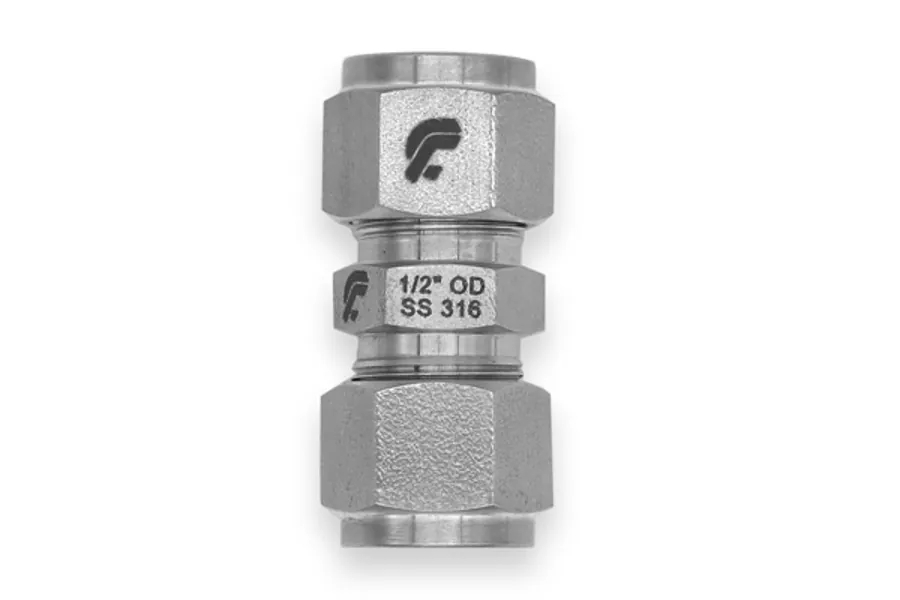
Incoloy 800H and 800HT (UNS N08810 and N08811) are nickel-iron-chromium (Ni-Fe-Cr) alloys built for high-temperature service. It's a controlled-carbon, coarse-grain version of Alloy 800, engineered specifically for creep and stress-rupture strength in sustained high-heat conditions. Crestflo supplies it in instrumentation-grade tube fittings, valves and tubing. Each part is engineered as a US drop-in replacement, with full heat-number traceability and delivery in 6-8 weeks.
Crestflo offers Incoloy 800 in instrumentation product forms: tube fittings, ferrules, valves, thermowells and instrumentation tubing. Furnace radiant tubes aren't part of the lineup, and neither are reformer or pyrolysis catalyst tubes, or mill pipe, plate and sheet. Those classic furnace-tube applications simply sit outside our instrumentation scope. Standard items ship from ready stock. Specials are made to order, with delivery running 6-8 weeks. Request an Incoloy 800H quote.
What Is Incoloy 800H / 800HT? A High-Temperature Ni-Fe-Cr Alloy
Incoloy 800H and 800HT sit at the high-temperature end of the base Alloy 800 (UNS N08800) family. All three share the same nominal nickel-iron-chromium chemistry. But the H and HT grades add two controls that unlock high-temperature performance: carbon gets fixed at 0.05-0.10%, and the material undergoes a high-temperature anneal that produces a deliberately coarse grain. Together, these give markedly higher creep and stress-rupture strength above roughly 1100 F (593 C), a point at which the fine-grained base grade simply isn't adequate anymore.
UNS N08811 (800HT) pushes the combined aluminum-plus-titanium content up to 0.85-1.20% to squeeze out a bit more rupture life. The two grades overlap enough in chemistry that mills often certify material as both 800H and 800HT at once. Specifiers turn to this alloy precisely where an austenitic stainless steel would give up on strength or start to scale, and where what's needed instead is a solid-solution, weldable grade that resists both oxidation and carburisation. Incoloy is a registered trademark of Special Metals Corporation. Crestflo has no affiliation with Special Metals and isn't endorsed by them; what we supply is parts built to the equivalent UNS/ASTM chemistry, not "genuine Incoloy."
Incoloy 800H Designations & Equivalents (UNS N08810, Werkstoff 1.4958)
Inconel 800 gets grouped under several designation systems, but a fitting or tube labeled with any of the names below refers to the same Ni-Fe-Cr grade. You'll also see it written as Incoloy 800 H, Alloy 800H, 800H alloy, 800H/HT and the older 800H/AT designation. People often ask for it informally as "Inconel 800," which is a common misnomer for what's properly an Incoloy grade.
| Grade | UNS | Werkstoff (W.Nr) | DIN / EN name | Common names |
|---|---|---|---|---|
| Incoloy 800H | N08810 | 1.4958 | — | Alloy 800H, 800H, 800H alloy |
| Incoloy 800HT | N08811 | 1.4959 | X8NiCrAlTi32-21 | Alloy 800HT, 800HT, 800H/AT |
| Incoloy 800 (base) | N08800 | 1.4876 | X10NiCrAlTi32-21 | Alloy 800, see base grade |
If you have a competitor's part number in an equivalent alloy, request your cross-reference from our engineering team at Crestflo. We've documented the base grade on our base-grade Incoloy 800 (UNS N08800) page.
Incoloy 800H Chemical Composition (N08810 vs N08811)
The table sets out nominal composition according to the applicable ASTM/UNS ranges. Values follow the relevant standard and can be adjusted to suit requirements. What separates 800H from 800HT comes down to one thing: control of aluminum plus titanium. That's expressed as the combined limit, and it's this figure that governs 800HT.
| Element | Incoloy 800H (N08810) % | Incoloy 800HT (N08811) % |
|---|---|---|
| Nickel (Ni) | 30.0-35.0 | 30.0-35.0 |
| Chromium (Cr) | 19.0-23.0 | 19.0-23.0 |
| Iron (Fe) | 39.5 min (balance) | 39.5 min (balance) |
| Carbon (C) | 0.05-0.10 | 0.06-0.10 |
| Aluminum (Al) | 0.15-0.60 | Al + Ti 0.85-1.20 |
| Titanium (Ti) | 0.15-0.60 | (combined, above) |
| Manganese (Mn) | 1.50 max | 1.50 max |
| Silicon (Si) | 1.00 max | 1.00 max |
| Copper (Cu) | 0.75 max | 0.75 max |
| Sulfur (S) | 0.015 max | 0.015 max |
Incoloy 800H Mechanical & Physical Properties (Density, Melting Range)
Annealed mechanical minimums and physical constants follow the standard published values for the grade. Those figures track the applicable standard, though they're customizable to requirement.
| Property (annealed) | US | SI |
|---|---|---|
| Tensile strength (min) | ~65 ksi | ~450 MPa |
| Yield strength, 0.2% offset (min) | ~25 ksi | ~170 MPa |
| Elongation (min) | ~30% | ~30% |
| Physical property | Value |
|---|---|
| Density | 0.287 lb/in³ (7.94 g/cm³) |
| Melting point (melting range) | 2475-2525 F (1357-1385 C) |
| Structure | Austenitic, solid-solution, face-centered cubic |
| Magnetic response | Essentially non-magnetic in the annealed condition |
High-Temperature Behavior: Creep, Oxidation & Carburization Resistance
The H and HT grades exist for one reason: high-temperature strength. Carbon is fixed at 0.05-0.10%, and annealing at high temperature produces a coarse grain; that grain carries far more creep and stress-rupture load than the base grade once temperatures climb above roughly 1100 F (593 C). 800HT doesn't stop there. Its tighter combined aluminum-plus-titanium spec extends rupture life further still. Where a component has to hold pressure and keep its dimensional stability under sustained heat, this alloy is the standard choice.
The high chromium and nickel content also give strong oxidation resistance in air to roughly 1800-2000 F (982-1093 C) and good resistance to carburisation and nitriding in the reducing, carbon-rich atmospheres common to petrochemical and hydrogen service. For instrumentation components, thermowells in hot process, high-temperature sampling and impulse lines, steam-traced assemblies, those same properties translate into stable, long-life parts where 316 stainless would scale or lose strength.
During fabrication, the alloy welds readily with the standard fusion processes (GTAW, GMAW and SMAW) using a matching or nickel-base filler. For creep-governed high-temperature service, a welding procedure qualified to ASME BPVC Section IX is normally specified. The coarse grain that gives 800H its rupture strength comes from the solution anneal, not from post-weld heat treatment, and that's why the anneal preserves it rather than any subsequent thermal step.
Incoloy 800 vs 800H vs 800HT: What Is the Difference?
Chemically, the three grades sit close together. Where they part ways is service regime. The comparison below spells out why engineers call for the H grade in creep service, and why the base grade doesn't make the cut.
| Property | 800 (N08800) | 800H (N08810) | 800HT (N08811) |
|---|---|---|---|
| Carbon control | 0.10 max | 0.05-0.10 (fixed) | 0.06-0.10 (fixed) |
| Grain size | Fine (as annealed) | Coarse (high-temp anneal) | Coarse (high-temp anneal) |
| Al + Ti control | Not controlled for creep | Individual Al, Ti limits | Combined 0.85-1.20 |
| Primary design regime | General / lower-temperature | Creep-rupture > ~1100 F | Optimized creep-rupture |
| Typical selection | Corrosion + moderate heat | Sustained high heat | Longest rupture life |
For lower-temperature and general corrosion applications, check the base-grade Incoloy 800 (UNS N08800) page on the Crestflo site.
Corrosion & Service Suitability
High heat isn't the only strength Incoloy 800H brings; it also holds up well against aqueous corrosion. Its nickel content resists chloride stress-corrosion cracking better than standard 304 or 316 austenitic stainless steels, and it stands up to many oxidising and reducing media too. The real strength, though, is high-temperature performance, not sour-service qualification. When hydrogen sulfide (H2S) sour service governs, an alloy such as Incoloy/Inconel 825 for sour service, qualified to NACE MR0175 / ISO 15156, is usually the right choice. Our engineering team can confirm the correct grade for your driver during the RFQ.
Incoloy 800H Product Forms: Tube Fittings, Valves, Thermowells & Tubing
Crestflo supplies Incoloy 800H / 800HT strictly in instrumentation product forms. Fittings come as compression tube and pipe fittings with single or double ferrules, hardened or non-hardened, in imperial and metric sizes, with end connections reaching up to 2" (50 mm) OD. Valves run from 1/16" to 1", with threaded or tube-fitting ends, and cover needle, ball, check and manifold (2/3/5-way) patterns. Thermowells come bar-stock, flanged or threaded. Instrumentation tubing meets the applicable ASTM tube specification, with values set per applicable standard and open to customization as required.
| Form | Size range | Options | Certification |
|---|---|---|---|
| Tube & compression fittings | Up to 2" (50 mm) OD | Single/double ferrule; hardened/non-hardened | EN 10204 3.1 (3.2 on request) |
| Instrumentation valves (needle, ball, check, manifold) | 1/16" to 1" | Threaded or tube-fitting ends | EN 10204 3.1 (3.2 on request) |
| Thermowells | Bar-stock, flanged/threaded | Machined to print | EN 10204 3.1 (3.2 on request) |
| Instrumentation tubing | Per applicable ASTM spec | Imperial + metric OD/wall | EN 10204 3.1 (3.2 on request) |
Take a look at Incoloy 800H tube fittings, instrumentation valves, thermowells, and high-nickel alloy instrumentation tubing. Crestflo doesn't stock furnace or reformer tubes, mill pipe, plate, or sheet, in this grade or any other.
Incoloy 800H Applications & Uses
In instrumentation, engineers specify Incoloy 800H / 800HT for high-temperature service, precisely where creep strength, oxidation resistance and carburisation resistance matter in practice. Thermowells sitting in hot process streams need it. So do high-temperature analytical and sampling lines, steam-traced impulse assemblies, and furnace-area instrument connections. These show up across petrochemical high-temperature service and hydrogen and reformer-area service.
Across the industry, this same alloy shows up in steam and hydrogen reformer tubes, ethylene pyrolysis and cracking furnace tubes, and heat-treatment fixtures. Those are mill and cast products, though. Crestflo doesn't make furnace tubes, it supplies the instrumentation components that connect to and monitor those systems.
Incoloy 800H Standards & Product-Form Specifications (ASTM / ASME)
Crestflo supplies the instrumentation forms listed in the table below. This alloy falls under product-form-specific ASTM specifications, each paired with a matching ASME SB equivalent. The mill-product specifications appear here too, but only for reference, so specifiers can confirm the grade. Crestflo doesn't supply those forms.
| Product form | ASTM | ASME | In Crestflo scope |
|---|---|---|---|
| Seamless pipe/tube | B407 | SB-407 | Reference only |
| Bar / rod | B408 | SB-408 | Reference only |
| Plate / sheet / strip | B409 | SB-409 | Not supplied |
| Welded tube | B515 | SB-515 | Instrumentation tubing |
| Forgings | B564 | SB-564 | Reference only |
| Fittings | B366 | SB-366 | Fittings |
A few related material standards matter here too. Instrumentation work often calls on ASTM bar-stock material standards, alongside the EN 10204 material test certificate framework.
Why Crestflo: US-Serving Incoloy 800H Manufacturer, Supplier & Stockist
Crestflo manufactures, supplies and stocks Incoloy 800H / 800HT for customers across the US. It's the instrumentation division of an export house that's over four decades old and carries Government-of-India recognition, with a proven record of deliveries into the Middle East. That background stands behind a US-facing instrumentation program aimed at specifiers and buyers who need high-nickel alloys without the 20-week lead times the major suppliers impose.
- Drop-in interchange, proven. Fittings carry performance qualification to ASTM F1387, the compression-tube-fitting interchange standard, and they're built as exact dimensional drop-in replacements for the major brands. Valves meet the applicable valve standards, too: ASME B16.34 and the relevant API specifications.
- 6-8 week lead time. Standard items ship from ready stock. Specials get made to order. Either way, delivery runs 6-8 weeks, a fraction of the 20-plus weeks the majors typically need.
- Traceability. Material test certificates follow the EN 10204 3.1 standard, with 3.2 available on request. Every part carries a heat/lot number.
- Quality system. Certification covers ISO 9001, 14001, and 45001, plus PED. PMI and NDT are handled in-house. Destructive testing happens at ISO/IEC 17025-accredited labs, and third-party inspection is available on request.
- Origin. Indian origin; US / European melt available on request, with full material traceability.
- Small MOQ and private label. CNC, VMC, EDM and milling all happen in-house, covering made-to-print work and full volume runs alike. Imperial and metric sizes are both handled without issue.
Datasheets and CAD drawings are available to customers on request. If you need Incoloy 800H / 800HT in your specific form and sizes, request an Incoloy 800H quote for current pricing, cost against your BOM, and lead time. Reach the US sales team at sales@crestflousa.com or +1 346 594 9005 (Houston, TX). Crestflo is ready to help.
Incoloy 800H FAQ
What is Incoloy 800H material?
Incoloy 800H (UNS N08810) is a nickel-iron-chromium alloy built for high-temperature service. It's a controlled-carbon, coarse-grain version of Alloy 800, tuned specifically for creep and stress-rupture strength above roughly 1100 F (593 C). Strength at elevated temperatures isn't its only virtue: it also resists oxidation and carburisation well.
What is the composition of Incoloy 800 / 800H?
The alloy runs nominally 30-35% nickel and 19-23% chromium, with iron making up the balance at a 39.5% minimum. Carbon sits in a tight 0.05-0.10% band, and aluminum and titanium are held under control too. What sets 800H apart from base 800 isn't the major-element chemistry. It comes down to the fixed carbon range and a coarser grain size.
What is the difference between 800, 800H and 800HT?
800 (N08800) is the base grade. 800H (N08810) locks carbon at 0.05-0.10% and keeps a coarse grain, which gives it better creep strength. 800HT (N08811) goes a step further, controlling combined aluminum-plus-titanium at 0.85-1.20% to get the best possible rupture life at high temperature. You'll often see the material dual-certified as 800H/800HT.
What temperature can Incoloy 800H handle?
This material is meant for sustained, creep-governed service above roughly 1100 F (593 C). In air, it resists oxidation well, holding up to about 1800-2000 F (982-1093 C). Your exact design temperature isn't fixed by the material alone. It depends on the loading and the code basis for your component.
Can Incoloy 800H be welded?
Yes. Incoloy 800H / 800HT welds readily using the standard fusion processes: GTAW, GMAW, and SMAW, each paired with a matching or nickel-base filler metal. For creep-governed high-temperature service, a welding procedure qualified to ASME BPVC Section IX is normally specified. One point worth stressing: the coarse grain that carries the alloy's rupture strength comes from the high-temperature solution anneal. It isn't set by post-weld heat treatment.
Is Incoloy 800H the same as Inconel 800?
No. People often call it "Inconel 800," but that's a mix-up. The correct name is Incoloy 800, or 800H, a nickel-iron-chromium alloy. Incoloy and Inconel are both trademarks of Special Metals, yet they cover separate alloy families.
What is the difference between Inconel and Incoloy?
Inconel alloys are, broadly speaking, nickel-based, with nickel making up around 50% or more of the mix. Incoloy alloys work differently: they're nickel-iron-chromium, and iron makes up a substantial share. Take Incoloy 800H, nickel sits at 30-35% there, with iron filling out the balance. That's precisely why it counts as an Incoloy and not an Inconel.
Does Crestflo supply Incoloy 800H tube fittings and tubing?
Crestflo supplies 800H / 800HT in instrumentation tube and compression fittings, ferrules, valves, thermowells and instrumentation tubing, with tube OD running up to 2" and valves from 1/16" to 1". Every shipment carries heat-number traceability, along with EN 10204 3.1 or 3.2 certificates. Furnace tubes, mill pipe, plate and sheet aren't part of the offering.
Is Incoloy 800H used for sour (H2S) service?
This alloy shines at high temperatures. That's its real strength, not qualification for sour service. Sour applications governed by NACE MR0175 / ISO 15156 usually call for Incoloy/Inconel 825 or another corrosion-resistant alloy instead. Check our NACE MR0175 and Inconel 825 pages for details, or reach out to our engineering team.
What certifications and traceability come with Crestflo 800H parts?
Crestflo holds ISO 9001, 14001 and 45001 certification along with PED approval. Its fittings are performance-qualified to ASTM F1387, and its valves meet ASME B16.34 / API standards. Every part leaves with a heat or lot number and an EN 10204 3.1 certificate, with 3.2 available on request. PMI and in-house NDT come standard too.
Is Incoloy 800H magnetic?
This alloy is austenitic, built from nickel, iron and chromium, and once annealed it's basically non-magnetic.
What is the lead time and MOQ for Incoloy 800H parts?
We keep standard items in stock and build specials to order, with delivery running six to eight weeks. Minimum order quantities are small, and private-label options are available. Send us your form and sizes, and we'll get you a quote.
What ASTM specification covers Incoloy 800H?
It depends on the product form. B407 covers unwelded pipe and tube, while B408 covers bar. Plate, sheet and strip fall under B409; welded tube under B515; forgings under B564; and fittings under B366, each matched to an equivalent ASME SB specification. Crestflo supplies the instrumentation forms of these specifications.