
Swagelok® Part Number Guide: Decode the Code & Cross-Reference to a Crestflo Equivalent
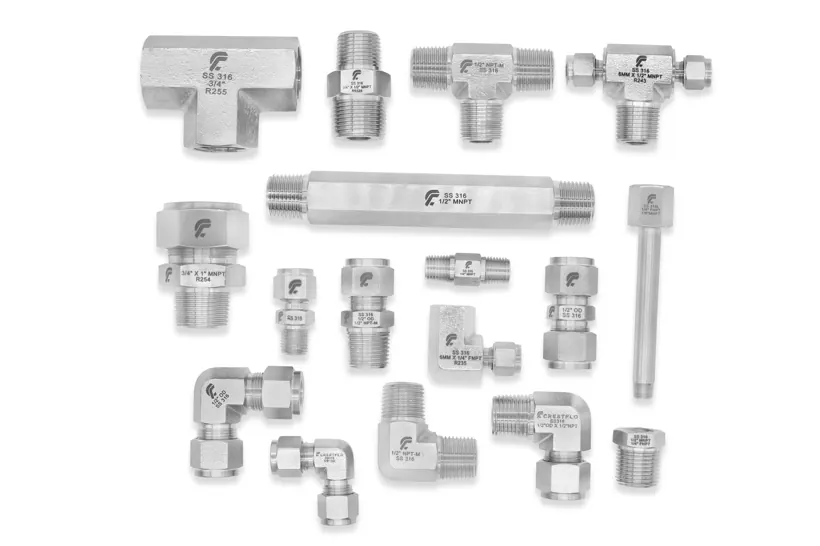
You've got a Swagelok® part number in front of you, something like `SS-400-1-4`, and two questions: what exactly is this fitting, and what's the second-source equivalent? This guide answers both. First it teaches you to read a Swagelok tube-fitting part number field by field: the material prefix, the tube-OD size code, the fitting-type designator, and the end-connection code. Then it shows you how to route that decoded part to a dimensionally equivalent Crestflo fitting, backed by ASTM F1387 and available in 316 stainless plus exotic alloys.
Crestflo is not affiliated with, authorized by, sponsored by, or endorsed by Swagelok Company. "Swagelok®" is a registered trademark of Swagelok Company. Every reference here is nominative, the names are used only to help you identify the parts you already buy so you can find the equivalent Crestflo fitting. What Crestflo supplies are independently manufactured equivalents, not genuine Swagelok products.
Scope: this guide covers instrumentation compression tube fittings, stainless and alloy fluid-system parts. "Ferrule" here means a fluid-system compression ferrule, not an electrical wire ferrule; "compression fitting" means an instrumentation tube fitting, not a copper plumbing fitting.
What a Swagelok tube-fitting part number is
A Swagelok tube-fitting part number is an ordering code, a compact string that spells out the fitting's body material, tube size, geometry, and end connections. Swagelok publishes the grammar in its Gaugeable Tube Fittings and Adapter Fittings catalog (MS-01-140), and the codes are consistent enough that once you know the pattern you can read most straight and shaped fittings on sight.
The general shape of the code is:
`[MATERIAL] - [TUBE-OD SIZE] - [FITTING TYPE] - [SECOND-END SIZE]`
Not every field appears on every part. A tube-to-tube union carries no separate end-size token because both ends are the same tube size; a male connector adds a trailing pipe-thread code. The safest way to read a code is left to right, resolving one field at a time against the tables below.
One rule up front: size codes are read from the published table, never derived by arithmetic. The code `810` means 1/2 in. tube OD, you look it up, you don't calculate it. The sections below give you those tables. Where a specific code isn't shown here, confirm it against the current Swagelok catalog rather than guessing.
Also specified as: ordering codes, part codes and interchange terms
Buyers describe this same task with a range of phrasings, Swagelok part number lookup, Swagelok ordering number guide, Swagelok fitting part number decoder, "how to read a Swagelok part number," "what does SS-400 mean," Swagelok tube fitting number breakdown, and Swagelok part number to Crestflo cross reference. They all resolve to the same two steps: decode the code, then match it to an equivalent.
How to read a Swagelok part number: material prefix, size, type, connection
Work the code left to right. The four fields, in order:
- Material prefix, letters at the start (e.g. `SS`, `S`, `B`) that fix the body alloy.
- Tube-OD size code, a two-to-four-digit number giving the tube outside diameter the fitting grips.
- Fitting-type designator, a digit (sometimes with a letter) identifying the body shape: union, tee, elbow, male connector, cap, plug, and so on.
- Second-end / connection code, a trailing number (and sometimes a letter suffix) giving the pipe-thread size or alternate end.
The three lookup tables below cover the first, second, and fourth fields. Fitting-type designators are the one field that varies most by product family; the worked examples show the common ones, and anything ambiguous should be confirmed against the catalog.
The Swagelok material prefix table
The leading letters set the body material. These are the widely documented prefixes:
| Prefix | Material |
|---|---|
| SS | 316 stainless steel |
| 316L / 6L | 316L (low-carbon) stainless, used on high-purity and low-carbon lines |
| S | Carbon steel |
| B | Brass |
| A | Aluminum |
| M | Alloy 400 (Monel) |
| HC | Alloy C-276 (Hastelloy C-276) |
| INC | Alloy 600 (Inconel 600) |
| TI | Titanium |
| 6MO | 6-Moly (254 SMO-class super-austenitic) |
| 625 · 825 · 2507 | Alloy 625, Alloy 825, Super Duplex 2507 and similar specialty grades |
So `SS` at the front means a 316 stainless body, the most common instrumentation material. `B` means brass, which sits outside Crestflo's US instrumentation scope. Exotic-alloy prefixes (Monel, Hastelloy C-276, Inconel, super-austenitic, duplex) tell you the part was specified for a corrosive or high-temperature service, exactly the range where a second source with broad alloy coverage matters most. If a prefix on your part isn't in this table, confirm it against the current Swagelok catalog before assuming a material.
The Swagelok tube-OD size code table
This is the field most people want decoded. In a tube-fitting part number the tube outside diameter is written as a two-to-four-digit code. The logic underneath it is simple: the leading digits are the tube OD expressed in sixteenths of an inch, and the trailing digits are grammar/series padding (`00`, or `10` on the half-inch-and-up sizes). That's why 1/4 in. (four sixteenths) reads as `400` and 1/2 in. (eight sixteenths) reads as `810`, not `800`.
| Tube OD | Sixteenths | Size code (fractional) |
|---|---|---|
| 1/16 in. | 1 | 100 |
| 1/8 in. | 2 | 200 |
| 3/16 in. | 3 | 300 |
| 1/4 in. | 4 | 400 |
| 5/16 in. | 5 | 500 |
| 3/8 in. | 6 | 600 |
| 1/2 in. | 8 | 810 |
| 5/8 in. | 10 | 1010 |
| 3/4 in. | 12 | 1210 |
| 7/8 in. | 14 | 1410 |
| 1 in. | 16 | 1610 |
| 1 1/4 in. | 20 | 2000 |
| 1 1/2 in. | 24 | 2400 |
| 2 in. | 32 | 3200 |
The "sixteenths" column is the mnemonic worth memorizing: 1/16 = 1, 1/8 = 2, 1/4 = 4, 3/8 = 6, 1/2 = 8, 5/8 = 10, 3/4 = 12, 1 in. = 16. Those same short numbers show up directly in the pipe-thread field (below). Note the two quirks: 1/2 in. is `810` (not `800`) and 1 1/4 in. is `2000` (not `2010`), because of the embedded series digit. When in doubt, read the code off the catalog table rather than converting the fraction yourself.
The Swagelok end-connection & NPT code table
When a fitting has a second end that isn't a tube stub, most often a male or female pipe thread, a trailing number gives that thread size. Here the code is the short "sixteenths" number, un-padded:
| Pipe (NPT) size | End-connection code |
|---|---|
| 1/16 in. | 1 |
| 1/8 in. | 2 |
| 1/4 in. | 4 |
| 3/8 in. | 6 |
| 1/2 in. | 8 |
| 3/4 in. | 12 |
| 1 in. | 16 |
Male NPT is the default for many connectors; letter suffixes flag other end forms (for example a weld or straight-thread variant). Female-thread and non-NPT ends (ISO/BSP taper and parallel, AN/JIC flare, SAE straight thread, tube-socket weld, bored-through) follow their own catalog codes. If your part carries a suffix you don't recognize, confirm it against the current Swagelok catalog before treating it as an NPT thread.
Worked examples: Swagelok part numbers decoded field by field
Reading the tables in isolation is one thing; here they are applied to real part numbers.
Example 1, `SS-400-1-4` (male connector)
| Field | Code | Meaning |
|---|---|---|
| Material | SS | 316 stainless steel body |
| Tube-OD size | 400 | 1/4 in. tube OD |
| Fitting type | 1 | Male connector |
| Second end | 4 | 1/4 in. male NPT |
Read out loud: a 316 stainless male connector, 1/4 in. tube OD to 1/4 in. male NPT.
Example 2, `SS-400-6` (union)
| Field | Code | Meaning |
|---|---|---|
| Material | SS | 316 stainless steel body |
| Tube-OD size | 400 | 1/4 in. tube OD |
| Fitting type | 6 | Union (tube × tube) |
Both ends are the same 1/4 in. tube, so there's no separate end-size token, a 316 stainless 1/4 in. tube-to-tube union.
Example 3, `SS-810-6` (union, larger size)
| Field | Code | Meaning |
|---|---|---|
| Material | SS | 316 stainless steel body |
| Tube-OD size | 810 | 1/2 in. tube OD |
| Fitting type | 6 | Union (tube × tube) |
Same union, one size up, a 316 stainless 1/2 in. tube-to-tube union. Notice how `810` decodes to 1/2 in., not "eight-tenths" of anything.
A note on the fitting-type field: the digit that names the body shape is the field that varies most across Swagelok product families, and the same shape can be written differently between straights, elbows, tees and reducers. Use the examples above as a pattern, and confirm the exact type designator for unions, tees, elbows, crosses and reducers against the current Swagelok catalog rather than assuming one digit always means one shape.
Metric vs fractional Swagelok part numbers
Swagelok makes the same fittings in metric tube sizes, and the part number tells you which system you're in. In a metric code the tube size is written with an `M`: a 6 mm tube OD reads as `6M` (padded in the ordering string, e.g. `6M0`), a 12 mm tube OD as `12M`, and so on. The number in front of the `M` is the millimeter size, read directly, no sixteenths conversion.
So `SS-6M0-1-4` decodes as a 316 stainless male connector, 6 mm tube OD, to a 1/4 in. male NPT, a metric tube end mated to an imperial pipe thread, which is common. The practical rule: an `M` in the size field means the tube dimension is metric; its absence means the fractional-inch table above applies. Metric and fractional tube ends are not interchangeable with each other, a 6 mm fitting is not a 1/4 in. fitting even though they're close in size, so decode the size field carefully before you cross-reference.
How to cross-reference a decoded Swagelok part to a Crestflo equivalent
Once the part number is decoded, cross-referencing it is straightforward. You now know the material, the tube OD, the fitting type, and the end connection, the four things that define a dimensional equivalent. Crestflo builds to the same two-ferrule geometry and the same imperial and metric size conventions, so a decoded Swagelok part maps to a Crestflo fitting location for location.
Two ways to do it:
- Use the interactive tool. The Crestflo cross-reference tool takes the part numbers you already buy and returns the Crestflo equivalent, the alloys it ships in, and the size and connection parity.
- Read the full interchange guide. The Swagelok tube-fitting cross-reference page explains the interchange in depth, fitting types covered, the alloy-availability matrix, and the ASTM F1387 basis. For the switch-cost and lead-time case, see Swagelok alternatives.
Part-number mapping isn't guessed, it's checked against your exact series, size, and material, which is why Crestflo builds your cross-reference to order rather than handing out a generic table. Send the decoded part numbers (or the raw ones, and let the engineering team decode them), a line-card export, a drawing, or a physical sample, and you'll get back the equivalent, notes on ferrule and connection parity, the available alloys, and a quote. Delivery runs 6–8 weeks.
Request your Swagelok® cross-reference & quote →
Crestflo equivalents come standard in 316/316L and are available across the exotic-alloy range, 904L, Duplex 2205, Super Duplex 2507, 254 SMO, Alloy 20, Inconel 625/825, Monel 400, Hastelloy C-276/C-22, and Titanium Gr2, in tube sizes up to 2 in. (50 mm) OD. Explore the core line at Crestflo tube fittings.
Why buyers second-source a decoded Swagelok part
Decoding the part is usually step one of a bigger job: finding a qualified second source. The reasons buyers do it are specific and honest.
- Lead time. Specials and exotic-alloy fittings from the majors can run long. Crestflo delivers in 6–8 weeks, ready stock for standard items, made-to-order for specials.
- Exotic alloys. If the prefix you decoded is Hastelloy, Monel, Inconel, or a super-austenitic/duplex grade, alloy availability drives the decision. Crestflo carries the same dimensional equivalent across the full CRA range, not just 316.
- Documented interchange. Crestflo compression tube fittings are tested to ASTM F1387, the performance-qualification standard for mechanically attached fittings. That's the difference between a documented, traceable equivalent and an uncontrolled marketplace listing.
- Cost after duties. Crestflo stays cost-competitive even once US duties and tariffs are factored in, with small MOQ and private-label options.
A word on the engineering: this is interchange, not intermix. Replace a complete Swagelok fitting with a complete Crestflo fitting at each location, body, nut, and both ferrules all Crestflo. Don't pair a Crestflo ferrule or nut with a Swagelok body (or the reverse) inside one joint; ferrule geometry and hardness are engineered as a matched set, and mixing components across brands can compromise the seal. Crestflo uses "interchange" and "equivalent" deliberately, and steers clear of "compatible" and "intermix." That's a safety fact, not a word preference.
Every part carries a heat/lot-number mark with EN 10204 3.1 material test certificates as standard (3.2 on request), backed by PMI verification. QA runs under ISO 9001 / 14001 / 45001 and PED certified systems. Origin is Indian; US / European melt is available on request, with full material traceability.
We Engineer Confidence.
Frequently asked questions
What does SS mean in a Swagelok part number?
`SS` at the start of a Swagelok tube-fitting part number designates a 316 stainless steel body. It's the most common material prefix on instrumentation fittings. Other prefixes include `S` for carbon steel, `B` for brass, `M` for Monel 400, `HC` for Hastelloy C-276, `INC` for Inconel 600, and `TI` for titanium; 316L lines are designated `316L` or `6L`.
What size is a 400 Swagelok fitting?
The size code `400` means a 1/4 in. tube OD. The logic is that the leading digit is the tube OD in sixteenths of an inch, four sixteenths is 1/4 in., with `00` as padding. So `600` is 3/8 in., `810` is 1/2 in., `1210` is 3/4 in., and `1610` is 1 in. Read the code from the table rather than converting the number arithmetically.
How do I read a Swagelok part number?
Read it left to right in four fields: material prefix (e.g. `SS` = 316 stainless), tube-OD size code (e.g. `400` = 1/4 in.), fitting-type designator (a digit for union, tee, elbow, male connector, etc.), and a trailing end-connection code for the pipe thread if the part has one. For example, `SS-400-1-4` is a 316 stainless male connector, 1/4 in. tube OD to 1/4 in. male NPT.
What does SS-400-1-4 decode to?
`SS-400-1-4` is a 316 stainless steel male connector, 1/4 in. tube OD × 1/4 in. male NPT. `SS` is the 316 stainless body, `400` is the 1/4 in. tube OD, `1` is the male-connector body type, and the trailing `4` is the 1/4 in. male NPT end.
Why is 1/2 inch coded 810 and not 800?
Because the trailing digits are series/grammar padding, and the half-inch-and-up sizes use `10` rather than `00`. The leading `8` is still the tube OD in sixteenths (eight sixteenths = 1/2 in.). The same pattern gives `1010` for 5/8 in. and `1210` for 3/4 in. It's a catalog convention, so read it from the table rather than calculating it.
How are metric Swagelok fittings numbered?
Metric tube sizes carry an `M` in the size field. A 6 mm tube OD reads as `6M` (written `6M0` in the ordering string), 12 mm as `12M`, and so on, the number before the `M` is the millimeter size, read directly. `SS-6M0-1-4` is a 316 stainless male connector, 6 mm tube OD to 1/4 in. male NPT. An `M` means metric; no `M` means the fractional-inch table applies.
Are metric and fractional Swagelok fittings interchangeable?
No. A 6 mm tube fitting and a 1/4 in. tube fitting are close in size but are not interchangeable, the ferrules grip a specific tube OD. Decode the size field first to confirm whether you're working in metric or fractional before cross-referencing to any equivalent.
What does the number after the last dash mean?
On a fitting with a pipe-thread end, the trailing number is the NPT (pipe) size in sixteenths: `2` = 1/8 in., `4` = 1/4 in., `6` = 3/8 in., `8` = 1/2 in., `12` = 3/4 in., `16` = 1 in. A letter suffix flags a non-standard end (for example a weld or straight-thread variant); confirm any unfamiliar suffix against the Swagelok catalog.
How do I find the Crestflo equivalent to a Swagelok part?
Decode the material, tube size, type and connection, then run the part number through the Crestflo cross-reference tool or send it to the engineering team. You get back the dimensionally equivalent Crestflo fitting, the alloys it's available in, and a quote, typically for delivery in 6–8 weeks. Start at the request-a-quote form or the full Swagelok cross-reference page.
Is a Crestflo equivalent a genuine Swagelok part?
No. Crestflo parts are independently manufactured dimensional equivalents, not genuine Swagelok products. Swagelok® is a registered trademark of Swagelok Company, and Crestflo is not affiliated with, authorized by, or endorsed by Swagelok Company. The interchange is factual and dimensional, backed by ASTM F1387 performance qualification.
Can I mix Crestflo and Swagelok fitting components in one joint?
Use complete Crestflo fittings as interchange equivalents, replace a whole Swagelok fitting with a whole Crestflo fitting at each location. Don't intermix a ferrule or nut from one brand with a body from the other inside a single joint; the ferrule set is engineered together, and mixing across brands can compromise the seal.
Where can I find the official Swagelok part-number tables?
The authoritative source is the current Swagelok catalog (the Gaugeable Tube Fittings and Adapter Fittings catalog, MS-01-140), which publishes the full ordering grammar and size tables. Use the tables in this guide to read most common codes, and confirm anything unusual, non-NPT ends, uncommon fitting types, or letter suffixes, against that catalog.
Related guides & cross-references
- Swagelok tube-fitting cross-reference, full interchange guide with the alloy-availability matrix
- Swagelok alternatives, the lead-time and cost case for second-sourcing
- Cross-reference tool, match your part numbers to Crestflo equivalents
- Crestflo tube fittings, the core compression tube-fitting line
- Request a quote, Name · Company · Email · Phone · Requirement description
Swagelok® is a registered trademark of Swagelok Company. Crestflo is not affiliated with, authorized, sponsored, or endorsed by Swagelok Company. Every reference here is nominative, used solely to identify equivalent parts. What Crestflo supplies are independently manufactured dimensional equivalents. Origin: Indian; US and European melt available on request, with full material traceability.